Sabitlenmiş Tweet
Abu Muhammad Walid Ashor
1.1K posts

Abu Muhammad Walid Ashor
@AbuMuhammadWA
“Here are selected beneficial insights from the words of the scholars, the books of knowledge, and whatever benefits come to mind.” — Ibn ʿAqīl, al-Funūn
Riyadh — London Katılım Temmuz 2017
98 Takip Edilen1.1K Takipçiler

On the Manners of Scholars & Teachers: Knowledge Never Ends
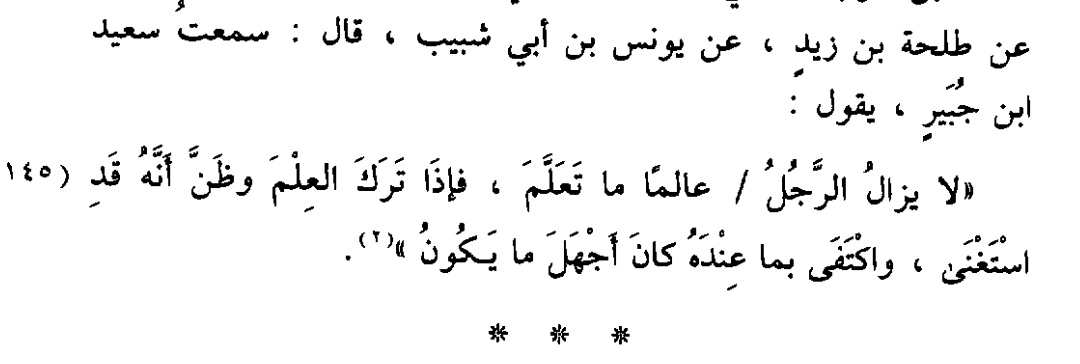
Sa'id ibn Jubayr said:
“A man remains knowledgeable as long as he continues to seek knowledge; but when he abandons knowledge, thinks he has learned all he needs and is satisfied with what he already has, he has reached his most ignorant state.”
(al-Faqih wal-Mutafiqqih of al-Khatib al-Baghdadi no. 1057)

English

Imam Malik: The Scholar Does Not Let People Use Him — Do Not Ruin Your Hereafter for Someone Else
Imam Malik Ibn Anas said to his student Abdullah ibn Wahb:
“Do not make your back a bridge for the people over which they pass to what they desire, for the greatest loser among people is the one who sells his Hereafter for the worldly life of someone else.”
Ibn Rushd (al-Jadd) commented: “The meaning of this is clear. An example of it is when a man asks a scholar who is his friend about a matter, hoping that he will give him a concession in it. That matter is one in which the evidences of prohibition and permissibility, or the obligation of something and the removal of that obligation, are conflicting. So the scholar gives preference to the evidences that permit the prohibited matter or remove the obligation, and he gives the verdict accordingly. The man then leaves pleased with the verdict he received and the concession that was given to him, while the scholar remains troubled and preoccupied about it.”
(al-Bayan wal-Tahsil of Ibn Rushd 18/524)

English

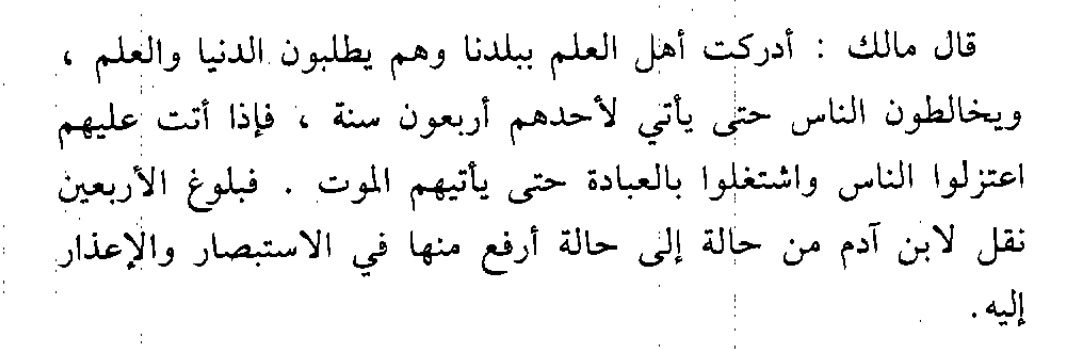
Imam Malik ibn Anas:
I saw the people of knowledge in our land (Madinah), and they used to seek the dunya [by working], study knowledge and mix with the people. However, when one of them reached the age of forty he would seclude himself from the people and busy himself with worship until death.
(Sharh Sahih al-Bukhari, Ibn Battal 10/152)

English

Failing to Speak Against Sins Draws Others Into It
Allah, the Most High said:
كَانُوا لَا يَتَنَاهَوْنَ عَن مُّنكَرٍ فَعَلُوهُ ۚ لَبِئْسَ مَا كَانُوا يَفْعَلُونَ
“They did not forbid one another from wrongdoing that they committed. How wretched was what they used to do.” (al-Maidah:79)
Shaykh Abdul-Rahman ibn Nasir al-Sa‘di said, while listing the negative consequences of remaining silent and failing to forbid evil:
“Remaining silent about the sins of those who commit them may cause the sin to seem appealing in the hearts of people, and some of them may begin to follow one another in doing it; for a person naturally has a strong desire to imitate those similar to him and those of his own kind.”
(Tafsir al-Sa‘di)

Română

Hadith — If You Are Not Forgiven in Ramadan, You Have Only Yourself to Blame.
Abu Hurayrah (radiyallahu anhu) narrated that the Prophet (sallallahu alayhi wa sallam) said' “Humiliated is the man who reaches Ramadan and it departs before he is forgiven.” (al-Tirmidhi & al-Hakim)
al-Allamah Muhammad ibn Isma‘il al-Amir al-Sanʿani said in his commentary:
“Indeed it is a month in which sins are forgiven and acts of obedience are multiplied. It does not pass except that Allah has forgiven those who turn toward obedience to Him and has overlooked their evil deeds. So whoever is not forgiven has only brought it upon himself, and the only one who ends up ruined is the one who ruins himself. Thus he becomes deserving of the supplication that Allah humiliate him because of his neglect regarding the right of Allah and his turning toward that which opposes what pleases Him.”
(al-Tanwir Sharh al-Jami‘ al-Saghir 6/249)
Note: The Arabic expression in the hadith literally means 'may his nose be rubbed into the dust' and it conveys the meaning of humiliation and abasement.

English

Ibn Taymiyyah: The Imam Must Use the Plural Form in Dua al-Qunut and Supplicate for the Congregation, Not for Himself Alone
Shaykh al-Islam Ibn Taymiyyah said:
“If the one praying behind the imam is saying ‘amin’ to the supplication of the imam, then the imam must supplicate using the plural form, as in the supplication of al-Fatiha in His statement: ‘Guide us to the straight path.’ For indeed the one praying behind him only says ‘amin' because he believes that the imam is supplicating for both of them together. So if he does not do so, then the imam has betrayed the one praying behind him.
As for the places in which each person supplicates for himself, such as the opening supplication, and what comes after the tashahhud and the like, then just as the one praying behind him supplicates for himself, the imam supplicates for himself.”
(Majmu al-Fatawa 23/118)

English

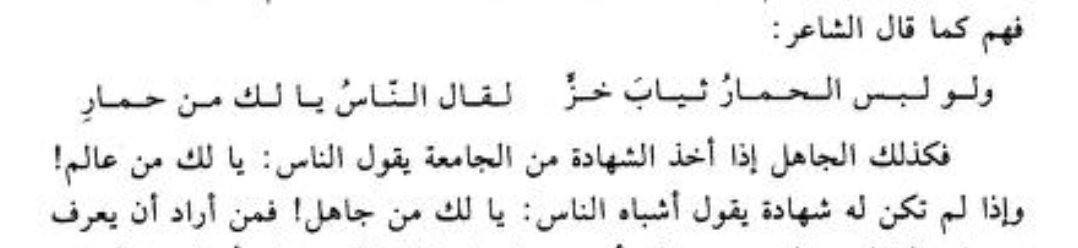
The Donkey Who Wears Fine Clothes: Shaykh Taqiuddin al-Hilali on the Obsession with Academic Certificates
Shaykh Muhammad Taqiuddin al-Hilali (rahimahullah) said, after pointing out that, unfortunately, many Muslims today are more concerned with a person’s academic certificates and credentials than with actual, legitimate knowledge:
“They are like the poet's statement:
وَلَوْ لَبِسَ الحِمَارُ ثِيَابَ خَزٍّ
لَقَالَ النَّاسُ: يَا لَكَ مِنْ حِمَارِ
'If a donkey were to wear silk garments,
people would say: what a fine donkey you are!'
Likewise, the ignorant person, if he obtains a certificate from a university, people say: what a great scholar you are! And if a person does not have a certificate, they say: what an ignorant person you are!”
(Sabil al-Rashad 3/19)

English

Siyanah al-Ilm: The Student of Knowledge Is Respected as Long as He Honours Knowledge and Preserves Its Dignity
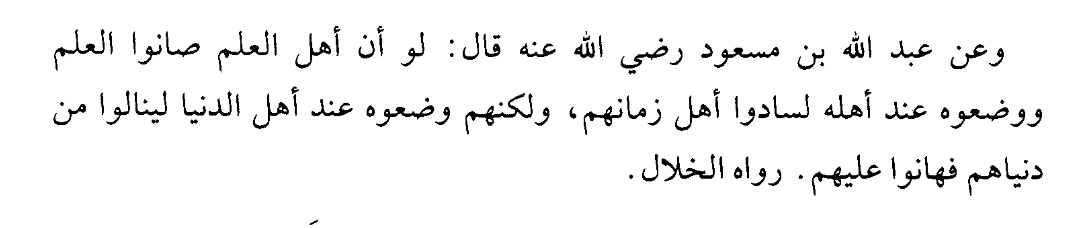
Abdullah ibn Mas'ud (radiyallahu anhu said) said:
“If only the people of knowledge honoured knowledge and preserved its dignity, placing it with those worthy of it, they would be the leaders of their time. However, they extended it to the people of the dunya in order to attain from their worldly possessions, so they became lowly in their eyes.”
(See al-Ādab al-Shariyyah 2/52)

English

The Sahabah Preferred Not to Be Placed in Positions of Authority and Were Relieved When Others Took Their Place
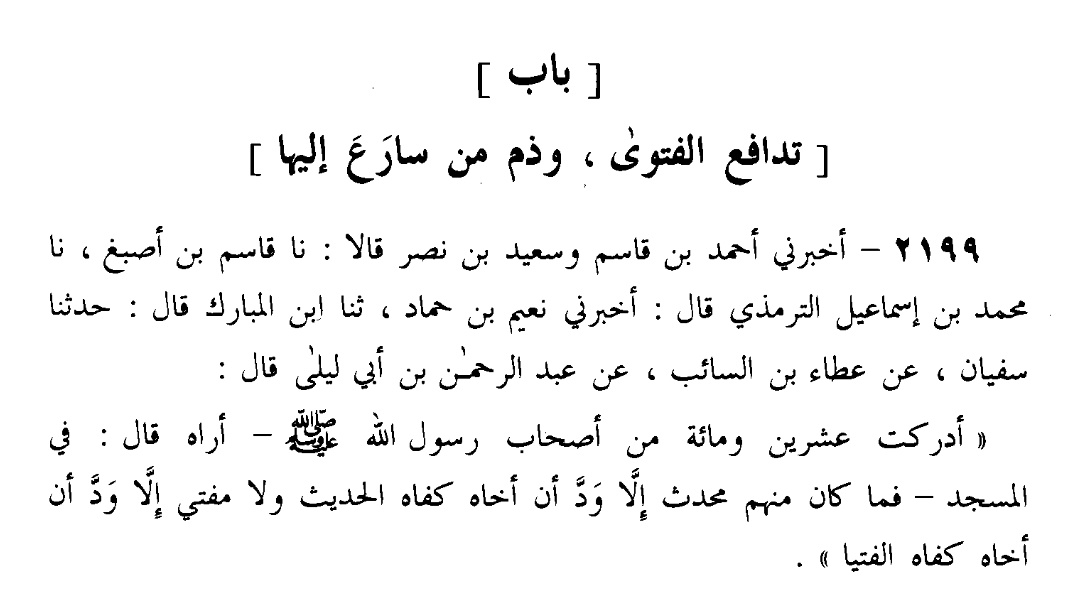
Abdul-Rahman ibn Abi Layla said:
“I met one hundred and twenty of the Companions of the Messenger of Allah—I believe he said: in the [Prophet's] mosque—there was not one of them who narrated a hadith except that he wished his brother would do it instead of him, nor one who gave a fatwa except that he wished his brother would give the fatwa instead of him.”
(Jami Bayan al-Ilm wa Fadlihi, no. 2199, in a chapter where Ibn Abdul-Barr compiled numerous narrations on this matter.)

English

It Is Permissible to Recite the Quran Quickly to Gain Reward, Even Without Reflection (Tadabbur)
Imam Alam al-Din al-Sakhawi said:
“The Noble Quran is recited for [different purposes]. It is recited for learning; in this case, one should focus on smaller portions and repeat [to memorise]. It is also recited for reflection and contemplation; in this case, one should recite with a slow and measured recitation (tartil) and pause [to ponder the meanings]. It is also recited to attain reward through abundant recitation; in this case, one may recite as much as possible, and he is not blameworthy if he chooses to recite quickly.”
Then al-Sakhawi mentioned the practice of the Salaf of frequently completing the Quran, especially during the seasons of goodness such as Ramadan.
(Jamal al-Qurra pg. 665)

English

Tafsir Must Follow the Salaf's Understanding — No New Interpretations of the Quran
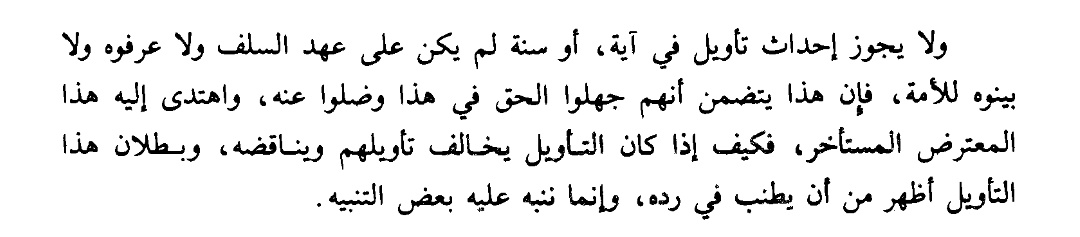
Hafidh Ibn ‘Abd al-Hadi (rahimahullah) said:
It is not permissible to introduce a new interpretation of a Quranic verse or Sunnah that was unknown to the Salaf, or which they did not explain. To do so implies that they were unaware of the truth and missed it, while a later person discovered it.
And if this new interpretation actually contradicts their understanding and opposes it, then its falsehood becomes even more apparent and does not require lengthy refutation.
(al-Sarim al-Munki fil-Radd ‘ala al-Subki, pg. 318)
Note: Some later scholars may explain the Quran with additional details not explicitly mentioned in the Tafsir of the early scholars. However, these new explanations remain within the scope of the original meanings, expanding them without contradicting or adding anything entirely new.

English
Abu Muhammad Walid Ashor retweetledi

🚨URGENT APPEAL: Save Markaz us-Sunnah!🚨
Alhamdulillah, we have now surpassed the £200,000 milestone!
RAISED: £202,000
REMAINING: £798,000
Target: £1M to secure our future BY THE END OF RAMADAN.
DONATE NOW❗
gofund.me/e55b61718

English

Imam al-Shatibi: The Scholar and Mufti Should Not Be Too Lenient or Too Strict
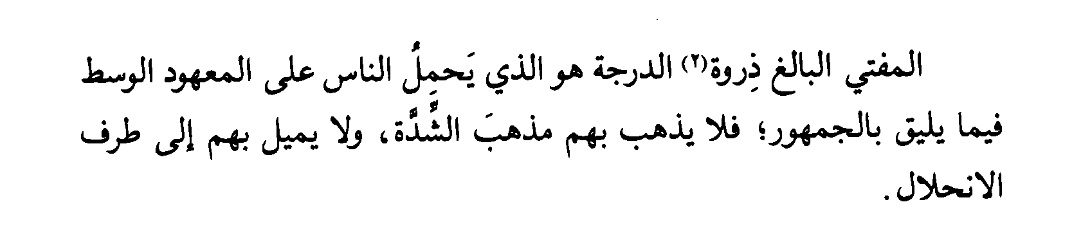
Imam al-Shatibi (rahimahullah) said:
“The mufti who has reached the highest level is the one who carries people upon the well-known middle course that is suitable for the general public: he does not drive them toward undue strictness, nor does he lead them toward moral looseness.”
(al-Muwafaqat 5/276)

English

Hadith: The Believer’s Honour is Night Prayer and His Dignity is Being Free of Need from People
The Messenger of Allah (sallallahu alayhi wa sallam) said:
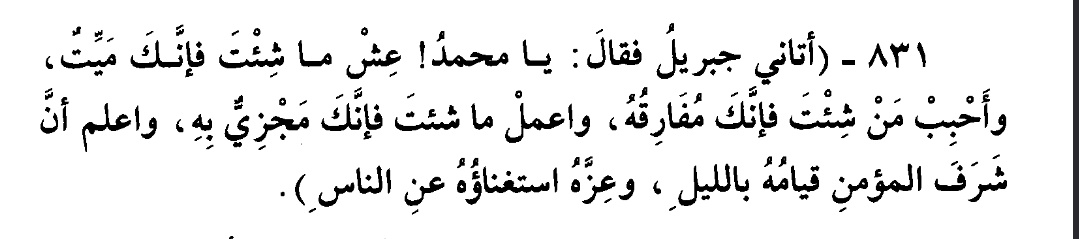
“Jibril came to me and said, ‘O Muhammad, live as you wish, for you will surely die; love whomever you wish, for you will surely part from him; and do whatever you wish, for you will be recompensed for it. And know that the honour of the believer is his standing in prayer at night, and his dignity lies in his being free of need from people.’”
(al-Tabarani & al-Hakim, see al-Silsilah al-Sahihah of al-Albani no. 831)

English

The Sahabah's Schedule for Completing the Quran in Seven Days (Fami bi-shawq)
فَمِي بِشَوْق
“My mouth is eager [to recite the Quran]”
Here, our Shaykh Salim Bamihriz (hafidhahullah) shares this well-known phrase. It is a mnemonic used to memorise how the Sahabah divided the Quran so that it could be completed every seven days. ‘Fami bi-shawq’ is a phrase made up of seven Arabic letters, each of which corresponds to the surah with which a day’s recitation begins. The daily portions are as follows:
Day One – Fa
From Surah al-Fatihah to the end of Surah al-Nisa.
(Fa refers to Fatihah)
Day Two – Mim
From Surah al-Maidah to the end of Surah al-Tawbah.
(Mim refers to Maidah)
Day Three – Ya
From Surah Yunus to the end of Surah al-Nahl.
(Ya refers to Yunus)
Day Four – Ba
From Surah al-Isra to the end of Surah al-Furqan.
(Ba refers to ‘Bani Israil’, another name for Surah al-Isra)
Day Five – Shin
From Surah al-Shuara to the end of Surah Ya Sin.
(Shin refers to Shuara)
Day Six – Waw
From Surah al-Saffat to the end of Surah al-Hujurat.
(Waw refers to ‘wa al-Saffat’, the opening verse of the Surah)
Day Seven – Qaf
From Surah Qaf to the end of Surah al-Nas.
(Qaf refers to Qaf)
الشيخ سالم بامحرز@SaalimBamehriz
هذه الطريقة التي تسمى: فمي بشوق ـ فهي اختصار بديع لكيفية ختم القرآن في سبعة أيام.
English

Hadith: Islam Will Enter Every Home
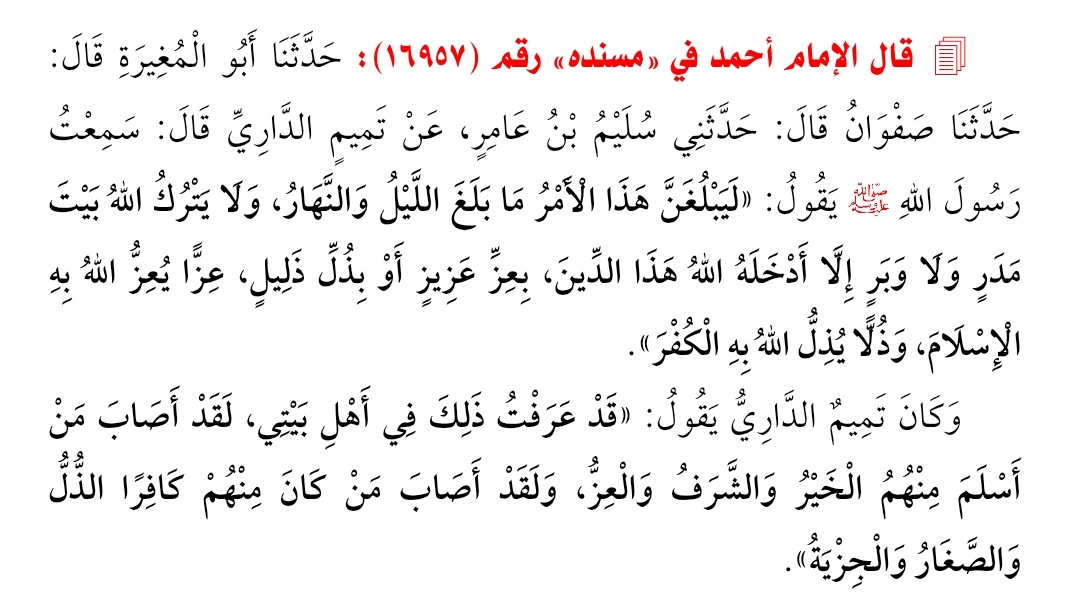
Tamim al-Dari (radiyallahu anhu) narrated: I heard the Messenger of Allah (sallahu alayhi wa sallam) say:
“This matter (Islam) will certainly reach everywhere that the night and the day reach. Allah will not leave any brick-built home or desert tent except that Allah will cause this religion to enter it, either with honour for one who is honoured or with humiliation for one who is humiliated; an honour by which Allah grants honour to Islam, or a humiliation by which Allah humiliates disbelief.”
Tamim al-Dari (radiyallahu anhu) used to say:
“I have seen this clearly among the people of my own household. Those of them who accepted Islam attained goodness, nobility, and honour, and those of them who remained disbelievers were struck with humiliation, abasement, and the jizyah.”
(Musnad Ahmad no. 16957, al-Albani: Sahih)

English