@Sebastian_Hols@E_line@IncidentalEcon The thing is, it's not close in terms of cost effectiveness. We posted an update and clarify that you need a consumer response close to the order of magnitude of the shutdown to change the conclusion
@E_line@IncidentalEcon@AdamAtherly Assuming zero reaction isn’t a neutral assumption about uncertain consumer reactions. At some point naming potential limitations doesn’t help your paper. “Our analysis of the Fed does not take into consideration the existence of the dollar” isn’t the making of a good paper
@E_line@afrakt Reason govt imposed shutdown is because the govt believes consumers will not change behavior sufficiently without strict regulations. If you believe our numbers are misleading you also believe the shutdown was unnecessary because consumers would have changed behavior anyway
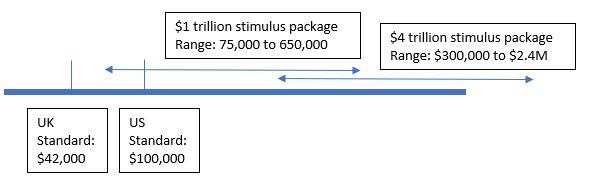
@afrakt We calculated the level of consumer response that would have rendered the shutdown cost effective. Using high end of death range,total value of QALYs saved is $1T. If the consumer reaction was equivalent to 80% of the effect of the government shutdown, it becomes cost-effective.
@afrakt Bigger question is how other countries would have reacted if the US had not shutdown. If other countries, particularly Canada, had followed the US lead and stayed open the economic impact would have been less. The international trade impact would swamp consumer effect. @E_line
@hilzoy@afrakt We think how consumers would react is unknown. We acknowledge the empty Georgia malls, but note the packed beaches in Florida and California and how spring breakers (didn't) react. Also we cite busy business in Stockholm. It will depend on how consumer perceive the risk.@E_line
It remains a good idea that may take some time to figure out. "Elective" treatments have been delayed, but many "elective" treatments aren't indefinitely elective. They can be delayed but maybe not for months. Systems are already planning on how to catch back up
@EconTalker@IncidentalEcon@E_line The data point that seems most likely to change is the mean age of death. The concordance of rates from China, Italy & US data made us confident in that number, but the media is indicating it may run younger in the United States. But that's based more on headlines than charts.
@EconTalker@IncidentalEcon@E_line Agreed. Parts of the stimulus are true economic costs & parts are transfers; it's a reasonable starting point and also a very conservative estimate. If you take something like 50% of one month's economic production, that gives a number of about $875B -- same range. It's low.
@IncidentalEcon@E_line@AdamAtherly Where is the estimate on morbidity? The disorder appears to cause pulmonary fibrosis is am unknown number of survivors. Even 1% of survivors who require oxygen would be a significant added cost that would favor intervention as oxygen therapy is not cheap
@EconTalker@E_line@IncidentalEcon This is CEA not CBA. As we say, this is how we make decisions like this all the time. If you don't like this here -- which is completely fair -- consistency argues that it doesn't apply elsewhere either. Politicians use the Rule of Rescue -- which voters prefer too!
@E_line@IncidentalEcon@AdamAtherly I don't think detailed CBA is the right way to think about this. The most important things are going to go unmeasured. I think most people understand that there are a lot of costs worth paying to save hundreds of thousands of lives. After that, harder to measure.