Adam Harrington
301 posts

Adam Harrington
@AdamHarrington
Adam Harrington investor and international venture capitalist is the co-founder of the Intellectual Digital Companies (iDC, iDG, iDBB).
it depends Katılım Ağustos 2009
214 Takip Edilen138 Takipçiler

Quote from Prof. Dame Pamela Shaw – Professor of Neurology, Honorary Consultant Neurologist at Sheffield Teaching Hospitals NHS Foundation Trust
“MND robs people of their strength and independence with heartbreaking speed – often within just a few years of diagnosis.
Yet science is finally catching up with the disease. The work we have been doing at Sheffield has already been effective such as M102’s early promise of stopping progression of disease and reversal of cells to a healthier state.
The collaboration between academia and the private sector is vital if we are to turn promising discoveries into real treatments.
With partners such as Aclipse Therapeutics and iDG, we are now translating years of laboratory research into clinical progress – and, most importantly, hope for people living with MND.
There is no medical condition more worthy of strong support for the development of disease-modifying therapies, than MND.”
English

*Forbes features iDG’s view on Iran’s market impact*
_*The Longer-Term View_*
Excerpt by Adam Harrington
Not all investors see the current turbulence the same way. Others are looking beyond the immediate disruption. *Adam Harrington, cofounder of Intellectual Digital Global*, sees the Iran war as a potential long-term positive that can ultimately strengthen the overall Middle East and make for a better VC environment globally.
"While we may see minor blips in early-stage valuations or longer sales cycles, there's no true risk-off regime yet," he says, adding that once markets stabilize, this could resolve into a stronger rally, particularly with tailwinds from pro-business policies, sweeping tax-and-spending packages, and likely deregulation.
Rather than halting early-stage venture activity, he argues the current environment is simply enforcing discipline. "Uncertainty slows decisions and stretches time-to-term sheet," he says. "Founders who win now manage burn like adults, raise a bit earlier, and blend equity with non-dilutive options. Wars don't stop innovation, they sharpen the sorting mechanism, quietly rewarding the most resilient companies and prepared founders."
forbes.com/sites/alisonco…
English
Adam Harrington retweetledi

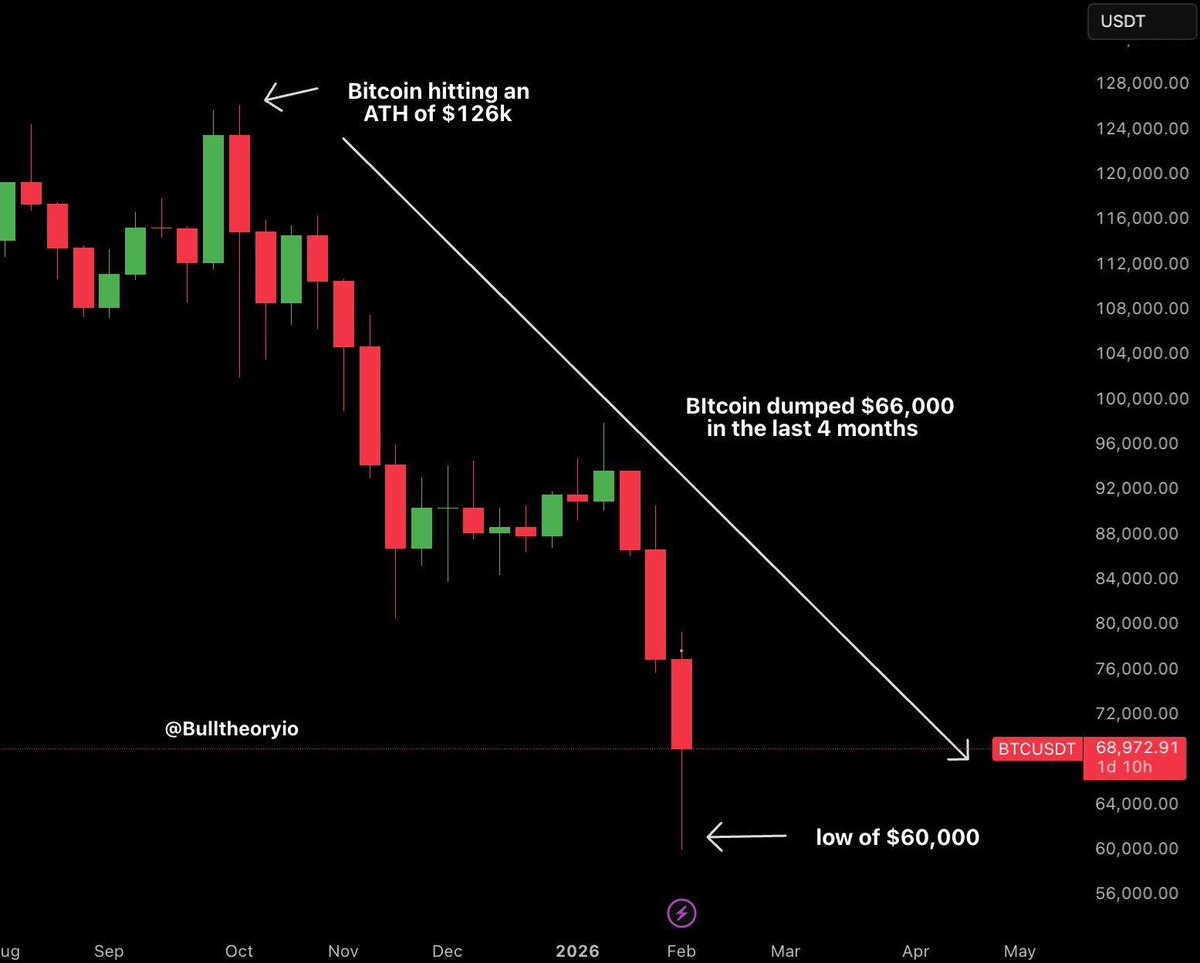
THIS IS WHY BITCOIN DUMPED NON STOP FROM $126,000 TO $60,000.
Bitcoin has now crashed -53% in just 120 days without any major negative news or event and this is not normal.
Macro pressure plays a role, but it’s not the main reason Bitcoin keeps dumping. The real driver is something much bigger that most people aren’t talking about yet.
Bitcoin’s original valuation model was built on the idea that supply is fixed at 21 million coins and that price moves based on real buying and selling of those coins. In the early cycles, this was mostly true. But today, that structure has changed.
A large share of Bitcoin trading activity now happens through synthetic markets rather than spot markets.
This includes:
• Futures contracts
• Perpetual swaps
• Options markets
• ETFs
• Prime broker lending
• Wrapped BTC
• Structured products
All of these allow exposure to Bitcoin’s price without requiring actual Bitcoin to move on chain. This changes how price is discovered because now selling pressure can come from derivative positioning rather than real holders selling coins.
For example:
If institutions open large short positions in futures markets, price can fall even if no spot Bitcoin is sold.
If leveraged long traders get liquidated, forced selling happens through derivatives, accelerating downside moves. This creates cascade effects where liquidations drive price, not spot supply.
That is why recent sell offs look very structured. You see long liquidation waves, funding flips negative, open interest collapses, all signs that derivatives positioning is driving the move.
So while Bitcoin’s hard cap has not changed, the effective tradable supply influencing price has expanded through synthetic exposure.
Price today reacts to leverage, hedging flows, and positioning, not just spot demand.
Adding to this, there are other factors too driving the current dump.
GLOBAL ASSET SELL-OFF
Right now, selling is not isolated to crypto. Stocks are declining. Gold and silver have seen volatility. Risk assets across markets are correcting.
When global markets move into risk-off mode, capital exits high-risk assets first and crypto sits at the far end of the risk curve. So Bitcoin reacts more aggressively to global sell offs.
MACRO UNCERTAINTY & GEOPOLITICAL RISK
Tensions around global conflicts, especially U.S.–Iran developments, are creating uncertainty.
Whenever geopolitical risk rises, supply chain risks increase, and markets shift toward defensive positioning. That environment is not supportive for risk assets.
FED LIQUIDITY EXPECTATIONS
Markets had been pricing a more dovish liquidity backdrop. But expectations around future policy leadership and liquidity stance have shifted.
If investors believe future Fed policy will be tighter on liquidity even if rates eventually fall, risk assets reprice lower.
ECONOMIC DATA WEAKNESS
Recent economic indicators job market trends, housing demand, credit stress are pointing toward slowing growth conditions. When recession fears rise, markets derisk.
Crypto, being the most volatile asset class, sees outsized downside during those transitions.
STRUCTURED SELLING VS CAPITULATION
Another important observation:
This sell off does not look like panic capitulation. It looks structured.
Consecutive red candles, controlled downside moves, and derivative driven liquidations suggest large entities reducing exposure, not retail panic selling.
When institutional positioning unwinds, it suppresses bounce attempts because dip buyers wait for stability before re-entering.
PUTTING IT ALL TOGETHER
It is a combination of:
• Derivatives driven price discovery
• Synthetic supply exposure
• Global risk-off flows
• Liquidity expectation shifts
• Geopolitical uncertainty
• Weak macro data
• Institutional positioning unwind
Until these pressures stabilize, relief rallies can happen, but sustained upside becomes harder.


English

*MND - Must try harder*
An article I wrote for Pharma Times…
Aclipse Therapeutics’ M102 is emerging as a leading, disease-modifying drug for ALS/MND, supported by innovative research at the University of Sheffield and strong preclinical results.
iDG’s backing has helped advance M102 towards human trials, positioning it to potentially slow or reverse disease progression and redefine the treatment landscape for ALS, a frequently devastating disease for athletes and the broader community.
Funding for innovation, not just charity, is essential to beat MND/ALS. iDG’s focus on breakthrough solutions and strategic investment in Aclipse’s M102 helps to ensure that the most promising therapies get the support needed to move quickly from research to the clinic, giving real hope to patients and showing investors the impact of our mission.
share.google/fKt7WVr4Bp46vA…
English

An article I wrote about collaborative and beneficial investment between the UK and USA. investmentweek.co.uk/opinion/451913…
English

Pleased to have Investment Week share my op-ed.
investmentweek.co.uk/opinion/451913…
English

An article I wrote for the London Daily News
*The strengths and challenges of the UK economy: A U.S. perspective*| London Daily News
londondaily.news/the-strengths-…
English
Adam Harrington retweetledi

Bhutan🇧🇹 is a magical place!
Up in the mountains. Has a mystical aura (仙气).
Now using magic internet money.
Tourism Bhutan@tourismbhutan
Experience Bhutan with the world’s first national crypto tourism payment system! Powered by Binance Pay and DK Bank, it offers seamless crypto payments for flights, hotels, local crafts, and much more. bit.ly/43iO6rO @binance
English
Adam Harrington retweetledi

Marc Andreessen on what makes Elon impossible to compete with
“I’m not aware of another CEO who operates the way he does.”
Marc believes you have to go back in history to the industrialists of the late 1800s and early 1900s to find founders comparable to Elon Musk (e.g. Henry Ford, Andrew Carnegie, Thomas Watson, Andrew Mellon, Cornelius Vanderbilt).
“Those guys ran very similar to the way Elon runs things… The top line thing is just this incredible devotion from the leader of the company to fully, deeply understand what the company does, to be completely knowledgeable about every aspect of it, and to be in the trenches and talking directly to the people who do the work to deeply understand the issues. And then be the lead problem solver in the organization. Basically what Elon does is he shows up every week at each of his companies, identifies the biggest problem the company’s having that week and he fixes it. He does that every week for 52 weeks in a row and then each of his companies has solved the 52 biggest problems that year.”
Marc juxtaposes this process with more conventional CEOs who respond to problems with planning, meetings, and reports.
The other crucial factor in Elon’s success that Marc points to is his ability to attract incredible talent:
“Many of the best people in the world want to work with him because if you work with Elon the expectations are through the roof in terms of your level of performance. And he is going to know who you are and what you’ve done. He’s going to know what you’ve done this week and if you’re underperforming. And he may fire you in the meeting if you’re not carrying your weight. But if you are as committed to the company as he is, and hard working and capable, many people who have worked for him say that they had the best experience of their lives.”
Marc recalls a famous line from somebody who joined SpaceX from another aerospace company and said, “It’s like being dropped into a shocking zone of competence. Everybody around me is so absolutely competent.”
And lastly, as Marc argues, Elon’s technical ability is another competitive advantage versus non-technical CEOs:
“When he identifies the bottleneck, he goes and talks to the line engineers who understand the technical nature of the bottleneck… He’s not asking the VP of Engineering to ask the Director of Engineering to ask the manager to ask the individual contributor to write a report that’s to be reviewed in three weeks. He doesn’t do that. What he does is he goes and personally finds the engineer who actually has the knowledge about the thing, and then he sits in the room with that engineer and fixes the problem with them. And again, this is why he inspires such incredible loyalty from especially the technical people who he works with. They’re just like, ‘Wow, if I’m up against a problem I don’t know how to solve, freaking Elon Musk is going to show up in his Gulfstream and he’s going to sit with me overnight in front of the keyboard or in front of the manufacturing line and help me figure this out.’”
Video source: @ChrisWillx (2024)
English