
Adina Aaron
37 posts

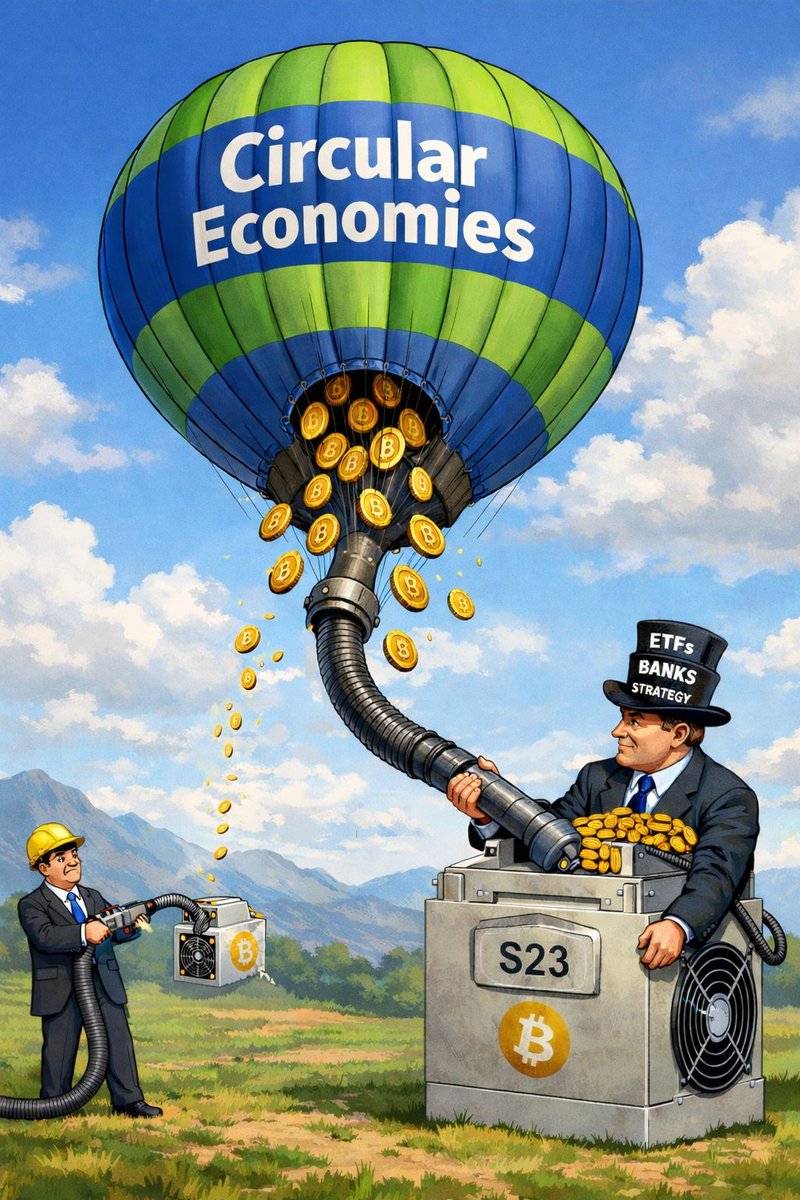
Great article by Fredrick Barber about Bitcoin's Centers of Gravity.
linkedin.com/posts/activity…

English
Adina Aaron retweetledi

The 21 toughest questions in Bitcoin!
Question 6 of 21.
Why is TIME perhaps the MOST important component of Bitcoin’s ability or inability to become a true permanent store of value?
If you believe that Bitcoin is a true long-term store of value with its current design (Adjusted By “Core Developers”, which is a small group of people) and refute the basis of the aforementioned question, we are open to dialog. We recommend reading the hint first.
Hint: Bitcoin is often compared to gold, but it must become more of an electronic elixir. Bitcoin must circulate to survive. There is no alternative for the network. Bitcoin will either become much more than gold or fail due to Core’s version of the Bitcoin protocol. BTC must gain additional capabilities which will solve more than BTC 's economic problems. BTC's current design may not make it through the next two halvings, based on the math. The current TPS will not support a mining network. As an electronic elixir, it must gain additional ingredients and evolve into something transformative. Read the next line twice. Bitcoin requires a minimum flow rate (MFR) to maintain the minimum economic incentive to mine (MEIM3). This is one of three requirements for Bitcoin to sustain itself as a system in perpetuity. If there is no adequate flowrate, the Bitcoin miners die out, as miners diversify out, or pool until recentralization is achieved and controlled by dominant fiat currencies over time. It's important to note that Bitcoin nodes don’t add blocks to the blockchain. Mining nodes are responsible for this task which keeps the network decentralized. We can stare at the price and do nothing but cheer for higher and price. At the same time, we will watch Bitcoin lose its use case. Loss of each miner may come in the form of a silent takeover, shut down, diversifying into more profitable ventures and other transitions into new business models that assigns electricity elsewhere and reduces independent hash rate production. This process will continue as get worse, as miners recentralize under the control of whatever entities (governments, institutions[c1] , etc.) buy the Bitcoin miners out, as the block subsidy (the amount won every ten minutes for solving a block) fails to nourish the whole of the mining network adequately as time progresses based on Satoshi’s original design. Satoshi did not create the flaw, its just math. We will come to an infliction point between 2024-2028 is what I briefed in Austin Texas three years ago. I also briefed that the halving cycle would end but not due to institutional adoption. That is a distraction. Bitcoin is 95% mined. Less than ~2% of the world is likely to own ~98% of the supply. Miners need Satoshis to flow but the creator didn’t leave a mechanism in place to overcome greed. We're all holding and it will eventually kill of most miners, recentralized the network, minimize its impact outside of paid-hype, and constitute a loss of use case. The flaw is with mankind and is exposed by Gresham’s Law and greed. Greed is our common enemy. We can’t all hold bitcoin forever and expect the miners to work for free. Many miners currently can't cover their operating expenses and quietly exit mining bitcoin. We need a constant flow of Satoshis as a direct result of proliferation. The flow is required because the supply is capped. The solution will require a community. I call it Permaflow. Permaflow is a subset of a new economic model I invented called Equilibrium Based Economics (EBE). Until next time.

English

🚨 BREAKING
Scott Bessent confirms the U.S. has officially started a Strategic Bitcoin Reserve.
Rules are simple:
- No buying
- No selling
- Confiscated BTC stays on the sovereign balance sheet
Translation:
Bitcoin just crossed from asset → state-held monetary reserve.
No hype.
No speculation.
This is sovereign recognition.
Bitcoin isn’t knocking on the door anymore.
It’s already inside.
English
@COOLCRYPTOCONVO Blockstream...a $3B company that pays Core developers to create Layer 2s that create fees for Blockstream🤦🏾, while pushing the developers not to increase the TPS.
English
Adina Aaron retweetledi
The 21 toughest questions in Bitcoin.
Question 1 of 21
If less than 2% of the entire world owns all of the Bitcoin, what will the other 98% of the world use?
If you are a Bitcoin Billionaire, Millionaire, or Minion, it doesn't matter. Ask your favorite Bitcoin expert these questions to really go beyond the same of discussions.
The CBC is out to change the Bitcoin community, as we decentralized the world's diaspora!!!
...Yes, Fred has really been in the Bitcoin game since 2011. Wait until you read #7 of 21. Saylor, the Trumps, and Dorsey will definitely want answers!!!
(The team will provide our answers each time a question receives a preselected random number of responses! Nope, they aren't all the same number... we plucked from a pot in the spirit of decentralization!!!)
So share!
Again,
1 of 21
If less than 2% of the entire world owns all of the Bitcoin, what will the other 98% use?
English
We're inviting everyone to Cool Bitcoin Convo's 3-day live webinar, December 18–20, 2025 at 12:00 PM EST, focused on one of the most important questions facing Bitcoin today: preventing recentralization as the network matures? Capped-supply economic systems vs. traditional. Q&A

English
@CoinMarketCap Institutional involvement does hurt Bitcoin more of their Bitcoin is not circulating. They are literally killing the mining network leading to less security & Recentralization. The percentage of transaction fees for miners has DECREASED since institutions have begun HODLING BTC.
English

LATEST: ⚡ Michael Saylor dismissed concerns that institutional involvement hurts Bitcoin price stability during a Fox Business interview, saying data shows BTC's annualized volatility has actually dropped from 80% in 2020 to 50% today.

English
@VillianTEN @WuBlockchain AI pays the bills, whereas BTC used as a store of value does not. Transaction fee received by miners barely at 4%, will not sustain BTC mining. Nothing to do with secrets, but everything to do with staying afloat financially.
English

@WuBlockchain From hashing to...hashing out privacy? AI needs secrets. Transparent chains don't offer them. @tenpeotocol
English

Bitfarms announced plans to wind down its Bitcoin mining operations over the next two years and convert its facilities into artificial intelligence (AI) and high-performance computing (HPC) data centers. The company said its 18-megawatt Bitcoin mining site in Washington will be the first to complete the transition by December 2026, fully dedicated to supporting AI and HPC operations. Following the announcement, Bitfarms’ shares fell about 18%.
cointelegraph.com/news/bitfarms-…
English
@DeOrganizedBTC With everything that has transpired and continues to unfold with BTC, I would really question that decentralized narrative.
English

@FlorynCat Fredrick Barber will be speaking at the Black Blockchain Summit conference in WASHINGTON DC, Sept 27th. He will be discussing his BTC solutions that address many of the issues that you mention.
English

Tomorrow, another The Last Days of A Condemned Man, with Roberto Alagna and Jean-Yves Ossonce. 2:30pm. Opéra Marseille.
English
Adina Aaron retweetledi


Français
Derrick Parker is going on as Porgy at the Chicago Lyric in a few hours. Please wish him the best of luck everyone!!!
English