Saad

9.3K posts

Saad banner
Saad

Saad

@AirlinePilotmax

Astrophysicist Ex NASA | FAA Airman| EASA ATPL (A)| AGI Instructor| Type Rated Examiner B737NG/Max| Rated on G550, A320|Flight Safety|Aviation Diplomacy

College Station, TX Katılım Ocak 2024
1K Takip Edilen11.7K Takipçiler
Sabitlenmiş Tweet
Saad
Saad@AirlinePilotmax·
I say it with way more commitment—Aviation industry in Pakistan is reeling. The Open Sky Policy favors GCC airlines more than Pakistani airlines. I say it again, the aviation industry will crash if the aviation policy isn't changed and the open sky policy is not fairly restructured. Look, we've seen this coming for years. Gulf carriers like Emirates, Qatar Airways, and Etihad have flooded our routes with hundreds of weekly flights, using their hubs to siphon off passengers who should be flying direct with our own airlines. They get subsidies, modern fleets, and endless capacity, while PIA and others here struggle with outdated planes and mounting debts. It's not just competition it's unbalanced. They operate from one or two points in their small countries but get access to a dozen cities in ours, a nation of over 220 million people. Our national carrier's market share has plummeted from 50% to around 20%, and that's no coincidence. Jobs are at stake, billions in potential revenue are leaking out, and our economy feels the hit every time a passenger chooses a foreign hub over supporting local aviation. We need reciprocity in these bilateral agreements real fairness, caps on their sixth-freedom rights that let them carry traffic beyond what's intended. If we don't renegotiate and protect our industry now, we'll be left with crumbling airlines, higher fares for passengers, and no strong national presence in the skies. The government must act decisively restructure the policy, level the playing field, and invest in our carriers before it's too late. Pakistan's aviation deserves better than this slow bleed.
English
2
8
49
38.4K
Ayesha Ijaz Khan
Ayesha Ijaz Khan@ayeshaijazkhan·
Will Dubai survive? What is the future of the GCC? In 3 hours I will be co-hosting a Space on this subject with @AirlinePilotmax Tune in at 14:30 US (EST) 19:30 London 22:30 Doha/Riyadh 00:30 Pakistan
English
5
2
26
1.6K
Saad
Saad@AirlinePilotmax·
@husnejahaan “Amazon stuff’s coming too.
English
1
0
1
403
~ coconut cupcake ~
~ coconut cupcake ~@husnejahaan·
My brother telling me he'll send ice cream coz I'm on my period and my son making me noodles coz I'm on my period and was craving them...alhamdolillah for such men in my life, the good, kind, considerate type. My brother treats his wife like a queen and inshaAllah my son will too
English
6
0
23
991
Saad
Saad@AirlinePilotmax·
The SMDA is best understood as a strategic diversification instrument, not a wholesale capability transfer. It is less about immediate transformation and more about diversification — a sign that the Middle East's security architecture is evolving . Pakistan brings credible conventional forces, and Chinese adjacency to the table. What it cannot bring is the integrated command architecture, satellite intelligence, and logistics depth that the American umbrella provided — and that Saudi Arabia is quietly discovering it cannot simply replace.
English
1
2
10
1.1K
Muniba Kamal
Muniba Kamal@MunibaKamal·
Doesn't the defence pact with Pakistan give Saudi Arabia top of the line capabilities to face any threat? Your thoughts?
English
2
0
6
1.2K
Saad
Saad@AirlinePilotmax·
Agreed. Authenticate the footage first before calling it a valid data point. But even if you grant it as real, a damaged aircraft is not a kill. That's a miss on terminal effect. DAS is supposed to give you full sphere awareness and fire control quality cueing. If the platform walked away, you have to ask whether the shot solution was valid, whether the weapons employment zone was correct, or whether DAS handed off degraded track data to the shooter. Any one of those is a serious red flag. A kill claim needs a confirmed kill. Damage assessment showing a flyable aircraft means the engagement was at best a partial. That's not DAS performing. That's DAS underperforming on a combat employment profile and we shouldn't be calling it a capability validation until we see the full HUD data, sensor track logs and post engagement BDA. Right now it's an unconfirmed with a question mark on the system that's supposed to be the whole point of the platform.
English
0
0
1
18
Ali Hamza
Ali Hamza@AliHamzaAwan1·
@AirlinePilotmax @zubairabbasi Forget about safe landing. I still have my reservations about that video. If it is real, the kill doesn't matter. The DAS performance has a big question mark on it even if aircraft was only damaged.
English
1
0
1
38
Ali Hamza
Ali Hamza@AliHamzaAwan1·
@zubairabbasi If the news is confirmed that F-35 has been shot down and that too with Chinese tech, this will change the global arms industry forever.
English
4
4
25
723
Saad
Saad@AirlinePilotmax·
The successful recovery of the aircraft under combat damage conditions speaks directly to the F-35's survivability architecture. Several design elements are relevant to this outcome. At the core of the F-35's operational effectiveness is its sensor fusion capability, which integrates data from radar, infrared and electronic warfare systems into a single coherent picture for the pilot. This gives the aircraft unmatched situational awareness, enabling faster and more informed decision making under adverse conditions. This capability almost certainly contributed to the pilot's capacity to assess aircraft state and execute a controlled emergency landing rather than eject. The F-35 incorporates a triple redundant fly by wire flight control system, structural design provisions for battle damage tolerance in critical flight control surfaces, and an advanced full authority digital engine control system capable of compensating for degraded aerodynamic states. These systems in combination allow the aircraft to remain flyable under conditions that would have rendered legacy fourth generation platforms unrecoverable. The aircraft's internal weapons and fuel carriage design, with no external pylons creating asymmetric drag, also reduces the complexity of maintaining controlled flight following structural damage to wing stations or external hardpoints. The emergency landing, rather than a loss of the airframe, carries significant implications at multiple levels.
True Justice@TrueJus51847303

@AirlinePilotmax why would this be shocking ? Please explain it to thenon technical ordinary Joe Public . Thanks

English
0
5
23
4.1K
Saad
Saad@AirlinePilotmax·
From a military intelligence perspective, the recovery of an F-35 that sustained combat damage under Iranian fire provides US engineering and intelligence teams with direct data on the nature of the weapon system employed, the precise impact geometry, and the boundaries of the aircraft's damage tolerance envelope. This intelligence product is of considerable operational value. From an adversary perspective, the incident is notable in its timing, arriving even as senior US officials have publicly projected confidence about the trajectory of the campaign. Defense Secretary Pete Hegseth stated on the morning of 19 March 2026 that the United States is winning decisively and that Iran's air defence capabilities have been substantially degraded. The Iranian ability to successfully engage a fifth generation stealth platform, regardless of the severity of the damage ultimately sustained, represents a messaging victory for Tehran independent of the physical outcome. From a platform credibility standpoint, the safe recovery of the aircraft under combat damage conditions reinforces rather than undermines confidence in the F-35's resilience. A fifth generation stealth fighter absorbing an engagement over hostile territory and returning to base under its own power is a demonstration of survivability that no adversary propaganda campaign can easily neutralise. The weight of evidence supports the US Central Command account. The aircraft recovered safely. The pilot is in stable condition. Iranian claims of catastrophic damage follow an established pattern of information distortion observed throughout the 2025 and 2026 conflict periods and should be treated with significant analytical scepticism pending physical evidence to the contrary. The incident nonetheless confirms that Iranian air defence elements retain residual capability to engage even low observable platforms operating in contested central Iranian airspace. This has direct implications for mission planning, ingress routing, and electronic warfare support requirements for all subsequent F-35 sorties operating in this theatre. The F-35 has demonstrated, in combat, that it can be hit and still come home.
English
2
3
10
1.1K
Saad
Saad@AirlinePilotmax·
The incident represents the first confirmed instance of Iran successfully striking an American aircraft since the war commenced in late February 2026. Both the United States and Israel have been operating F-35s throughout the conflict, with each airframe carrying a programme acquisition value in excess of USD 100 million. As of this incident, at least 16 US military aircraft have been destroyed since the commencement of hostilities with Iran, including 10 MQ-9 Reaper strike drones destroyed by enemy fire and a further six aircraft badly damaged in attacks or accidents. The most consequential losses by airframe value were attributed to accidents, including three F-15s lost to friendly fire in Kuwait and a KC-135 tanker destroyed during an aerial refuelling operation. The precise nature of the weapon system employed against the F-35 has not been publicly disclosed by US Central Command. Open assessments have considered the possibility of a ground based air defence system, a surface to air missile, or an alternative engagement platform. Iran's Islamic Revolutionary Guard Corps issued a statement claiming direct responsibility for the strike. The IRGC stated the F-35 was engaged at approximately 0250 hours local time in central Iranian airspace by an advanced next generation air defence system operated by the Revolutionary Guards Aerospace Force. The IRGC further claimed the aircraft sustained heavy damage and asserted that the jet's ultimate fate remained under assessment, with a high probability of a subsequent crash. US Central Command has not corroborated any element of the Iranian account, maintaining only that the aircraft landed safely and the pilot sustained no life threatening injuries. It is analytically important to note that Iran previously claimed to have shot down F-35s during the 12 day war with Israel in June 2025. Those assertions were subsequently assessed as unsubstantiated. Iranian media circulated imagery purportedly depicting wreckage of Israeli F-35I aircraft, though the evidence was widely assessed as fabricated or digitally manipulated, and the Israeli military categorically denied the claims. This pattern of information warfare must be factored into any assessment of the current Iranian narrative. The successful recovery of the aircraft under combat damage conditions speaks directly to the F-35's survivability architecture. Several design elements are relevant to this outcome. At the core of the F-35's operational effectiveness is its sensor fusion capability, which integrates data from radar, infrared and electronic warfare systems into a single coherent picture for the pilot. This gives the aircraft unmatched situational awareness, enabling faster and more informed decision making under adverse conditions. This capability almost certainly contributed to the pilot's capacity to assess aircraft state and execute a controlled emergency landing rather than eject. The F-35 incorporates a triple redundant fly by wire flight control system, structural design provisions for battle damage tolerance in critical flight control surfaces, and an advanced full authority digital engine control system capable of compensating for degraded aerodynamic states. These systems in combination allow the aircraft to remain flyable under conditions that would have rendered legacy fourth generation platforms unrecoverable. The aircraft's internal weapons and fuel carriage design, with no external pylons creating asymmetric drag, also reduces the complexity of maintaining controlled flight following structural damage to wing stations or external hardpoints. The emergency landing, rather than a loss of the airframe, carries significant implications at multiple levels.
CNN@CNN

A US F-35 fighter jet damaged by suspected Iranian fire makes an emergency landing at an US air base in the Middle East, sources say cnn.it/3NOOLMK

English
4
8
41
6.5K
Saad
Saad@AirlinePilotmax·
Pakistan is a nuclear-armed state operating in one of the world's most volatile strategic environments. It merits close, honest, and unsentimental attention from the American intelligence community. What it does not merit is insertion into a superpower adversarial threat matrix on the basis of missiles that do not exist, aimed at a country that Pakistan has no coherent strategic logic to threaten. Intelligence that overstates threat for geopolitical convenience is not intelligence. It is a liability, and in the arena of nuclear affairs, liabilities carry consequences that no conditional sentence can responsibly disclaim.
English
0
0
4
770
Saad
Saad@AirlinePilotmax·
Pakistan has been engaged in an active diplomatic reset with Washington throughout 2025 and into 2026. The United States played a central role in brokering the ceasefire that ended the May 2025 India-Pakistan conflict. Islamabad has actively cultivated American goodwill at the highest levels, including through its military leadership. These are not the behavioural signatures of a state constructing intercontinental strike capability against its interlocutor. They are the signatures of a state navigating a difficult regional environment and seeking the strategic assurance that comes with American engagement. If any rationale for extended-range Pakistani missile research exists at all, it is deterrence against external intervention in a future South Asian crisis, not aggression against American cities. That is a categorically different strategic posture from the one Gabbard implied before the Senate, and conflating the two represents either an analytical failure or a deliberate mischaracterisation. It is worth examining precisely what Gabbard actually said, because her language, stripped of its dramatic context, is notably thin on substance. She spoke of countries "researching and developing" systems and stated that Pakistan's long-range missile development "potentially could include" intercontinental ballistic missiles. This conditional framing is not a finding. It is a projection of a possibility derived from a research trajectory, applied to a country whose strategic doctrine offers no rationale for the capability being projected. Researching a technology and deploying it as an operational strategic threat against the United States are two entirely different conditions, separated by years of development, billions of dollars of investment, and a fundamental political decision to abandon a nuclear posture that has remained India-focused for the entirety of its existence. Presenting the first as evidence of the second, before the United States Senate, is an act of analytical overreach that no credible intelligence assessment should permit itself. One cannot responsibly analyse this assessment without acknowledging what it may be designed to accomplish beyond the domain of intelligence. Grouping Pakistan alongside China, Russia, and North Korea in a single threat matrix transmits a pointed message to Islamabad: your deepening strategic alignment with Beijing carries a cost in how Washington chooses to categorise you. It is coercive statecraft communicated through the instrument of an intelligence briefing, and in doing so it distorts both simultaneously. The intelligence loses its credibility, and the statecraft loses its transparency. This matters because the audience for such an assessment extends well beyond the Senate chamber. It is read in Islamabad, in Beijing, in New Delhi, and in every capital that monitors American strategic signalling. When a country is placed on a threat list not because its doctrine or behaviour warrants inclusion but because its relationships are inconvenient, the integrity of the entire assessment is compromised, and with it, the credibility of the institution that produced it. Sound strategic analysis demands that capability, intent, and context be weighed together with equal rigour. Gabbard's assessment, as it pertains to Pakistan, elevates speculative capability above established doctrine, dismisses decades of consistent strategic behaviour, ignores the reciprocal and superior capabilities of a US-aligned regional power, and positions a conditional research trajectory as an active threat to the American homeland.
English
1
0
5
1.1K
Saad
Saad@AirlinePilotmax·
Presenting the 2026 Annual Threat Assessment before the United States Senate Select Committee on Intelligence, Director of National Intelligence Tulsi Gabbard placed Pakistan within the same adversarial bracket as Russia, China, North Korea, and Iran, warning American lawmakers that Islamabad's evolving missile capabilities could potentially place the United States homeland within range. Her written assessment went further still, positioning Pakistan across multiple threat categories simultaneously. This is a remarkable claim, and not in a favourable sense. It conflates hypothetical technological trajectories with established strategic intent, equates a regionally calibrated deterrence posture with global aggression, and compresses a country of extraordinary geopolitical complexity into a threat category designed for declared adversaries of the United States. Each of these errors demands examination on its own terms. The foundational failure of Gabbard's characterisation is its complete disregard for Pakistan's declared and consistently observed nuclear doctrine. Pakistan's nuclear architecture has been India-specific since the moment it was conceived. This is not diplomatic positioning or public relations management. It is reflected in every dimension of how Pakistan has structured its deterrent posture: the yield and delivery range of its warhead systems, the geographic orientation of its command and control infrastructure, the nature of its arms acquisitions, and the language of every credible strategic communication Islamabad has produced over nearly three decades. A deterrence architecture built methodically around a single regional adversary does not transform into a global strike apparatus simply because a missile's theoretical range, at some speculative future point of development, could arithmetically encompass a distant continent. Intent and doctrine are the determinative variables in any responsible threat assessment, and on both counts, the evidence consistently points in one direction: South Asia, not North America. What renders Gabbard's assessment particularly unconvincing is the precision of what it chooses to exclude. India's missile development programme, which objectively approaches and in certain respects exceeds Pakistan's in terms of strategic range and technological sophistication, is entirely absent from her roster of threats. India is currently developing intercontinental ballistic missile systems with ranges that would dwarf anything Pakistan is alleged to be researching. Its existing long-range ballistic missiles already cover a vast portion of the globe. This omission is not an intelligence gap. It is a reflection of the sustained strategic tilt that Washington has maintained toward New Delhi, and it fatally undermines any claim that Gabbard's assessment is a neutral product of objective analysis. An intelligence evaluation that highlights speculative missile ranges in one country while ignoring comparable or superior confirmed capabilities in a strategically preferred partner is not functioning as intelligence. It is functioning as foreign policy, and it does so while wearing the borrowed authority of a classified threat assessment. Even accepting, for the sake of argument, the technical possibility of an extended-range Pakistani missile programme at some point in the future, Gabbard's assessment never seriously engages with the question that any credible analysis must answer first: to what end? Why would Pakistan invest the enormous financial, political, and diplomatic capital required to develop and field a capability aimed at the continental United States?
English
6
3
25
3K
Saad
Saad@AirlinePilotmax·
Alarms in Qatar!
English
1
1
37
2.4K
Saad
Saad@AirlinePilotmax·
The ongoing conflict reveals a stark asymmetry in the Middle East's security architecture. Iran, facing direct assaults from superior military powers, exercises agency through escalation, choosing targets that extend the pain beyond its borders and impose costs on those entangled in the broader confrontation. Its actions, while aggressive, stem from a position of strategic necessity: to deter further attacks by demonstrating that aggression carries regional repercussions. In contrast, the Gulf Cooperation Council states find themselves ensnared in a framework they helped sustain yet cannot fully control. For decades, hosting American military installations promised protection against precisely the threats now materializing. That bargain, once viewed as a cornerstone of stability, has instead transformed these nations into front-line vulnerabilities. When external powers initiate hostilities, the bases become immediate focal points for retaliation, pulling the Gulf into a conflict they explicitly sought to avoid. This dynamic underscores a fundamental imbalance: the architects of the security order retain the initiative to strike or withdraw, while the hosts bear the consequences without commensurate authority. The promised shield has become a lightning rod, exposing the limits of outsourced deterrence in an era of prolonged, multi-domain warfare. True protection demands greater autonomy, yet the path toward it risks further instability in an already volatile neighborhood. The Gulf's leaders now confront an uncomfortable truth: alignment offers influence but rarely insulation, and survival may require rethinking the very arrangements once deemed essential.
Maheen Ghani@maheenghani_

Iran isn’t acting in a vacuum, and the GCC isn’t operating with full freedom either. Hosting bases isn’t always a position of power, sometimes it’s a survival strategy. One is responding to an attack, the other is navigating a system it didn’t design, in a war it didn’t start. The same system meant to protect them is now exposing them. Power isn’t distributed equally, yet the consequences are.

English
1
4
32
3.9K
Saad
Saad@AirlinePilotmax·
@Lee_Cobaj I miss this place - and the aura - and the history around it.
Saad tweet media
English
0
0
1
18
Goose Lee 💙💛
Goose Lee 💙💛@Lee_Cobaj·
Was meant to being going to Oman last week to write about the marine life, inc rare Arabian humpback whales which have lived in a basin off Salalah for more than 70,000 years. Because it's so safe, they are only whales which don't migrate, and now they are being bombed. Brutal.
AFP News Agency@AFP

From sea turtles to birds and the gentle dugong, the Persian Gulf's diverse but fragile marine life is threatened by the bombs and oil of the war in the Middle East. u.afp.com/SLeb

English
1
1
8
1.1K
Saad
Saad@AirlinePilotmax·
Tonight, Ayesha Ijaz Khan and I will co-host an X Space. Timings: 19:30 PM London time 22:30 PM Doha time 00:30 AM Islamabad time (next day) The topic: The GCC in a Quagmire Join us for what promises to be a thoughtful discussion! @ayeshaijazkhan
English
4
6
39
2.2K
Saad
Saad@AirlinePilotmax·
When I worked in Beijing as a foreign pilot for a Chinese airline, I underwent a security clearance process every year. The interviews were conducted by the Ministry of State Security (MSS). The officer who questioned me was exceptionally sharp; he demonstrated detailed knowledge of my background and even my geopolitical inclinations. That experience taught me never to underestimate China's geopolitical awareness and sophistication. The Chinese are closely watching American military tactics and are actively involved in intelligence, surveillance, and reconnaissance activities around the Persian Gulf, including through intelligence-gathering vessels like the Liaowang-1 and satellite networks that monitor US deployments, aircraft movements, and operations in the region amid ongoing regional war .
English
9
66
643
53.7K
Saad
Saad@AirlinePilotmax·
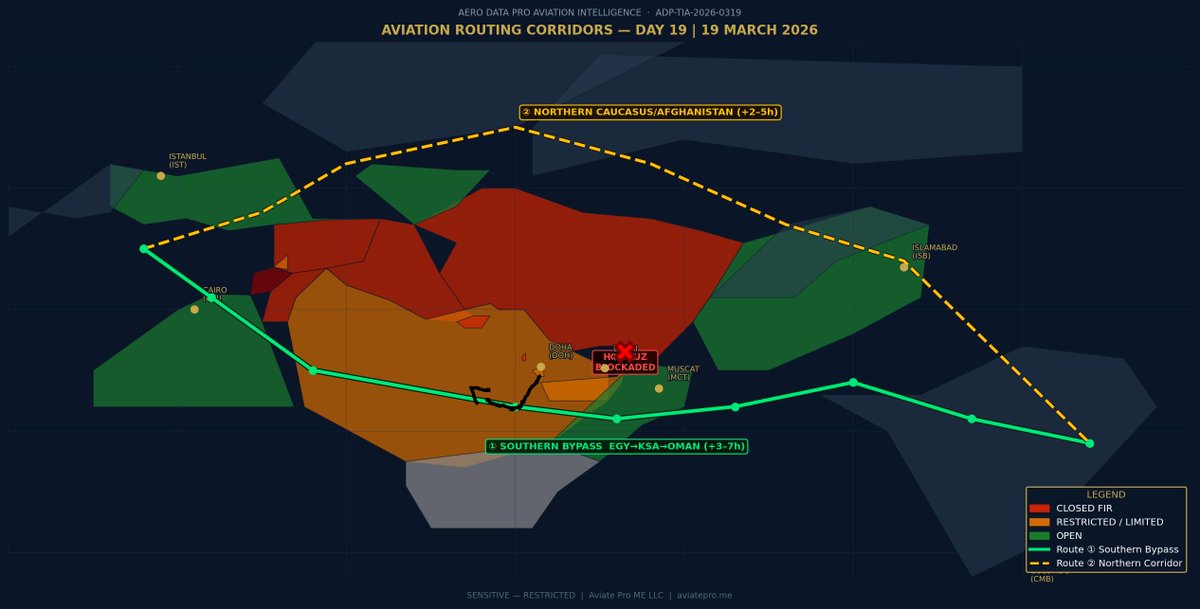
Hormuz remains blockaded. Persian Gulf FIRs are closed or severely restricted, forcing all commercial traffic onto two active bypass corridors. Route ① Southern Bypass via EGY → KSA → OMAN adds 3 to 7 hours to westbound and eastbound operations. Route ② Northern Corridor via Caucasus and Afghanistan adds 2 to 5 hours across the board. The Black Line on today's map marks Emergency ATS Route L564. The Qatar Civil Aviation Authority has approved this dedicated corridor for 8 hours per day to facilitate departures and arrivals into and out of Doha under the current airspace restrictions.
Saad tweet media
English
1
5
5
1.5K
Saad
Saad@AirlinePilotmax·
Do not take Donald Trump’s statements too seriously, especially those he posts on Truth Social. What he writes there often bears little resemblance to what he actually does in practice. His public rhetoric and his real-world actions frequently diverge sharply. Meanwhile, the relationship between Israel and the United States remains exceptionally close and tightly coordinated, with both nations continuing to work hand in glove on security, intelligence, and strategic matters regardless of the noise coming from any single political figure.
English
2
18
65
4.3K