
Alessandro Peri

136 posts

Alessandro Peri banner
Alessandro Peri

Alessandro Peri

@AlePeri83

Associate Professor at CU Boulder, Economics. Macroeconomist with interests in Computational Economics (FPGAs) and Law and Economics. Runner in the spare time.

Boulder Katılım Şubat 2016
664 Takip Edilen355 Takipçiler
Sabitlenmiş Tweet
John Stachurski
John Stachurski@john_stachurski·
I know we shouldn't be driven by desire for accolades but I am proud of this one. Maybe I didn't entirely waste my short moment of time on this beautiful planet 🥹❤️ #davidkendrickprize" target="_blank" rel="nofollow noopener">comp-econ.com/contest-and-pr… @SocCompEcon
English
32
24
232
24.5K
Alessandro Peri retweetledi
Jesús Fernández-Villaverde
Jesús Fernández-Villaverde@JesusFerna7026·
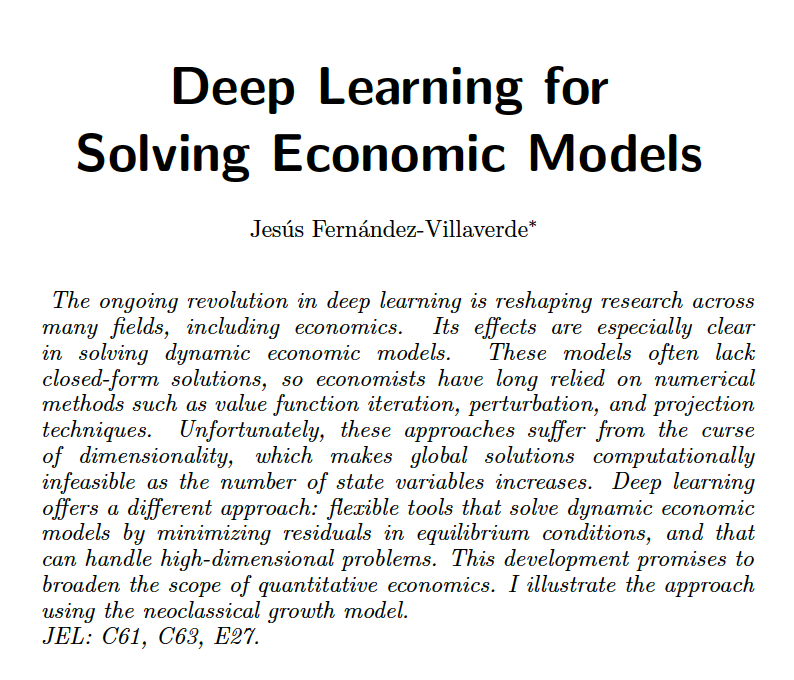
I am very happy that my survey paper, "Deep Learning for Solving Economic Models," is forthcoming in the Journal of Economic Literature (pending final replication checks, which should be quick). The paper benefited greatly from the editor, David Romer, five referees, and many friends who read earlier versions. I believe the result is a solid introduction to the field, though in 48 pages, there is only so much one can do. So, I created a companion webpage: sas.upenn.edu/%7Ejesusfv/dee… where you can find the paper, the code, and some slide decks with my teaching material. My plan is to expand the slides over time, adding new material and updating them as new results appear. I will probably do a thorough revision once the spring semester is over. Those who follow my feed know that I think deep learning is the most fundamental change to computational economics in the last 40 years. I am by now convinced it is more important than the development of Markov chain Monte Carlo methods in the early 1990s or the introduction of projection and perturbation methods in the 1980s. To find a comparable shift, one would probably need to go back to Richard Bellman's invention of value function iteration in 1957. More pointedly, we need to redesign the Ph.D. in economics. Not at the margin. From the ground up. Economists can either fully embrace the deep learning revolution or become irrelevant, as has already happened, I would dare say, to some fields in academia that refused to accept reality. Finally, let me apologize to everyone working in this area whom I could not cite. Space was a binding constraint. And yes, this post was written with the considerable help of AI. There is nothing I am prouder of than the fact that AI is now an integral part of every step I take in my professional life.
Jesús Fernández-Villaverde tweet media
English
20
291
1.3K
127.8K
Alessandro Peri retweetledi
Olivier Blanchard
Olivier Blanchard@ojblanchard1·
RIP Chris Sims. I was enormously influenced by Chris. My own, perhaps idiosyncratic take: His main contribution came at a time when macroeconomists had constructed the first wave of big macroeconometric models. They were constructed piece by piece, a consumption block, an investment block, and so on. Each piece looked reasonable, but when assembled together, the implied macro dynamics were all wrong. What Chris did was to turn things around, namely argue that one had to start from the actual macro dynamics, the so called VARs, and show how, with minimal identification conditions (leading to "structural" VARs), they could be used to suggest the dynamic effects of various shocks, dynamics that the structural models had to replicate. To say that his approach was influential would be to understate its influence. Today, a model that did not fit the VAR evidence, would be simply dismissed.
English
9
180
778
64.6K
Alessandro Peri retweetledi
Jon Steinsson
Jon Steinsson@JonSteinsson·
I want to take a moment to defend calibration. A common critique of macro by non-macro people centers on the supposed lack of scientific rigor associated with calibration of models. 1/10
English
7
156
697
0
Alessandro Peri retweetledi
Jesús Fernández-Villaverde
Jesús Fernández-Villaverde@JesusFerna7026·
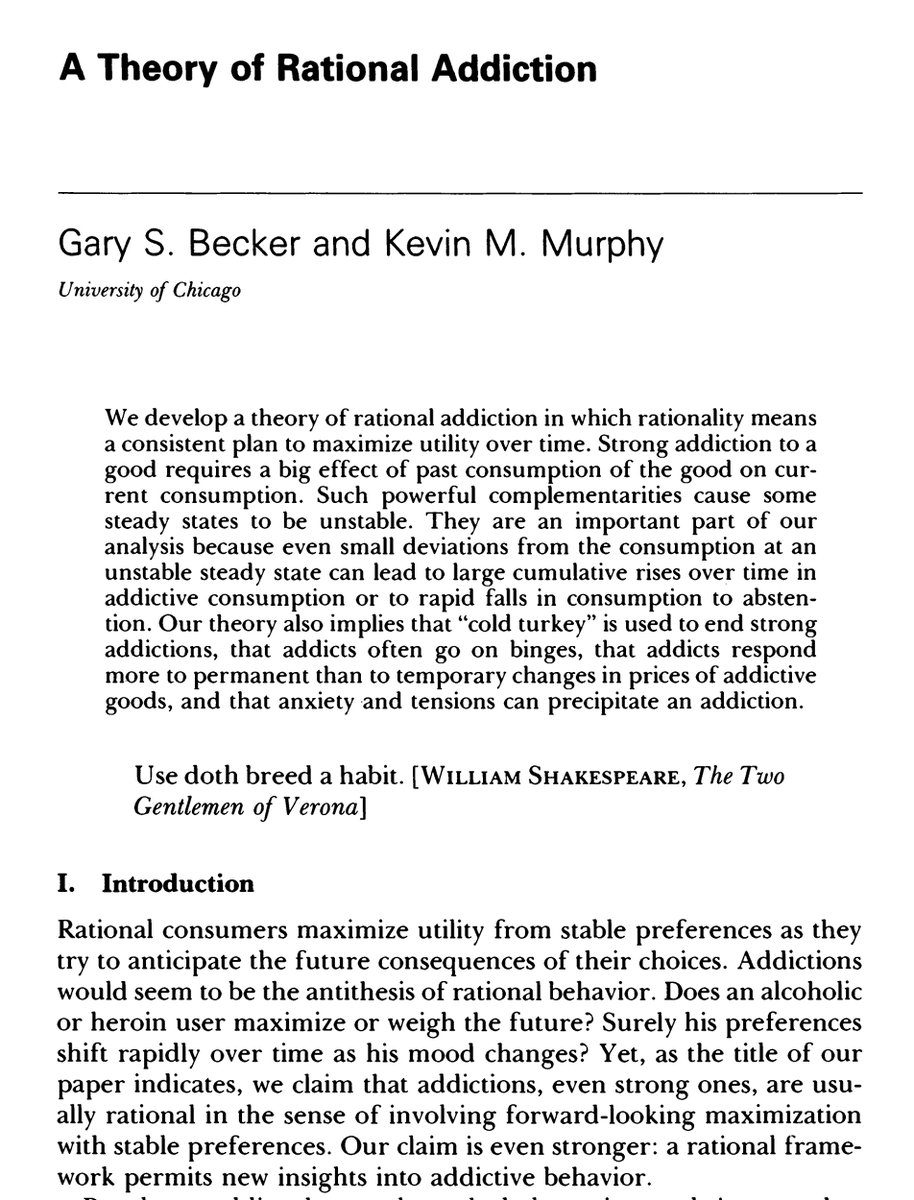
Olivier Blanchard (@ojblanchard1) had a provocative post yesterday about a higher preference of French people for leisure: x.com/ojblanchard1/s… I have learned nearly an infinite amount of economics from Olivier since I was an undergrad, and he came to Spain to present a report on our unemployment problem, so I feel a bit intimidated about pushing back on this idea. I am perfectly happy with the idea that preferences are heterogeneous: some people like leisure more than others. And the goal of economic policy should never be to maximize output, but to maximize welfare. If most people in France enjoy sitting in the beautiful sun of Provence while productivity increases, who am I to question their wisdom? But perhaps one of the aspects of economics that I have always felt uneasy about is how little effort we have put into exploring the extent to which preferences are endogenous. Let me borrow from an old idea of Gary Becker and Kevin M. Murphy (1988) in their classic “A Theory of Rational Addiction,” a beautiful piece of work all students of economics should read. Becker and Murphy consider a model with two consumption goods: one that requires “consumption capital” to be enjoyed and one that does not. Think about fine wine: it takes some time and experience to truly enjoy a good bottle. In comparison, every kid enjoys candy on first taste, no experience required (nor much is gained from repeated tastings). How much an agent invests in “consumption capital” determines whether increases in consumption of the first good in the past will lead to higher consumption of that good in the future. Many leisure activities belong to the former group, not the latter: going to the Opera, appreciating fine food, discovering the charming streets of a world-class city, ... Based on that observation, let me extend Becker and Murphy’s framework to the work-leisure choice by introducing the notion of “leisure capital.” Imagine a situation where, in France, taxes on labor income were high (or, equivalently, wages were lower than they should have been because of misallocation). This made leisure activities preferable in the past because their relative price was low (let’s assume the income effect was small), leading to an increase in the “leisure capital” of the French today and, therefore, in how French society takes advantage of increases in productivity. Now, one could argue that this reasoning is a hyper-sophisticated form of rationality that does not resemble reality. But I have seen this phenomenon at a micro level: very rich people who made their own fortunes are often not very good at enjoying leisure, but their kids are extremely good at it, because they accumulated plenty of “leisure capital” when they were young. More seriously, other observers of society would have found the reasoning natural, because there is a long tradition of analyzing labor supply decisions as embedded in social relations. Let us start with Karl Marx. In historical materialism, consciousness follows the forces of production. When the forces of production generate a lower labor supply (for whatever reason), consciousness will follow through the multiple channels of the superstructure, starting with the creations of the culture industry that favor leisure. Having delightful bistros is an epiphenomenon of a deeper structure of relations of production. In the opposite direction, E.P. Thompson, also from a Marxist perspective (though less orthodox), emphasized that the factory system required clock-based discipline and, therefore, that within a generation or two of the Industrial Revolution, punctuality became a cardinal virtue. Just reverse E.P. Thompson’s analysis. And Émile Durkheim, with his view of how social facts shape the division of labor in society, might have agreed as well. For Durkheim, social facts are “every way of acting which is general throughout a given society, while at the same time existing in its own right, independent of its individual manifestations.” In this perspective, the French have absorbed a particular relationship to work through decades of participation in French economic life, which is not divorced from taxes and regulations. Of course, one could reply that it might be the preferences for leisure that are behind higher taxes and regulations. For example, you can use regulations to move to a better coordination equilibrium: you do not want to take vacations if your spouse at another firm cannot take a vacation at the same time. This is what Max Weber would have called an elective affinity (Wahlverwandtschaft) of leisure and taxes. But that reply only reinforces my point that we probably want to think about preferences and economic policy as a simultaneous system, more than one driving the other. The practical implication is that policy reforms may have effects far beyond what an analysis that takes preferences as given would suggest. If decades of high taxes built up “leisure capital” in France (which fits perfectly with Olivier’s observation that the French are better at leisure), lowering taxes tomorrow will not instantly undo that accumulation. Preferences have their own inertia. But by the same token, sustained policy changes can, over time, reshape what people want, not just what they can afford. The real problem with all this reasoning, though, is that it makes welfare analysis a nightmare! I will leave that task to someone smarter than me.
Jesús Fernández-Villaverde tweet media
Olivier Blanchard@ojblanchard1

The French are not lazy. They just enjoy leisure more than most (no irony here) And this is perfectly fine: . As productivity increases, it is perfectly reasonable to take it partly as more leisure (fewer hours per week, earlier retirement age), and only partly in income.

English
40
201
1.2K
230.3K
Hanbaek Lee
Hanbaek Lee@HanbaekLee·
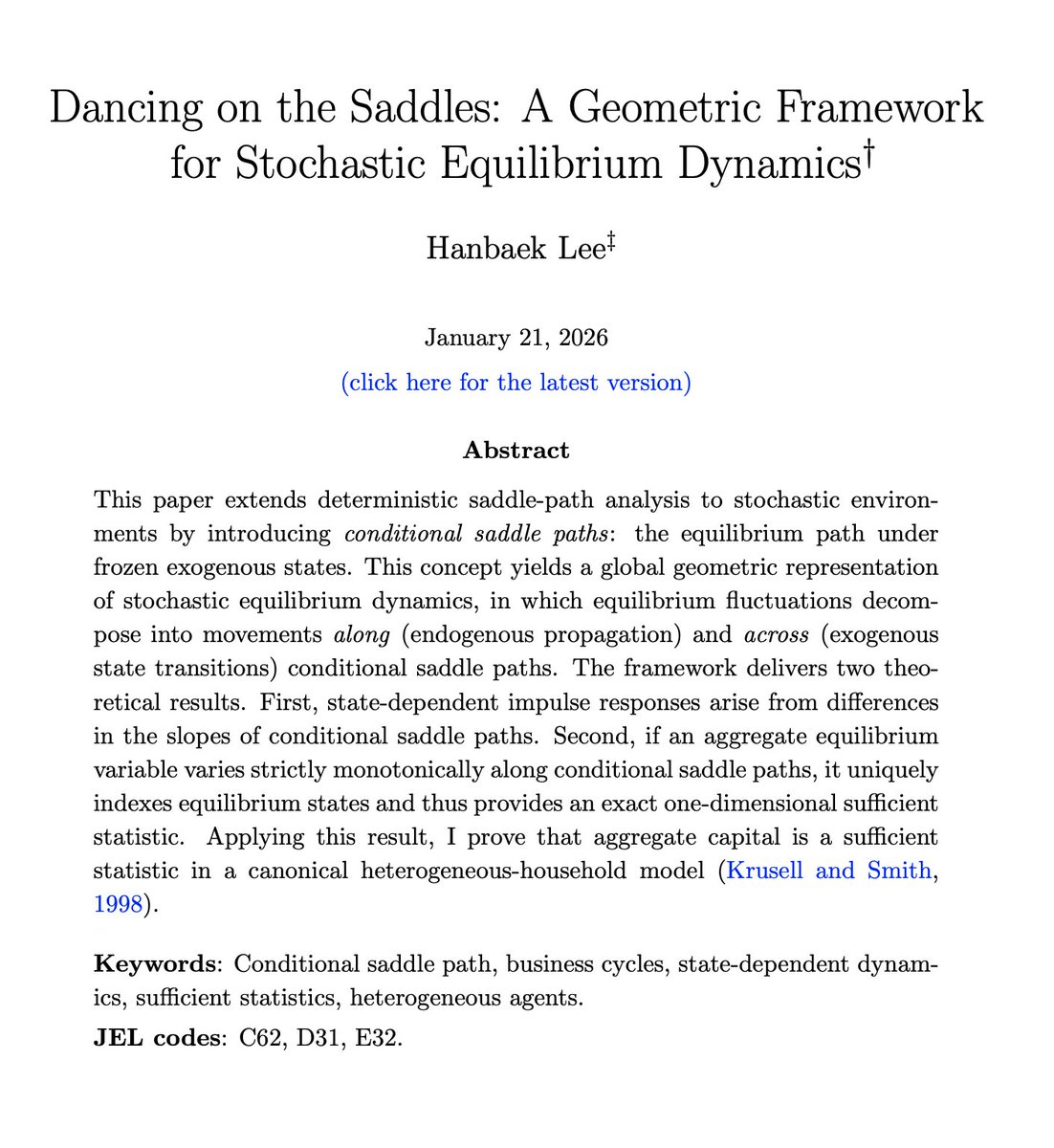
🚨 New working paper: 🕺 Dancing on the Saddles 1/ Solow and Ramsey-Cass-Koopmans gave us phase diagrams to visualize growth dynamics. But we lack a systematic counterpart for stochastic environments. I extend saddle-path analysis by introducing "conditional saddle paths."
Hanbaek Lee tweet media
English
9
34
198
19.5K
Alessandro Peri retweetledi
Jesús Fernández-Villaverde
Jesús Fernández-Villaverde@JesusFerna7026·
🚨 I’m extremely happy to announce that the new Master of Applied Economics and Data Science (MEDS) at @penneconomics is now accepting applicants for entry in August 2026: 🔗 lps.upenn.edu/degree-program… MEDS is a program that Frank Schorfheide (as chair) and I (as DGS) helped spearhead, but reaching this exciting stage has been possible thanks to the dedication of the whole department and @Penn’s administration. I would like to highlight in particular the two MEDS directors: Michael Lipsitz and Frank Diebold. It’s hard to imagine two better people to lead a program designed to give ambitious students cutting-edge skills at the intersection of modern economics and data science. 👉 If that sounds like you, check out the MEDS webpage!
English
2
34
175
23.4K
Alessandro Peri retweetledi
José-Elías Gallegos
José-Elías Gallegos@JoseEGaIIegos·
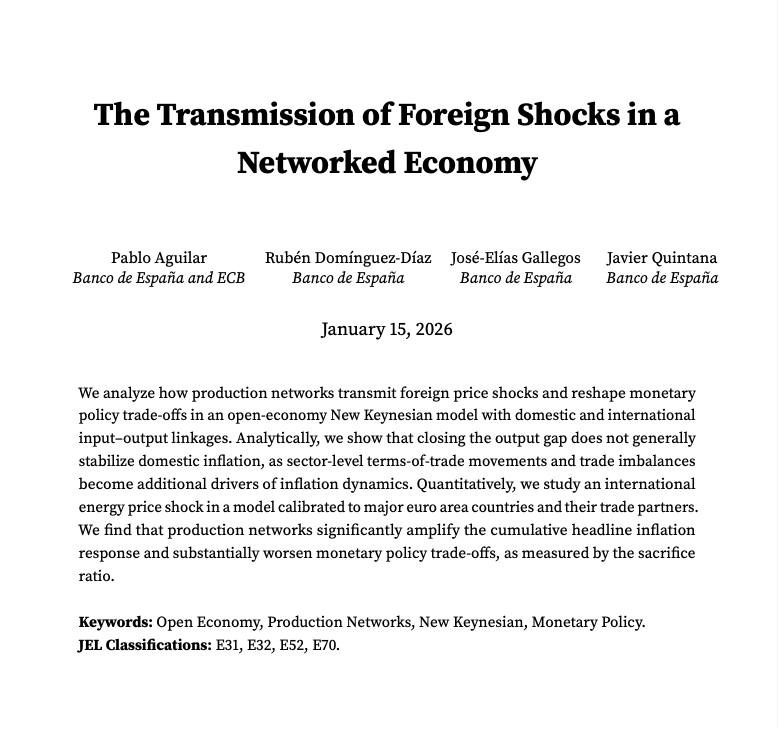
🚨 New WP alert‼️ 1/6 Our new paper introduces a multi-country, multi-sector NK model with domestic & international input-output linkages. It extends standard open-economy models (e.g. Gali & Monacelli 2005) by incorporating production networks into foreign shock transmission.
José-Elías Gallegos tweet media
English
2
16
70
5.1K
Alessandro Peri retweetledi
Cristiano Cantore
Cristiano Cantore@c_cantore·
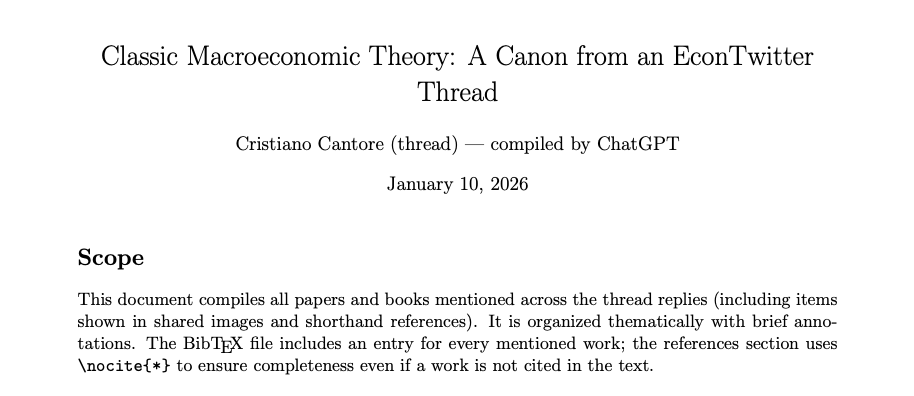
Given the success of the thread, and as promised to some in the replies, I gave ChatGpT all the suggestions and let it compile a document which you can download here drive.google.com/file/d/1ivqa7t… Thanks to everyone who contributed! caution: I haven't touched it
Cristiano Cantore tweet media
Cristiano Cantore@c_cantore

📣 Call for classic macro papers! What are the *macro theory* papers that every PhD student should have read—but often hasn’t? #EconTwitter 🧵👇 1/

English
0
22
180
18.2K
Alessandro Peri retweetledi
Yucheng Yang
Yucheng Yang@YuchengYang1993·
It's been an immersive pleasure to work on this with the great @ben_moll, Chiyuan & Andreas! In short, we propose 𝐒𝐭𝐫𝐮𝐜𝐭𝐮𝐫𝐚𝐥 𝐑𝐋 to sidestep the curse of dimensionality of heterogeneous agent macro, which enables fast global solutions to models we struggled with!
Ben Moll@ben_moll

New paper: benjaminmoll.com/SRL/

English
4
29
228
37.5K
Fabrizio Leone
Fabrizio Leone@fabrizioleone93·
I am extremely excited to join the @cepr_org International Trade & Regional Economics programme as a Research Affiliate! Excited to connect, collaborate, and contribute to this amazing network!
English
2
0
24
2.7K
Alessandro Peri retweetledi
CU Boulder Econ
CU Boulder Econ@cu_boulder_econ·
Assistant Professor Macroeconomics The Department of Economics invites applications for a tenure-track assistant professor position in macroeconomics to begin August 2026. The initial application deadline is November 20, 2025. ​ jobs.colorado.edu/jobs/JobDetail…
English

0
1
4
11.1K