Sabitlenmiş Tweet
Alea Research
20.4K posts

Alea Research
@AleaResearch
Objective analysis for sophisticated capital allocators. Helping protocols with strategic positioning. https://t.co/DFYzbB4bZX
Katılım Ağustos 2022
1.7K Takip Edilen23.3K Takipçiler

🎵Spotify - open.spotify.com/episode/2UpukT…
🍎Apple - podcasts.apple.com/us/podcast/onc…
📽️YouTube - youtu.be/fAUvXEM9ni0?si…

YouTube
English

The future of US crypto regulation is being written right now.
@alenka_on_x and @kaisakaisa_ sat down with one of the people helping shape it – @AdrianWall8395, Head of US Policy at @trondao and Managing Director at @DSAForg.
Inside:
🔹 The real chances of CLARITY Act passing this year.
🔹 What GENIUS Act changed for stablecoins.
🔹 Why has stablecoin yield become such a contentious issue.
🔹 What banks are still worried about.
🔹 TRON’s role in shaping regulation.
New episode of Onchain, Honestly! 👇
English
Alea Research retweetledi

High speed, low cost, scalability – that’s what every new general-purpose blockchain has been pitching since 2018.
@Aptos has those too: unique scalable infra, architecture customisation through Move, and ultra-low fees.
But these arguments alone no longer work. They’ve become commodities.
So how can L1s and L2s still compete?
Hear Ash @ASHAWONN, Senior Vice President at Aptos Foundation, explain their strategy.👇
Focus first. Build for the use cases that actually make sense on-chain, supported by differentiated technology and a strong commitment to core decentralisation values.
English

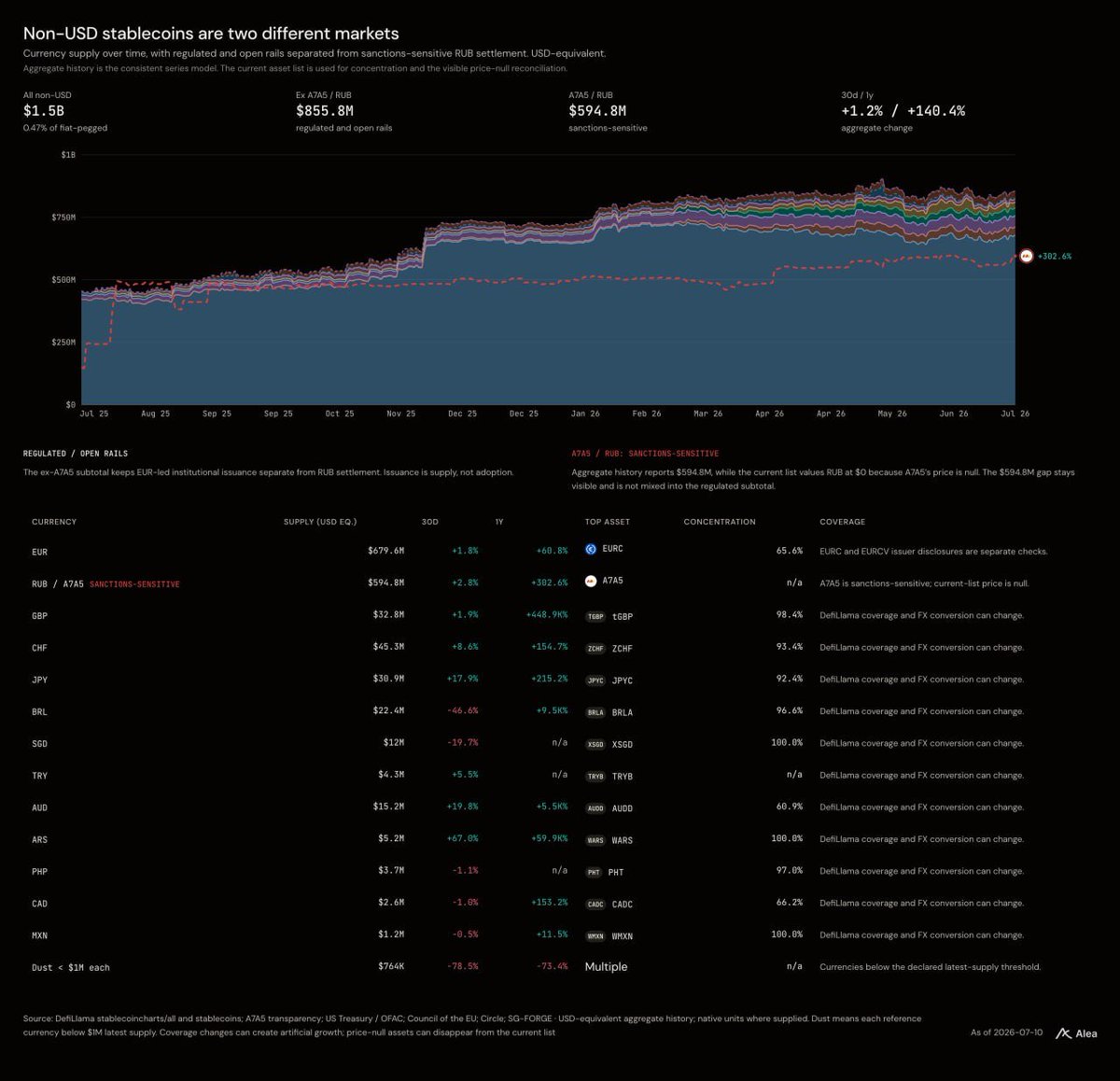
Non-USD stablecoins total about $1.5B, only 0.47% of fiat-pegged supply. According to the data, there's a mix of two markets.
A7A5/RUB accounts for ~$595M. It is a sanctions-sensitive ruble settlement rail, not comparable with regulated euro issuance. Excluding it leaves roughly $856M across regulated or open rails.
Euro assets dominate that pool. EURC holds ~54% of non-USD market share and EURCV another ~15%. Most other fiat pegs remain small and concentrated around one issuer or venue.
Supply alone overstates the usable market. A stablecoin can add to outstanding supply while offering weak redemptions, thin secondary liquidity, stale pricing, or limited venue access.

English

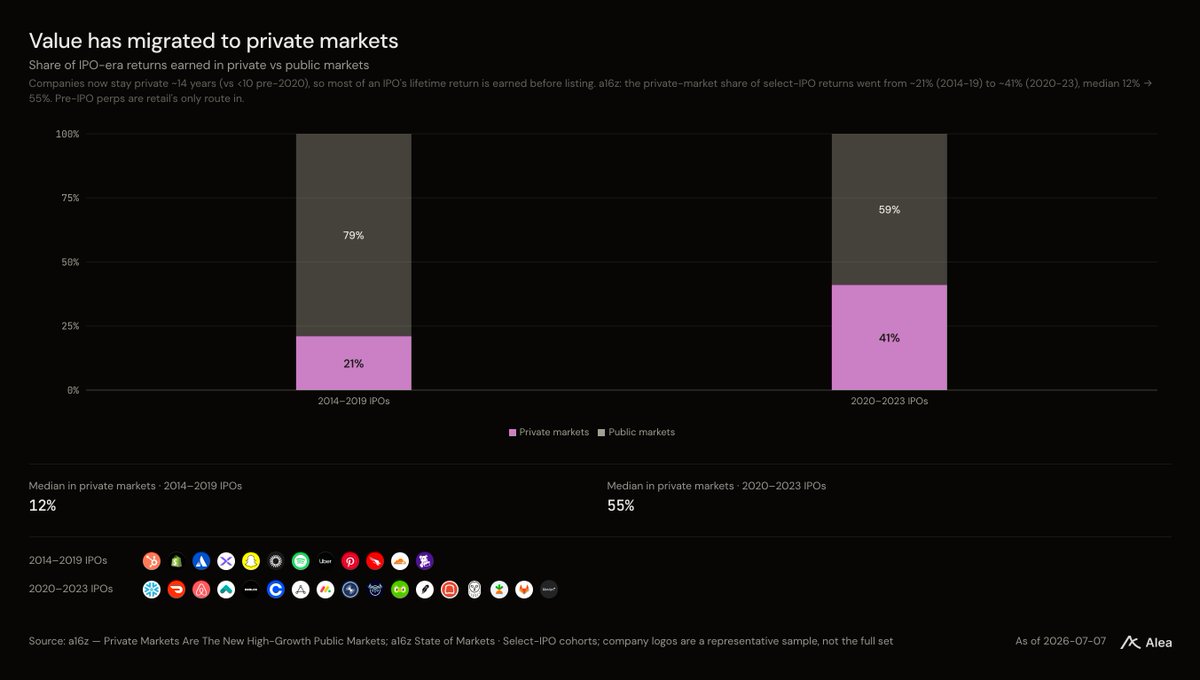
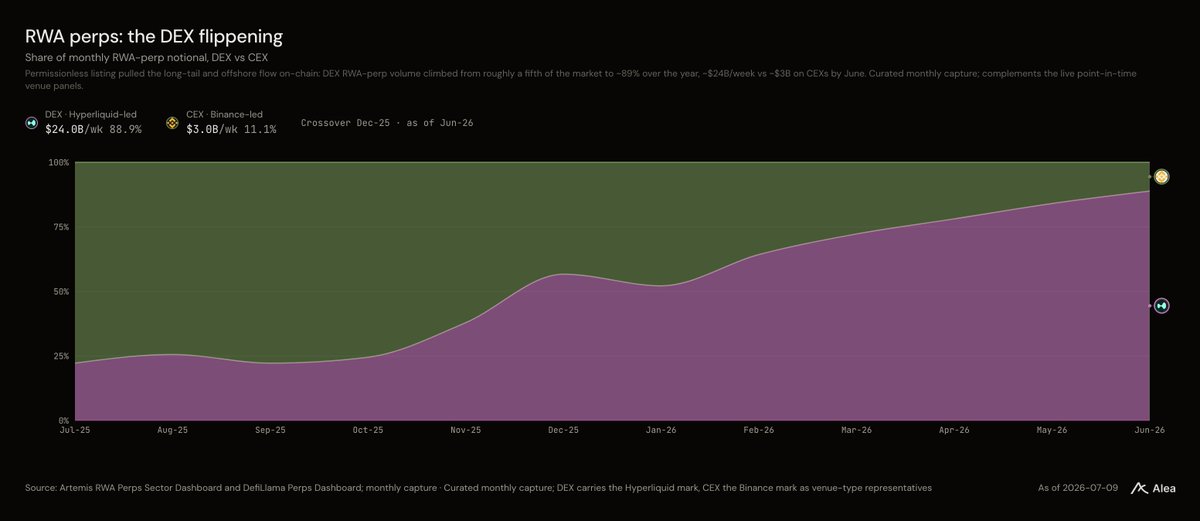
The IPO isn’t the beginning anymore. It’s the exit.
For recent cohorts, private markets captured ~41% of IPO-era returns vs ~21% before. Median private capture jumped from 12% to 55%.
Companies stay private longer. The value accrues earlier. Retail gets in later.
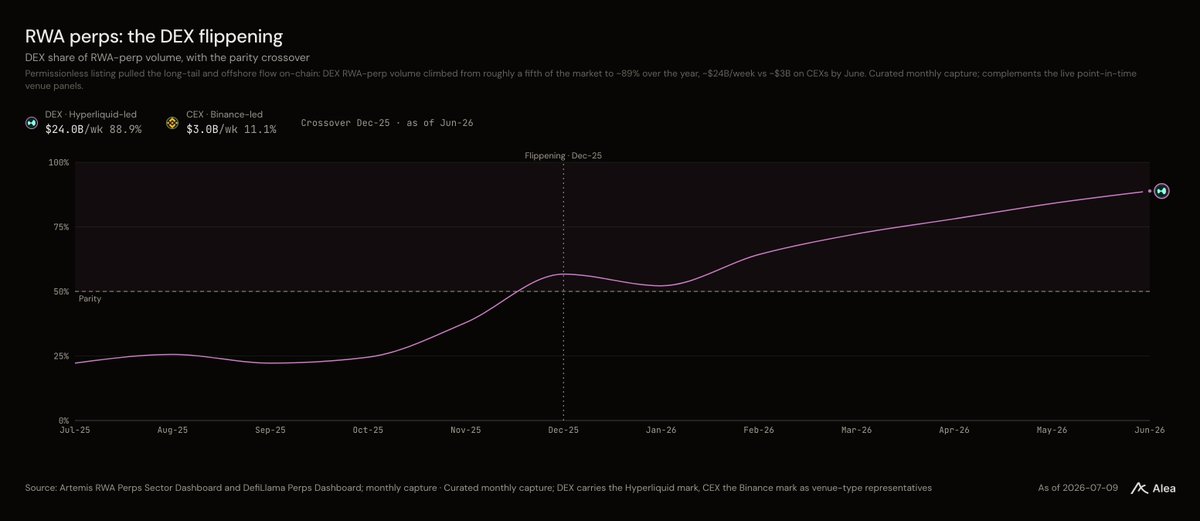
That’s the case for pre-IPO perps.


English
Alea Research retweetledi

Alea Research@AleaResearch
Crypto’s utility is narrower than the last cycle suggested. The strategy? Optimise for actual onchain demand, not every possible use case. @kaisakaisa_ and @alenka_on_x welcomed Ashwin Pampati from @Aptos Foundation to Onchain, Honestly! to discuss where crypto has product-market fit, why Aptos is moving beyond the generic L1 playbook, and how that translates into building commercially sustainable blockchain ecosystems. Links to full episode in the comments👇🏻
English

Onchain cash is cheap, but the balance sheet is full.
Stablecoin lending is not starved for deposits.
Across Aave, Morpho, Compound, Spark, Fluid, Euler, and Liquity markets, @DefiLlama shows 157 stablecoin markets with $13.2B supplied and $9.4B borrowed. Weighted utilization is 72%, high enough to matter, but the median supplier earns only 2.20%. The median borrower pays 3.94%.
The dispersion is where the market is talking. Fluid and Morpho sit at the high end of the borrow curve, with median stablecoin borrow APYs of 6.37% and 5.96%. SparkLend, Compound V3, and Aave V3 cluster closer to 3.8% to 3.9%. In the large markets, SparkLend Ethereum USDT is the pressure point: $423M supplied, 96% utilized, and a 7.00% borrow APY. Aave's Ethereum USDT market is larger at $2.35B supplied and 93% utilized, but charges 5.59%.
The DeFi-TradFi basis is the main tell. The median supply rate across the largest stablecoin pools is 2.27%, while FRED's 1-month Treasury bill series prints 3.69%. Depositors are accepting lower cash yield for collateral utility, leverage access, points, liquidity, or protocol-specific exposure.
That changes the relative-value question. Before, stablecoin lenders could earn a premium over T-bills for taking smart-contract, oracle, and liquidation-system risk. Today the median lender is not being paid that broad premium. The opportunity is narrower: find where borrow demand is real, where utilization is near the kink, and where the extra yield is not merely compensation for fragile collateral.
Risk has not disappeared; it has become more concentrated. @TheDefiSphere reports 201,096 lending liquidations all-time, with $3.86B of debt repaid and $4.28B of collateral seized. In the latest 1,000 events, from June 26 to July 9, $6.83M of collateral was seized and the median realized penalty was 4.38%. Morpho accounted for roughly 90% of recent seized value, and the top five collateral assets accounted for 89%.
Lending is not flashing a broad funding squeeze. It is pricing microstructure. The stablecoin cash leg is cheap versus bills, but certain protocols and assets still pay up because utilization, collateral mix, and liquidation tails are local.
What would change the view is a clean move back above bills in the median supply rate while utilization stays high. That would mean DeFi cash is again being paid for liquidity risk, not merely for optionality.


English