
Dr. Alex Sévigny, APR

20K posts

Dr. Alex Sévigny, APR banner
Dr. Alex Sévigny, APR

Dr. Alex Sévigny, APR

@alexsevigny

Assoc. Prof., @McMasterMCM. Editor-in-Chief of @JPComms. Chief Examiner of APR @CPRSNational. PR. Data. AI. Politics. Strategy. Vegan. Progressive Catholic.

Hamilton, Ontario Katılım Haziran 2009
721 Takip Edilen2.7K Takipçiler
Sabitlenmiş Tweet
Dr. Alex Sévigny, APR
Dr. Alex Sévigny, APR@alexsevigny·
I did a 1st vlog post. Friends, colleagues and others have asked me to share ideas, thoughts and insights that I have through my research and teaching work as a professor in the @McMasterMCM or as a consultant with The Tantalus Group. youtube.com/watch?v=1yBWj3…
YouTube video
YouTube
English
0
0
2
170
Dr. Alex Sévigny, APR retweetledi
Yann LeCun
Yann LeCun@ylecun·
I love Geoff. But he understands even less than Dario about the effects of technological revolutions on the labor market. Again, don't listen to AI scientists, as brilliant as they might be, and even less to AI CEOs, as successful as they might be, for questions of labor economics. Listen to reputable economists who have studied these things like @Ph_Aghion , @DAcemogluMIT , @erikbryn , @amcafee , @davidautor , etc.
English
153
219
2.8K
289.6K
Dr. Alex Sévigny, APR retweetledi
Dr. Lemma
Dr. Lemma@DoctorLemma·
A woman transporting rescue cats to their new homes had no choice but to put some in cargo. When the plane landed in Athens, Greece, she watched nervously through the window as luggage came down the ramp. Then she saw a baggage handler pick up each cat carrier slowly, crouch down, look inside, and gently talk to the animals one by one. He didn’t know anyone was watching. His name is Archie Ardales, 32, originally from the Philippines. When asked why he did it, he said the cats were probably scared because it was their first flight. He just wanted to comfort them.
English
1.1K
9.3K
104K
4.1M
Dr. Alex Sévigny, APR
Dr. Alex Sévigny, APR@alexsevigny·
Happy Easter to all of my Orthodox Christian family and friends! Christ is risen!
Dr. Alex Sévigny, APR tweet media
English
10
0
2
66
Dr. Alex Sévigny, APR retweetledi
Andrej Karpathy
Andrej Karpathy@karpathy·
Judging by my tl there is a growing gap in understanding of AI capability. The first issue I think is around recency and tier of use. I think a lot of people tried the free tier of ChatGPT somewhere last year and allowed it to inform their views on AI a little too much. This is a group of reactions laughing at various quirks of the models, hallucinations, etc. Yes I also saw the viral videos of OpenAI's Advanced Voice mode fumbling simple queries like "should I drive or walk to the carwash". The thing is that these free and old/deprecated models don't reflect the capability in the latest round of state of the art agentic models of this year, especially OpenAI Codex and Claude Code. But that brings me to the second issue. Even if people paid $200/month to use the state of the art models, a lot of the capabilities are relatively "peaky" in highly technical areas. Typical queries around search, writing, advice, etc. are *not* the domain that has made the most noticeable and dramatic strides in capability. Partly, this is due to the technical details of reinforcement learning and its use of verifiable rewards. But partly, it's also because these use cases are not sufficiently prioritized by the companies in their hillclimbing because they don't lead to as much $$$ value. The goldmines are elsewhere, and the focus comes along. So that brings me to the second group of people, who *both* 1) pay for and use the state of the art frontier agentic models (OpenAI Codex / Claude Code) and 2) do so professionally in technical domains like programming, math and research. This group of people is subject to the highest amount of "AI Psychosis" because the recent improvements in these domains as of this year have been nothing short of staggering. When you hand a computer terminal to one of these models, you can now watch them melt programming problems that you'd normally expect to take days/weeks of work. It's this second group of people that assigns a much greater gravity to the capabilities, their slope, and various cyber-related repercussions. TLDR the people in these two groups are speaking past each other. It really is simultaneously the case that OpenAI's free and I think slightly orphaned (?) "Advanced Voice Mode" will fumble the dumbest questions in your Instagram's reels and *at the same time*, OpenAI's highest-tier and paid Codex model will go off for 1 hour to coherently restructure an entire code base, or find and exploit vulnerabilities in computer systems. This part really works and has made dramatic strides because 2 properties: 1) these domains offer explicit reward functions that are verifiable meaning they are easily amenable to reinforcement learning training (e.g. unit tests passed yes or no, in contrast to writing, which is much harder to explicitly judge), but also 2) they are a lot more valuable in b2b settings, meaning that the biggest fraction of the team is focused on improving them. So here we are.
staysaasy@staysaasy

The degree to which you are awed by AI is perfectly correlated with how much you use AI to code.

English
1.2K
2.5K
20.6K
4.3M
Dr. Alex Sévigny, APR retweetledi
Andrej Karpathy
Andrej Karpathy@karpathy·
LLM Knowledge Bases Something I'm finding very useful recently: using LLMs to build personal knowledge bases for various topics of research interest. In this way, a large fraction of my recent token throughput is going less into manipulating code, and more into manipulating knowledge (stored as markdown and images). The latest LLMs are quite good at it. So: Data ingest: I index source documents (articles, papers, repos, datasets, images, etc.) into a raw/ directory, then I use an LLM to incrementally "compile" a wiki, which is just a collection of .md files in a directory structure. The wiki includes summaries of all the data in raw/, backlinks, and then it categorizes data into concepts, writes articles for them, and links them all. To convert web articles into .md files I like to use the Obsidian Web Clipper extension, and then I also use a hotkey to download all the related images to local so that my LLM can easily reference them. IDE: I use Obsidian as the IDE "frontend" where I can view the raw data, the the compiled wiki, and the derived visualizations. Important to note that the LLM writes and maintains all of the data of the wiki, I rarely touch it directly. I've played with a few Obsidian plugins to render and view data in other ways (e.g. Marp for slides). Q&A: Where things get interesting is that once your wiki is big enough (e.g. mine on some recent research is ~100 articles and ~400K words), you can ask your LLM agent all kinds of complex questions against the wiki, and it will go off, research the answers, etc. I thought I had to reach for fancy RAG, but the LLM has been pretty good about auto-maintaining index files and brief summaries of all the documents and it reads all the important related data fairly easily at this ~small scale. Output: Instead of getting answers in text/terminal, I like to have it render markdown files for me, or slide shows (Marp format), or matplotlib images, all of which I then view again in Obsidian. You can imagine many other visual output formats depending on the query. Often, I end up "filing" the outputs back into the wiki to enhance it for further queries. So my own explorations and queries always "add up" in the knowledge base. Linting: I've run some LLM "health checks" over the wiki to e.g. find inconsistent data, impute missing data (with web searchers), find interesting connections for new article candidates, etc., to incrementally clean up the wiki and enhance its overall data integrity. The LLMs are quite good at suggesting further questions to ask and look into. Extra tools: I find myself developing additional tools to process the data, e.g. I vibe coded a small and naive search engine over the wiki, which I both use directly (in a web ui), but more often I want to hand it off to an LLM via CLI as a tool for larger queries. Further explorations: As the repo grows, the natural desire is to also think about synthetic data generation + finetuning to have your LLM "know" the data in its weights instead of just context windows. TLDR: raw data from a given number of sources is collected, then compiled by an LLM into a .md wiki, then operated on by various CLIs by the LLM to do Q&A and to incrementally enhance the wiki, and all of it viewable in Obsidian. You rarely ever write or edit the wiki manually, it's the domain of the LLM. I think there is room here for an incredible new product instead of a hacky collection of scripts.
English
2.8K
7K
58.3K
20.9M
Dr. Alex Sévigny, APR retweetledi
Andrej Karpathy
Andrej Karpathy@karpathy·
- Drafted a blog post - Used an LLM to meticulously improve the argument over 4 hours. - Wow, feeling great, it’s so convincing! - Fun idea let’s ask it to argue the opposite. - LLM demolishes the entire argument and convinces me that the opposite is in fact true. - lol The LLMs may elicit an opinion when asked but are extremely competent in arguing almost any direction. This is actually super useful as a tool for forming your own opinions, just make sure to ask different directions and be careful with the sycophancy.
English
1.8K
2.4K
31.4K
3.4M
Dr. Alex Sévigny, APR retweetledi
Josh Kale
Josh Kale@JoshKale·
Andrej Karpathy just dropped a project scoring every job in America on how likely an AI will replace it from 0-10 > Scraped all 342 occupations from the Bureau of Labor > Fed each one to an LLM with a detailed scoring rubric > Built an interactive treemap where rectangle size = number of jobs and color = how exposed that job is to AI The key signal in his scoring: if the work product is fundamentally digital and the job can be done entirely from a home office, exposure is inherently high. The scale: 0-1: Roofers, janitors 4-5: Nurses, retail, physicians 8-9: Software devs, paralegals, data analysts 10: Medical transcriptionists Average across all 342 occupations: 5.3/10. The entire pipeline is open source. BLS scraping, LLM scoring, the visualization. All of it. Much respect for the sensei this is scary and awesome
English
287
880
6.9K
1.2M
Dr. Alex Sévigny, APR retweetledi
Nav Toor
Nav Toor@heynavtoor·
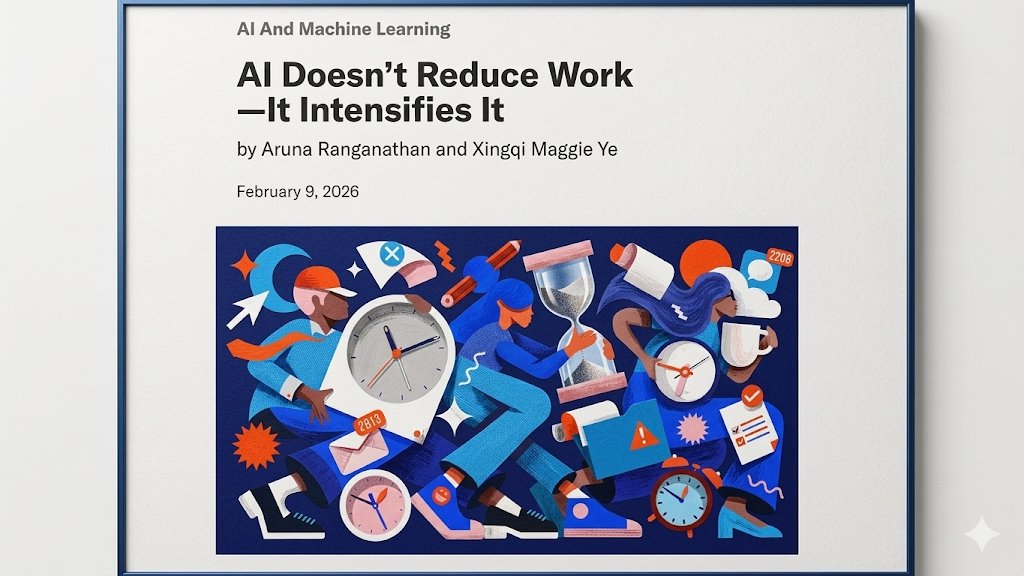
🚨BREAKING: Berkeley researchers spent 8 months inside a tech company watching how employees actually use AI. The promise was simple: AI will save you time. Do less. Work smarter. The opposite happened. Workers didn't use AI to finish early and go home. They used it to take on more. More tasks. More projects. More hours. Nobody asked them to. They did it to themselves. The researchers sat inside the company two days a week for 8 months. They watched 200 employees in real time. They tracked work channels. They conducted 40+ interviews across engineering, product, design, and operations. Here's what they found. AI made everything feel faster, so people filled every gap. They sent prompts during lunch. Before meetings. Late at night. The natural stopping points in the workday disappeared. People ran multiple AI agents in the background while writing code, drafting documents, and sitting in meetings simultaneously. It felt like momentum. It felt productive. But when they stepped back, they described feeling stretched, busier, and completely unable to disconnect. 83% said AI increased their workload. Not decreased. Increased. 62% of associates and 61% of entry-level workers reported burnout. Only 38% of executives felt the same strain. The people doing the actual work absorbed the damage while leadership celebrated the productivity numbers. Then came the trap nobody saw coming. When one person uses AI to take on extra work, everyone else feels like they're falling behind. So the whole team speeds up. Nobody formally raises expectations. But the new pace quietly becomes the default. What AI made possible became what was expected. The researchers gave it a name: workload creep. It looks like productivity at first. Then it becomes the new baseline. Then it becomes burnout. AI was supposed to give you your time back. Instead it's eating more of it. And the worst part? You're doing it to yourself. Voluntarily.
Nav Toor tweet media
English
316
2.2K
7K
1.1M
Dr. Alex Sévigny, APR retweetledi
Mark Carney
Mark Carney@MarkJCarney·
I join Christians around the world in celebrating Ash Wednesday, and the start of Lent. As we enter this season of reflection and repentance, let us renew our commitment to the common good, and the dignity of all.
English
807
458
4.4K
161.5K
Dr. Alex Sévigny, APR retweetledi
Tansu Yegen
Tansu Yegen@TansuYegen·
They are now 3D printing a 12 meter boat in one piece with robots, no mold and no extra cost, so what once needed a full shipyard can now be done with a giant printer 🚢
English
691
3.7K
33.9K
3.2M
Dr. Alex Sévigny, APR retweetledi
Christopher Hale
Christopher Hale@ChristopherHale·
Pope Leo flanked by two altar girls for the first time of his pontificate.
Christopher Hale tweet media
English
324
1.9K
18.5K
641.2K
Dr. Alex Sévigny, APR retweetledi
The Associated Press
Larry the cat, the Chief Mouser to the Cabinet Office, is celebrating 15 years as the British government's official rodent-catcher. The unofficial first feline has served under six prime ministers.
English
280
3.5K
24.2K
1.4M
Dr. Alex Sévigny, APR
Dr. Alex Sévigny, APR@alexsevigny·
Contact me, if you would like to work with me as a strategic management consultant, executive trainer or keynote speaker.
English
0
0
0
14
Dr. Alex Sévigny, APR
Dr. Alex Sévigny, APR@alexsevigny·
If you would like to learn with me, consider applying to join the McMaster University Master of Communications Management program (@mcmastermcm), where I teach and supervise research.
English
1
0
1
19
Dr. Alex Sévigny, APR
Dr. Alex Sévigny, APR@alexsevigny·
I was thrilled to learn that I have been inducted into the College of Fellows of the Canadian Public Relations Society. This recognition is very meaningful to me. Their belief in the quality of my work and contributions to the profession are deeply meaningful to me.
Dr. Alex Sévigny, APR tweet media
English
1
1
5
166