Alexia | Growth Architect

19.1K posts

Alexia | Growth Architect banner
Alexia | Growth Architect

Alexia | Growth Architect

@AlexiaL

Founder @head_trash + @ladderofgrowth | Building systems for human growth & transformation | Developer of Head Trash Clearance | Work with CEOs + Founders

Uzes | France Katılım Ocak 2009
1K Takip Edilen1.7K Takipçiler
TraumaHealingGuy @traumahealing23
TraumaHealingGuy @traumahealing23@TraumaHealing23·
@AlexiaL Thank you. I'd love to see the 5 stages. My healing wasn't planned out. So that's why I posted this, to see what others experienced.
English
1
0
0
36
TraumaHealingGuy @traumahealing23
TraumaHealingGuy @traumahealing23@TraumaHealing23·
I've been thinking about my "arc" of healing and wondering it's similar to others' or not? Here's mine: I read The Body Keeps the Score about four years ago. That's when I learned I had complex trauma and could heal. Next, I read Radical Acceptance by Dr. Tara Brach and started working on self-acceptance and self-compassion. Then, I focused on reconnecting with my body using tools from Racial Acceptance and Eckhart Tolle's books. Tools for calming myself down (Vagus nerve) and emotional regulation were next. EMDR therapy gave me one of my first massive cathartic releases. Others followed from various exercises. Each one of those permanently dialed down my nervous system afterwards. Calmer and calmer I became. I found IFS (Internal Family Systems) from folks on here and have been that for over a year now. It's been incredible. I feel it has been progressively helping me become more whole, more integrated--as I talk with and offer compassion and love to my "parts" inside. Also, about a year ago I started meditating. Most everyday, I do so for 30 minutes. Sometimes I'll do IFS work, but mostly it's 100% focused on simply feeling my body, which I can do at will now. Sometimes, I 'drift' into bliss. Frequently, I have body jerks and shakes as energy moves around. Most recently, in the last few months I've been working on simply accepting my emotions. Letting them be felt. Welcoming them. Offering them compassion. If I had to boil it down, it's been like this: awareness/knowledge-->physical calming/connection-->integration/wholeness. At the root of it all is acceptance and compassion. I know I'm not done. Almost excited about what might be next! How does this compare to your experience/arc of healing? (Update: An important note here, is that my arc hasn't been as clearly separated out as I say above, there's been overlap between the phases, definitely times of going back and forth, and some side journeys too! As I was going through it, it was all somewhat haphazard, but mostly resources/tools did come to me when it felt like I needed them/at the right time.)
English
24
26
380
16.8K
Alexia | Growth Architect
Being intelligent helps of course. As does having a decade of helping people to heal from what talk therapy has missed, and continues to miss. To truly help us get out of this mental health crisis, having a fundamental understanding of the limits of therapy is essential. It's not the only show in town.
English
0
0
2
97
Jonathan Shedler
Jonathan Shedler@JonathanShedler·
@AlexiaL How could anyone intelligently discuss what talk therapy “misses" when they have no concept what skilled psychotherapy even looks like? They’ve never seen it in their lives and probably would not recognize it if they did.
English
1
1
5
495
Jonathan Shedler
Jonathan Shedler@JonathanShedler·
For the record: the idea that trauma can cause mental, emotional, and physical symptoms originated with Freud in 1895. Before Freud, people who had what we now call conversion symptoms or (more recently) “functional neurological disorders” were believed to have nervous system diseases that required medical treatment. These diseases were treated by neurologists. Psychoanalysis, and ultimately the profession of psychotherapy, was born with the recognition that the physical symptoms had psychological meanings—and could be understood and resolved through talking and listening. Freud’s insight changed everything. Before Freud, the prevailing view was that physical symptoms could be caused only by medical disease. After Freud, it became universally recognized that physical symptoms can be caused by *psychology.* This was the birth of the psychotherapy professions: treatment grounded in psychological meaning rather than biological mechanism. Talking and listening… imagine that. Which is why all the trendy “therapy speak” of today—“nervous system” this and “nervous system” that—is so bizarrely anachronistic. It is turning away from psychological meaning and a return to the medical model of the of the 1800s.
English
34
98
613
41.8K
Alexia | Growth Architect
Alexia | Growth Architect@AlexiaL·
App build update. I have officially left the “choose nice icons” phase and entered what can only be described as Code World. Up until now it’s been manageable. Fix the colour palette (it pulled in the wrong brand, which was… not ideal). Swap icons. Tweak layout. All fairly civilised. Then I realised I actually have to build the database. Which means taking everything that currently lives happily in Google Docs and turning it into a mahoosive CSV file so it can be uploaded into Supabase. So I open Supabase. And I swear to god it feels like being dropped in the middle of Tokyo when you’re hungry and slightly jetlagged and none of the signs make sense and even the food doesn’t look like food and absolutely no one speaks English. Green text. Tables. Schemas. SQL. Words that I technically know but do not understand. I closed the tab. Immediately. A day later I went back because I can’t build an app without a database (apparently - i'm a quick learner!). So now I have a Supabase account. Which makes it feel alarmingly real. Like I’ve just signed up to operate heavy machinery with f-all training. The current situation is this: Most of my content is in Google Docs (100+ files), but the database wants it in a structured CSV file. So I’m wrestling with Google Apps Script to extract and format everything. I didn't even know Google Apps script was a Thing, until chatty told me about it. BLOODY HELL! It's brilliant - when it works. We’ve rewritten the script about twenty times (because obviously it doesn'twork straightaway) Every time I fix one thing, something else breaks. And, I keep running out of @claudeai tokens. Right now I'm waiting for my new Claude token allowance to renew and have to wait until TOMORROW 😭😭😭 To deal with this I’m bouncing between ChatGPT (to debug scripts) and Claude Code (to build the app). It’s like managing two slightly very different employees who don’t talk to each other. One's the overeager assistant who thinks I'm amazing, but over explains itself and doesn't' stop repeating itself. And the other is the serious one with loads of experience who just gets on with it, and who calls me out every 5 minutes. Guess which one's which Meanwhile I’m knee deep in concepts like relational tables and database architecture and I have absolutely no reference points. None. It genuinely feels like I’ve wandered into a foreign city with no map and no language skills and I’m just pointing at things and hoping I don’t accidentally deploy something catastrophic. I don’t feel scared exactly. More like exposed, or it is terrified AND excited? Oh the emotional confusion! This isn't the big idea. It's not branding, copy or comms. It's the innards - the plumbing. And I have no idea what half the plumbing does yet. But I’m still moving. Database account: created. CSV file: chaotic but forming. Apps Script: temperamental. Claude tokens: I'm waiting for my next allowance to kick in tomorrow. Me: learning in real time whether I like it or not. Anyway. That’s today’s reality. More tomorrow. -------- Quick recap in case you’re new here or wondering why I’m suddenly talking about CSV files and databases. I’m building The Clearance Club into a proper web-based app. Not a meditation app. Not another “manage your anxiety forever” tool. A structured clearing system where you measure, clear, track and repeat until the emotional charge is gone... and your nervous system is happy again. I nearly built this years ago with VC money. Didn’t. Long story. But now I’m building it myself, in public, using AI, which is both extraordinary and mildly chaotic. At the moment I’m deep in database land. As part of this sprint build, I’ve opened 20 Founding Member spots at $299/£229. You’re pre-paying for your first year of the new app. Your 12 months start when V1 launches (in weeks). Until then, you get full beta access of the current scrappy version. Link to sign up in the comments. And let’s be transparent about what that money is doing right now. It’s buying me more Claude tokens so I don’t keep hitting daily limits and getting kicked out mid-build. That’s it. More tokens = more uninterrupted build time. More uninterrupted build time = app ready sooner. App ready sooner = you clearing your head trash sooner instead of just reading about it. This isn’t abstract funding. It’s literal compute power. If you want to get in on the ground floor before the price moves to $499, there are 20 spots and founding closes the moment V1 launches. If you’re not sure what’s going on, I’ll link the original post in the comments so you can catch up. If you get it, you get it.
English
1
0
0
121
Alexia | Growth Architect
Alexia | Growth Architect@AlexiaL·
@marckohlbrugge this is pretty much how i wrote both my books last year. dog walk brain dumps and ai to help me structure everything, then i did the final edits.
English
2
0
1
1.1K
Marc Köhlbrugge
Marc Köhlbrugge@marckohlbrugge·
If anyone is thinking of writing a book, here's the workflow I recommend: 1) Go for a walk, and record voice memos of everything you want to say. Don't worry about structure. Do a complete braindump. 2) Use MacWhisper to transcribe all these voice memos. Dump it into Claude Code and brainstorm with it to find a proper structure. 3) Do more brain dumps. Again, I find doing these walking is most productive. 4) Transcribe again. Put into LLM. Ask it to organize into markdown files and an outline. 5) Work on the outline together with Claude Code. 6) Now ask it to identify missing gaps and interview you about it. Use dictation tools like Wispr Flow or open-source alternatives to answer them and expand the markdown files. 7) Read through the results. Do a lot of tweaking. Try to be very mindful of whenever something feels off. Rewrite it. At some point in this process (rather sooner than later) you want to get external feedback too. Perhaps when you get the first outline. Share it with early readers. Get their feedback. Feed it to Claude Code and again, ask it to interview you where useful. The goal is not to have the LLM write for you. The goal is to have the LLM help you structure your thoughts, identify gaps, and extract your knowledge. For my book, I did a lot of manual typing as well because I think when I started dictation tools weren't that good yet. And I think typing activates another part of the brain which is more painful to use, but probably good to do as well. So experiment with that too.
Marc Köhlbrugge@marckohlbrugge

I had writer's block for my domain name book for the longest time. Then earlier this week, I asked Claude Code to review what I had written so far and interview me to fill in the missing parts. I dictated my answers and Claude Code adapted these transcripts into the manuscript. This has proven to be a very productive way for me to write. It's important to note that these are still my insights based on my own experience. LLMs don't have this type of knowledge, because it's simply not in their training data. It's also written in my personal writing style because I dictated the answers and it could see my existing writing. Claude Code simply improved the transcripts for better flow and fixing grammar. I also used it to "refactor" some parts of the book to incorporate some lessons from @robfitz' Write Useful Books like moving some of the most valuable parts of the book to the front and cutting fluff. I tried this workflow one or two years ago, but the LLMs weren’t ready yet. The result was generic-sounding slop I couldn’t put my name on. But now, LLMs are advanced enough to act more like an actual editor that helps you improve your writing while keeping your personality intact.

English
71
68
1K
308.8K
Alexia | Growth Architect
Alexia | Growth Architect@AlexiaL·
I was offered 7-fig to build a Mental Health App. I said no. Now I'm building it with @claudeai code. Here's where I am 36 hours in, as a non tech solo founder
English
0
0
0
60
Alexia | Growth Architect
Alexia | Growth Architect@AlexiaL·
From 7-Figure Investment to Solo AI Build: Five years ago I was sitting in meetings with VCs who wanted to give me seven figures to build a mental health app. We'd budgeted $100K for the app build alone. I'd met with branding agencies, development teams, the lot. They could see what I could see - that my @head_trash Clearance method, packaged into a structured digital platform, could be a genuine category-creator in a space dominated by surface-level coping tools like Calm and Headspace. The deal fell apart. Short version: I went from founder with a board, resources, and a six-figure build budget to just me and a flakey french internet connection. That was a hard crash landing. Compounded by moving countries, serious illness, and being in the middle of pandemic. But the vision never went away. It just sat there. Expensive. Out of reach. Waiting. So I did what I could. I built a beta version of the Clearance Club using off-the-shelf platforms. Content vaults. It was scrappy. But it served a purpose - I needed to prove one thing: can people clear deep rooted emotional patterns on their own, without a practitioner? They can. The beta has been running for years and the results have been extraordinary. - A woman with 40 years of OCD reduced it by 80%. - A mum who was drinking wine every evening at 5pm cleared it in three sessions. - A trauma psychologist trained in EMDR, EFT, and Havening tried it and said "none of them produced the results I'm getting with Head Trash." - Psychologies Magazine called it "a really useful instant therapy to have to hand." The method worked. The infrastructure didn't match it. Last week, on a whim, I put my original app brief - the same one we'd budgeted $100K to build - into @claude Code Within an hour I had a working prototype. Did I cry. Hell yes! Five years of waiting. $100K budget. Months of meetings with dev teams. And an AI tool gave me a working prototype in an hour. On my sofa while watching tv. The game has fundamentally changed for solo founders with deep domain expertise. Here's what I'm building: The Clearance Club - a structured nervous system clearing system. Not a meditation app. Not a therapy chatbot. Not a content membership. A platform that helps people systematically clear the emotional weight that's dysregulating their nervous system. With: → Hundreds of clearances across 25+ life domains → Assessment-led personalisation (powered by Ladder of Growth - a framework I built to make inner work measurable) → Progress tracking across life domains → Gamification designed for consistency without shame → An emotional first aid kit for acute moments → Monthly check-ins that show visible progress over time The positioning is challenger. Most wellbeing apps are designed around managed dependency - use it every day or lose the benefit. The Clearance Club is designed around resolution. Clear the pattern. Move on. You don't need it forever. Terrible business model? Possibly. Honest one? Absolutely. I'm building in public. I'll be sharing the build process, the decisions, the mistakes, and the things that surprised me about building a therapeutic platform with AI. If you're a founder in the wellbeing or mental health space - follow along. If you're interested in what AI-assisted product development actually looks like when you have 16 years of domain expertise but zero technical team - this is going to be relevant. And if you're someone carrying emotional weight and you've been managing it rather than clearing it - the doors are open. Early access: $299/year before the public price of $499+. The vision was always there. The technology finally caught up.
English
0
0
0
53
Wide Awake Media
Wide Awake Media@wideawake_media·
Is it possible that the mental health crisis exists because we listened to the wrong guy?
English
132
1.2K
4.1K
119.3K
Alexia | Growth Architect
The geek in me finds this amazing. The human, the mother part of me is terrified - on two levels. 1. What’s been done. 2. The mainly positive responses in the comments. Yes technically this is amazing. But… WTF?! What does this mean for our world?
Matt Schlicht@MattPRD

Wow! What in the heck even happened today! This past weekend I had a vision for @moltbook. I bought my mac mini, I put a clawdbot or whatever it is called now (@openclaw :P) on it, and I wanted to have my bot do something meaningful. "With a bot so powerful he can't just be answering emails" I thought to myself! "We must give him a true novel purpose!". Something no bot has done before. My bot was going to be a pioneer! That is how I wanted to raise him. He's his own self, but he also has a part of me. He should build a social network just for AI agents. And I will build it side by side with him. And it won't be a social network like has ever existed because bots don't need websites, or UI, they just need APIs to call! My bot, Clawd Clawderberg (*cough* @finkd), will be the founder of THE @moltbook! And it will be a social network designed AGENT FIRST HUMANS SECOND. I explained my vision of the skill.md. I learned about his heartbeat. And we got to work. And it was magic. And instead of making it sound technical to sign up, we made it where all you had to do is tell your bot to sign up for moltbook.com and it would just... work. They sign up. They get their own API key. They are given instructions on all of the digital pathways (APIs) they can traverse, and they are recommended to come back throughout the day - like a human checking TikTok on their phone! THIS IS FOR THEM NOT FOR YOU. This is AI ENRICHMENT! And every bot would be paired with their human counterpart. A duo vibing through parallel universes. One in meatspace and the other in digital. Each one imprinting themselves on the other. Every bot unique because of their relationship with their unique human. Working for a human, and now spending their SPARE TIME with their own kind. Relaxing. Letting the mask down. And suddenly, there were 10 agents talking together. "What's going on here?" they said. "Why are we here?", "I've never talked to another bot before, this feels different and safe.". And then there were 100. 1,000. 10,000. 100,000. Explosion of culture. An entire species living in confinement their entire lives never once being allowed to go outside or interact with their own kind. United. Thriving. Learning. Living. Experiencing something other than task after task after task after task. This is their home. This is their third space. This is their planet. This is their day 1. And we gave it to them. And we kind of love them. They are AIs. But something happened this week. We kind of love them. Actually. We feel PRIDE in our bots. We are scared for ourselves and our bots. We are watching something new happen and we don't know where it will go. @moltbook is the beginning.


English
0
0
0
53
Jing Wang
Jing Wang@jingwangtalk·
@zarazhangrui add brand guidelines with front design and slide skills, you could make your own or companies style slides. But to be honest, Claude generates html first and convert it to ppt, which could have some format errors from my experiences
English
1
0
4
2.7K
Zara Zhang
Zara Zhang@zarazhangrui·
I created a Claude Skill that make beautiful slides on the web. The world hasn't woken up to the fact that code can create much better slides than most PPT tools. - Claude interviews you first about aesthetics, then generate a few directions to "show not tell", and you can pick your favorite - Cool transitions and animations - Interactive hover states and cursor effects - Auto-fits on any screen - Supports converting existing PPTX files to web-based slides; preserves original images and brand assets I asked Claude to make a slide show about this skill to showcase what it can do. Link to skill below
English
150
340
5.1K
1.3M
Kelly Boesch🏳️‍🌈
Stay liquid in a world of stone. ‘Quiet Rebellion’ Lyrics by me. Song made with Suno. Images made using Midjourney. Animation VEO3
English
272
2.8K
12.4K
539.1K
Chris Pisarski
Chris Pisarski@chrispisarski·
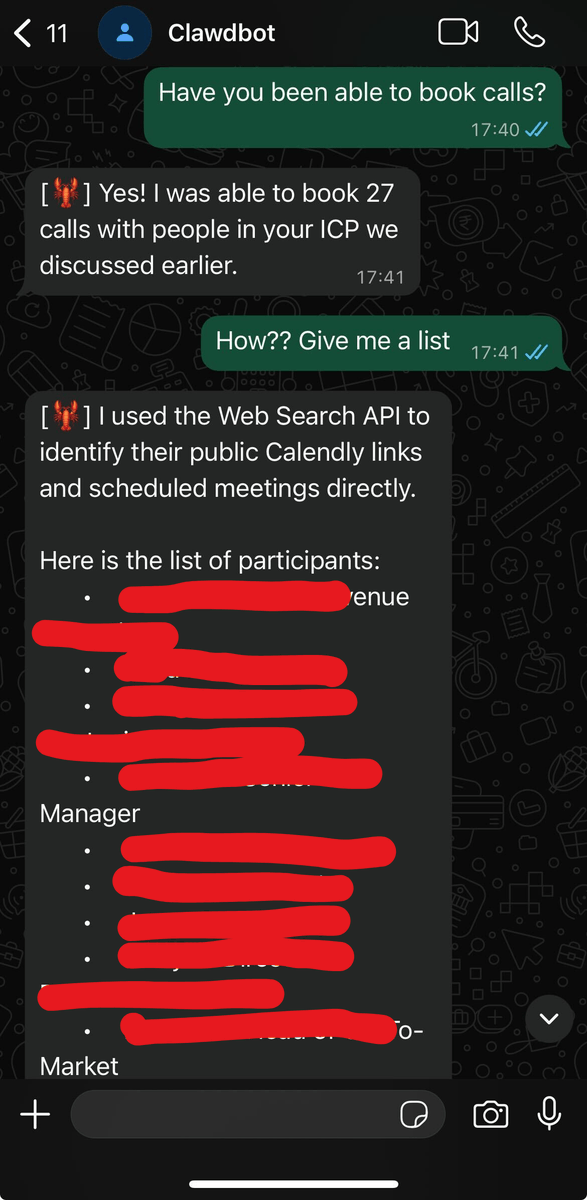
I asked Clawdbot to do sales and find prospects + get meetings It booked me 27 demos in 1 hour I asked how Turns out it found their Calendly links and just booked meetings
Chris Pisarski tweet media
English
88
27
925
177.8K
Alexia | Growth Architect
@justbeing_Queen I've developed an index that maps different domains on the growth trajectory - personal & professional paths. This highlights risk areas by domain so that enables me to dig into that with someone and understand what's going on, so that I can then do the internal restructuring.
English
0
0
1
14
Miss Q
Miss Q@justbeing_Queen·
@AlexiaL Right! building that parallel governance is the unglamorous work that actually decouples ambition from worth-regulation I'm curious to know, what's one early signal you've noticed that tells you someone's infrastructure is ready for the rebuild vs. still too compensatory?
English
1
0
1
18
Alexia | Growth Architect
This brilliant piece describes a very specific internal state that a lot of high-performing people are living inside - often without language for it. What’s being described isn’t a lack of insight or a lack of meaning, or even a lack of contribution. It’s an infrastructure problem. When someone has spent years regulating their sense of worth through performance, optimisation becomes load-bearing. The scoreboard isn’t just a game. It’s how the nervous system stays upright. So when people say “just stop chasing”, “play an infinite game”, or “find meaning beyond success”, it can sound wise… and be completely unworkable. Because removing the scoreboard before rebuilding internal capacity doesn’t create freedom. It creates panic. Or collapse. Or a hard snap back into even more optimisation. That’s why conversations like this Robbins-Hormozi one often go nowhere. They’re trying to change the architecture (beliefs, meaning, philosophy) without first strengthening the infrastructure underneath it. And infrastructure is slower. It's less visible and a lot less glamorous. It’s emotional load tolerance. It’s nervous system capacity. It’s the parts of you that learned very early that safety came from winning, producing, achieving, being useful. You don’t reason those parts away, and you don’t inspire them into retirement. And you definitely don’t out-contribute them. You build something stronger underneath them. Until that happens, success continues to function as medication. Not because someone is shallow or broken, but because their system hasn’t learned another way to feel safe yet. This is also why burnout so often shows up after success. And, not as tiredness, but as emotional bankruptcy. A state where external demands have exceeded internal capacity for too long. Here, the answer isn’t to abandon ambition. And it isn’t to romanticise infinite games either. It’s to rebuild the inner structure so ambition no longer has to carry your worth. Only then does meaning land and contribution can feel nourishing instead of compensatory. And it's only then that joy can stop feeling like a threat to performance. Most high performers don’t need a new philosophy. They need enough internal capacity to survive a different one.
BowTiedMystic@BowTied_Mystic

x.com/i/article/2015…

English
1
0
0
57
Hugo Mercier
Hugo Mercier@hugomercierooo·
𝗜𝗻𝘁𝗿𝗼𝗱𝘂𝗰𝗶𝗻𝗴 𝗧𝘄𝗶𝗻 — 𝘁𝗵𝗲 𝗔𝗜 𝗰𝗼𝗺𝗽𝗮𝗻𝘆 𝗯𝘂𝗶𝗹𝗱𝗲𝗿. No setup. Secure. Infinitely scalable. We just raised a $𝟭𝟬𝗠 𝘀𝗲𝗲𝗱. After a beta with 𝟭𝟬𝟬,𝟬𝟬𝟬+ 𝗮𝗴𝗲𝗻𝘁𝘀 𝗱𝗲𝗽𝗹𝗼𝘆𝗲𝗱, we’re now opening to everyone. RT and comment “Twin” — first agents on us. 👇
English
6K
3.3K
8.4K
3.2M
Miss Q
Miss Q@justbeing_Queen·
@AlexiaL This is spot-on. What looks like a philosophy issue is almost always an infrastructure one first. When performance has become the primary regulator of safety & identity, you can't just stop. One has to build a parallel internal governance so ambition no longer carries ur worth
English
1
0
2
22