Alisa Cohn

8.3K posts

Alisa Cohn banner
Alisa Cohn

Alisa Cohn

@AlisaCohn

Startup & CEO Coach; advisor; author and podcast host of From Start-up to Grown-up; journalist; angel investor; Broadway investor; ENTJ ftw!
New York City Katılım Şubat 2009
4.1K Takip Edilen5K Takipçiler
Sabitlenmiş Tweet
Alisa Cohn
Alisa Cohn@AlisaCohn·
(1/13) Here are the 10 most downloaded episodes of my podcast From Start-up to Grown-up of 2021 (A thread): #podcasts #startups #leadership
English
6
6
53
0
Alisa Cohn
Alisa Cohn@AlisaCohn·
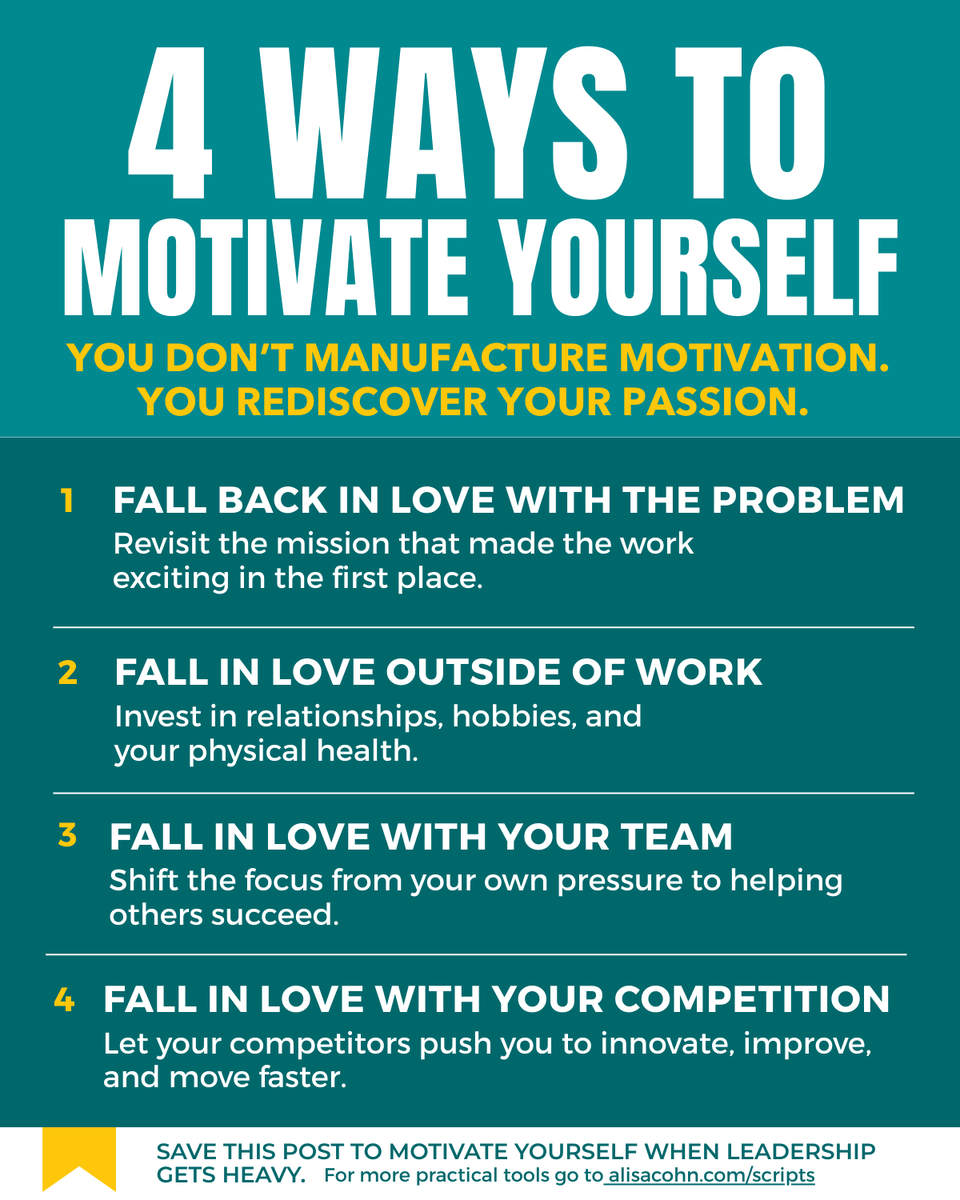
I've coached hundreds of leaders through burnout. The pattern is the same. They achieve success, then lose the fire that got them there. The solution isn't more vacation days or better work-life balance talks. It's rediscovering what made you fall in love with this work in the first place. Here are 4 ways to reignite that energy: ❤️ Fall in love with the problem you're solving So many leaders are buried in metrics and back to back meetings. Last month, I had a client revisit their original vision for their team. They actually got a bit teary. And energized. Here's what you can do: ✅ Block 30 minutes this week to write down why this role mattered to you ✅ Revisit the mission that made the work exciting in the first place ✅ Talk to someone your work has positively impacted ❤️ Fall in love with life outside the office The most energized leaders I know have something that lights them up beyond work. One of my clients started rock climbing. Another writes poetry. It doesn't compete with leadership. It fuels it. Here's what you can do: ✅ Schedule one activity this week that has nothing to do with work ✅ Set a hard boundary on weekend work (even 4 hours makes a difference) ✅ Text an old friend you've been meaning to catch up with ❤️ Fall in love with your team's success Nothing recharges a burned-out leader faster than watching someone they developed succeed. This single shift transform founders who were ready to quit into leaders who couldn't wait to get to work. Here's what you can do: ✅ Identify one team member who's ready for their next growth opportunity ✅ Spend 15 minutes this week asking them about their career goals ✅ Make one introduction that could accelerate their development ❤️ Fall in love with the competition Your biggest competitor just launched something bold? Good. Use that fire. One client told me: "When our rival raised a lot of money, we used that to galvanize the team. We're building something big here." Here's what you can do: ✅ Research what your top competitor is doing differently ✅ Identify one area where you can outperform them ✅ Turn competitive pressure into fuel for your team, not fear The energy that brought you to leadership is still there. You just need to remember what made you fall in love with this work. Which of these resonates most with where you are right now?
Alisa Cohn tweet media
English
0
0
1
35
Alisa Cohn
Alisa Cohn@AlisaCohn·
Most leaders I know obsess over performance. 🔹Feedback cycles. 🔹Accountability metrics. 🔹Progress reviews. And they should! This is all necessary. But here's what I've learned: it's not enough. I often ask a question in the sessions I lead: who was the leader who had the most impact on you. And here’s who people describe: the leader who had high standards and ALSO cared about where you were going. When your team knows you're invested in their development, not just their output: ➡️ Loyalty deepens ➡️Confidence compounds ➡️ Your bench strength multiplies How do you showcase this? With a simple practice: Regular career conversations. 🔵Ask where they want to go. 🔵Ask what skills they're itching to build. 🔵Ask how you can clear the path. What if you don’t specifically know the path they can use to grow? It doesn’t matter. Just asking these questions signals you care about them. And they help people find their own path. Which is what real growth is anyway. Leadership isn't just about hitting targets. It's about creating the conditions for your people to grow. And achieve heights that neither of you had anticipated.
Alisa Cohn tweet media
English
0
0
0
20
Alisa Cohn
Alisa Cohn@AlisaCohn·
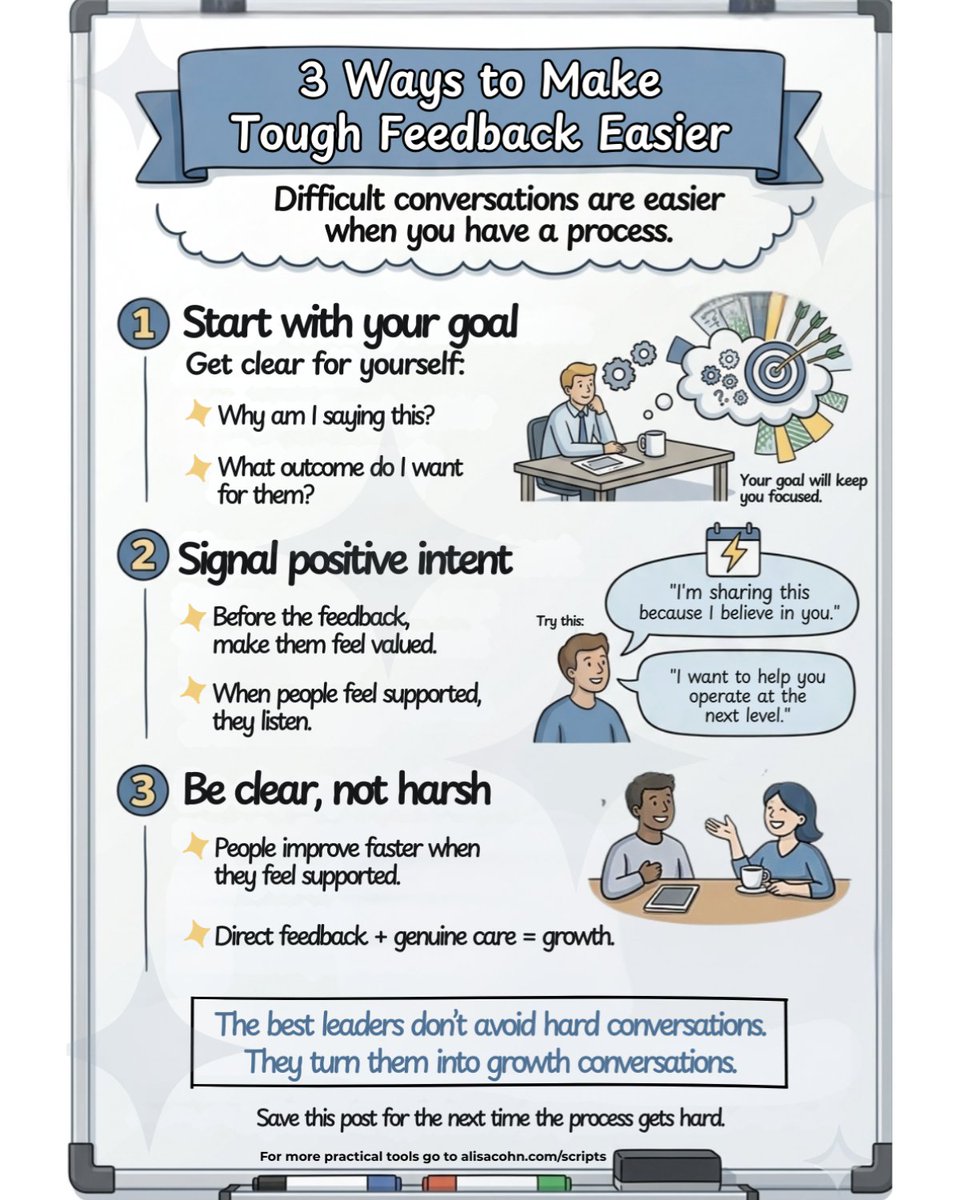
Many leaders dread giving tough feedback. They rehearse the conversation in their heads. They delay the meeting. They soften their words so much the message gets lost. But here's what I've learned after coaching leaders for over 25 years: difficult conversations get easier when you have a clear process. Here are 3 ways to make tough feedback easier: 1️⃣ Start With Your Goal Get clear before you speak: Why am I saying this? What outcome do I want for them? Your goal keeps you focused during the conversation. It prevents you from wandering into personal frustration or past grievances. 2️⃣ Signal Positive Intent Before giving feedback, make the person feel valued. When people feel supported, they're more open to listening. Try these phrases: "I'm sharing this because I believe in you." "I want to help you operate at the next level." People hear criticism differently when they know it comes from a place of care. 3️⃣ Be Clear, Not Harsh The key equation: Direct feedback + genuine care = growth. People improve faster when they feel respected, supported, and challenged at the same time. You don't need to soften your message. You need to deliver it with genuine intention to help. It's easy to delay. But I promise you'll regret it. The best time to have that conversation is now. What's one feedback conversation you've been putting off that could change someone's trajectory?
Alisa Cohn tweet media
English
0
0
0
22
Alisa Cohn
Alisa Cohn@AlisaCohn·
A professional poker player taught me a powerful leadership lesson. "When poker players owe money, it's not the money that's the problem," he said. "It's not even that the debt grows. The problem is when they stop responding to your texts." "The moment they stop communicating," he said, "that's when they're finished. They become pariahs. Nobody will trust them again." It's the same for you as a leader. When a crisis hits, your instinct might tell you to buy time. Figure it out quietly. Keep it contained until you have answers. That's backwards. When you're in trouble, you need to double down on your communication. Not hide from it. ✅ Call the board yourself. Don't let them hear bad news from someone else. ✅ Tell your team what's wrong, what you're doing about it, and what help you need. ✅ Update stakeholders constantly, even when progress is slow. The leaders who excel aren't the ones who never face problems (there are always crises). They're the ones who face them with clear eyes and straight talk. Your reputation isn't built on perfection. It's built on how you handle imperfection. 💭 Don't go silent. Who needs to hear from you this week?
Alisa Cohn tweet media
English
0
0
0
39
Alisa Cohn
Alisa Cohn@AlisaCohn·
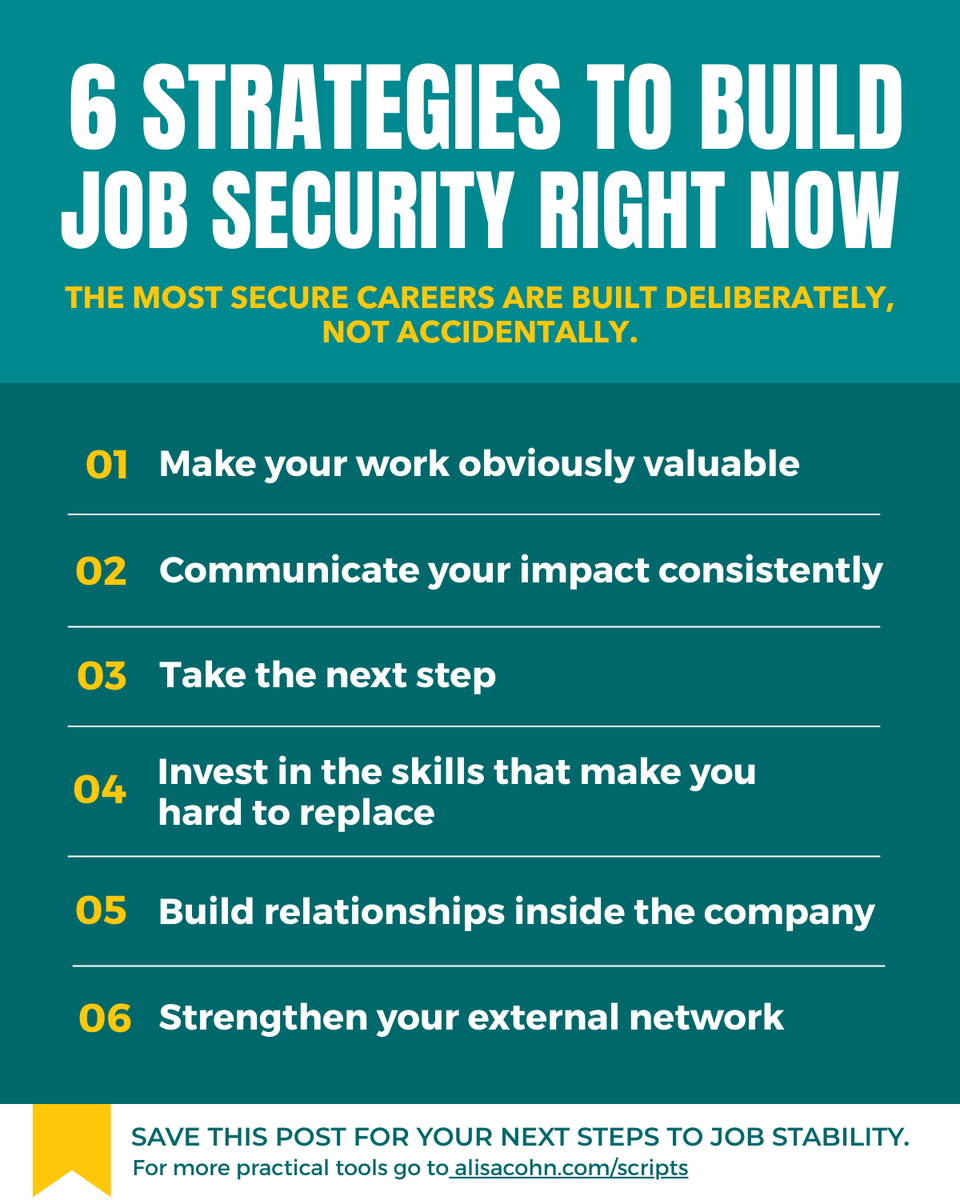
Layoffs are all over the news. Don't panic. Just take action. After 25 years of coaching people at all levels through multiple economic cycles, I've seen this pattern before. You can't control the macro environment or what your company will decide to do. But you can control how you position yourself. Here are 6 strategies that can help you build your job security right now. 1️⃣ Make your work obviously valuable Look for high-impact projects. Get involved with initiatives that everyone knows are critical and strategic. The question isn't "Am I doing good work?" It's "Am I working on what matters most?" 2️⃣ Communicate your impact consistently Send simple updates to your manager about what you're working on and the results you're driving. Mention what you’re working on to others. You don’t have to oversell. Facts strategically shared are more powerful than any pitch. 3️⃣ Take the next step Rather than handing off problems, think through the next step. Don't say "I'm stuck. What should I do?" Instead say, "I'm stuck. Here's what I think my next few steps are." Your manager can redirect you, but you've positioned yourself as proactive. 4️⃣ Invest in the skills that make you hard to replace Master the tool no one else wants to learn. Or build expertise in the area the company is betting on. Then invest the time to own it. 5️⃣ Build relationships inside the company Being known and liked often matters more than your performance. It may not be fair, but it's reality. Strong internal relationships help you survive layoffs or find new roles within the company. 6️⃣ Strengthen your external network Stay connected with former colleagues and industry contacts. Offer to help them. Make time for coffee meetings. This keeps you current on market opportunities and gives you options when you need them. Here's the test I give my clients to gauge network health: How many calls would it take you to land a new job? If the answer is more than 10, start building relationships now. 👉 Pick one. Start this week.
Alisa Cohn tweet media
English
0
0
0
52
Alisa Cohn
Alisa Cohn@AlisaCohn·
The setback is never the problem. Your response to it is. You didn't get the promotion you deserved. Someone else took credit for your breakthrough idea. The new hire got a better offer than you did after three years. It stings. I get it. But here's what separates people who recover from those who stay stuck. Most people respond to workplace setbacks in ways that sabotage them: ➡️ They get bitter and let resentment poison their performance ➡️ They gossip to anyone who'll listen ➡️They shut down or turn passive-aggressive You might feel justified. But you're just shrinking your own influence. Here's what actually moves the needle: ✅ Feel it, then release it Process the frustration fully. Just don't set up camp there. ✅ Mine it for intelligence What does this tell you about how decisions really get made? How can you position yourself differently next time? ✅ Invest your energy strategically Figure out where, and with whom, you can be successful and focus on those areas. When you stop fixating on what went wrong and start focusing on what's possible, everything becomes clearer. And easier. You gain respect. You build real allies. You get opportunities that actually matter. The people who advance aren't the ones who never face setbacks. They're the ones who refuse to let setbacks define their next move. Follow Alisa Cohn @AlisaCohn for more practical strategies that help you lead more successfully.
Alisa Cohn tweet media
English
0
0
0
72
Alisa Cohn
Alisa Cohn@AlisaCohn·
The most formidable obstacle to meaningful change isn't a lack of strategy or resources. We don't fail because we make mistakes. Mistakes can be fixed. We fail because we quit. And we quit far more often than we should. That’s the thesis behind my friend Nir Eyal's @nireyal new book “Beyond Belief.” I love his framework for understanding motivation: The 3 B's: 💡Behavior — knowing what to do 💡Benefit — knowing why to do it 💡Belief — believing your effort will make a difference Most of us focus on the first two. We study strategy. We clarify our goals. We understand the ROI. But without the third B, motivation collapses. You can have the perfect plan and crystal-clear purpose, but if you don't believe your effort matters, you'll quit the moment things get hard. Here are 3 things you can do right now: 1️⃣Audit Your Limiting Beliefs Identify one area where you're stuck or close to quitting. Write down what you currently believe about your ability to succeed there. Then ask: "Is this belief serving me?" Not "Is it true?" but "Does it help me move forward?" 2️⃣Practice Mental Contrasting Don't just visualize success. It actually saps your energy! Instead, visualize your goal, then list the 3 biggest obstacles in your way. Your brain will automatically start linking solutions to challenges. 3️⃣ Reframe Setbacks as Information, Not Identity The next time something goes wrong, catch yourself. Don't say "I'm not good at this" or "This isn't working." Say, "I haven't figured this out yet." One is a permanent label. The other is temporary data. The question isn't whether you have what it takes. The question is whether you believe you do. Belief isn’t mindless positivity. It profoundly changes how you think. It changes what you see and feel. And there it changes what you're capable of doing. 👉 Grab a copy of Beyond Belief before March 16th and you’ll get all sorts of goodies! Link in the thread.
Alisa Cohn tweet media
English
1
0
0
32
Alisa Cohn
Alisa Cohn@AlisaCohn·
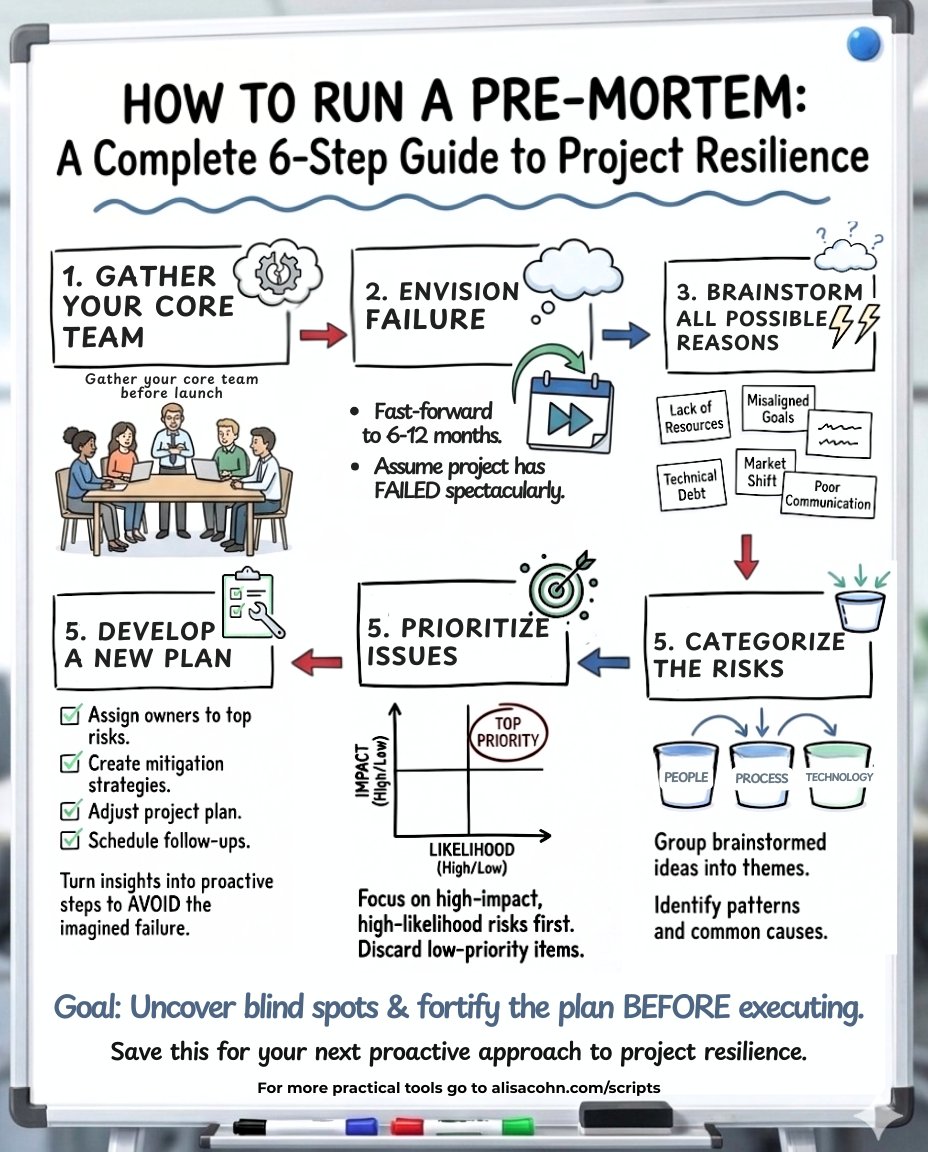
Most teams do post-mortems. High-performing teams do pre-mortems. I’ve been coaching teams for over 25 years and this very powerful tool drives higher level outcomes. Here’s why: Post-mortems dissect what went wrong after the damage is done. Pre-mortems identify what could go wrong before you start. Here's how it works: Put yourself six months in the future. Imagine your project has failed spectacularly. Ask yourself why. That thought experiment surfaces key risks. It also gives permission to name things that people see but won’t say. That nagging feeling about the timeline; concern about stakeholder buy-in; worry about the process. A pre-mortem gives your team permission to voice their concerns without seeming negative or unsupportive. Here's your step-by-step process to run your own pre-mortem: 🎯 Gather your core team in one room ⏰ Set the scene: "It's six months from now. This project failed spectacularly." ✍️ Give everyone 10 minutes to write down specific reasons why it failed 💬 Go around the room and share every scenario 🔍 Identify patterns in the responses ⚡ Create concrete mitigation plans for the top 3-5 risks When you run this process, people feel safe being productively skeptical. They can share what’s on your mind, and then everyone can work together to address these concerns. In advance, not after they’ve advanced to become a major problem. Your team already knows what could derail the project. A pre-mortem just gives them permission to say it. What's one risk everyone on your team can see but nobody wants to mention?
Alisa Cohn tweet media
English
1
0
2
55
Alisa Cohn
Alisa Cohn@AlisaCohn·
I asked Matt Oppenheimer @matt_oppy what he's still working on as a leader. Matt is the founder and CEO of Remitly @remitly . He grew it from an idea based on his travels to a public company serving customers in 170 countries. His curiosity and growth mindset built the company. In this clip he talks about the shadow side. Those same qualities can cost him decisiveness. Someone brings him a compelling argument and he thinks “good point.” Which is mostly good. Until it slows things down. He called it his towering strength and its shadow. Every strength has one. In this entire conversation Matt is so honest about what’s really going on when you start and build a company. We talk about how upbringing shapes your leadership, how to  manage your executive team as the company grows, and  what it’s really like to get your company ready to go public. 👉 Check out the episode and let me know what you think (link in the thread.)
English
1
0
0
63
Alisa Cohn
Alisa Cohn@AlisaCohn·
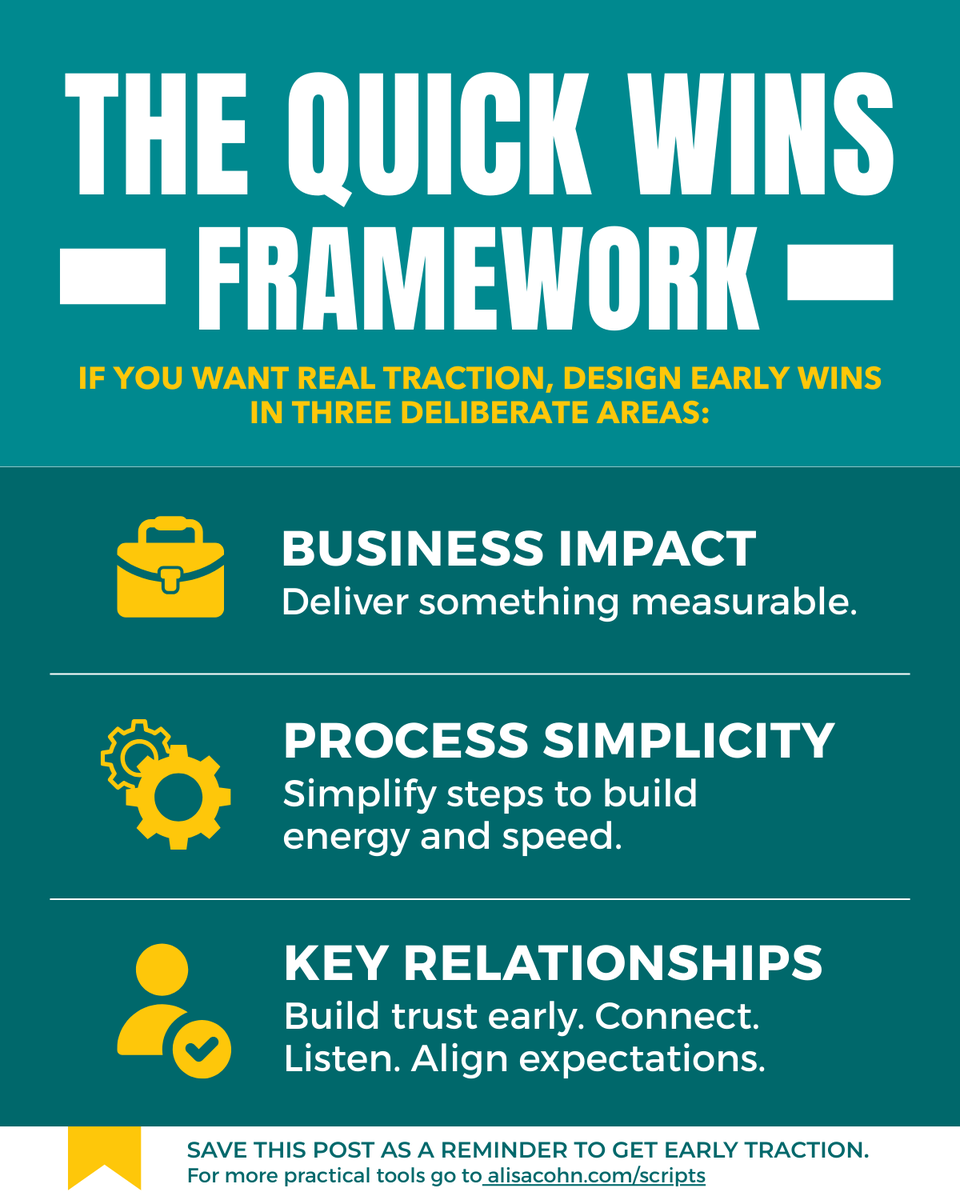
What enables success as a new leader isn't the brilliance of your ideas. It's your ability to gain traction. After working with hundreds of leaders in new roles, I've seen the same pattern. The ones who succeed fastest don't start with the biggest initiatives. They start with wins that matter to the people around them. Traction comes from quick wins. The graphic shows the Quick Wins Framework that I use with my clients. Design early wins in three deliberate areas: 📊 Business Impact: Deliver something measurable Close a deal that's been stuck in pipeline. Ship a delayed feature or project. Improve a specific metric like response time or customer satisfaction score. ⚡ Process Simplicity: Simplify steps to build energy and speed Eliminate a redundant approval step. Consolidate three recurring meetings into one. Create a template that saves your team hours weekly. 🤝 Key Relationships: Build trust early. Connect. Listen. Align expectations. Schedule 1:1s with your key stakeholders in your first two weeks. Ask people "What are your top priorities?" "What are some things you hope I'll change?" And then get back to them about what you did with that insight. Even if you don't take action, people feel heard and that's a win. The critical insight most new leaders miss: these are wins in the eyes of others, not necessarily you. That new system you think is brilliant? Your team might find it complicated. That metric you're focused on? Your boss might care about something completely different. Quick wins aren't about impressing people with your genius. They're about delivering on what matters to them. What's one quick win you could design in your role right now that would matter most to the people around you?
Alisa Cohn tweet media
English
0
0
0
46
Alisa Cohn
Alisa Cohn@AlisaCohn·
Most people don't fail because they're not good enough. They fail because they didn't expect it to get hard. I've coached hundreds of leaders over 25 years, and I keep seeing the same pattern. Talented people abandon ambitious projects, back away from challenges they were excited about, and stop pursuing opportunities they genuinely wanted. The executive who was thriving in their old role but struggles through their first six months after a big promotion thinks, "Maybe I'm not cut out for this," and starts looking for a new job. The founder, who raised some initial seed funding, was building something promising but stopped when he got a few rejections from new investors. "Maybe this idea won't work," he thought, and prepared to shut down the company. The leader whose significant initiative gets bogged down in bureaucracy and politics thought, "Maybe I'm the one missing something," and stopped trying to push it forward. All of them took the obstacles as signals to stop. But that's not what's happening. It just got hard. That's different. Snags aren't proof you're on the wrong path. They're proof you're doing something that matters. The people who make it through aren't tougher or smarter than those who don't. They just asked themselves one question early on: "What will I do when this gets hard?" And when hard showed up, they remembered their answer. 👉 What's something meaningful you're working on right now that's gotten harder than you expected?
Alisa Cohn tweet media
English
0
0
0
45
Alisa Cohn
Alisa Cohn@AlisaCohn·
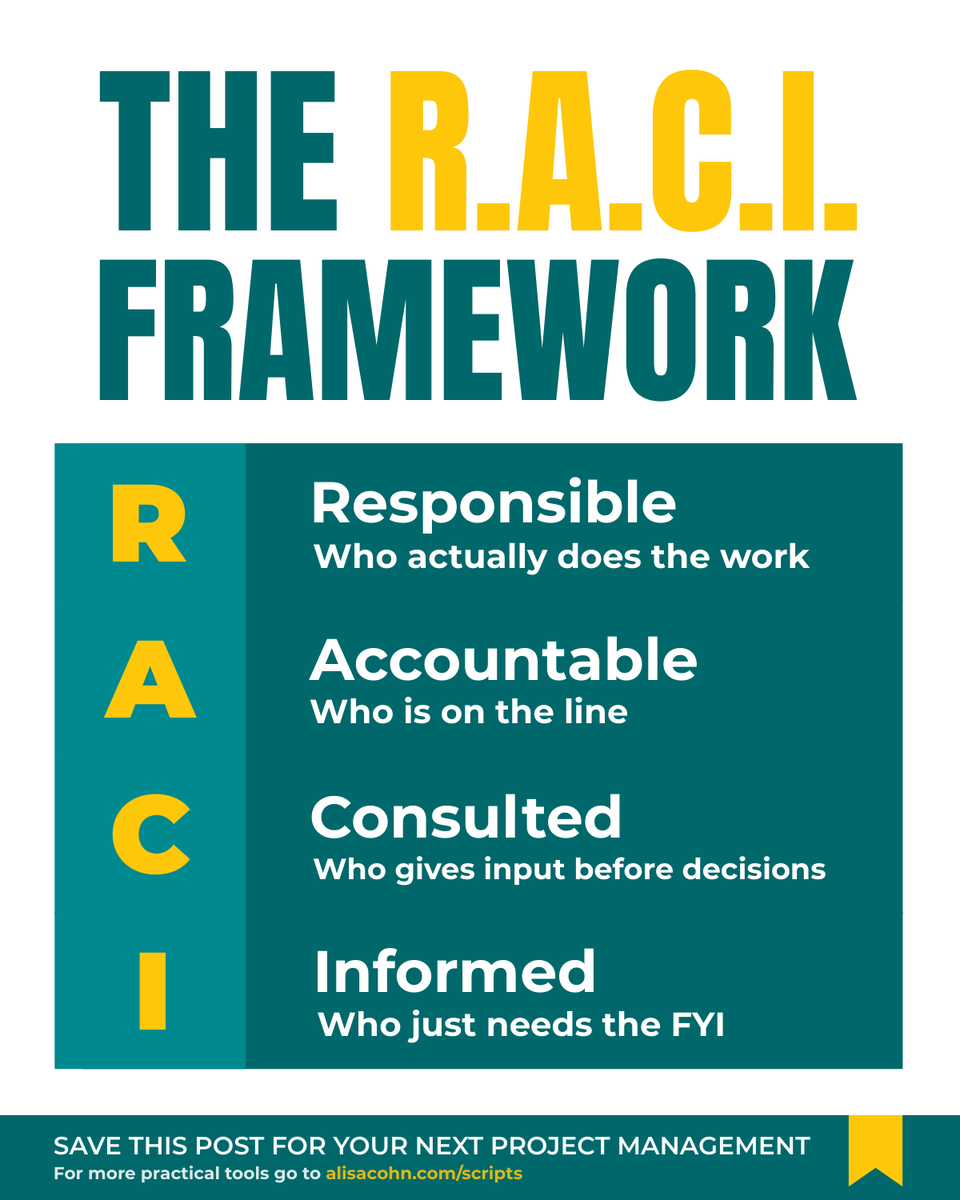
When I ask a leader "who's in charge of this initiative?" and the answer isn't clear, I know the project is going to be convoluted and over budget. After 25 years of coaching executives, I’ve found that this one thing hijacks projects: Roles aren't defined. People show up expecting to have input into  decisions when they're only there to be informed. No one clearly owns the outcome. One of my clients had a team struggling with their marketing strategy because nobody owned the full customer journey from first touch to renewal. Another client had a massive bottleneck in hiring because too many people thought they were supposed to give input when really they were just being kept in the loop. It sounds counterintuitive. More hands should make lighter work, right? But when everyone is responsible, no one is responsible. When five people "own" the deliverable, it becomes an orphan. Enter the RACI framework. RACI cuts through the confusion every time. Here's a walk through: 🎯 Responsible = Who actually does the work The people executing specific tasks. One person per task. 📋 Accountable = Who is on the line The single person who owns the outcome. Not doing the work, but answering for the results. 💬 Consulted = Who gives input before decisions People whose expertise shapes the decision but don't make the final call. 📢 Informed = Who just needs the FYI People who need awareness but have no input or execution role. Here's how it played out with my clients: For the marketing strategy: Previously, Marketing owned acquisition, Sales owned conversion, Product owned onboarding. And nobody owned the full journey. The CEO made the CMO accountable end-to-end. Marketing Director, Sales Director, and Product Leader became responsible for their specific pieces. Customer Success was consulted on retention insights. The executive team stayed informed. For hiring: We clarified that the hiring manager was accountable for the hire. The team lead and HR were consulted on fit and compensation. Department heads who thought they had veto power? They were actually just informed. The bottleneck disappeared overnight. Things move smoothly when everyone knows exactly where they fit. Everyone understands the handoffs. No more confusion about who the leader of the effort is. No more hurt feelings about people feeling left out. What's the messiest project you've seen that better ownership could have saved?
Alisa Cohn tweet media
English
1
0
0
54
Alisa Cohn
Alisa Cohn@AlisaCohn·
After 25 years of coaching leaders, I've learned that speed in business isn't about working faster. It's about questioning the assumptions everyone accepts as necessary. One of the most powerful questions I coach my clients to ask their teams: “What would it take to see results in two weeks rather than one quarter? Two recent examples: One of my CEO clients challenged her team to launch their new feature in 3 weeks instead of 12. “I don’t want to make you crazy, but it’ll give us faster feedback for a larger strategic initiative,” she told them. Her team immediately started problem-solving. They questioned every assumption in their process, figured out how to run tasks in parallel, identified what help they needed, and stripped down to truly essential features. They hit the deadline. Compare that to the second CEO. He asked his team why the product was taking so long to ship. His team rattled off excuses: "There are a lot of requirements.” “We have a lot of stakeholders to get on board.” “It’s more complex than you think.” Same pressure point. Completely different response. In the era of compressed timeframes, quick iteration, and the world changing so quickly, pushing for speed isn’t reckless. It's about examining the sacred cows built into the  processes. Speed comes from challenging the processes you've never questioned. From asking "what if" instead of accepting "we can’t." What timeline are you defending that deserves to be challenged?
Alisa Cohn tweet media
English
0
0
0
34
Alisa Cohn
Alisa Cohn@AlisaCohn·
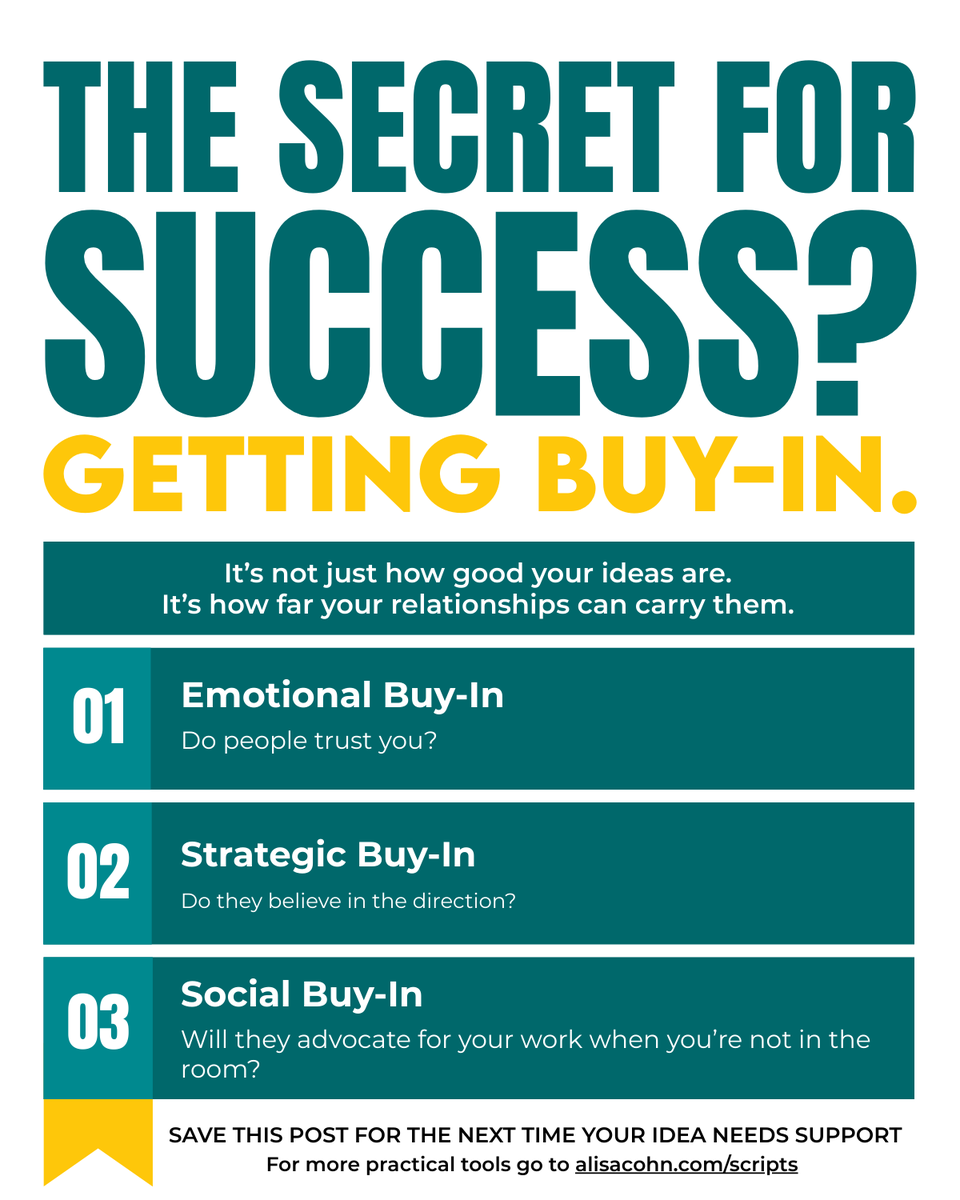
What’s the most overlooked skill for achieving success? No matter how brilliant your ideas or how high-quality your work, success ultimately depends on one thing: other people. You need the buy-in of  investors, employees, peers, and  supervisors. Otherwise even the best ideas won’t take off. Here’s what you need to know: 1️⃣ Founders need buy-in at every level It starts with employees, customers, and investors. If you can’t rally others to believe in your vision, you won’t have the resources or support to build the company you envision. 2️⃣ In organizations, collaboration is non-negotiable Projects don’t succeed in isolation. You need peers to contribute, direct reports to execute, and leaders to advocate for your work. 3️⃣ Your network is your lifeline Neglecting workplace relationships can leave you stranded, limiting your ability to influence and collaborate effectively. Early in my career, I thought success was all about individual effort. Over time, I realized that no matter how good you are, it’s the relationships you cultivate that determine how far your ideas can go. Building trust, respect, and connection with others isn’t a “nice to have;” it’s a necessity. What’s your plan to build the right relationships in the year to come?
Alisa Cohn tweet media
English
0
0
0
44
Alisa Cohn
Alisa Cohn@AlisaCohn·
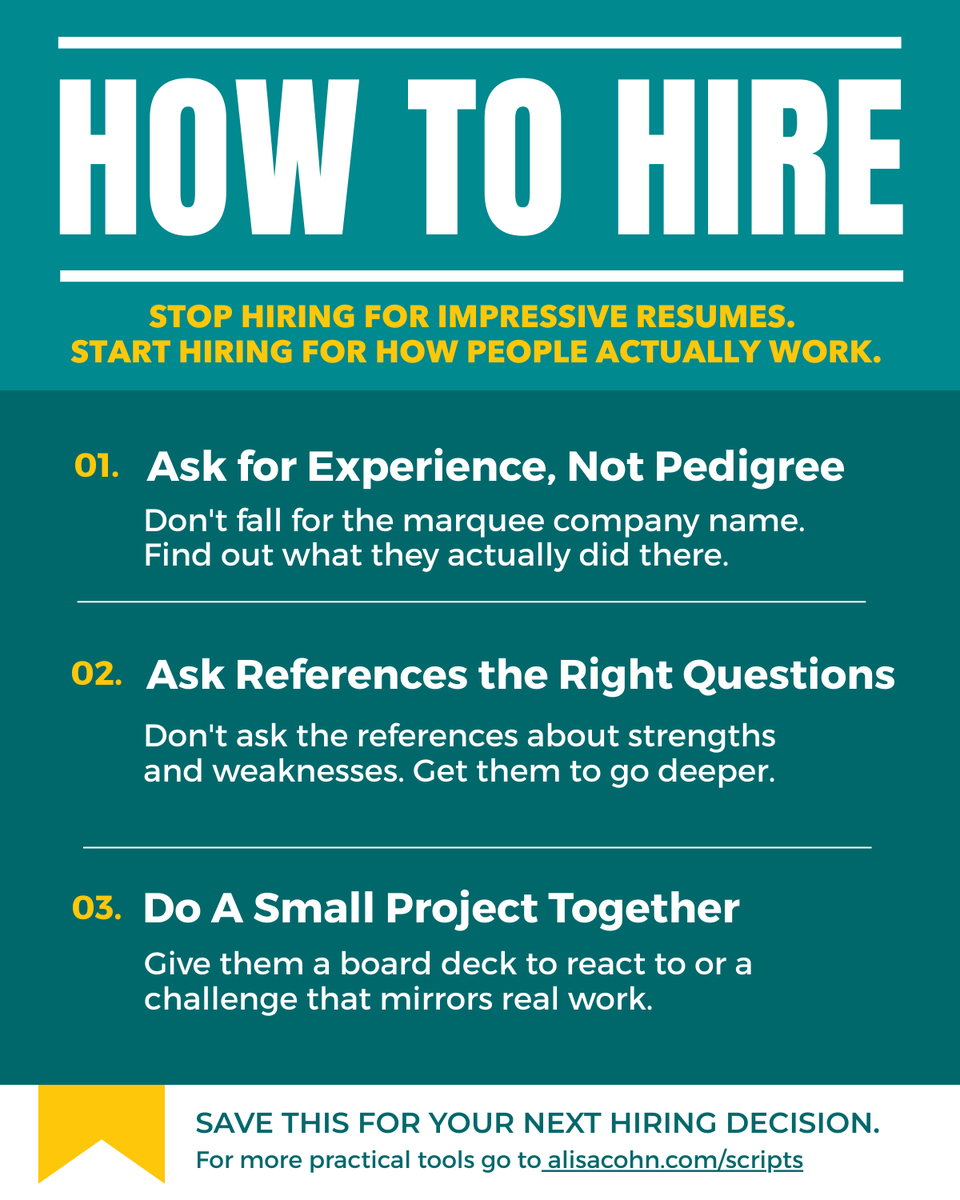
Bad hires cost more than money. They cost momentum. I've worked with hundreds of leaders who've made expensive hiring mistakes. The ones who learned to hire better all shifted their focus from impressive resumes to three simple tests: ➡️ Ask for experiences, not pedigree. Don't fall for the marquee company name. Find out what they actually did there. Some questions to ask: How did you approach the projects that led to your top accomplishments? Who did you need to collaborate with and were any of them hard to get on board? Were there unexpected issues and how did you handle them? Were they the drivers of the key initiatives or just in the room when they happened? Their stories will show you. ➡️ Ask references the right questions Don't ask the references about strengths and weaknesses. Get them to go deeper. Some questions to ask: What were some of their most significant accomplishments? What specific obstacles did they have to overcome? Are you planning to hire them away from me? This cuts through polite reference theater. Find out what they actually accomplished and if the manager secretly wants them back. ➡️ Do a small project together. Give them a board deck to react to or a challenge that mirrors real work. Some things to look for: Are they willing to tell you the truth or just praise you? Do they focus on identifying the problem only or do they seek solutions? How do they respond to feedback? You'll see how they actually operate, not just what they tell you. The best predictor of future performance isn't the companies they used to work at. It's the details about how they work. What's your go-to tool to hire the best people?
Alisa Cohn tweet media
English
0
0
3
95
Alisa Cohn
Alisa Cohn@AlisaCohn·
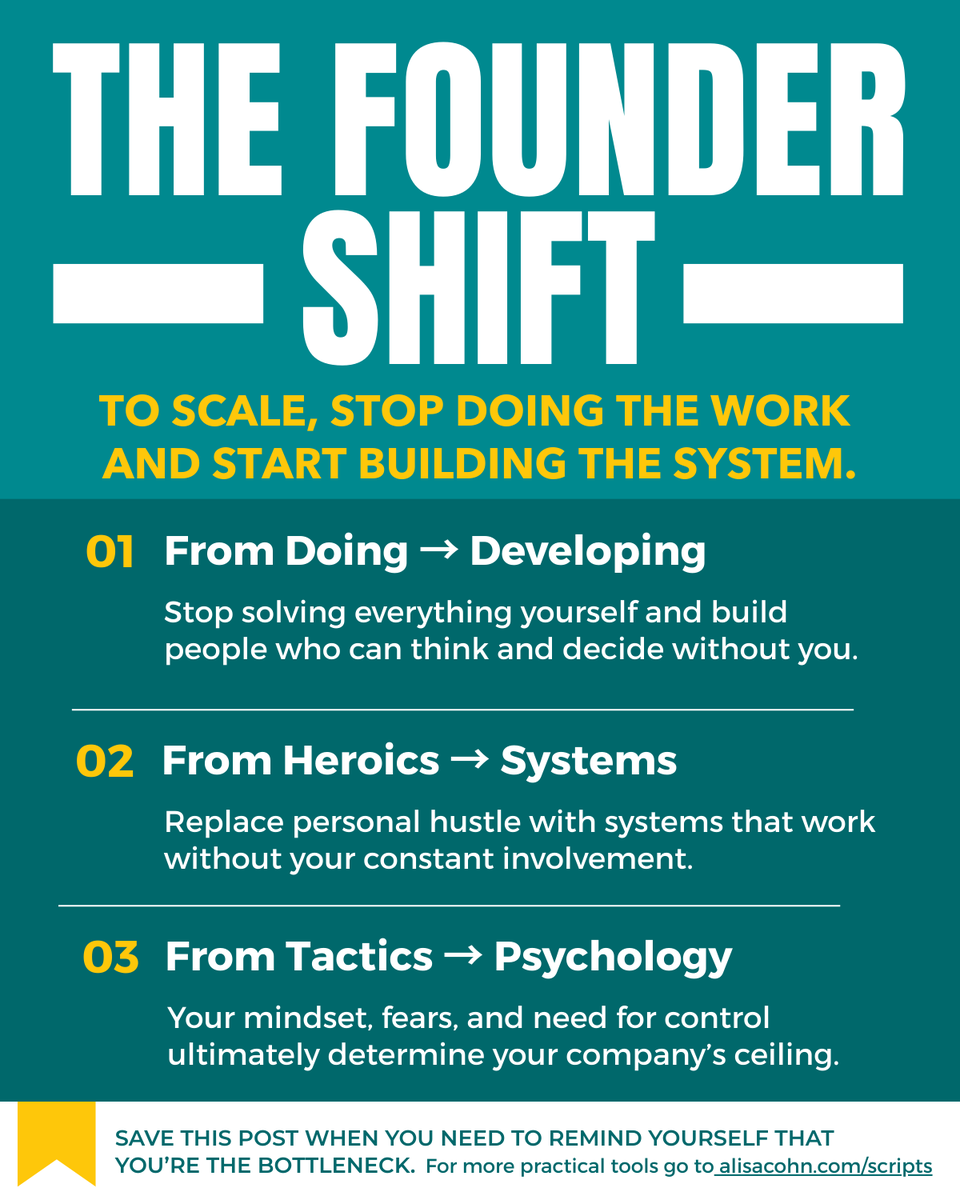
I've been coaching startup CEOs for 25 years and the hardest lesson never changes: The skills that make you a great founder will destroy your ability to scale. In the early days, brute force was everything. Answer customer calls. Work until 3 AM. Handle sales, ops, and strategy yourself. It worked because you could touch every part of the business. But as the company scales, everything breaks. And so do you. Your team waits for you to make decisions rather than making them yourselves. Sales plateau because you’re the only one who can close. Customer experience becomes inconsistent because everything runs through you. Good people get frustrated and leave because they can't get clear direction or feel trusted. You're still working harder than ever, but growth stalls. Here's what has to shift: ✅ From doing everything to developing others Stop being the person with all the answers. Start building people who can think and decide without you. ✅ From heroics to systems The company can't run through your brain anymore. Build processes that work when you're not in the room. ✅ Psychology becomes your new job Your need for control, your triggers, your blind spots all become the ceiling for your entire organization. Most founders don’t like this. They think structure will kill what made them special. But here's what I've seen: The CEOs who resist this get lapped by competitors who figured it out. A good question to ask yourself: Where are you the bottleneck in your own business and how can you develop someone else so you can get out of the way?
Alisa Cohn tweet media
English
0
0
1
57
Alisa Cohn
Alisa Cohn@AlisaCohn·
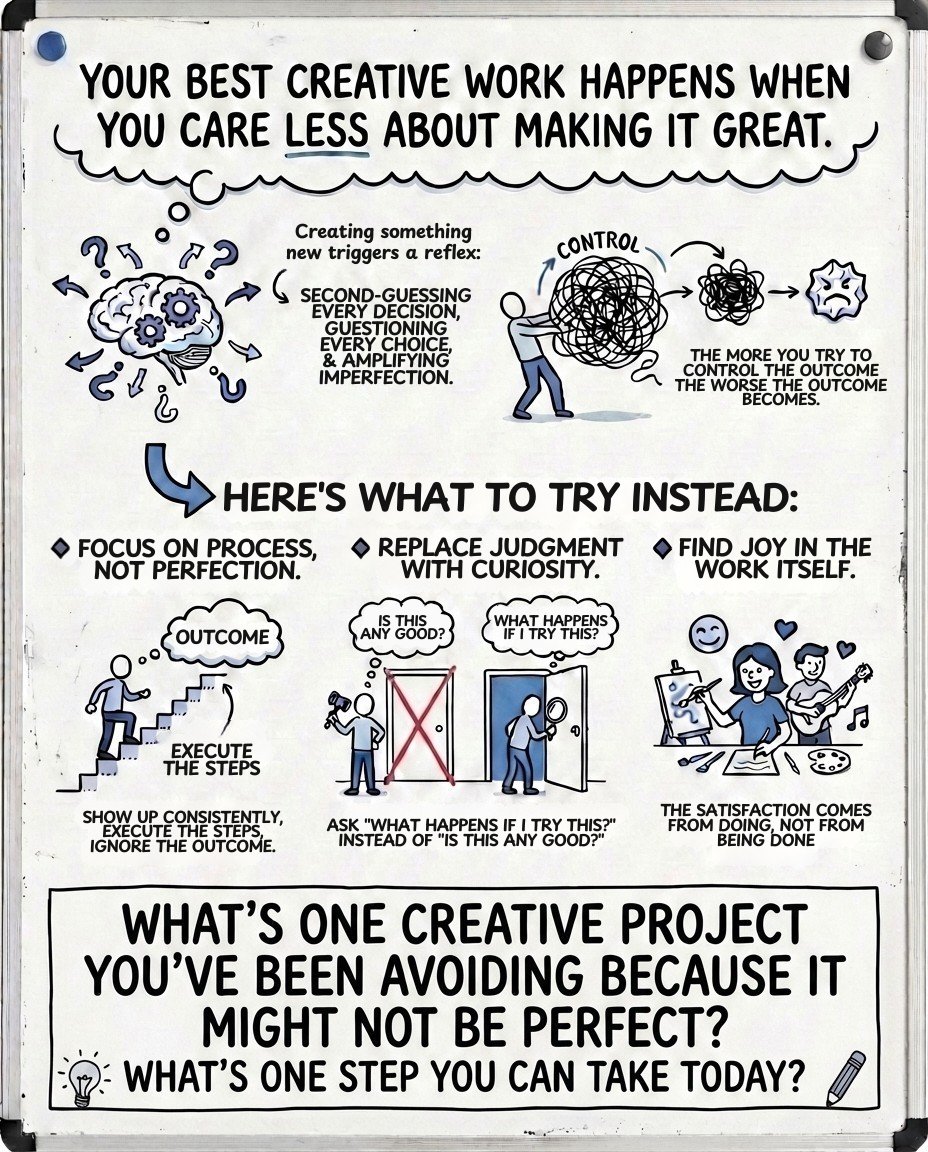
Your best creative work happens when you care less about making it great. Creating something new often triggers a reflex: second-guessing every decision, questioning every choice, and amplifying every imperfection. The more you try to control the outcome, the worse the outcome becomes. Here's what to try instead: 🔷 Focus on process, not perfection. Show up consistently, execute the steps, ignore the outcome 🔷 Replace judgment with curiosity Ask "What happens if I try this?" instead of "Is this any good?" 🔷Find joy in the work itself The satisfaction comes from doing, not from being done When I sit down to do anything creative, I try to simply put one foot in front of the other. I get my fingers typing; I record my ideas; I sit down at the piano and bang away. It's not always brilliant, it's never perfect, but the forward motion is my guide. When you're engaged with the work instead of worried about the result, your best ideas show up. What's one creative project you've been avoiding because it might not be perfect? What's one step you can take today?
Alisa Cohn tweet media
English
0
0
0
36
Alisa Cohn
Alisa Cohn@AlisaCohn·
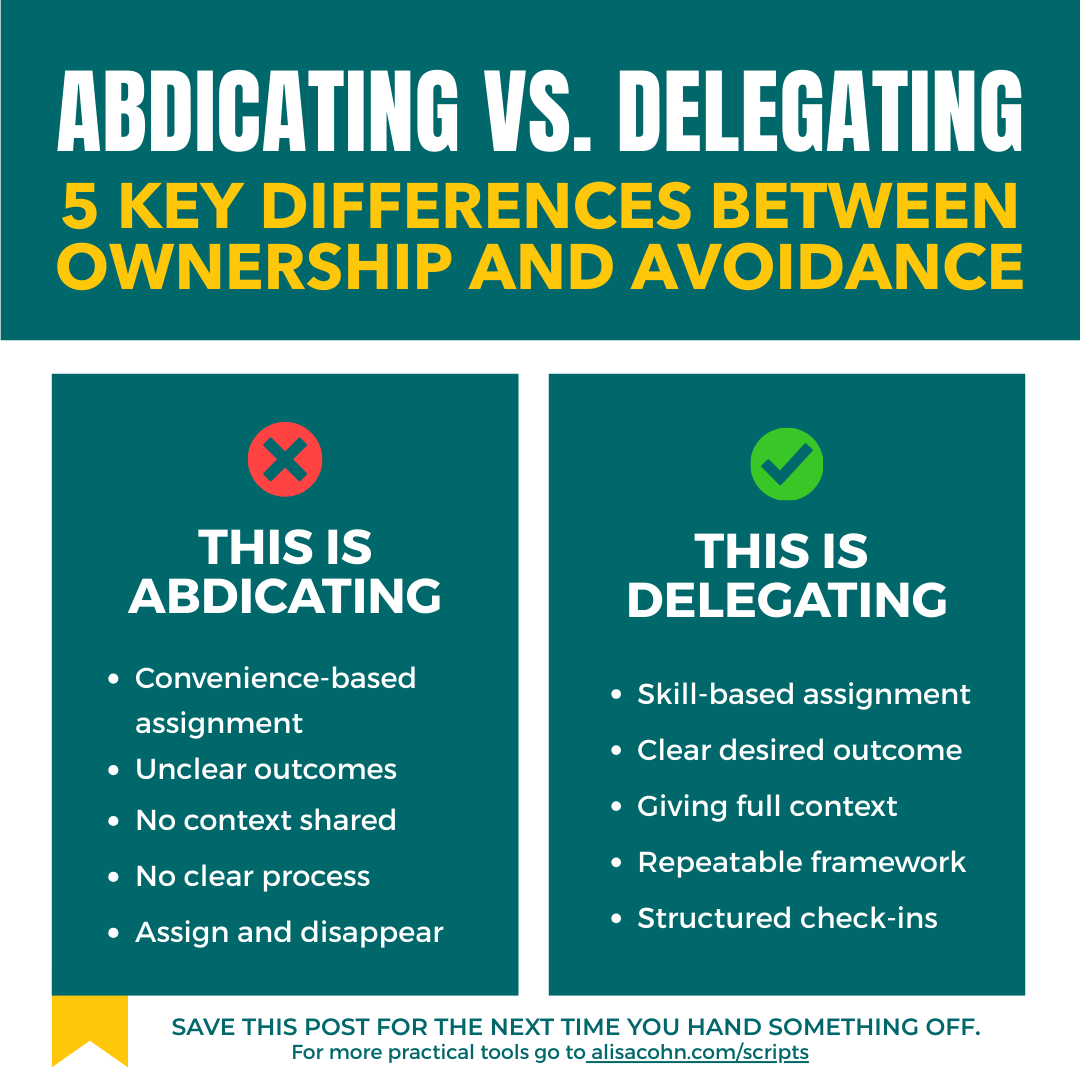
After 25 years of coaching leaders, I've learned that how a leader delegates determines how fast their company can move. I see leaders make this mistake over and over again. They think handing something off is the same as setting someone up to succeed. There's a difference between abdicating and delegating. When you abdicate: ❌You hand off a task and mentally move on to the next fire. ❌You give it to someone who’s standing right there, rather than the best person. ❌You assume they've got it. Then three weeks later, you're frustrated the work isn't done right. But they’re confused because they sincerely thought they were doing a good job. When you delegate: ✅You hand off the task to someone with the right skills ✅You both agree on the outcome ✅You give them clarity and context and check in to see how it’s going You  set them  up to win. And you make this a repeatable process so everyone knows what to expect. Your company can only scale if you master real delegation. Because at some point, you run out of hours in the day. The work has to flow through other people. In this cheat sheet, I've broken down 5 critical differences. The CEO who abdicates stays stuck. The CEO who delegates builds a company that grows without them. Which one are you?
Alisa Cohn tweet media
English
0
0
2
47