Ali Usman Muhammad

754 posts

Ali Usman Muhammad

Ali Usman Muhammad

@Aliussmann

Tech nomads

Maiduguri, Nigeria Katılım Şubat 2022
350 Takip Edilen40 Takipçiler
Ali Usman Muhammad retweetledi
Nav Toor
Nav Toor@heynavtoor·
In 2016, a man with no CS degree quit his job to study for a Google interview. He was an English major. A self-taught web developer. A former Korean translator in the US military. He studied 8 to 12 hours a day. For 8 months straight. Algorithms. Data structures. System design. Operating systems. Networking. Every topic Google asks. He tracked every minute of it on GitHub. He called the repo "Google Interview University." Then he applied to Google. Google never called him back. Here's the wildest part: The repo he left behind became one of the most-starred projects on GitHub. Over 343,000 stars. Used by thousands of devs to break into FAANG. He got hired at Amazon as a Software Engineer. His name is John Washam. The repo is now called coding-interview-university. Inside you get: - A multi-month study plan, week by week - Every CS topic Google, Amazon, Meta and Microsoft actually ask - Algorithm patterns with worked examples - System design from zero to senior - Big-O, data structures, trees, graphs, recursion, dynamic programming - Behavioral interview prep - Mock interview drills - Book and lecture recommendations he personally used - Flashcards, video resources, and a coding question practice plan Self-paced. Free. No course. No paywall. No upsell. Just one engineer's 8-month study log, open for anyone who wants to follow it. If you are preparing for a tech interview, this is the most complete free roadmap on the internet. 100% Open Source. (Link in the comments)
Nav Toor tweet media
English
31
394
3.1K
180.5K
Ali Usman Muhammad retweetledi
aditya
aditya@adxtyahq·
a founder explained what tools like Claude Code, Cursor, and AI coding agents are actually changing, and it’s not as simple as “AI will replace devs” or “AI is just a tool” the uncomfortable truth is that code is becoming cheap, and clarity is becoming the real bottleneck which is why some developers are accelerating like crazy, while others feel stuck even with the same tools this video captures that shift pretty well:
English
9
4
24
1.8K
Ali Usman Muhammad retweetledi
Ihtesham Ali
Ihtesham Ali@ihtesham2005·
A MIT student figured out how to compress an entire semester of lecture content into one 90-minute study session. He calls it "context stacking," and it's the most unfair thing I've seen done with NotebookLM. I asked him to walk me through it. He did. I haven't studied the same way since. Here's exactly what he does. Two days before each lecture, he uploads everything into NotebookLM. The assigned readings, the previous week's slides, 3 or 4 related papers he finds himself, and any problem sets that are still open. Most students wait for the lecture to explain the material. He walks in having already built a mental model of it. That's step one. But it's not the move that makes it unfair. The first prompt he runs across all of it: "What are the 5 core concepts this week's content is built on, and how do they connect to what I studied last week?" Not summarize. Not define. Connect. NotebookLM pulls threads across everything he uploaded simultaneously. It surfaces relationships between ideas that would take a normal student weeks of review to notice. He gets that map before the lecture even starts. Then he runs the prompt that does most of the work. "What would I need to genuinely understand about this material to be able to teach it to someone with zero background in this subject?" That question is doing something most students never force themselves to do. It exposes exactly where his understanding is solid and exactly where it's hollow. The gaps show up immediately, and he spends the rest of the 90 minutes filling only those gaps. Not reviewing what he already knows. Only fixing what he doesn't. The final prompt is the one that separates context stacking from every other study method I've heard of. "What question could a professor ask about this material that would expose a student who understood the surface but missed the underlying logic?" He's not studying for the exam he expects. He's studying for the exam designed to catch people who only think they understood it. By the time he sits in the lecture hall, the professor is not teaching him anything new. The professor is confirming what he already mapped, filling in a few details, and occasionally surprising him with something he didn't anticipate. That surprise is the only thing he writes down. Most students leave a lecture hoping the material will eventually click. He walks in with it already clicked, and uses the lecture to find out what he missed. That's not a study hack. That's a completely different relationship with learning.
Ihtesham Ali tweet media
English
121
1K
6.1K
582.4K
Ali Usman Muhammad retweetledi
Aakash Gupta
Aakash Gupta@aakashgupta·
These videos were the single most expensive flex in labor history. Tech workers had the best negotiating position of any white-collar workforce in 50 years. Remote work, $250K+ comp, four-day work weeks, unlimited PTO. The only thing keeping that deal alive was ambiguity. Nobody outside tech knew exactly what the day looked like. Then thousands of people filmed it and posted it to the one platform where non-tech people actually hang out. Every "day in my life as a Google PM" video that showed two hours of real work became ammunition for every CFO building a layoff deck. Every CEO trying to justify RTO got a free highlight reel. Every recruiter benchmarking comp against "market rate" suddenly had video evidence that the market was overpaying. The negotiating leverage depended on information asymmetry. The TikToks destroyed it voluntarily. For free. For likes.
Boring_Business@BoringBiz_

Tech workers realizing that they could have kept high pay, job stability and remote work if they just stopped making cringe “Day in my Life” videos on TikTok

English
65
708
5.9K
551.1K
Ali Usman Muhammad retweetledi
Technical Ben
Technical Ben@TechnicalBben·
Some people think networking means attending just events, but it can also happen through your phone. Two years ago, after university, I finally got to learn a skill and I was confused about how to get a client to work with you. I had no experience or knowledge or a mentor, i only had my free certification from HUBSPOT academy in marketing, I was very scared of i wouldn't make it out the trenches because I was the first born from a very broke family. So I took a bold step, "I use to my friends that stranger will make you rich", we should start networking before finish uni. But I couldn't too because my school was far from civilization lmao 🤣 out there in the mountains 😭 of ibogun. I activated my LinkedIn and started using it saw what people posted I was confused, I was like "how do you get an opportunity from this platform?" But I optimize my page to my best knowledge with a lots of skill on my bio. Doing rubbish, but didn't know it was part of the growth. So I made a rule for myself: Lower your expectations. Increase your outreach. I started texting and building relationship and showing people I was learning. I had less than 10 views then on each post no likes. But kept it going in the DM. ( Mind you I had stopped applying for jobs on quick apply. ) One day curiosity drove me to check out Ferrari, why because most companies on the planet has a profile on LinkedIn. So I texted a lady who works there, because according to my research women are more likely to reply you on LinkedIn than men. On platforms like LinkedIn, outreach campaigns and recruiter data often show: Higher reply rates from women More thoughtful, longer responses Greater willingness to help or guide. So I sent a message. She replied. We talked for a while about what she does. Then we got on a Google meet call. Then another call. Later, she left Ferrari and started her own consulting business. And she told me clearly: “If you ever come to Europe and want to get into the automobile space, reach out. I’ll recommend you.” That one message opened a door I didn’t even know existed. Same thing happened again with a marketing specialist she referred me I got my first job I still work there. And the lady who worked with Ferrari, We spoke about how I could help her business. Real conversations. Real opportunities. No connections. No experience. Just outreach. Here’s the truth most people avoid: The problem is not lack of opportunities. It’s that you’re too selective, too scared, or too slow to reach out. People overthink: Who exactly should I message? What exactly should I say? Meanwhile, the real game is volume. Send the message. Take the risk. Start the conversation. That’s how I used my phone to network my way from Akute to working with big brands across Europe and America. 🤣😭 Networking with strangers on Internet is goated. And if you need a marketing specialist you can reach out to me. Broke ones will rise again.
Ja Leto@_falsi1ke

NETWORKING IS CRAZY. You can literally get rich by meeting the right people.

English
33
65
589
19.4K
Ali Usman Muhammad retweetledi
Vaishnavi
Vaishnavi@_vmlops·
A guy didn't have a CS degree wanted to work at Google studied 8-12 hrs/day for months got hired at Amazon instead he open-sourced his entire study plan coding-interview-university - 337k stars on GitHub covers everything: DSA, trees, graphs, dynamic programming, system design, OS, networking github.com/jwasham/coding… the most complete free CS curriculum on the internet
Vaishnavi tweet media
English
20
467
4.5K
224.9K
Ali Usman Muhammad retweetledi
Michael Taiwo
Michael Taiwo@AskMichaelTaiwo·
You can make $500/hr selling your knowledge. I started doing this when I was in Shell. And it was one of the reasons I left so I can double down on what was working. If you are considering diversifying your 9-5, get into expert networks. This is one example from a company called GLG. I tell them what I know about "US Hydrogen Energy" and they pay me for that. I literally set my price. Depending on demand/supply, you can set yours to $150, $250 or $1,000 an hour. Books >>> Yahoo.
Michael Taiwo tweet media
English
56
216
1K
101.6K
Ali Usman Muhammad retweetledi
Ihtesham Ali
Ihtesham Ali@ihtesham2005·
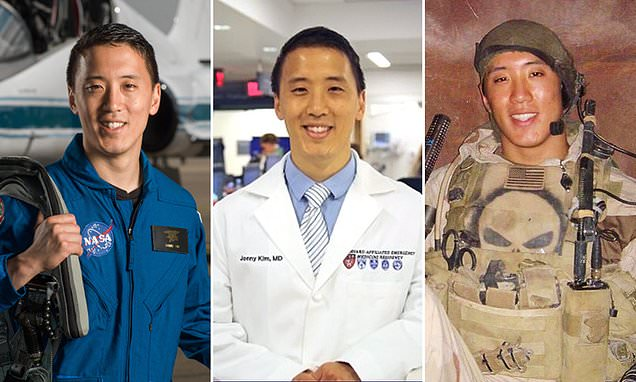
I watched Jonny Kim's NASA interview 3 times before I understood what he was actually saying. Most people see Navy SEAL, Harvard doctor, astronaut and think he's just built different. Gifted. Some rare genetic outlier. That's not what happened at all. He became an elite SEAL first. 100+ combat missions. Complete mastery of that world. Then he used that foundation to get through Harvard Medical School. Then used both to excel at NASA astronaut training. The interviewer asked him how he learned so fast across such different fields. His answer was strange. He said the content didn't transfer. The ability to learn did. Here's what that actually means. When you go deep enough in any field, you stop just memorizing facts. You start building patterns. A chess master doesn't calculate every move. They see the board and patterns fire instantly. A senior programmer doesn't read every line. They scan and know exactly where to look. That pattern recognition is the thing that transfers. Not the knowledge itself. Jonny didn't carry SEAL tactics into medical school. He carried the feeling of mastery. He knew what it felt like to be completely lost and push through anyway. He knew the exact stages of going from beginner to expert. He knew how to develop intuition in an unfamiliar environment. That made him 40% faster learning each new field than someone starting from zero. Most people trying to become polymaths skip this entirely. they hop between interests every few months, never going deep enough to build real pattern recognition in anything. They collect hobbies and call it range. Real polymaths go uncomfortably deep in one thing first. Everything else gets easier because of it.
Ihtesham Ali tweet media
English
17
122
822
85.5K
Ali Usman Muhammad retweetledi
Ruffin Perri-Greno
Ruffin Perri-Greno@gyina_yie·
Purdue University, USA has great programs with graduate assistantship opportunities. You can even apply to a straight PhD with your undergraduate degree. NB: Email department chair or coordinator / “cold email” before starting an application. For graduate programs: 👇🏽 purdue.edu/academics/ogsp…
Ruffin Perri-Greno tweet media
English
5
25
113
7.6K
Ali Usman Muhammad retweetledi
Vivo
Vivo@vivoplt·
Cancel weekend plans. You need to: • Learn Claude Code • Build 1–2 workflows in Cowork • Set up Perplexity Computer & Finance • Optimize Cowork (plugins + skills) • Set up OpenClaw • Test Google AI tools (Nano Banana 2, NotebookLM, etc.) • Try basic agentic tools (Manus) • Use AI to create a business plan • Build an AI second brain (Notion) • Try Notion Agents • Learn automation (MCPs, Zapier, n8n) • Learn prompt engineering • Read AI articles • Explore robotics
English
95
622
5K
224.9K
Ali Usman Muhammad retweetledi
Suhas Sumukh
Suhas Sumukh@suhasasumukh·
we just acquired 1825Fund.com this brings together two teams that were already aligned in how early-stage backing should be done. shreyansh and simaq have built 1825 Fund with strong founder relationships and a clear point of view on early-stage deployment. they now join @evm_capital, actively deploying capital and working closely with founders. with this, we combine their approach with our infrastructure, network, and platform to operate as one unified fund. one fund, team now on a larger scale. excited for what we build next. more details here: open.substack.com/pub/evmcapital…
English
39
15
315
16.9K
Ali Usman Muhammad retweetledi
Ihtesham Ali
Ihtesham Ali@ihtesham2005·
A Harvard neuroscience professor who teaches at Harvard Summer School said something that completely changed how I think about memory. She wasn't talking to journalists. She was answering a student question about why smart people still forget everything they study. Her name is Dr. Tracey Tokuhama-Espinosa, and she has spent decades researching how the brain actually encodes and retrieves information. Here's what she said: "The ultimate litmus test of learning is using the information in a new context, not just remembering it for a test." That one sentence exposes why most people's study habits are completely broken. Here's the actual system she teaches Harvard students to retain what they learn. The first thing she kills immediately is the myth that you have one learning style. The idea that you're a "visual learner" or an "auditory learner" is not supported by modern neuroscience. Your brain wants to learn through as many senses as possible at once, because each sense creates a separate neural pathway to the same knowledge. More pathways means faster and stronger recall. The second technique is spaced repetition, but she explains the mechanism in a way most people never hear. Every time you retrieve a memory, you physically thicken the myelin sheath around that neural connection, which makes the electrical signal travel faster. You aren't just reviewing information you are literally rewiring your brain to access it more quickly. The third technique floored me. She tells students to teach what they just learned to someone else within 24 hours, because teaching forces you to find the gaps in your own understanding before the exam does it for you. The fourth is what she calls "feed-forward" instead of feedback. When you get something wrong, don't treat it as a failure. Ask only one question: what would I do differently next time? That reframe keeps the brain in a learning state instead of a defensive one. But the most underrated insight she shared was this: the single biggest factor in long-term retention is whether you can make the material personally meaningful to your own life. Your brain prioritizes storing things that feel relevant and discards things that feel abstract. The students who remember everything aren't studying harder. They're studying in a way that the brain was actually designed to absorb.
Ihtesham Ali tweet media
English
82
1.1K
4.1K
338.6K
Ali Usman Muhammad retweetledi
Nabil Abdullah
Nabil Abdullah@NabilMinhaz·
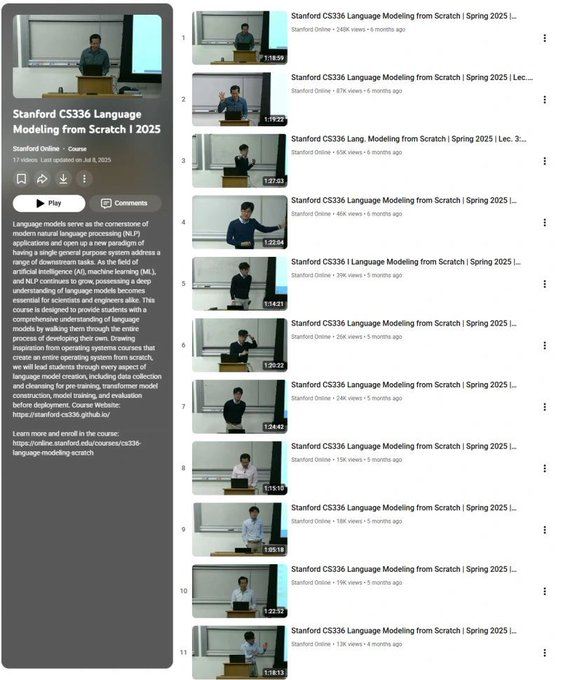
There are 2 career paths in AI right now: The API Caller: Knows how to use an API. (Low leverage, first to be automated, $150k salary). The Architect: Knows how to build the API. (High leverage, builds the tools, $500k+ salary). Bootcamps train you to be an API Caller. This free 17-video Stanford course trains you to be an Architect. It's CS336: Language Modeling from Scratch. The syllabus is pure signal, no noise: ➡️ Data Collection & Curation (Lec 13-14) ➡️ Building Transformers & MoE (Lec 3-4) ➡️ Making it fast (Lec 5-8: GPUs, Kernels, Parallelism) ➡️ Making it work (Lec 10: Inference) ➡️ Making it smart (Lec 15-17: Alignment & RL) Choose your path. (I will put the playlist in the comments.) ♻️ Repost to save someone $$$ and a lot of confusion. ✔️ You can follow @NabilMinhaz , for more insights.
Nabil Abdullah tweet media
English
39
276
1.5K
92.1K
Ali Usman Muhammad retweetledi
Michael Taiwo
Michael Taiwo@AskMichaelTaiwo·
Everyone wants to be top 1% in their field, but the insane level of work required to get there has humbled many people before their desire ever sees the light of day. Malcolm Gladwell says it takes 10,000 hours to reach mastery. Even at 20 hours of focused practice a day, a full year only gets you to 7,300 hours. Many people who desire to be the 1% of the 1% abandon that ambition in under a year. In U.S. immigration, if you are at the top 1% of your field, you are considered someone with Extraordinary Ability (EB-1A visa). Prove it with the right documentation, and a Green Card is within reach. But this is exact what makes the EB-1A visa difficult to get and their numbers remain largely unclaimed. Proving that you're truly elite is a serious and difficult undertaking that most applicants cannot meet. So what I'm saying? You can want it. You can desire to be it. But be ready to match that want & desire with the work it demands. You either increase the sacrifice or reduce the ambition.
Daughter of Muthoni@Miss_Muthoni_

I want to excel in something so well that I am the top 1% in that field.

English
14
80
489
28.2K
Ali Usman Muhammad retweetledi
Nav Toor
Nav Toor@heynavtoor·
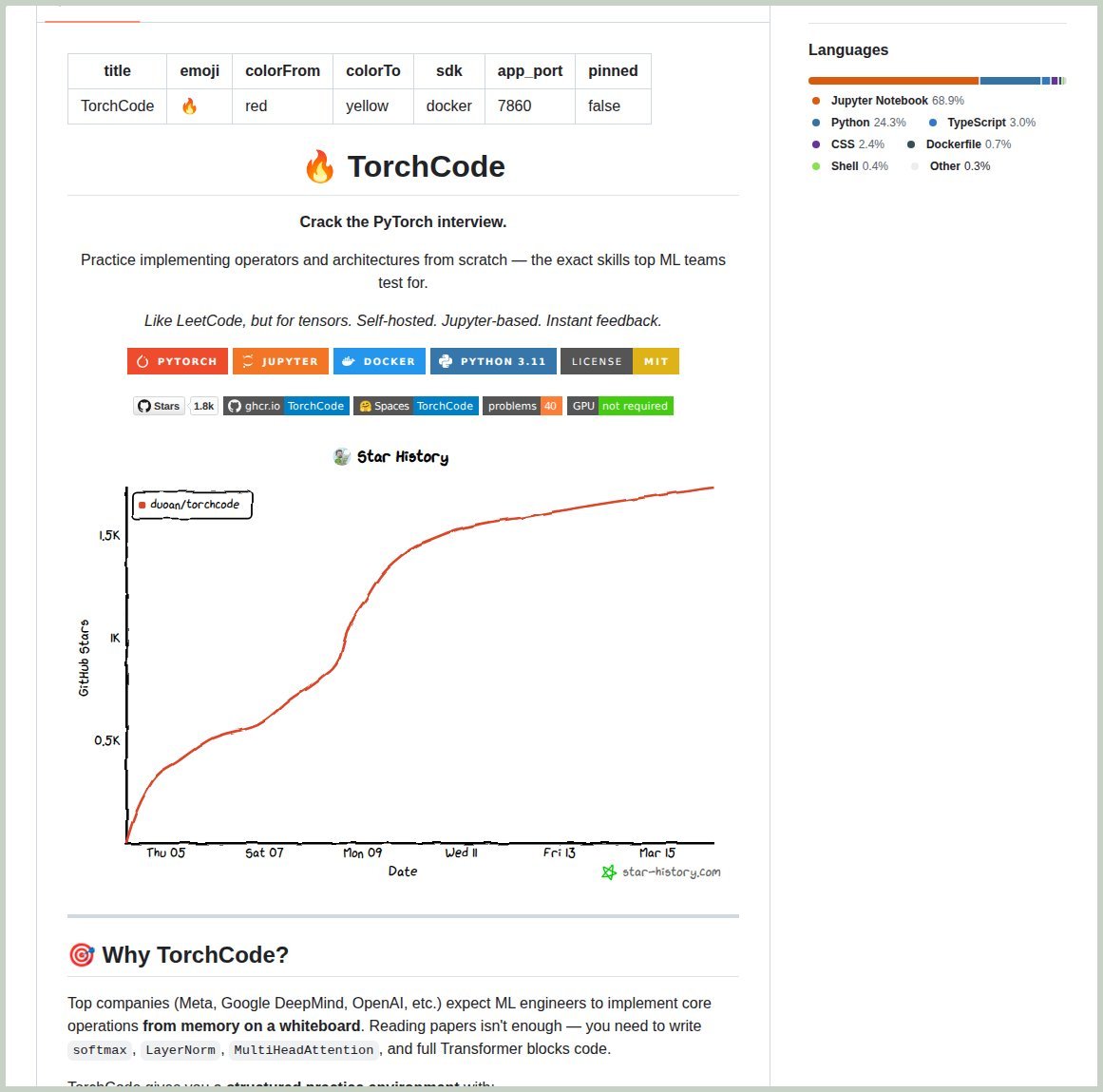
🚨 Meta, Google DeepMind, and OpenAI all ask the same thing in ML interviews: "Implement softmax from scratch.." Most candidates fail. Someone just open sourced the training ground for it. It's called TorchCode. LeetCode, but for PyTorch. 39 problems that test the exact skills top AI labs hire for. No tutorials. No hand-holding. Implement it or fail. Instant auto-grading. Here's what's inside this thing: → Implement ReLU, softmax, LayerNorm, dropout from scratch → Build multi-head attention, full Transformer blocks, GPT-2 → Automated judge checks correctness, gradients, and timing → Colored pass/fail per test case like competitive programming → Hints when you're stuck. Full reference solutions after you try. → Progress tracking. What you solved, best times, attempt counts. → Runs in your browser. No GPU needed. No signup. No cloud. Here's the wildest part: Every problem is a real interview question from top AI companies. You're not learning theory. You're practicing the exact exercises that get people $400K+ offers at Meta AI, DeepMind, and OpenAI. Try it right now on Hugging Face. Zero install. Opens in your browser. ML bootcamps charge $10,000 to $30,000 to teach this. Interview prep courses charge $2,000+. This is free. 776 GitHub stars. MIT License. 100% Open Source.
Nav Toor tweet media
English
34
161
1.2K
189.1K
Ali Usman Muhammad retweetledi
Nav Toor
Nav Toor@heynavtoor·
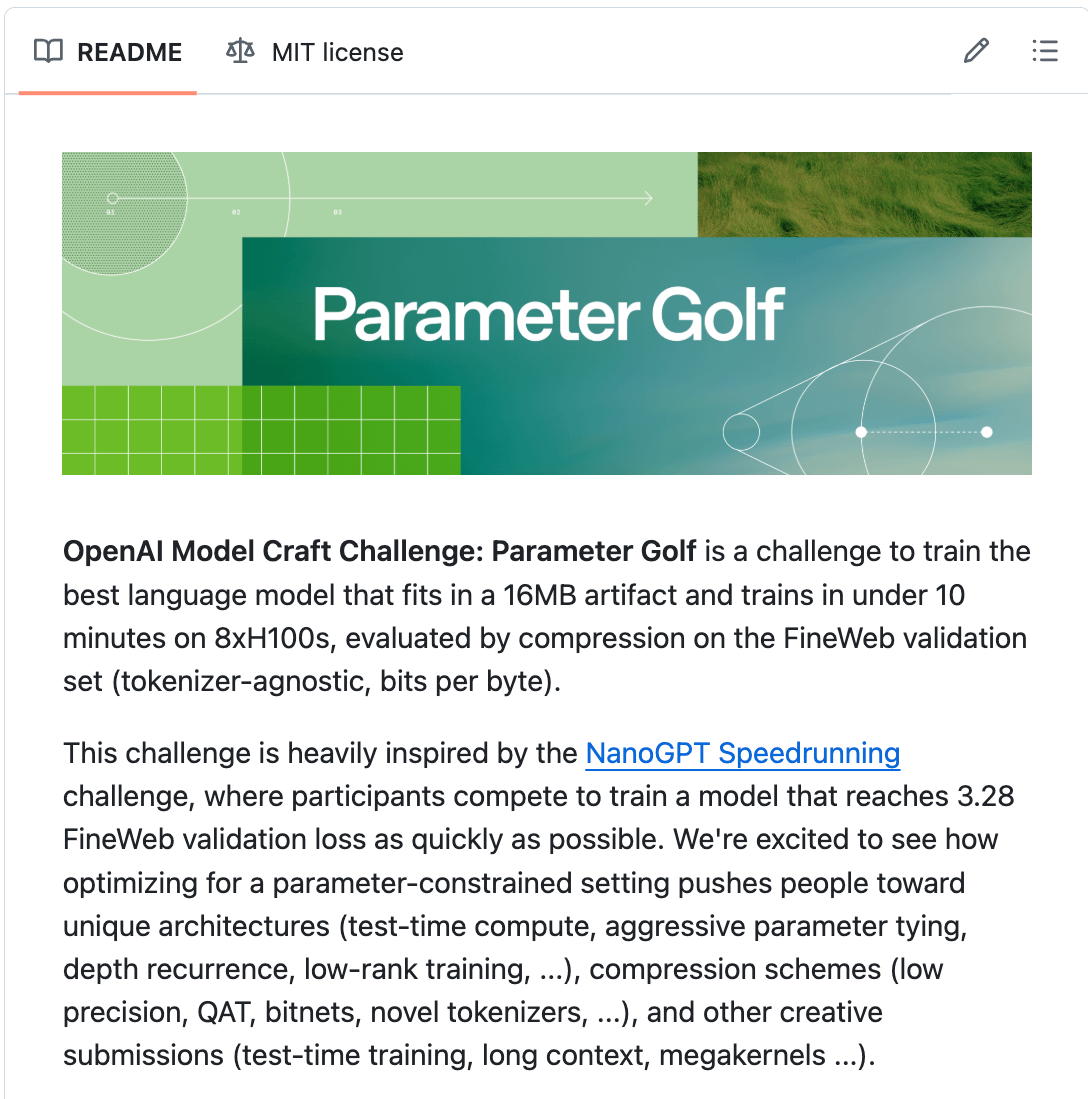
🚨 PhD students are panicking. OpenAI just told the world: we don't care about your degree. Build the best AI model under 16MB and we'll find you. That's smaller than one photo on your phone. It's called Parameter Golf. Train the smartest language model you can. It must fit in 16 megabytes. You get 10 minutes on 8xH100 GPUs. Lowest score wins. OpenAI is backing it with $1,000,000 in free compute credits. No resume. No interview. No PhD required. Just build. Here's what's inside this thing: → A public leaderboard where anyone can submit → Competitors beating each other's scores within hours → Architectures nobody has ever tried before → The baseline scored 1.2244. In 3 days it dropped to 1.1428. Still falling. → 236 pull requests. 1,500 forks. The leaderboard changes every few hours. Here's the wildest part: Top performers get noticed by OpenAI researchers and recruiters directly. No application. No hiring pipeline. Your model IS your resume. AI labs spend millions recruiting through conferences and university pipelines. OpenAI just replaced all of that with a single GitHub repo. Challenge runs until April 30th. Everything is public. 3.1K GitHub stars. MIT License. 100% Open Source.
Nav Toor tweet media
English
51
234
2K
254.5K
Ali Usman Muhammad retweetledi
Yuri Sagalov
Yuri Sagalov@yuris·
The latest YC batch made me update my priors on build speed. YC batches are a quarterly snapshot of what technology makes possible, and it's clear something materially changed over the last 3-4 months. W26 teams are shipping _much_ faster than F25 and prior.
English
18
16
407
136.2K
Ali Usman Muhammad retweetledi
Louis Gleeson
Louis Gleeson@aigleeson·
Some dumb researchers still read papers one by one. Stanford PhD students just use Claude. Here are 9 prompts that turn 40+ papers into structured literature reviews, knowledge maps, and research gaps in minutes:
Louis Gleeson tweet media
English
26
197
1K
130.4K