Alpazey

115 posts

Alpazey

Alpazey

@Alpazey

Katılım Ocak 2024
63 Takip Edilen34 Takipçiler
Alpazey
Alpazey@Alpazey·
@freexjt The ideas differ but produce the same result - try it out on your chart
English
0
0
0
98
JT
JT@freexjt·
@Alpazey that would be anti-ote. not the same as inversion ote
English
1
0
1
150
JT
JT@freexjt·
a long time ago i discussed “inversion” OTE OTE is the range where orders are paired for continuation this i also the range of price that must be “overcame” for expansion to permit… 🔑
English
1
0
6
543
Alpazey
Alpazey@Alpazey·
@freexjt @I_Am_The_ICT Can you give an example of a “pattern of time”? How do you quantify a pattern of time? Nothing vague
English
0
0
0
63
The Inner Circle Trader
The Inner Circle Trader@I_Am_The_ICT·
What I do is not pattern based. Frankly markets do not book for pattern sake. It is TIME driven and coded to reprice to one of two premises on the basis of Premium or Discount. Liquidity or Inefficiency... nothing more... nothing else. I'm flattered you think it's "patterns".
English
73
242
2.2K
110.7K
Alpazey
Alpazey@Alpazey·
@hopiplaka unless you look for the same occurrence when drawing the fib as an extension - but I get your point
English

0
0
0
70
Hopiplaka
Hopiplaka@hopiplaka·
@Alpazey True, but than you miss the point of the ote zone being the wick, a hallmark of high probability reflections
English
1
0
1
251
Hopiplaka
Hopiplaka@hopiplaka·
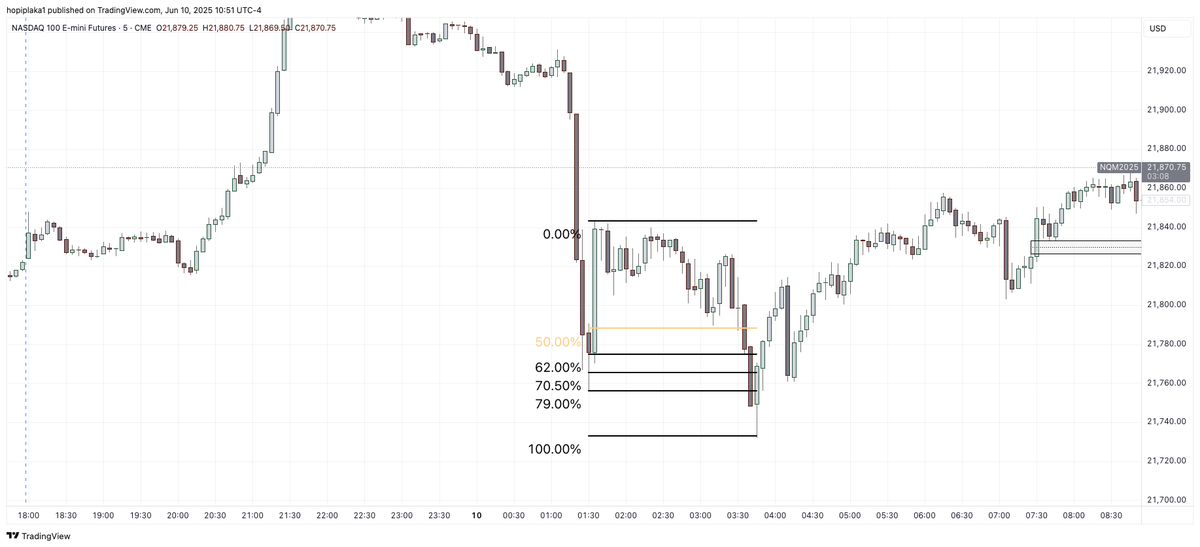
See how the "reflection" pattern creates a new low, and the "OTE zone" accidentally maps to the wick of the previous swing low?
Hopiplaka tweet media
Hopiplaka@hopiplaka

One of @I_Am_The_ICT first patterns were the OTE and the Reflection pattern. They make up a nice swing low here. I couple this with a #goldbach algo 1 fib

English
5
3
21
4K
Alpazey
Alpazey@Alpazey·
@freexjt I figured out what you meant by equilibrium :) use it recursively, first for a e.g. 4h candle, then the 1H candle encapsulated by it at its closure, continue to do this and you can call tops and bottoms if you pair it with a PD array
English
1
0
4
279
JT
JT@freexjt·
The candles that print on your data feed or an after image, or “ foot print” conveying that which has already occurred Consider it latent delivery of price action
English
2
1
5
782
Alpazey
Alpazey@Alpazey·
@freexjt by the way, when you refer to equilibrium, do you mean the opening of a range, or the actual 50% of said range?
English
1
0
3
174
JT
JT@freexjt·
@Alpazey keep studying, it’s been two days since we talked… equilibrium is very key 🔑
English
2
0
1
257
JT
JT@freexjt·
10 pips ranges 20 handles ranges fixed ranges
English
2
0
4
653
Alpazey
Alpazey@Alpazey·
@freexjt do you have a chart based example?
English
1
0
0
130
JT
JT@freexjt·
whether the daily range is 100 pips (points/handles, etc) or 10, would you believe me if i told you the market operates on the same time based assignment? delivery windows and deferment windows some fill with closure some fill with wick some are used to build in LQ for taking
English
3
0
6
490
Alpazey
Alpazey@Alpazey·
@freexjt I also got your heartbeat analogy :) ohlc = heartbeat
Alpazey tweet media
English
1
0
0
151
JT
JT@freexjt·
@Alpazey (2/2) the teachings and guidance from ipda data range month 5, paired with month 7 (high resistance to low resistance 1&2) — i cannot re-explain several hours of teachings over a twitter conversation. i’m giving you the direct guidance as to what to look for and how to go about
English
2
0
0
248
JT
JT@freexjt·
institutions can’t move price indefinitely (one direction, one side)… they must maintain risk parity by rebalancing positions unpaired liquidity yields unbalanced books
English
2
0
7
605
Alpazey
Alpazey@Alpazey·
@freexjt I understand that in a premium + PD array, price will move to a discount + the same type of pd array as this is how order pairing would work 🫡
English
0
0
1
89
Alpazey
Alpazey@Alpazey·
@freexjt ignore the 3rd line I accidentally included
English
0
0
0
43
JT
JT@freexjt·
@Alpazey revisit my response to you about how to screen record and observe all of these things happening with all time frames of your personal choice open to see how they interact as specific, turning points of the market… -
English
3
0
0
184
JT
JT@freexjt·
@Alpazey - you are not going to look at things one time and understand the entire workings of how things work; repetition
English
1
0
2
102
Alpazey
Alpazey@Alpazey·
@freexjt So do you have an recommendations I should take from here? When I observe the 20/40/60 look back on 3 different time frames, I struggle to see how they play into each other
English
1
0
0
144
JT
JT@freexjt·
@Alpazey if that’s what you would like to do, there’s so many models you can make. the algo is complicated bit engaging with a few principles of the algo is not
English
1
0
1
153
Alpazey
Alpazey@Alpazey·
@freexjt Ok now I’m getting somewhere - so now I’m guessing I need to somehow stack these rules into a system based on the look back of 3 different timeframes 👀
English
1
0
0
126
JT
JT@freexjt·
@Alpazey YES now you are thinking 👏🏾…. every function has an assigned time (you figure this part out) based on the timeframe you’re observing, but every timeframe follows the same rules (3) that’s exactly why you see elongated distortion followed by sharp moves, and more consolidation
English
1
0
1
171
Alpazey
Alpazey@Alpazey·
@freexjt p3: so we don’t have magical variable times, but instead we have these segments where we need to classify what happens in each segment and make a logical decision on that will happen next
English
1
0
1
75
JT
JT@freexjt·
@Alpazey time governs your entire life, you don’t even know it
English
3
0
0
181
Alpazey
Alpazey@Alpazey·
@freexjt p2: and classify them as consolidation, expansion, reversal or retracement, we can expect price to transition from one state to another, if price completes one of these states, e.g. a price run, before the end of the 3rd segment, it will just consolidate
English
1
0
1
87