AlphaSense

20.4K posts

AlphaSense banner
AlphaSense

AlphaSense

@AlphaSenseInc

Powering the world’s biggest decisions. 7K+ enterprises trust our AI and market intelligence platform to deliver timely insights. (Not investment advice)

US | EU | IN Katılım Eylül 2013
506 Takip Edilen33.5K Takipçiler
Sabitlenmiş Tweet
AlphaSense
AlphaSense@AlphaSenseInc·
AlphaSense has been recognized as a Leader in the inaugural 2026 Gartner Magic Quadrant™ for Competitive & Market Intelligence Platforms. We are positioned highest on Ability to Execute and furthest on Completeness of Vision. Most research workflows are broken by design. Analysts toggle between seven tabs, chase down paywalled reports, and manually reconcile conflicting data before they can surface a single insight. We believe this placement reflects what our customers already know: when you unify fragmented data (broker research, expert call transcripts, filings) into a single AI platform, research doesn’t just get faster. It gets fundamentally better. The future of research is unified, AI-accelerated, and source-verified and we believe we’re building it. Learn more here: alpha-sense.com/reports/gartne…
English
0
7
19
8.1K
AlphaSense
AlphaSense@AlphaSenseInc·
$NU reported record Q1 2026 financial results driven by customer growth, expanded monetization, and AI-driven operational improvements, while maintaining disciplined credit underwriting and signaling measured international expansion into the US market. - Revenue reached $5 billion for the first time, driven by customer growth and an increase in average revenue per active customer (APAC) to around $16. - Customer base growth continued across Latin America, with 135 million total customers, including over 115 million in Brazil, 15 million in Mexico, and nearing 5 million in Colombia. - Net income hit a record $871 million, up 41% year-over-year on an FX-neutral basis, marking the highest first-quarter net income in company history. - Credit portfolio grew 40% year-over-year to $37.2 billion, with strong growth across all products: credit cards (+36%), unsecured lending (+53%), and secured lending (+38%). - Deposits totaled $42.4 billion, up 22% year-over-year, though Brazil saw a modest decline due to seasonality and liability management.
AlphaSense tweet media
English
0
3
17
3.4K
AlphaSense
AlphaSense@AlphaSenseInc·
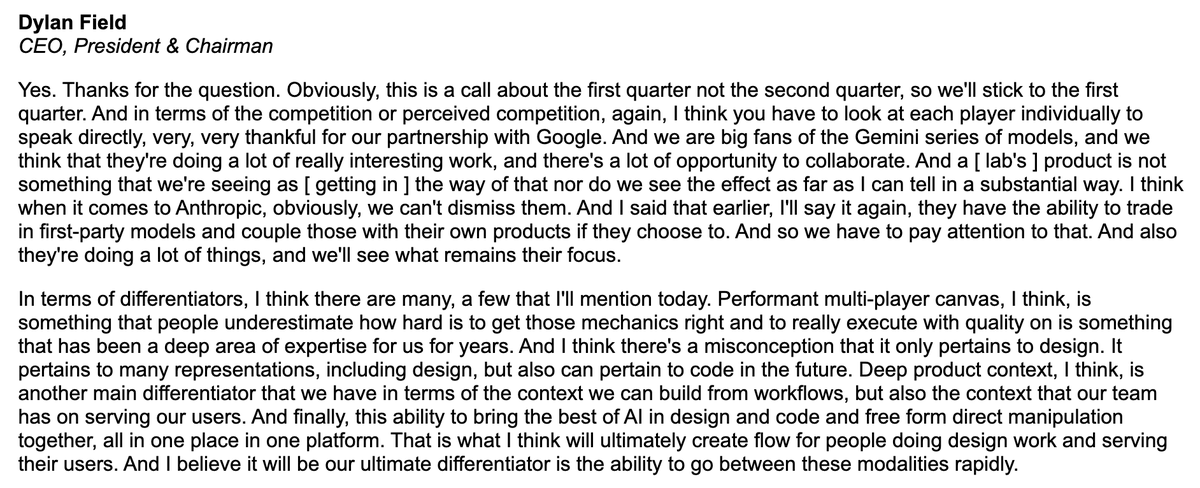
$FIG CEO acknowledged Google's competing product as a minimal threat and Anthropic as a more serious one to watch, while arguing Figma's ultimate differentiator is its unified platform combining AI, design, code, and multiplayer canvas in one seamless experience. "And in terms of the competition or perceived competition, again, I think you have to look at each player individually to speak directly, very, very thankful for our partnership with Google. And we are big fans of the Gemini series of models, and we think that they're doing a lot of really interesting work, and there's a lot of opportunity to collaborate. And a [ lab's ] product is not something that we're seeing as [ getting in ] the way of that nor do we see the effect as far as I can tell in a substantial way. I think when it comes to Anthropic, obviously, we can't dismiss them. And I said that earlier, I'll say it again, they have the ability to trade in first-party models and couple those with their own products if they choose to. And so we have to pay attention to that. And also they're doing a lot of things, and we'll see what remains their focus. In terms of differentiators, I think there are many, a few that I'll mention today. Performant multi-player canvas, I think, is something that people underestimate how hard is to get those mechanics right and to really execute with quality on is something that has been a deep area of expertise for us for years. And I think there's a misconception that it only pertains to design. It pertains to many representations, including design, but also can pertain to code in the future. Deep product context, I think, is another main differentiator that we have in terms of the context we can build from workflows, but also the context that our team has on serving our users. And finally, this ability to bring the best of AI in design and code and free form direct manipulation together, all in one place in one platform. That is what I think will ultimately create flow for people doing design work and serving their users. And I believe it will be our ultimate differentiator is the ability to go between these modalities rapidly."
AlphaSense tweet media
English
0
5
27
3.8K
AlphaSense
AlphaSense@AlphaSenseInc·
$FIG reported exceptional Q1 2026 results driven by strong AI adoption, accelerating revenue growth, and expanding customer engagement across enterprise and mid-market segments, with management raising full-year guidance on the back of AI credit monetization momentum and broad-based seat expansion. - Figma Inc. reported Q1 2026 revenue of $333 million, representing 46% year-over-year growth. - The net dollar retention (NDR) rate increased to 139%, reaching its highest level in over two years. - The total paid customer base grew to approximately 690,000, a 54% increase compared to the previous year. - Figma raised its full-year 2026 revenue guidance to a range of $1.422 billion to $1.428 billion. - Paid customers spending more than $10,000 in IRR grew 37% year-over-year, while those spending over $100,000 grew 48%. - Full-year non-GAAP operating income guidance was raised to between $125 million and $135 million, representing a 9% margin at the midpoint.
AlphaSense tweet media
English
0
1
13
2.4K
AlphaSense
AlphaSense@AlphaSenseInc·
If you are interested in more interviews like this one, make sure to follow us! Stop second-guessing. Whether you're tracking market shifts, exploring new opportunities, or need clarity on complex decisions, our extensive transcript library and custom expert calls give you the competitive edge you need. ⬇️ alpha-sense.com/trial-request-…
English
0
1
0
1.4K
AlphaSense
AlphaSense@AlphaSenseInc·
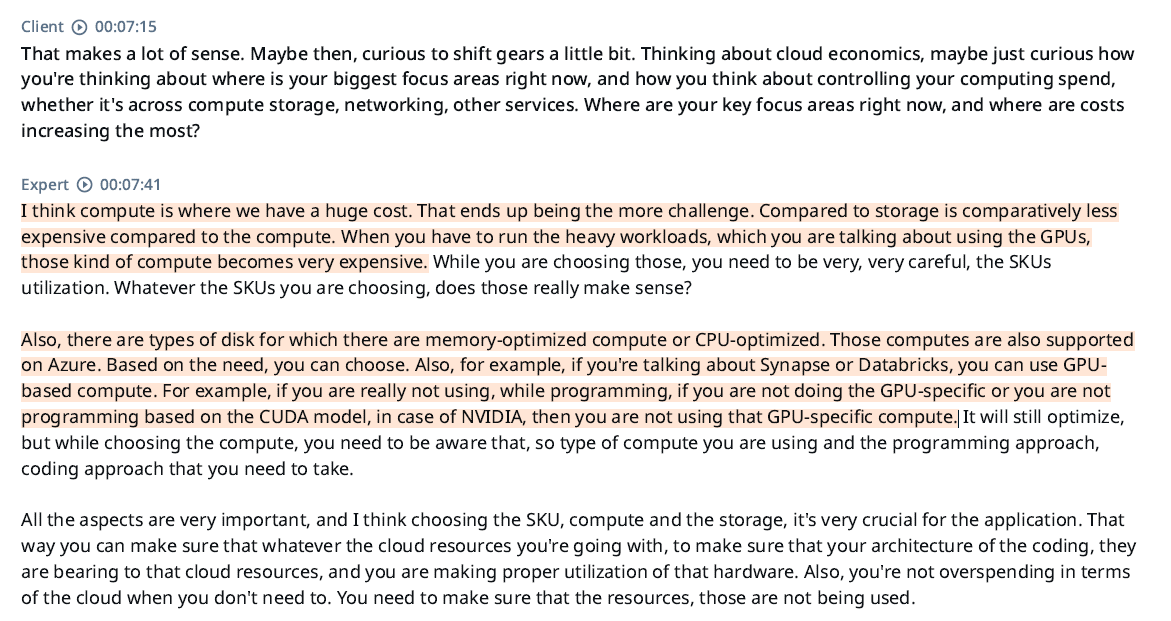
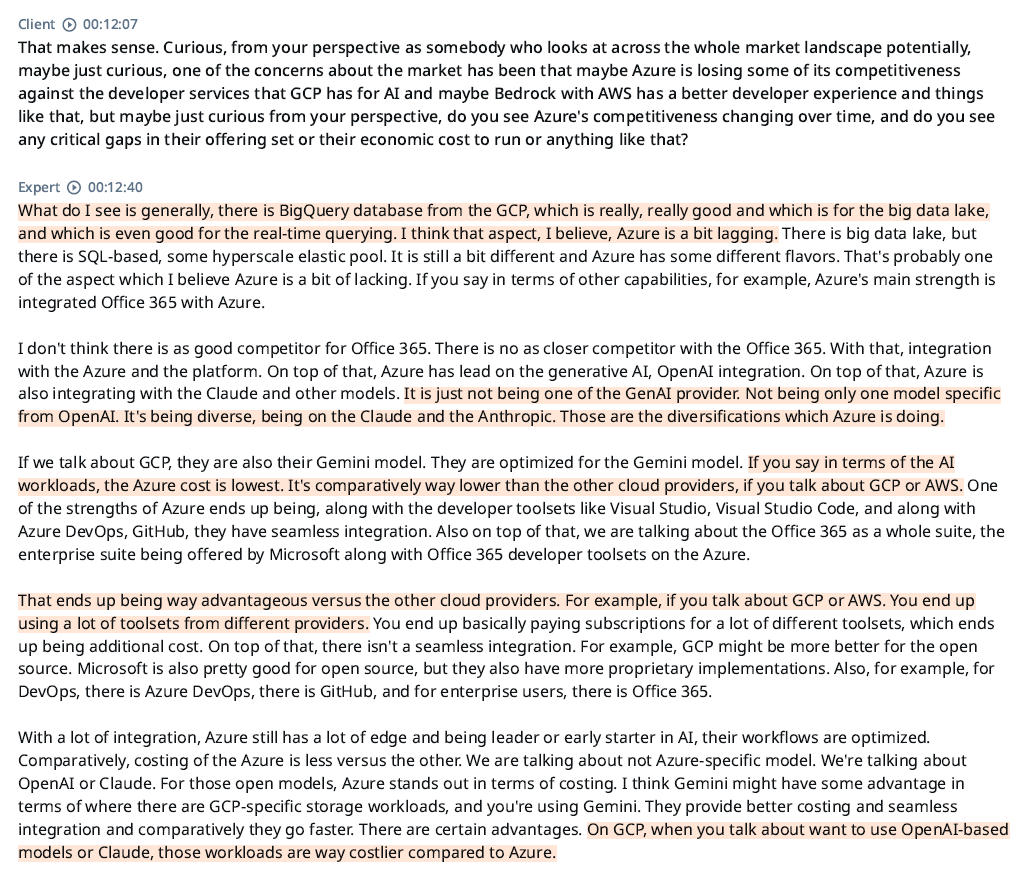
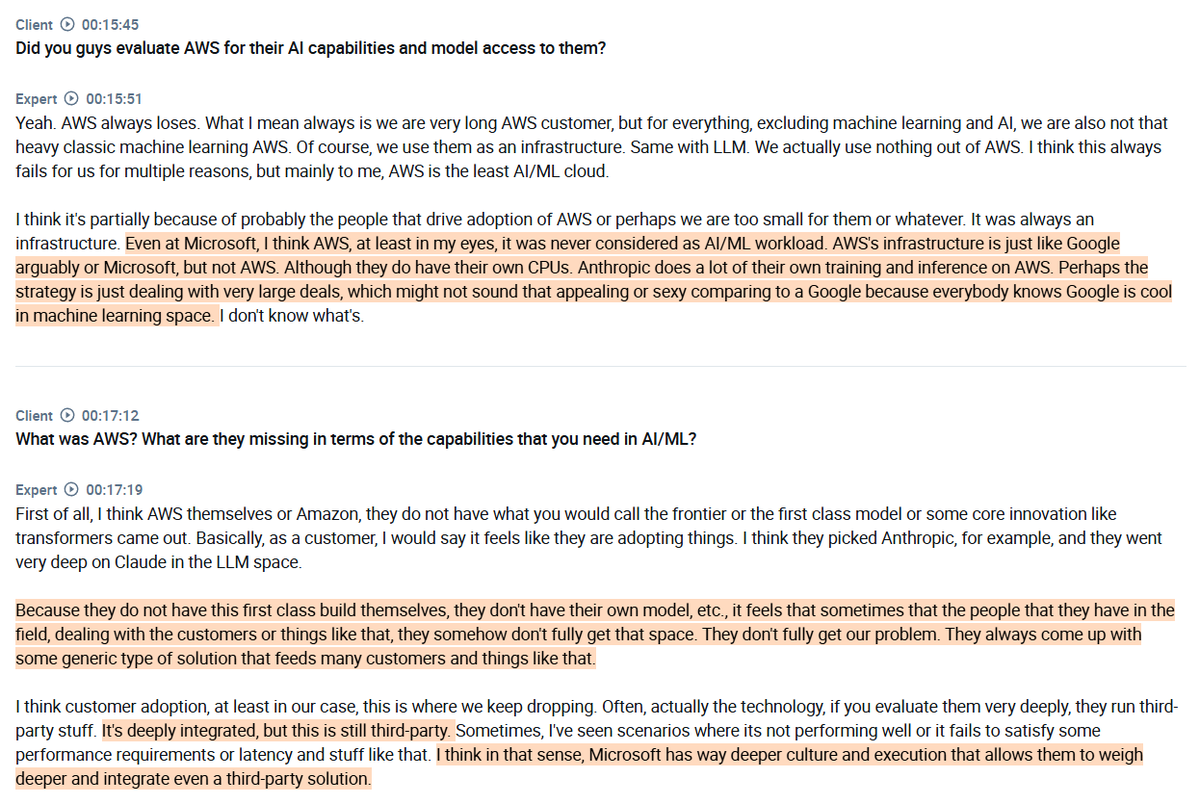
Former $MSFT employee on why enterprise customers keep choosing Azure ( $AMZN, $GOOGL, $ORCL ): - The expert sees compute as the single biggest cost driver, particularly for GPU-heavy AI workloads, with storage comparatively manageable. The key is making sure the type of compute chosen actually matches the workload, whether that is memory-optimized, CPU-optimized, or GPU-based, since picking the wrong configuration means paying for capability that never gets fully used. - The expert notes that Azure's main weakness is in big data and real-time querying, where GCP's BigQuery is stronger, and Azure's offerings in that space feel a step behind. Where Azure makes up for it is in the depth of its integrated ecosystem, with Office 365, Visual Studio, GitHub, and Azure DevOps all working together natively in a way that $GOOGL and $AMZN cannot match without stitching together multiple third-party tools at additional cost. - The expert highlights that $MSFT is making a deliberate move away from single-model dependence by integrating OpenAI and Claude alongside other models, adding meaningful flexibility for enterprise customers. On cost, Azure is cheaper than GCP or AWS for AI workloads running on models like ChatGPT or Claude, while GCP has the edge in cost and integration, especially when running Gemini on its native storage infrastructure. - According to the expert, enterprise deals are where cloud providers offer their best pricing, and going multi-cloud typically means giving that up since you are no longer committing fully to any single provider. Multi-cloud gives flexibility to switch and pick the best tool for each workload, but it comes at a cost, both financially and in terms of integration, with security challenges around traffic routing adding another layer of complexity that a single-provider setup avoids. - The expert believes $ORCL is behind major cloud providers, with strengths concentrated in databases and a smaller overall service offering. Rather than competing directly, $ORCL's strategy is to host its services on other clouds like AWS, giving its large existing database customer base a path to migrate to the cloud without having to move to OCI directly.
AlphaSense tweet mediaAlphaSense tweet mediaAlphaSense tweet mediaAlphaSense tweet media
English
4
10
68
9.3K
AlphaSense
AlphaSense@AlphaSenseInc·
Volatile energy prices, shifting supply chains, and diverging policy paths are making it harder than ever for APAC leaders to read the macro signals that actually matter. As companies rethink supply chains, navigate inflation pressures, and invest in AI-driven productivity, the gap between resilient and vulnerable markets is widening. We break down the biggest forces shaping APAC markets right now, from energy shocks and policy divergence to thematic investing and AI adoption. Read the full post here: alpha-sense.com/resources/rese…
AlphaSense tweet media
English
0
0
3
1.7K
AlphaSense
AlphaSense@AlphaSenseInc·
If you are interested in more interviews like this one, make sure to follow us! Stop second-guessing. Whether you're tracking market shifts, exploring new opportunities, or need clarity on complex decisions, our extensive transcript library and custom expert calls give you the competitive edge you need. ⬇️ alpha-sense.com/trial-request-…
English
0
0
0
1.6K
AlphaSense
AlphaSense@AlphaSenseInc·
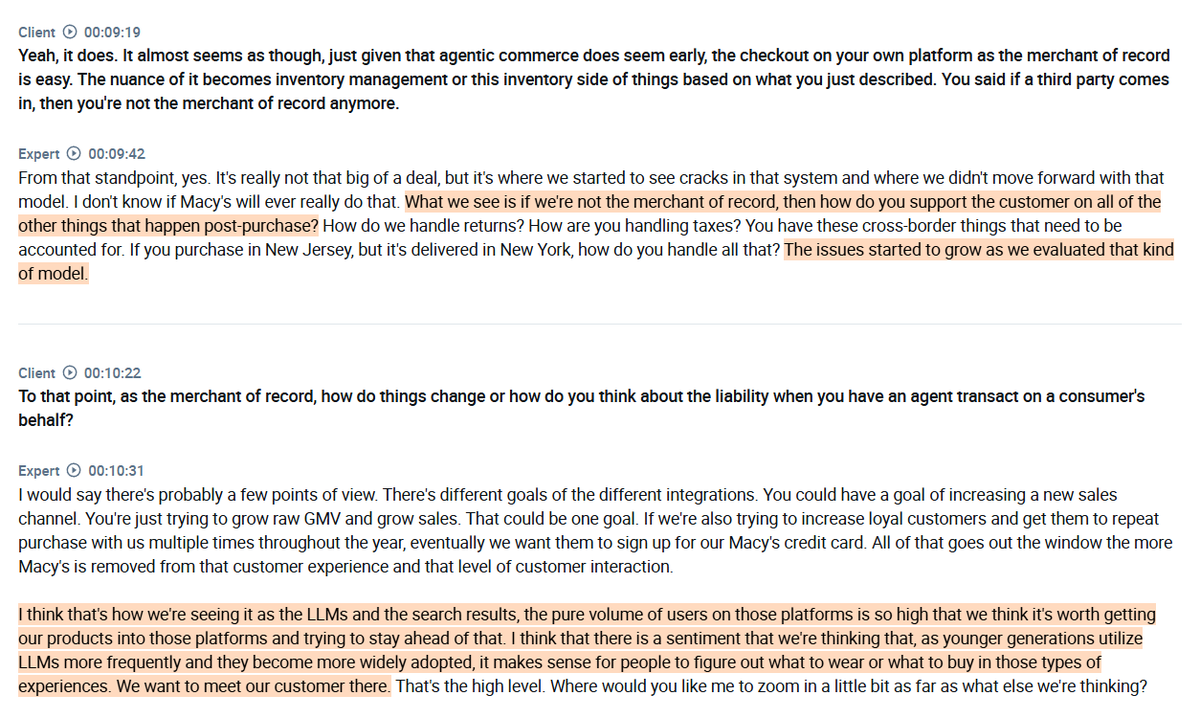
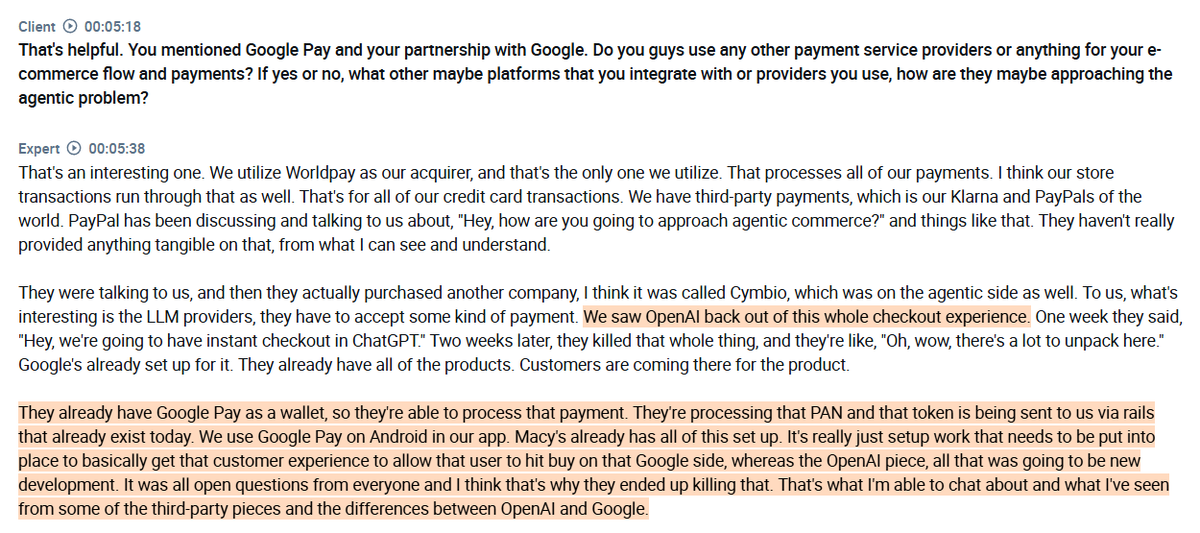
Industry expert explains how $GOOGL is positioning itself to lead the shift toward agentic commerce: - The expert sees $GOOGL in a stronger position than OpenAI on agentic commerce precisely because the infrastructure is already in place: Google Pay, existing product listings, and payment solutions are all live and working today, making the shift to agentic checkout largely a setup exercise. OpenAI announced an instant checkout experience in ChatGPT but walked it back within two weeks, which the expert sees as a reflection of how many open questions still exist on that side, compared to $GOOGL, where the foundational pieces are already in place. - The expert emphasizes that the merchant-of-record question is where agentic commerce gets complicated, noting that losing that status creates many unresolved issues with returns, taxes, and cross-border transactions, which quickly make that model impractical. Still, the expert sees the volume of users on LLM platforms as too large to ignore and views getting products into those environments as a way to stay ahead of a generational shift in which younger consumers increasingly turn to AI to decide what to buy. - The expert highlights several gaps in the current $GOOGL offering. Ranking is unpredictable, with search results shifting positions in response to parameter changes, such as size selection, in ways that $GOOGL's own product team cannot fully explain, meaning there is no loyalty built into the system and no transparency around how results are ordered. Also, the MVP does not support multiple quantities or multi-item bags, which creates friction for any retailer with an average transaction above one unit. - Another unresolved question is cannibalization, with the expert noting that a user transacting directly on $GOOGL Shopping might not land on the retailer's site, removing all the downstream opportunities around basket size, credit card sign-ups, and repeat visits that make those customers valuable in the first place. Even $GOOGL struggled to explain how success should be measured in that scenario. - The expert believes that agentic commerce is not a meaningful traffic driver in the short term, noting that LLM-sourced traffic has been among the lowest of any search engine, though month over month growth has been consistent. Looking further out, the expert sees single digit percentage of total sales coming from LLMs as achievable within roughly two years.
AlphaSense tweet mediaAlphaSense tweet mediaAlphaSense tweet mediaAlphaSense tweet media
English
1
16
83
11.1K
AlphaSense
AlphaSense@AlphaSenseInc·
👀 Look who's coming to #AlphaSummit2026. We are elated to announce George Lee, Co-Head of the Goldman Sachs Global Institute, as a keynote speaker! As the former Co-CIO of @GoldmanSachs and current co-lead of the firm’s AI steering group, George has spent decades at the intersection of technology and innovation. Having advised giants like Microsoft, Apple, Alphabet, Meta, and Tesla, he brings an unparalleled perspective on how AI, geopolitics, and global markets are fundamentally reshaping business strategy. Join us in October at The Glasshouse in NYC for three days to explore the next frontier of market intelligence — where AI, data, and human expertise converge. alphasummit.ai/?utm_source=tw…
English
0
0
1
1.8K
AlphaSense
AlphaSense@AlphaSenseInc·
The role and purview of the modern CFO has evolved significantly as our own Samantha Greenberg can attest. She is dedicating at least 🔟 hours a week to honing her AI skills. Sharpening those skills ensures that she is at the forefront of being hands-on to best serve the Product, Engineering and Go-To-Market teams as a Finance leader. Learn how one Samantha has gone from AlphaSense power user to now driving a truly AI-native finance organization via @CFODive: cfodive.com/news/alphasens…
AlphaSense tweet media
English
0
1
8
2.4K
AlphaSense
AlphaSense@AlphaSenseInc·
Over the past year, $AKAM has seen rapid growth in cloud and AI demand, reshaping its financial outlook and strategy. The company has expanded beyond traditional edge services into high‑scale cloud infrastructure, highlighted by a $1.80 billion contract with a leading AI frontier‑model company. This shift reflects rising demand for AI inference, where Akamai’s distributed network delivers the low‑latency performance required for real‑time applications.
AlphaSense tweet media
English
1
2
9
3.5K
AlphaSense
AlphaSense@AlphaSenseInc·
If you are interested in more interviews like this one, make sure to follow us! Stop second-guessing. Whether you're tracking market shifts, exploring new opportunities, or need clarity on complex decisions, our extensive transcript library and custom expert calls give you the competitive edge you need. ⬇️ alpha-sense.com/trial-request-…
English
0
0
0
1.6K
AlphaSense
AlphaSense@AlphaSenseInc·
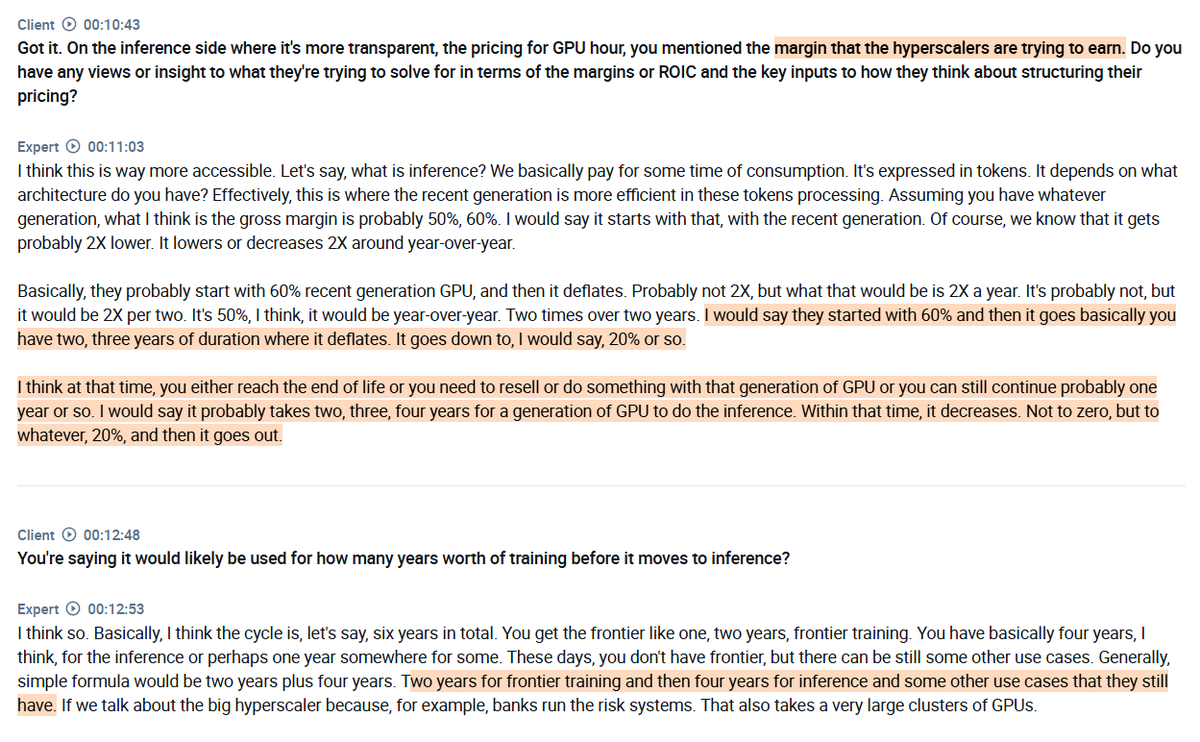
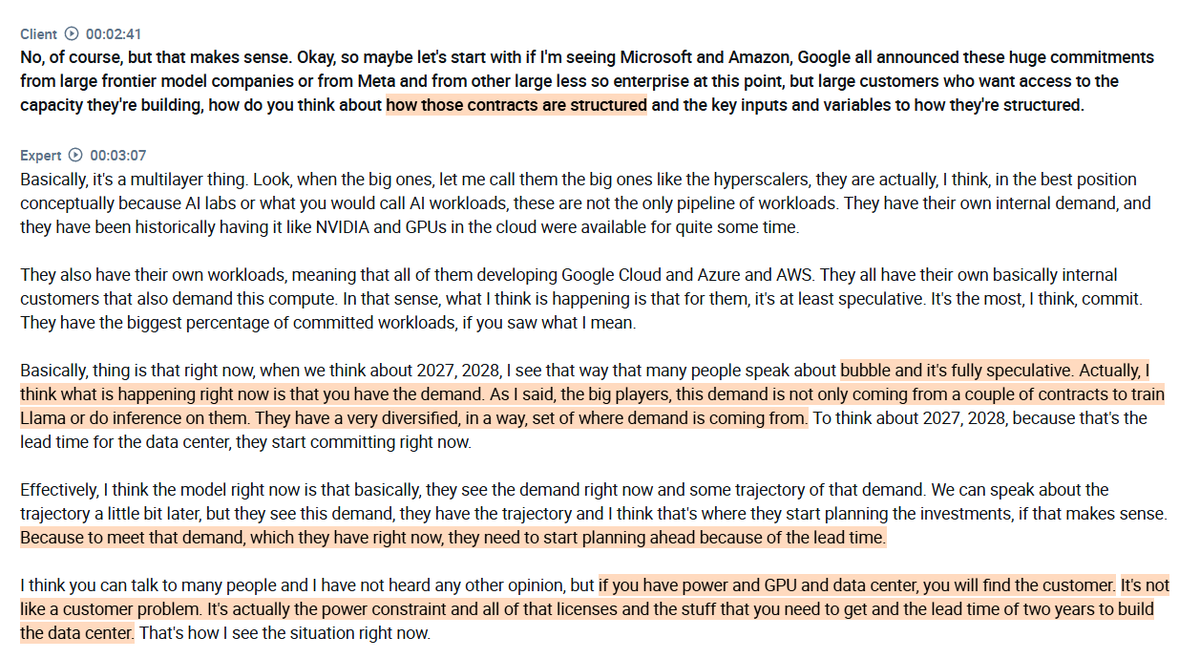
Former $MSFT employee on why hyperscalers extract more value from AI hardware than others ( $AMZN, $GOOGL ): - According to the expert, hyperscalers operate very differently from neoclouds or companies managing their own infrastructure. They are comfortable spending heavily on the newest GPUs because they have the scale to keep using that hardware for many years. The newest chips are first used for the most demanding AI workloads, and later get shifted into less intensive tasks across other parts of the data center network, allowing hyperscalers to keep extracting value from them over time. - The expert does not see agentic AI workloads as necessarily requiring LPX rack infrastructure, at least based on direct experience working with customers deploying agentic solutions for departmental use cases like finance and CRM. Those workloads involve moving large chunks of data across systems and orchestrating commands, but the compute intensity does not rise to the level where LPX rack density becomes a hard requirement. - The expert sees strong potential for edge computing in agentic workflows, with more processing happening closer to the user, whether on on-prem servers or even devices like the Mac mini, which he says technically sophisticated users have quietly started adopting for these use cases. In his view, the appeal is not just about speed or efficiency. Security is becoming just as important, as many companies are far more comfortable keeping sensitive data and internal workflows on their own systems instead of relying entirely on a hyperscaler's cloud. - The expert sees current CapEx investment in data centers as stretched, and expects that the same workloads running today could be delivered 30% cheaper in five years as efficiency improves, at which point the market will correct. Power and water constraints are seen as the real forces that will start to slow CapEx growth over that horizon, with data sovereignty adding another layer on top, forcing buildout across geographies with very different regulatory regimes and significantly higher construction costs.
AlphaSense tweet mediaAlphaSense tweet mediaAlphaSense tweet mediaAlphaSense tweet media
English
1
10
53
8K
AlphaSense
AlphaSense@AlphaSenseInc·
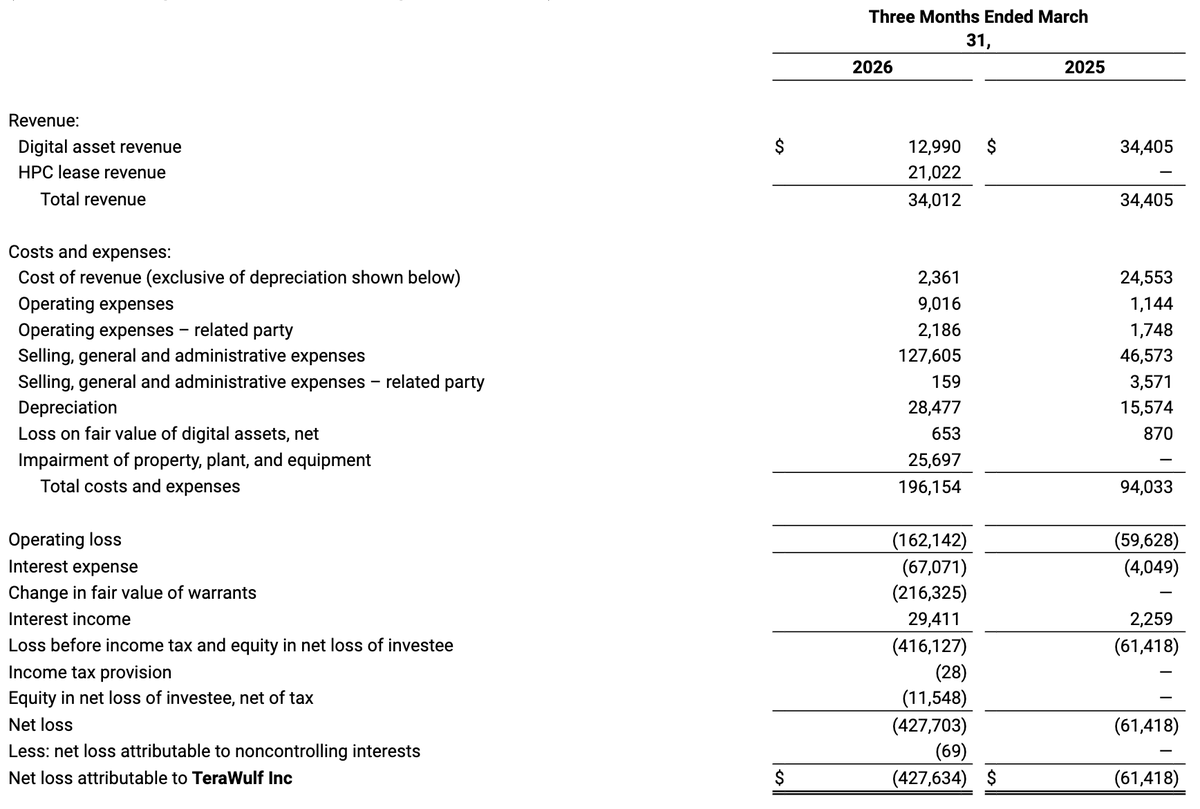
$WULF Earnings: - Generated Q1 2026 revenue of $34.0 million, including $21.0 million of HPC lease revenue. - Maintained strong liquidity position, with approximately $3.1 billion of cash and restricted cash as of quarter-end. Paul Prager, Chairman and Chief Executive Officer of TeraWulf, commented: “The first quarter of 2026 was defined by execution. We entered the year with a fully established platform, including sites, contracts, and capital, and are now converting that foundation into operating performance and recurring revenue. At Lake Mariner, we have 60 megawatts of energized critical IT capacity for Core42 and began generating meaningful lease revenue during the quarter. At the same time, we continue to advance construction in close coordination with our second tenant, Fluidstack, aligning infrastructure delivery with hardware deployment. CB-3 remains on schedule, and execution across the campus continues to progress well. More broadly, we are building a power-advantaged platform that we believe is increasingly differentiated in a market constrained by access to power. Our strategy is unchanged, and we remain focused on disciplined execution." Patrick Fleury, Chief Financial Officer of TeraWulf, added: “The first quarter reflects a more stable, contracted revenue model. HPC lease revenue contributed $21.0 million in the period, representing the initial ramp of long-term customer agreements at Lake Mariner. We ended the quarter with approximately $3.1 billion of cash and restricted cash, providing substantial liquidity to fund our development pipeline. Our capital structure is designed to align long-term financing with contracted cash flows, supporting disciplined growth while maintaining financial flexibility. As we continue to scale, we expect the business to be increasingly driven by recurring, contracted revenue, reducing exposure to the volatility historically associated with bitcoin mining.” research.alpha-sense.com/?docid=PR-3650…
AlphaSense tweet media
English
0
1
5
2.6K
AlphaSense
AlphaSense@AlphaSenseInc·
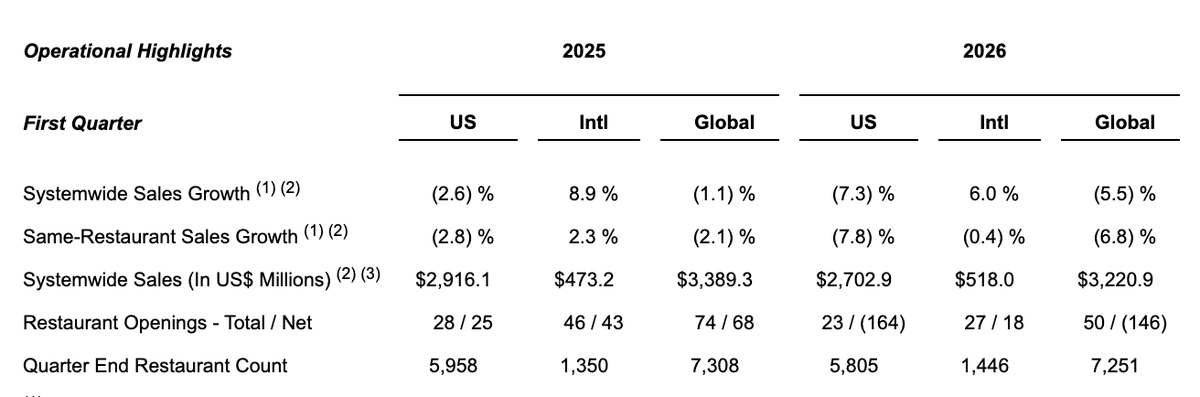
$WEN Earnings: - Global systemwide sales were $3.2 billion, a decrease of 5.5% - International systemwide sales grew 6.0% - Reported net income was $22.7 million and adjusted EBITDA was $111.3 million - Reported diluted earnings per share and adjusted earnings per share were $0.12 - Entered into a franchise agreement to build up to 1,000 restaurants across China - Reaffirms full-year 2026 outlook "We are taking decisive action to strengthen the Wendy's system and improve performance," said Ken Cook, Interim CEO. "During the first quarter, we introduced a new Biggie platform, upgraded our premium hamburgers, and launched new chicken sandwiches. Additionally, our focus on operational excellence is driving improvement in order accuracy and key customer satisfaction metrics. While our first quarter results reflect a business in the early stages of a turnaround, we are making progress to improve our U.S. business and are confident in the direction we are heading." "Our international business continues to deliver strong results, with systemwide sales up 6.0% in the quarter supported by further expansion in key growth markets. We're also excited to announce today a new franchise agreement with an experienced restaurant operator to build up to 1,000 restaurants across China over the next 10 years and look forward to bringing Wendy's to more fans around the globe." "These actions are strengthening our foundation and positioning Wendy's to regain momentum and deliver sustainable growth and long-term value creation." research.alpha-sense.com/?docid=PR-5fd8…
AlphaSense tweet media
English
1
2
3
2.2K
AlphaSense
AlphaSense@AlphaSenseInc·
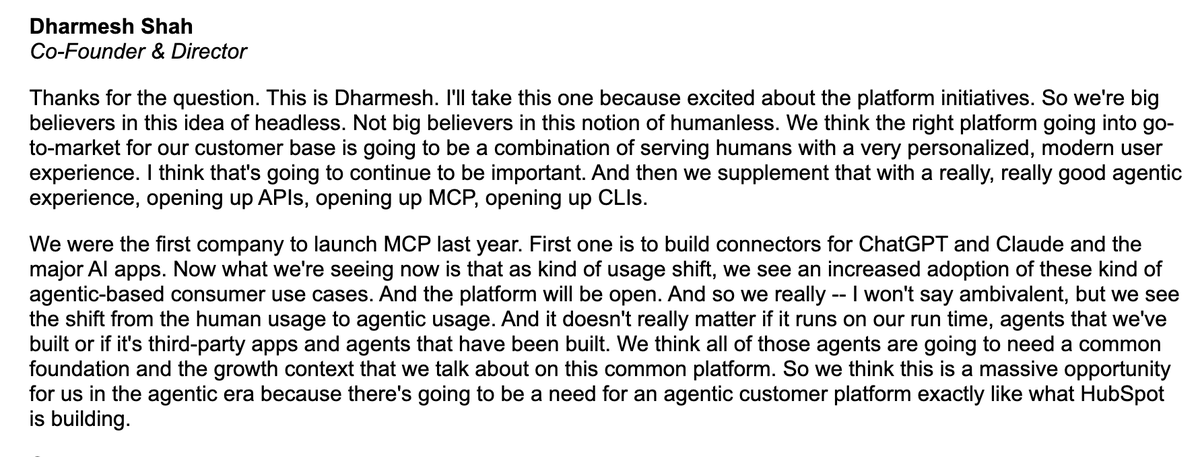
$HUBS Co-founder says the company is moving toward a headless but not humanless future, allowing a traditional human interface to work alongside agentic workflows. The platform is designed to stay open to both internal and third-party agents through APIs, MCP, and connectors. He noted that because agents require a unified foundation and shared context to be effective, HubSpot is positioning itself as the primary agentic customer platform. "I'll take this one because excited about the platform initiatives. So we're big believers in this idea of headless. Not big believers in this notion of humanless. We think the right platform going into go-to-market for our customer base is going to be a combination of serving humans with a very personalized, modern user experience. I think that's going to continue to be important. And then we supplement that with a really, really good agentic experience, opening up APIs, opening up MCP, opening up CLIs. We were the first company to launch MCP last year. First one is to build connectors for ChatGPT and Claude and the major AI apps. Now what we're seeing now is that as kind of usage shift, we see an increased adoption of these kind of agentic-based consumer use cases. And the platform will be open. And so we really -- I won't say ambivalent, but we see the shift from the human usage to agentic usage. And it doesn't really matter if it runs on our run time, agents that we've built or if it's third-party apps and agents that have been built. We think all of those agents are going to need a common foundation and the growth context that we talk about on this common platform. So we think this is a massive opportunity for us in the agentic era because there's going to be a need for an agentic customer platform exactly like what HubSpot is building."
AlphaSense tweet media
English
3
2
26
24.2K
AlphaSense
AlphaSense@AlphaSenseInc·
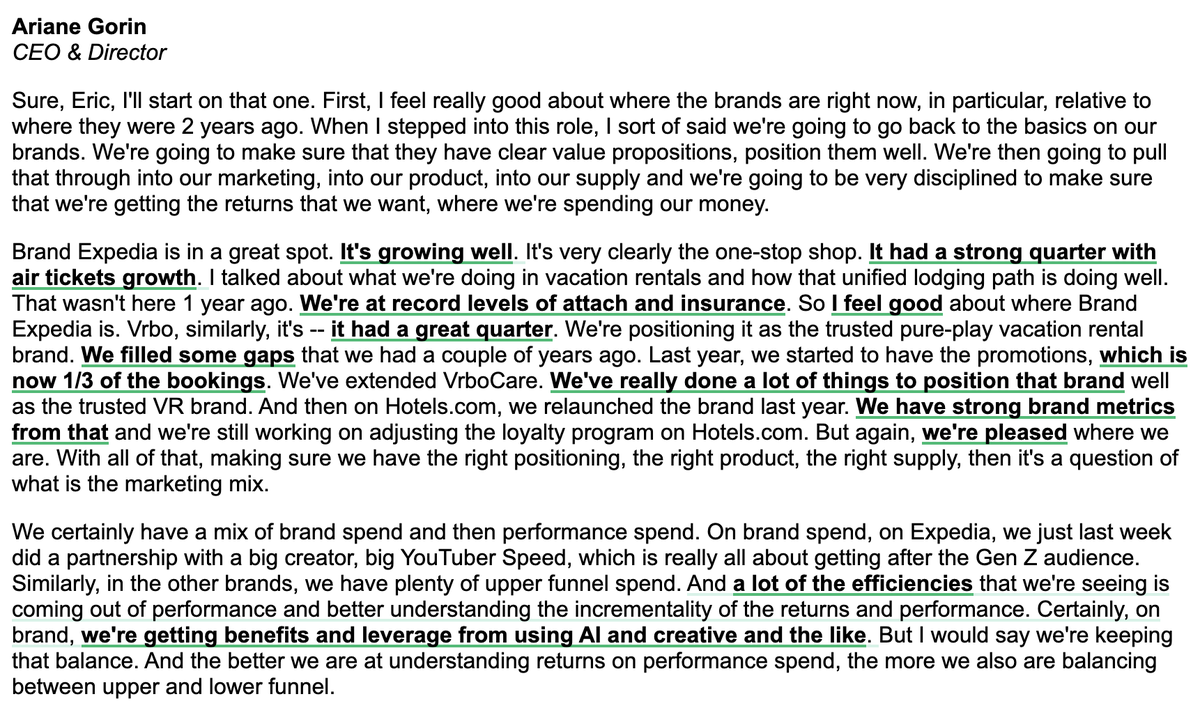
$EXPE's CEO said the company's consumer brands are far healthier than two years ago, as each now has a clear value proposition, stronger product alignment, and improving performance. With that foundation in place, the company is balancing brand and performance marketing more effectively. It is now using creators, upper-funnel campaigns, and AI-driven efficiency gains to drive direct traffic while optimizing returns on performance spend. "First, I feel really good about where the brands are right now, in particular, relative to where they were 2 years ago. When I stepped into this role, I sort of said we're going to go back to the basics on our brands. We're going to make sure that they have clear value propositions, position them well. We're then going to pull that through into our marketing, into our product, into our supply and we're going to be very disciplined to make sure that we're getting the returns that we want, where we're spending our money. Brand Expedia is in a great spot. It's growing well. It's very clearly the one-stop shop. It had a strong quarter with air tickets growth. I talked about what we're doing in vacation rentals and how that unified lodging path is doing well. That wasn't here 1 year ago. We're at record levels of attach and insurance. So I feel good about where Brand Expedia is. Vrbo, similarly, it's -- it had a great quarter. We're positioning it as the trusted pure-play vacation rental brand. We filled some gaps that we had a couple of years ago. Last year, we started to have the promotions, which is now 1/3 of the bookings. We've extended VrboCare. We've really done a lot of things to position that brand well as the trusted VR brand. And then on Hotels.com, we relaunched the brand last year. We have strong brand metrics from that and we're still working on adjusting the loyalty program on Hotels.com. But again, we're pleased where we are. With all of that, making sure we have the right positioning, the right product, the right supply, then it's a question of what is the marketing mix. We certainly have a mix of brand spend and then performance spend. On brand spend, on Expedia, we just last week did a partnership with a big creator, big YouTuber Speed, which is really all about getting after the Gen Z audience. Similarly, in the other brands, we have plenty of upper funnel spend. And a lot of the efficiencies that we're seeing is coming out of performance and better understanding the incrementality of the returns and performance. Certainly, on brand, we're getting benefits and leverage from using AI and creative and the like. But I would say we're keeping that balance. And the better we are at understanding returns on performance spend, the more we also are balancing between upper and lower funnel."
AlphaSense tweet media
English
0
2
4
1.4K
AlphaSense
AlphaSense@AlphaSenseInc·
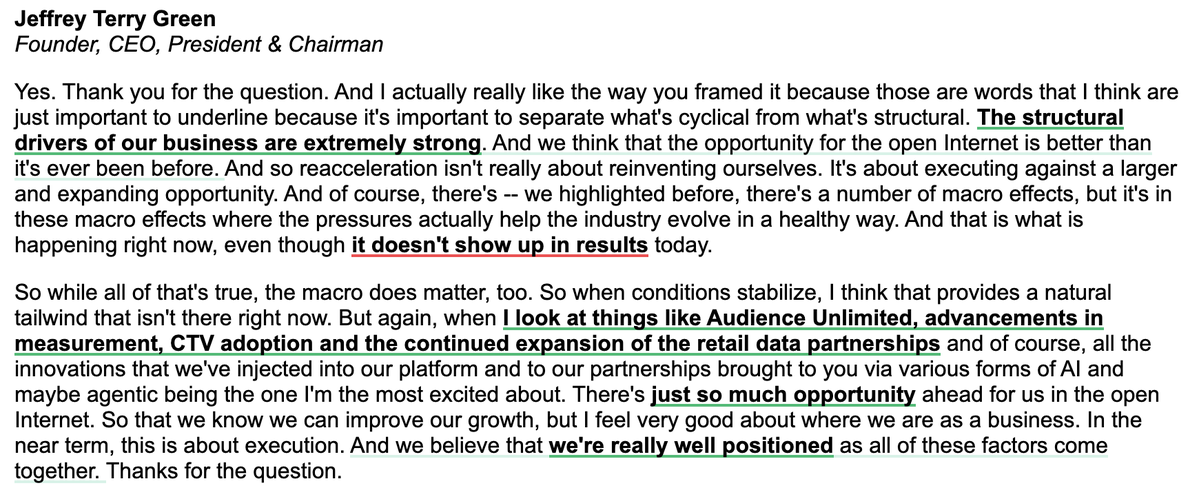
$TTD's CEO said the Q2 slowdown is mostly cyclical, as macro uncertainty weighs on big global brands. He remains confident because the structural drivers behind The Trade Desk are exceptionally strong. Re-acceleration will come from executing against expanding opportunities in measurement reform, CTV, retail data, and agentic-AI innovations, all of which position the company for stronger growth as macro conditions stabilize. "I actually really like the way you framed it because those are words that I think are just important to underline because it's important to separate what's cyclical from what's structural. The structural drivers of our business are extremely strong. And we think that the opportunity for the open Internet is better than it's ever been before. And so reacceleration isn't really about reinventing ourselves. It's about executing against a larger and expanding opportunity. And of course, there's -- we highlighted before, there's a number of macro effects, but it's in these macro effects where the pressures actually help the industry evolve in a healthy way. And that is what is happening right now, even though it doesn't show up in results today. So while all of that's true, the macro does matter, too. So when conditions stabilize, I think that provides a natural tailwind that isn't there right now. But again, when I look at things like Audience Unlimited, advancements in measurement, CTV adoption and the continued expansion of the retail data partnerships and of course, all the innovations that we've injected into our platform and to our partnerships brought to you via various forms of AI and maybe agentic being the one I'm the most excited about. There's just so much opportunity ahead for us in the open Internet. So that we know we can improve our growth, but I feel very good about where we are as a business. In the near term, this is about execution. And we believe that we're really well positioned as all of these factors come together."
AlphaSense tweet media
English
1
3
7
2.2K
AlphaSense
AlphaSense@AlphaSenseInc·
Toyota Motor Corporation reported strong fiscal year 2026 results driven by increased vehicle sales and price revisions, though the company faces headwinds from U.S. tariffs and Middle East disruptions, with management emphasizing business structural transformation and a shift toward mobility services to return to sustainable growth. - Sales revenues amounted to JPY 50,684.9 billion, with operating income at JPY 3,766.2 billion, despite a year-on-year decline of JPY 1,293 billion. - The decline in operating income was primarily due to U.S. tariffs amounting to JPY 1.38 trillion, which could not be fully offset by price revisions and cost improvements. - Net income stood at JPY 3,848 billion, supported by strong product competitiveness and expanded value chain profits. - Consolidated vehicle sales reached 9,595,000 units, a 102.5% year-on-year increase, driven by strong demand in Japan and North America. - The forecast for fiscal year 2027 projects consolidated operating income of JPY 3.0 trillion, a decrease of JPY 766.2 billion from the previous year, marking the third consecutive annual decline.
AlphaSense tweet media
English
0
1
2
1.1K
AlphaSense
AlphaSense@AlphaSenseInc·
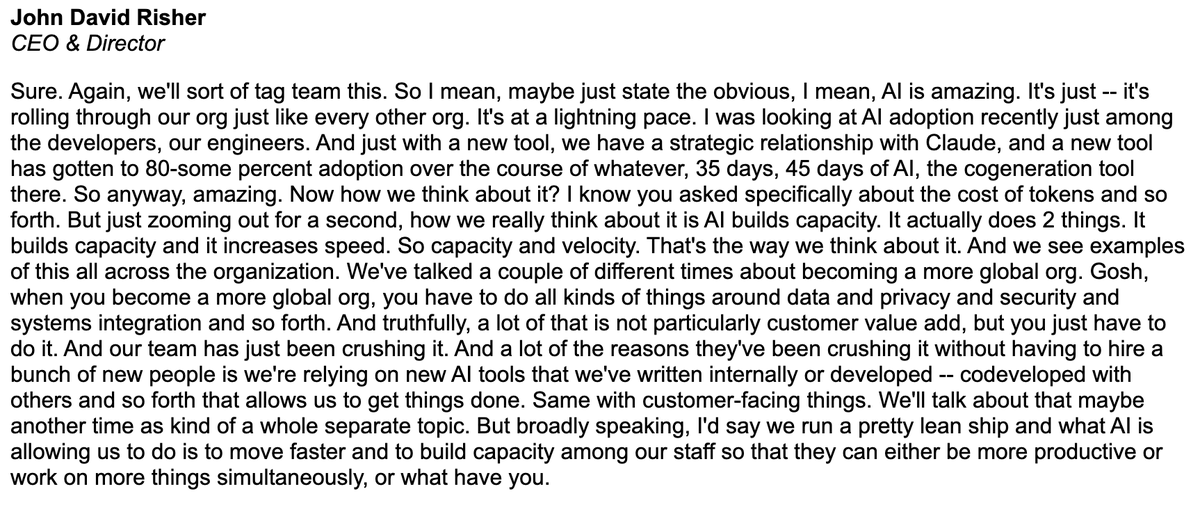
$LYFT's CEO said AI is spreading rapidly inside Lyft, boosting capacity and speed across the organization and letting teams handle major global-scale work without adding headcount. Because AI tools are now widely adopted by engineers, the company can stay lean while moving faster. "I mean, AI is amazing. It's just -- it's rolling through our org just like every other org. It's at a lightning pace. I was looking at AI adoption recently just among the developers, our engineers. And just with a new tool, we have a strategic relationship with Claude, and a new tool has gotten to 80-some percent adoption over the course of whatever, 35 days, 45 days of AI, the cogeneration tool there. So anyway, amazing. Now how we think about it? I know you asked specifically about the cost of tokens and so forth. But just zooming out for a second, how we really think about it is AI builds capacity. It actually does 2 things. It builds capacity and it increases speed. So capacity and velocity. That's the way we think about it. And we see examples of this all across the organization. We've talked a couple of different times about becoming a more global org. Gosh, when you become a more global org, you have to do all kinds of things around data and privacy and security and systems integration and so forth. And truthfully, a lot of that is not particularly customer value add, but you just have to do it. And our team has just been crushing it. And a lot of the reasons they've been crushing it without having to hire a bunch of new people is we're relying on new AI tools that we've written internally or developed -- codeveloped with others and so forth that allows us to get things done. Same with customer-facing things. We'll talk about that maybe another time as kind of a whole separate topic. But broadly speaking, I'd say we run a pretty lean ship and what AI is allowing us to do is to move faster and to build capacity among our staff so that they can either be more productive or work on more things simultaneously, or what have you."
AlphaSense tweet media
English
0
1
3
1.6K