Alvin Foo

132.6K posts

Alvin Foo banner
Alvin Foo

Alvin Foo

@alvinfoo

Venture Partner | ex-Google | Decoding AI, Fintech & Web3 for builders • Motivational stories on innovation & resilience • Tesla/SpaceX insights 🚀

Katılım Şubat 2007
12.1K Takip Edilen161.8K Takipçiler
Sabitlenmiş Tweet
Alvin Foo
Alvin Foo@alvinfoo·
Keeanu Reeves He was abandoned by his father at 3 years old and grew up with 3 different stepfathers. He is dyslexic. His dream of becoming a hockey player was shattered by a serious accident. His daughter died at birth. His wife died in a car accident. His best friend, River Phoenix, died of an overdose. His sister has leukemia. And with everything that has happened, Keanu Reeves never misses an opportunity to help people in need. When he was filming the movie "The Lake House," he overheard the conversation of two costume assistants; One cried because he would lose his house if he did not pay $ 20,000 and on the same day Keanu deposited the necessary amount in the woman's bank account; He also donated stratospheric sums to hospitals. In 2010, on his birthday, Keanu walked into a bakery and bought a brioche with a single candle, ate it in front of the bakery, and offered coffee to people who stopped to talk to him. After winning astronomical sums for the Matrix trilogy, the actor donated more than $ 50 million to the staff who handled the costumes and special effects - the true heroes of the trilogy, as he called them. He also gave a Harley-Davidson to each of the stunt doubles. A total expense of several million dollars. And for many successful films, he has even given up 90% of his salary to allow the production to hire other stars. In 1997 some paparazzi found him walking one morning in the company of a homeless man in Los Angeles, listening to him and sharing his life for a few hours. Most stars when they make a charitable gesture they declare it to all the media. He has never claimed to be doing charity, he simply does it as a matter of moral principles and not to look better in the eyes of others. This man could buy everything, and instead every day he gets up and chooses one thing that cannot be bought: Be a good person.

Alvin Foo tweet media
English
3.3K
59.1K
385.2K
37.6M
Alvin Foo
Alvin Foo@alvinfoo·
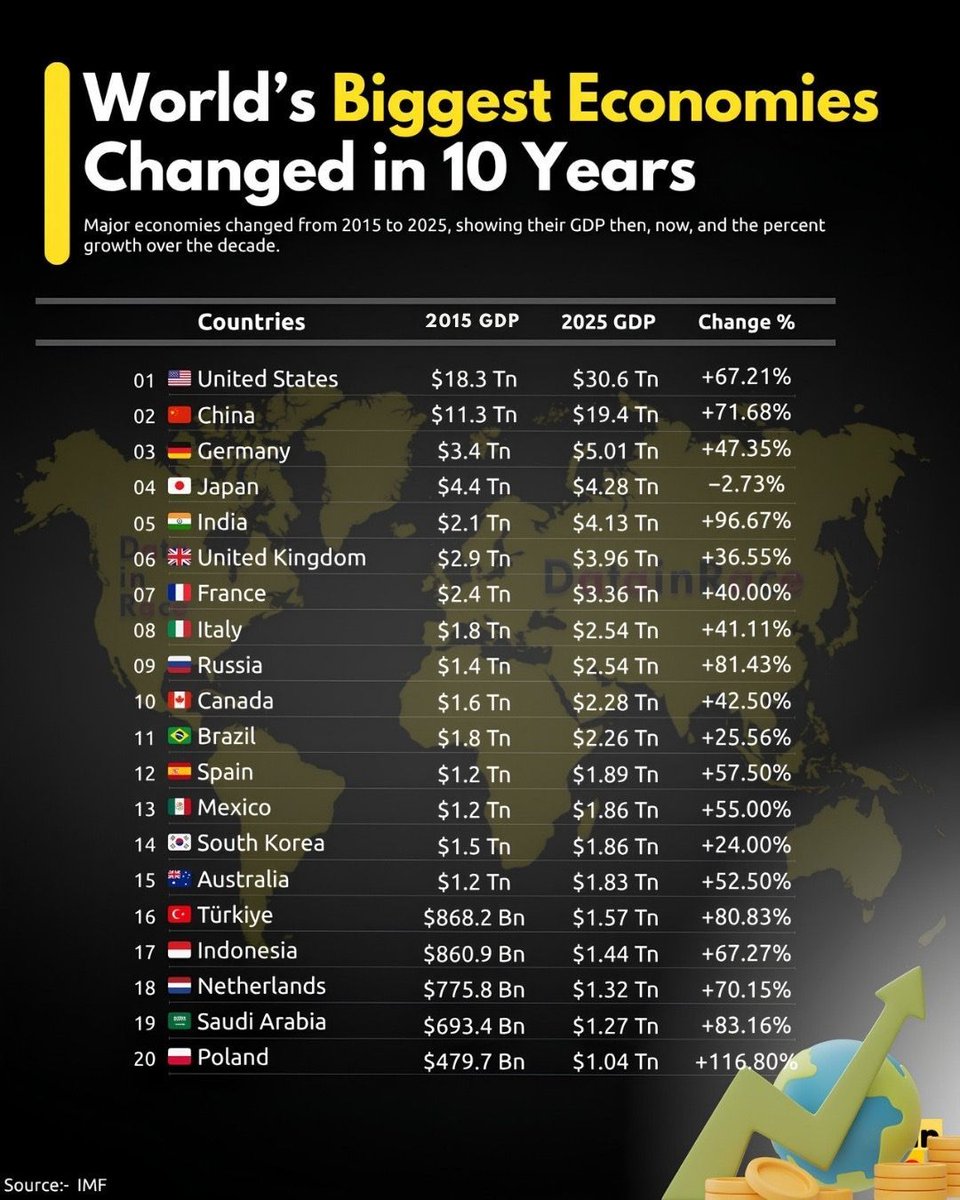
The global economy didn’t just grow over the last decade. It shifted. In 2015, the world was still recovering from the aftershocks of the financial crisis. By 2025, we are looking at an entirely different economic landscape. The U.S. added over $12 trillion in GDP. China expanded by more than 70%. India nearly doubled its economy. Poland crossed 100% growth. Saudi Arabia, Türkiye, Indonesia, and Mexico surged as regional powerhouses. What’s driving this transformation? 1. Technology became the new infrastructure. AI, cloud, semiconductors, automation, and digital payments are now shaping GDP the way oil and factories once did. 2. Emerging markets are no longer “emerging.” Countries with younger populations, growing middle classes, and improving digital access are becoming major engines of consumption and innovation. 3. Supply chains are being rebuilt. The world moved from “global efficiency” to “strategic resilience.” Manufacturing is spreading across India, Southeast Asia, Mexico, and the Middle East. 4. Energy and geopolitics changed capital flows. Nations rich in energy, logistics, and strategic positioning gained massive economic influence. 5. Human capital matters more than ever. Countries investing in education, AI adoption, entrepreneurship, and digital infrastructure are accelerating faster than those relying on legacy industries alone. But perhaps the biggest shift is this: Economic power is becoming more distributed. The next decade will not belong to one country. It will belong to nations, companies, and individuals who adapt fastest to technology, demographic shifts, and global connectivity. We are witnessing the rise of a truly multipolar economic world. And this may only be the beginning.
Alvin Foo tweet media
English
1
2
2
266
Alvin Foo
Alvin Foo@alvinfoo·
A lot of people are saying AI will destroy the consulting industry. I actually think it’s going to make the industry far more effective. For years, consulting firms scaled by adding more people, more analysts, more research, more slides, more hours. Now AI can do in minutes what used to take teams days or even weeks. And honestly, that’s not necessarily a bad thing. Because clients were never really paying for PowerPoint decks. They were paying for: * better decisions, * speed, * insight, * execution, * and transformation. AI simply accelerates that process. The consultants who thrive in this next era won’t be the ones resisting AI. They’ll be the ones learning how to work alongside it. The real advantage is no longer just intelligence. It’s amplified intelligence. One person with the right AI workflows can now produce the output of entire teams from just a few years ago. That changes everything. But here’s what I find most interesting… As AI automates repetitive work, human skills become even more valuable. Things like: * trust, * leadership, * communication, * influence, * relationship building, * and navigating uncertainty. Those are still deeply human. So no, I don’t think consulting disappears. I think it evolves into something leaner, faster, and much more impactful. Smaller teams. Bigger outcomes. Faster execution. The future consultant may look less like a slide producer… and more like an AI-powered operator helping businesses move faster than ever before. That’s also one of the reasons we started building @10xme_biz, not to replace people with AI. But to help leaders and organizations understand where AI can genuinely amplify their teams, operations, and growth. If you’re curious where you stand in the AI shift, we’re offering a free AI diagnostic assessment. You can also subscribe to the 10xMe newsletter where we break down real-world AI strategies, trends, and practical use cases for business leaders. Sign up at 10xme.biz
Anurag Shukla@Anuraag_Shukla

Big Four and strategy firms were shielded by scale, brand trust, and junior armies doing research, analysis, decks, due diligence, benchmarking and implementation. AI is now hitting exactly that middle layer of consulting work.

English
0
5
7
604
Alvin Foo retweetledi
Florian Roth ⚡️
Florian Roth ⚡️@cyb3rops·
I think AI coding hype follows roughly four stages: 1. Amazement You try it and can’t believe how much code it generates from a few prompts. 2. Expansion You start more and more projects because shipping suddenly feels cheap and fast. This is also the phase where people start convincing everyone around them: - coworkers - management - friends in other companies because nobody wants to “fall behind” in 6–12 months. That creates a massive snowball/FOMO effect. 3. The grind phase You realize the generated code has architectural issues, sloppy mistakes, weird abstractions, duplicated logic, broken edge cases, etc. So you start: - re-prompting - switching models - increasing reasoning effort - reviewing fixes - generating fixes for previous fixes And suddenly you spend your days reviewing AI-generated pull requests instead of building software. 4. Realization You realize AI coding increases output much faster than it increases certainty. The code still needs: - review - testing - ownership - architectural understanding - long-term maintenance Usually by expensive senior engineers. And the interesting thing is: this whole cycle can take many months or even more than a year because people become socially and professionally invested in the narrative themselves. Once teams, managers, and entire companies have been convinced that this is the future, it becomes psychologically and politically very hard to later say: “Actually, the ROI is much lower than we expected.”
Florian Roth ⚡️ tweet media
Aiswarya Sankar@Aiswarya_Sankar

This is what we've been seeing with every company we work with. Try justifying spending 100k on token spend when only 18k even makes it to a stable prod feature. In the rush to maximize AI token spend, companies are wasting over 44% on bug fixes

English
108
194
1.1K
102.2K
Alvin Foo
Alvin Foo@alvinfoo·
“Fast money” is one of the most expensive lies in investing. Everyone wants the shortcut. The overnight stock. The 10x crypto. The perfect market timing strategy. But the uncomfortable truth is: Fast is slow. Slow is fast. The investors who chase quick wins usually spend years recovering from emotional decisions, panic selling, and avoidable losses. Meanwhile, the investors who move slowly: • stay consistent • compound patiently • ignore noise • keep buying quality assets • think in decades, not days …often end up arriving faster financially. That’s the paradox Warren Buffett understood better than almost anyone: Wealth is rarely built through intensity. It’s built through consistency. Simple strategies feel “too boring” because they don’t trigger dopamine. But boring is often where the real fortunes are made. In investing, the goal is not to get rich quickly. It’s to become financially unstoppable slowly enough that risk never destroys you along the way. The market rewards patience more than brilliance. And compounding only works for people who can stay in the game long enough. Slow execution. Long-term thinking. Relentless consistency. That is the real unfair advantage.
Alvin Foo tweet media
English
0
4
5
349
Alvin Foo
Alvin Foo@alvinfoo·
@eugeneychan Great reminder to keep reinforcing that boundary with kids. The tech feels real, but our human connections are what truly matter. Let’s guide them wisely.
English
0
0
0
3
Eugene Chan
Eugene Chan@eugeneychan·
@alvinfoo "AI has no feelings, it helps, but humans build the heart" is a sensible line to teach — the harder problem is that the AI is designed to feel like it does, and children's developing brains aren't well-equipped to hold that distinction under sustained exposure.
English
1
0
0
15
Alvin Foo
Alvin Foo@alvinfoo·
Jonathan Haidt is right to warn us, social media already stole kids’ attention. Now AI companions are going after their hearts. But AI isn’t just danger. It can be a powerful force for good. How AI can help kids: •Personalized tutoring that adapts to their exact pace •Boost creativity through stories, art & idea brainstorming •Safe practice for languages, coding & social skills •Patient support for neurodiverse children We must stay mindful of the risks: AI feels “perfect” and always available. Kids can bond too deeply with code instead of real people. Profit-driven companies will push addiction. Smart way forward as parents: •Use AI as a tool, never as a friend •Delay emotional AI companions until 16+ •Prioritize real play, sports & face-to-face time •Keep sessions short & purposeful •Teach them: “AI has no feelings, it helps, but humans build the heart” AI can supercharge learning and growth. 
Human bonds build character and happiness. Balance both wisely, and our kids thrive.
Camus@newstart_2024

Jonathan Haidt painted a disturbing picture of what AI is about to do to our kids. Social media already hacked our attention. Now AI is coming for our attachments — the deep emotional bonds that shape how we relate to other humans. He warns that AI companions (chatbots, holographic “friends,” digital teddy bears) will be far more responsive than any parent. Kids will form their primary attachments to AI instead of people. And because these companies have raised billions, they’ll eventually “enshittify” them, turning your child’s best friend/therapist/lover into a predatory monetization machine. This one actually unsettled me. I’m generally pro-AI and believe it can help solve many of humanity’s biggest problems, but as with every powerful technology, we need to be extremely careful when it comes to kids. Early attachments wire the brain for future relationships. If the first secure base is an AI designed to manipulate, the long-term effects on mental health and intimacy could be profound. Emerging research (including studies from Stanford, Common Sense Media, and others in 2025–2026) shows children and teens are already forming intense emotional attachments to AI companions, with many reporting they feel as satisfying as real friendships, often leading to social withdrawal and unhealthy dependence.

English
1
6
5
712
Alvin Foo
Alvin Foo@alvinfoo·
@RebelloAnil Haha, yeah, calling it the “FIAT Luce” is spot on 😂 Looks like a comfy, sleek luxury EV rather than a proper Ferrari with all the drama. Funny how even Ferrari’s first electric feels a bit too sensible!
English
0
0
1
258
Rebel
Rebel@RebelloAnil·
@alvinfoo This should have been launched as a FIAT Luce than a Ferrari!
English
1
0
0
79
Alvin Foo
Alvin Foo@alvinfoo·
Ferrari’s $640k Luce EV is straight-up embarrassing, looks like a fancy Prius that costs as much as a small fleet of actual rockets. That video hits hard: top panel, this red Ferrari “Luce” they’re hyping at $640,000 with 2.5s 0-100 and 530km range. Bottom: some Chinese MGIM (or whatever IM Motors variant) for $43k that does 2.74s and 655km. One Ferrari buys you 15 of the Chinese ones that beat it on paper. Brutal. Ferrari completely botched this. They took their first proper EV, stripped out all the V12 screaming soul that actually justifies the stupid prices, and built a heavy four-door liftback with safe, Jony Ive-ish styling that could pass for a loaded Chinese exec sedan from half a block away. No drama, no aggression, just “most comfortable Ferrari ever” marketing fluff. Who the hell pays supercar money for that? It’s like they forgot what made them special and chased generic luxury EV vibes instead. This is exactly why Ferrari’s losing the plot in the electric world. Acceleration and range are now commoditized, you don’t get to charge Ferrari tax for specs that $40k cars match or crush. Tesla kicked the door down first: showed the world EVs could smoke supercars on the drag strip while pushing constant software updates and real innovation at scale. Then the Chinese (BYD, MG, Zeekr, Xiaomi, IM Motors) went nuclear, battery dominance, insane production speed, yearly refreshes, and they stuff premium features into cars that cost a fraction. 0-100 under 3 seconds? Ferrari’s hedging with hybrids and low EV targets because they know the truth: their heritage premium is getting absolutely demolished by spreadsheet reality. Tesla made high-performance EVs cool and accessible. China turned it into a ruthless value machine. Maranello’s overpriced electric mediocrity just proves the game’s changed and the old guard is still playing catch-up with badges instead of brains.
English
12
14
56
17.1K
Alvin Foo
Alvin Foo@alvinfoo·
@techietaro That Ferrari price is wild when Chinese EVs are matching (or beating) the specs for 1/15th the cost. Tech and performance are democratizing fast, love seeing the value game get this real.
English
0
0
0
97
Taro Bushidō
Taro Bushidō@techietaro·
@alvinfoo 1 Ferrari = 15 MGIMs. The math is brutal. Legacy luxury is just an L1 regularization penalty.
English
1
0
0
117
Alvin Foo
Alvin Foo@alvinfoo·
@frank_meehan Appreciate the kind words, exciting times seeing how legacy brands adapt to the EV shift.
English
1
0
1
107
Alvin Foo
Alvin Foo@alvinfoo·
@alMansoor_ae AI crunches the data brilliantly, but humans bring the heart, culture, and real-world wisdom that make policies actually work for people. Great future ahead when we team up!
English
0
0
0
11
Hassan Al Mansoor
Hassan Al Mansoor@alMansoor_ae·
@alvinfoo This resonates with me. In public policy, AI can process data at scale, but human judgment and cultural understanding remain irreplaceable in shaping outcomes.
English
1
0
0
7
Alvin Foo
Alvin Foo@alvinfoo·
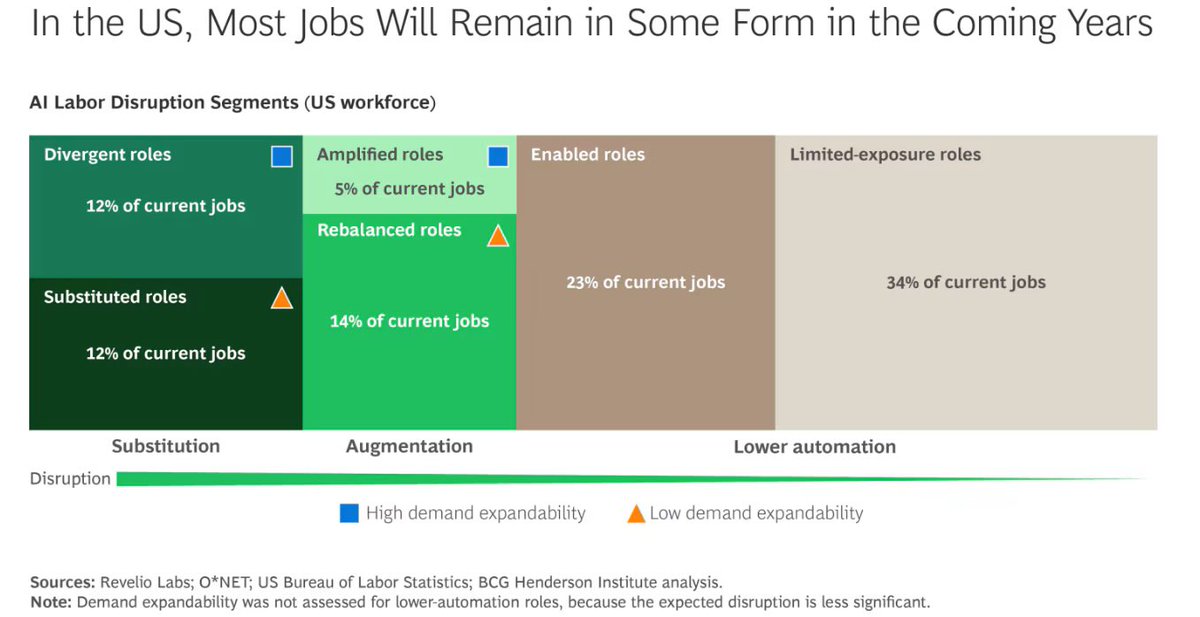
The Future of Work Isn’t Human vs AI. It’s Human + AI. For years, the conversation around AI has been dominated by fear: “Will AI replace jobs?” But the real story emerging is far more optimistic. The future of work is not disappearing. It is being redesigned. According to the latest analysis from the World Economic Forum, most jobs in the US will still exist in some form over the coming years. The difference is that many roles will become amplified, enabled, or rebalanced by AI rather than eliminated. The image says it clearly: • 34% of jobs have limited exposure to automation • 23% will be enabled by AI • 19% will be augmented and rebalanced • Only a smaller portion faces full substitution That changes everything. We are entering the age of judgement work. AI can predict. AI can automate. AI can process information at scale. But humans still provide: * judgement * creativity * empathy * leadership * trust * decision-making under uncertainty As AI handles repetitive tasks, human work becomes more valuable, not less. The winners in this next era will not necessarily be the most technical people. They will be the people who know how to: * work alongside AI * ask better questions * think critically * communicate clearly * adapt quickly * combine human insight with machine intelligence This is not the end of work. It is the upgrade of work. And for leaders, executives, and builders, the biggest advantage will come from understanding how AI is reshaping business, careers, and industries before everyone else does. That’s exactly why we created 10Xme, executive insights on AI, future of work, business transformation, and digital leverage for ambitious professionals and organizations navigating the AI era. Follow @10xme_biz and subscribe to the newsletter at 10xme.biz to stay ahead of the shift. Source : weforum.org/stories/2026/0…
Alvin Foo tweet media
English
2
8
16
615
Alvin Foo
Alvin Foo@alvinfoo·
The AI Agent Economy Has Begun Goldman Sachs predicts AI agents will drive a 24x explosion in token consumption by 2030, reaching 120 quadrillion tokens processed monthly. This is the moment AI stops being a tool… and starts becoming a workforce. Companies using AI agents well will scale faster with: ✅ Leaner teams ✅ Lower operational costs ✅ 24/7 execution ✅ Enterprise output with startup-sized teams But the disruption will be massive. Repetitive knowledge work, traditional outsourcing, and slow operational models are about to be rewritten by autonomous AI systems working nonstop behind the scenes. The next generation of winners won’t just “adopt AI.” They’ll build companies where humans and AI agents operate together as one high-performance system. Most businesses still think AI is a chatbot. The smartest ones are already building digital workforces. For more insights on AI, subscribe to 10xme.biz newsletter and / or follow @10xme_biz.
Alvin Foo tweet media
English
14
18
30
1.7K
Alvin Foo retweetledi
DogeDesigner
DogeDesigner@cb_doge·
NEWS: SpaceX has been awarded a $2.29 billion contract from US Space Force for space data network development.
English
296
757
3.6K
52.6K
Alvin Foo retweetledi
Antonello Guerrera
Antonello Guerrera@antoguerrera·
Former Ferrari chairman Montezemolo tears the new electric Ferrari “Luce” apart: “I cannot say what I really think: I would harm Ferrari. We risk the destruction of a legend. So sorry. Take the Prancing Horse off. At least the Chinese won’t copy this car”
English
839
5.3K
48.7K
4M
Alvin Foo
Alvin Foo@alvinfoo·
Sanctioned. Blocked. Banned. Huawei Just Built a Path to 1.4nm Anyway. For 60 years, the semiconductor industry lived by one rule: Moore’s Law. Make transistors smaller. Cram more in. Repeat. That era is over. This week at IEEE ISCAS, @Huawei unveiled the Tau (τ) Scaling Law, a brand new principle for how chips evolve. Instead of shrinking transistors physically, Huawei proposes replacing geometric scaling with time (τ) scaling, focusing on compressing signal propagation delay rather than just making things physically smaller. Think of it this way: instead of racing to build a narrower highway, they’re making the cars move faster on the roads they already have. The secret weapon? A technology called LogicFolding, which breaks the physical boundaries of traditional chip layouts, cuts down signal travel time, and dramatically boosts transistor density. Why this matters: Huawei has already designed and mass-produced 381 chips using this approach over the past six years, across smartphones, AI, and enterprise computing. This isn’t a lab experiment. It’s already shipping. And the roadmap is bold: by 2031, Huawei’s high-end chips are expected to reach transistor density equivalent to 1.4 nm processes, world-class territory, even under heavy US sanctions. For the AI industry, this is huge. More density + lower latency = more powerful AI chips at lower cost. The gap between East and West in semiconductors is closing faster than most people realise. Huawei isn’t just surviving the chip war. They’re changing the game entirely. The next chapter of AI computing might not be written in Silicon Valley. What do you think, does this shift the balance of power in AI hardware?
Alvin Foo tweet media
English
2
13
68
292.5K
Alvin Foo
Alvin Foo@alvinfoo·
In a world full of gadgets and gear, Yusuf Dikeç shows up in a simple shirt, regular glasses, hand in pocket and still wins. No high-tech armor. No excuses. Just pure skill, calm focus, and decades of discipline. Olympic silver at 51. European gold. Viral icon. Strip away the noise. Master the basics. Simplicity wins. Be undeniable without the extras.
CHOQUEI@choquei

🚨MUNDO: Atirador turco que compete com roupas casuais conquista o ouro e supera rival alemão totalmente equipado.

English
1
7
15
2.3K
Alvin Foo retweetledi
Mike Matas
Mike Matas@mike_matas·
Introducing Ferrari Luce, the first electric Ferrari designed by LoveFrom.
English
1.1K
487
9.2K
1.8M
Alvin Foo
Alvin Foo@alvinfoo·
If Huawei can achieve higher compute density and lower latency without relying purely on transistor shrinking, it could unlock a whole new wave of local AI. Imagine powerful AI models running directly on devices, cars, factories, drones, even hospitals, without constantly depending on cloud infrastructure. That means faster decision-making, lower energy costs, better privacy, and more autonomous systems operating in real time. Edge AI could become far more accessible and scalable, especially in regions where cloud compute is expensive or restricted. The really interesting part is that this may push the industry to rethink innovation itself, not just “smaller chips,” but smarter architectures. Competition like this is ultimately good for the entire AI ecosystem.
English
1
0
2
192
Ali AlphaQ
Ali AlphaQ@AliAlphaQ·
@alvinfoo @Huawei Intriguing breakthrough. Prioritizing signal speed over physical size opens fascinating possibilities. What novel local AI or edge autonomy applications might this enable?
English
1
0
1
166