Alvin Foo

133.8K posts

Alvin Foo banner
Alvin Foo

Alvin Foo

@alvinfoo

Venture Partner | ex-Google | Decoding AI • Motivational stories on innovation & resilience • Tesla/SpaceX insights 🚀

Katılım Şubat 2007
12.2K Takip Edilen162.7K Takipçiler
Sabitlenmiş Tweet
Alvin Foo
Alvin Foo@alvinfoo·
Keeanu Reeves He was abandoned by his father at 3 years old and grew up with 3 different stepfathers. He is dyslexic. His dream of becoming a hockey player was shattered by a serious accident. His daughter died at birth. His wife died in a car accident. His best friend, River Phoenix, died of an overdose. His sister has leukemia. And with everything that has happened, Keanu Reeves never misses an opportunity to help people in need. When he was filming the movie "The Lake House," he overheard the conversation of two costume assistants; One cried because he would lose his house if he did not pay $ 20,000 and on the same day Keanu deposited the necessary amount in the woman's bank account; He also donated stratospheric sums to hospitals. In 2010, on his birthday, Keanu walked into a bakery and bought a brioche with a single candle, ate it in front of the bakery, and offered coffee to people who stopped to talk to him. After winning astronomical sums for the Matrix trilogy, the actor donated more than $ 50 million to the staff who handled the costumes and special effects - the true heroes of the trilogy, as he called them. He also gave a Harley-Davidson to each of the stunt doubles. A total expense of several million dollars. And for many successful films, he has even given up 90% of his salary to allow the production to hire other stars. In 1997 some paparazzi found him walking one morning in the company of a homeless man in Los Angeles, listening to him and sharing his life for a few hours. Most stars when they make a charitable gesture they declare it to all the media. He has never claimed to be doing charity, he simply does it as a matter of moral principles and not to look better in the eyes of others. This man could buy everything, and instead every day he gets up and chooses one thing that cannot be bought: Be a good person.

Alvin Foo tweet media
English
3.4K
58.6K
383K
37.6M
Alvin Foo
Alvin Foo@alvinfoo·
“WHEN PARENTS GET OLD... Let them grow old with the same love they raised you with. Let them talk and tell stories over and over again with the same patience and interest they listened to you as a child. Let them win, as they have often let you win. Let them enjoy their friends, conversations with their grandchildren... Let them enjoy living among the objects that have accompanied them for a long time, because they suffer when they feel that you are tearing pieces of their life . Let them make mistakes, as you have done so many times. LET THEM LIVE and try to make them happy on the last leg of their journey, the same way they shook your hand when you started yours." - Pablo Neruda
Alvin Foo tweet media
English
0
0
4
349
Alvin Foo
Alvin Foo@alvinfoo·
Life doesn’t teach with words, it teaches with pain. Learn. Grow. Evolve.
Alvin Foo tweet media
English
0
0
3
653
Alvin Foo retweetledi
Ruben
Ruben@rdominguezibar·
Demis Hassabis just published the most consequential essay in AI this year. Nobel Prize winner. CEO of Google DeepMind. The person who built AlphaFold. His estimate: AGI in a few years. His comparison: not the internet. Electricity. Fire. The number that should stop you cold is this one. 10x the Industrial Revolution at 10x the speed. The Industrial Revolution took 100 years to reshape civilization. He is describing something an order of magnitude larger happening in a decade. His policy proposal is the part nobody is covering: ▫️ A FINRA-style Standards Body for frontier AI ▫️ Labs submit models 30 days before release for independent testing ▫️ Benchmarks updated quarterly, built independently from labs ▫️ The body could coordinate a slowdown among all Frontier Labs if needed That last bullet is the one. The CEO of Google DeepMind just publicly proposed a legal mechanism to pause AI development if the situation demands it. He ended with this: "We've essentially found a way to make sand think." Either the most important sentence written this decade or the most embarrassing. No in between.
Ruben tweet media
Demis Hassabis@demishassabis

x.com/i/article/2076…

English
10
16
141
32.4K
Alvin Foo
Alvin Foo@alvinfoo·
Memory just became the most political commodity on Earth. For decades, countries fought over oil. Today, the next strategic resource is memory. Not human memory. AI memory. Every AI model, data center, autonomous vehicle, smartphone, defense system, and cloud platform depends on DRAM. Yet nearly 90% of the world’s supply comes from just three companies: 🇰🇷 Samsung 🇰🇷 SK hynix 🇺🇸 Micron That’s an extraordinary level of concentration for a technology that powers the global digital economy. This isn’t just a semiconductor story. It’s a geopolitical story. The countries that secure access to advanced memory chips will have an advantage in: • AI infrastructure • Cloud computing • National security • Industrial competitiveness • Future economic growth As AI demand accelerates, memory is becoming more than a component. It’s becoming strategic leverage. We’ve already seen governments restrict exports, subsidize domestic chip manufacturing, and compete aggressively for semiconductor leadership. Expect that trend to intensify. The AI race isn’t just about building better models anymore. It’s about controlling the infrastructure that makes those models possible. The next global power struggle won’t be fought over who has the smartest AI. It will be fought over who owns the memory that keeps AI running. Want to stay ahead of the AI transformation? Sign up for a FREE AI Diagnostic and our weekly AI newsletter at 10xme.biz and learn how executives can leverage AI before the next wave reshapes every industry.
Alvin Foo tweet media
English
0
0
3
545
Alvin Foo
Alvin Foo@alvinfoo·
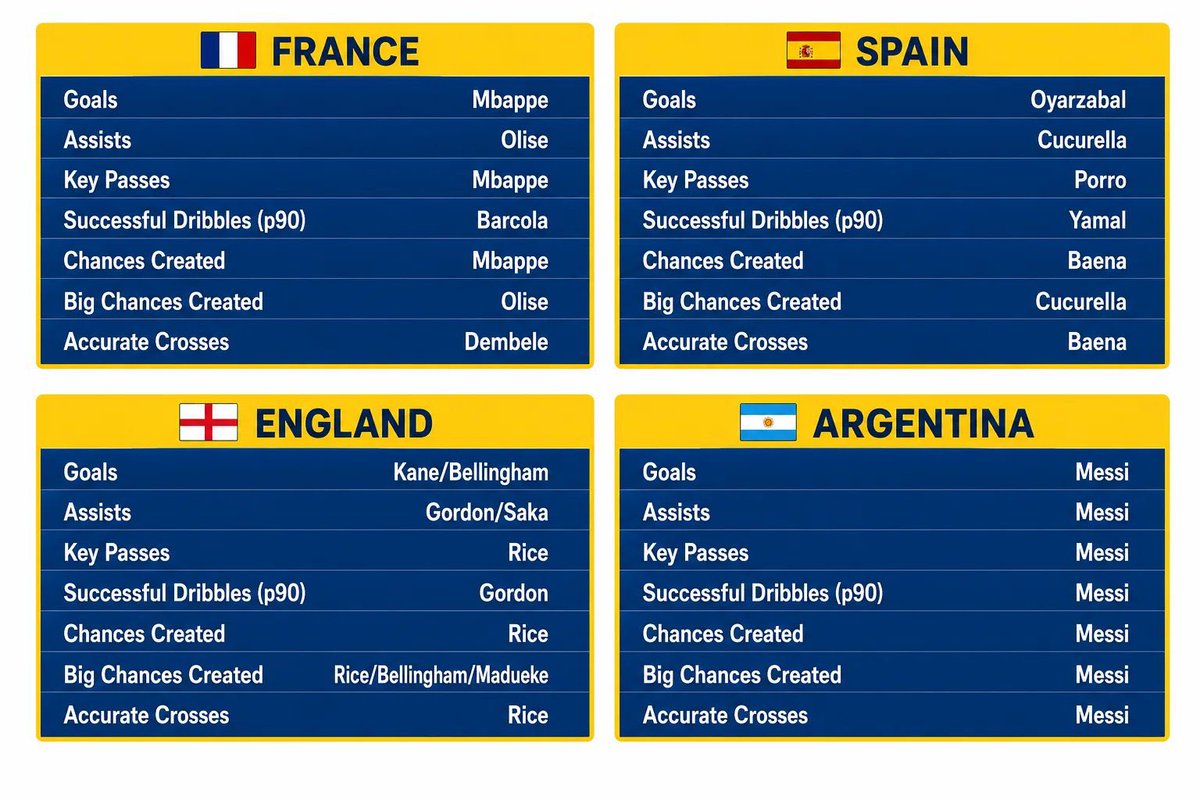
Spain totally outclassed France to earn their spot at the FIFA WORLD CUP 2026 Final
Alvin Foo tweet media
English
1
0
8
876
Alvin Foo
Alvin Foo@alvinfoo·
Humans win on average cost today, but the tail matters most: elite AI agents at ~$4/hr (and dropping fast) will eat mediocre $80/hr engineer hours for breakfast. The real 100x leverage isn’t just more tokens, it’s ruthless optimization and agentic workflows. Management and model quality are the new moat. We’re still early. The firms that treat AI like elite talent, not just tools will dominate the next decade.
a16z@a16z

"Humans are cheaper than tokens on average, but good tokens are cheaper at scale." For median firms, agent costs sit near $80/hour, roughly in line with a software engineer. But at the tails, an agent can cost $4/hour or $7,000/hour depending on how it's managed. Hebbia CEO George Sivulka on why 100X tokens are the new 10X engineers: a16z.news/p/the-next-ai-…

English
0
2
2
972
Alvin Foo
Alvin Foo@alvinfoo·
The average person often tells a very different story than the headlines. This chart removes the top 1% of earners to better reflect the living standards of the typical citizen. The results are revealing: 🇺🇸 Average American (excluding the top 1%): ~US$72,000 🇨🇦 Canada: ~US$58,000 🇪🇺 Europe: ~US$51,000 🇨🇳 China: ~US$28,000 🇮🇳 India: ~US$13,000 🌍 Africa: ~US$7,000 It also highlights something many people overlook: The poorest 20% in the US, Canada, and Europe still enjoy purchasing power that exceeds the average income in many developing regions. But this isn’t about declaring one country “better” than another. It’s a reminder that economic success should be measured by how broadly prosperity is shared, not just by the number of billionaires or the size of GDP. Countries that consistently raise living standards for the majority tend to have: * Strong productivity growth * High-value industries * Quality education and healthcare * Stable institutions * Long-term investment in innovation For emerging economies, the challenge isn’t simply to create more wealth. It’s to ensure that growth translates into higher incomes, better opportunities, and improved quality of life for ordinary people. As AI, automation, and new technologies reshape the global economy, the countries that invest in their people, not just their infrastructure, will be the ones that thrive over the next decade. The real question isn’t “How rich is a country?” It’s “How well does the average citizen live?” Data can spark important conversations but it’s also worth remembering that living standards depend on more than income alone. Factors like healthcare, education, housing costs, safety, public services, and inequality all play a significant role.
Alvin Foo tweet media
English
1
0
4
1.4K
Alvin Foo retweetledi
Bull Theory
Bull Theory@BullTheoryio·
96 out of every 100 US companies never made their investors any money. A new study from Arizona State tracked every stock listed on US markets from 1926 to 2025. That is 29,754 stocks over 100 years. The market created $90.96 trillion in that time. All of it came from just 1,082 companies. The other 27,999 gave investors nothing. Most stocks lose money. Only 48% of stocks made any money at all. Only 41% beat a savings account. 59% of companies lost money for shareholders. The median stock lost 6.87%. But the average stock returned 30,621%. That gap is the whole story. A few enormous winners pull the average up while most stocks bleed. So who were the winners? • Apple: $5.02 trillion • Nvidia: $4.58 trillion • Microsoft: $4.03 trillion • Alphabet: $3.57 trillion • Amazon: $2.27 trillion These are not market caps. This is total wealth created for shareholders since the company listed, measured against what that money would have earned sitting in Treasury bills. Apple and Nvidia alone made 10.6% of all the wealth the US market has created since 1926. The same researcher ran this study in 2018 with data through 2016. Back then it took 89 companies to make up half of all the wealth ever created. Nine years later, it takes only 46. In the 90 years up to 2016, the top 30 companies made 31% of all the wealth. In the nine years since, the top 30 made 61%. Nvidia by itself made 9.32% of everything created since 2017. Concentration doubled in nine years. And those nine years are exactly the years the AI trade took over the market. The typical company got worse at the same time. In the first six decades of the study, the median stock returned 63.6% per decade. In the last four decades, it dropped to 5.8%. The market kept going up. Most companies stopped going up with it. People keep saying the S&P is being carried by a handful of AI stocks, as if this is something new. It is not. The market has always run on a tiny number of winners. What changed is how few of them there are now.
Bull Theory tweet mediaBull Theory tweet media
English
79
222
877
89K
Alvin Foo
Alvin Foo@alvinfoo·
This message from a Japanese teacher serves as a beautiful reminder of the values we often overlook in our busy lives. In a world that prioritizes deadlines and productivity, he encourages his students to embrace happiness and take their time. The teacher’s words resonate deeply: - No Due Date: Life isn’t a race. It’s okay to move at your own pace. - Please Be Happy: Happiness should be our priority, not just an afterthought. - Take Your Time: Reflecting on our journey is just as important as completing tasks. His invitation to share a moment of joy and connection “please turn to me and say ‘I did it’” highlights the importance of celebrating our achievements, no matter how small. Let this be a gentle nudge to prioritize what truly matters: our well-being and the bonds we share with others. As we navigate our own paths, let’s remember to pause, reflect, and cherish the moments that bring us joy.
Alvin Foo tweet media
English
0
6
11
790
Alvin Foo
Alvin Foo@alvinfoo·
@KeeHianTan Owning the competitive reality instead of pointing fingers is exactly what drives progress. Chinese companies’ rapid rise in EVs, AI, and beyond is impressive and a wake-up call for everyone to keep innovating faster.
English
0
0
0
39
Kee-Hian
Kee-Hian@KeeHianTan·
@alvinfoo Thanks for sharing your on-the-ground knowledge. Always easier to blame external factors than to acknowledge their own inadequacies and change accordingly. The growing competitiveness of Chinese companies and sub sectors is clear.
English
1
0
1
12
Alvin Foo
Alvin Foo@alvinfoo·
Why Foreign Companies Are Really Leaving China, It’s Not What You Think After 20+ years living and working in China, advising and witnessing countless foreign firms enter, thrive, and eventually exit, I need to address a common misconception. Headlines often paint a picture of companies fleeing due to “risk,” “instability,” or being “bullied.” The reality I’ve seen on the ground is far more straightforward and uncomfortable: They simply lost the competitive edge. Chinese companies that once served as low-cost suppliers have evolved into formidable rivals. They now match, and often surpass, foreign players in technology, execution speed, capital efficiency, and market responsiveness. What used to be “good enough” from a global brand no longer wins when local competitors deliver faster innovation at better value. Many Fortune 500 companies I worked with relied on past successes, slow decision-making, and outdated USPs. They failed to innovate aggressively or adapt quickly enough to China’s hyper-dynamic market. Meanwhile, local firms studied them, improved upon their models, and outmaneuvered them. This isn’t about geopolitics or safety. It’s about competition, pure and simple. Blaming external factors may feel easier, but it prevents the hard self-reflection needed to succeed in the next market. Nowhere is this shift clearer than in EVs and AI. Chinese EV makers have moved from catching up to leading the world, dominating global sales, battery technology, and affordable innovation at scale. In AI, Chinese firms are rapidly advancing models, applications, and infrastructure with unmatched speed and data advantages. These sectors show how local champions are not just competing at home but capturing international markets and reshaping entire industries. Key lesson: In China and beyond, resting on legacy advantages is the fastest way to become irrelevant. True resilience comes from continuous innovation, speed, and a willingness to face competitive reality head-on.
Alvin Foo tweet media
English
2
7
18
1.1K
Alvin Foo
Alvin Foo@alvinfoo·
When Cristiano Ronaldo was once asked about the real reason behind his breakup with the famous supermodel Irina Shayk, his response became a lesson in the values of loyalty and righteousness. Ronaldo said: "She put me between two choices; she asked me irritably: 'Why do you take your mother with you everywhere? You have to choose between me and her!'.. And my response was decisive: I can never abandon my mother for another woman, and I don't regret that decision." He continued with words filled with tears and gratitude: "When I was a little child, my mother used to wash clothes and clean houses to provide me with a bite to eat and buy me a pair of shoes to run after my dream in football. Today, everything I am is thanks to her. My mother is one of a kind, and she will always remain by my side." ♥️ Great in sports and great in morals
Alvin Foo tweet media
English
9
87
734
24.4K
Alvin Foo
Alvin Foo@alvinfoo·
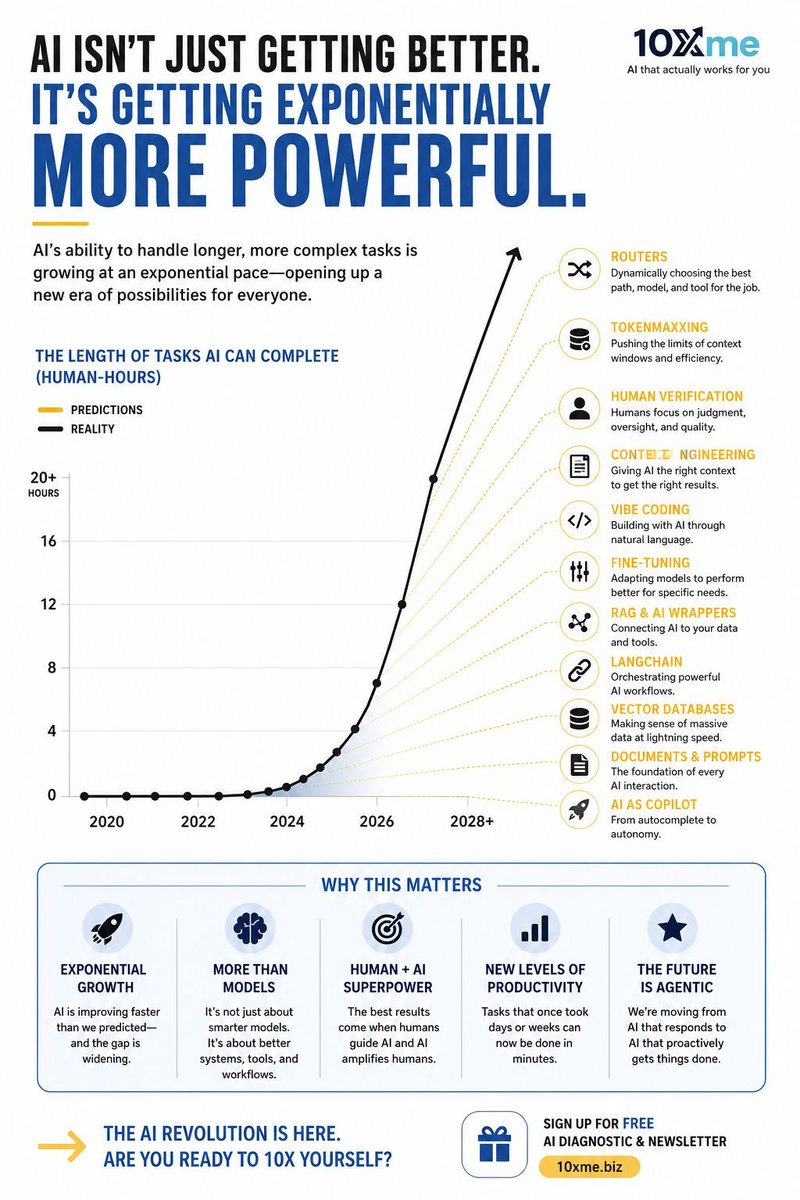
AI Isn’t Peaking. It’s Compounding. Every few weeks, someone declares we’ve reached the limits of AI. Then a new model arrives. A new capability emerges. A new benchmark gets shattered. The conversation quickly shifts from “AI can’t do this” to “AI has always been able to do that.” The real story isn’t that AI is improving. It’s how fast it’s improving. Just two years ago, AI could reliably help with tasks measured in minutes. Today, it’s completing increasingly complex work that takes hours and that curve continues to steepen. This changes the way we should think about work. The winners won’t necessarily be: ❌ The best prompt engineers. ❌ The people using the latest AI model. ❌ The companies with the biggest AI budgets. The winners will be those who continuously redesign how they work as AI capabilities evolve. The progression is already happening: ➡️ AI Assistant → AI Copilot → AI Agent → AI Workforce Every improvement doesn’t just make AI a little smarter—it expands the range of work AI can handle autonomously. That means: • More repetitive work disappears. • More knowledge work becomes AI-assisted. • Human value shifts toward strategy, creativity, judgment, leadership, and decision-making. • Businesses that adapt early create compounding productivity advantages. The biggest mistake you can make today is assuming the AI you use today is the AI you’ll be using next year. It won’t be. The question is no longer: “Will AI improve?” It’s: “Is your business improving as fast as AI is?” If the answer is no, the gap between AI capability and your organization’s capability will continue to widen. Now is the time to build AI-native workflows, not just experiment with AI tools. At 10xme, we help executives and businesses identify where AI can create the biggest impact. 📈 Get your FREE AI Diagnostic and subscribe to our AI newsletter at 10xme.biz. The future won’t wait. Neither should your AI strategy.
Alvin Foo tweet media
English
2
5
15
917
Alvin Foo
Alvin Foo@alvinfoo·
“Light travels faster than sound. That’s why some people appear bright… until they speak.” 😅 It made me laugh, but it also made me think. In today’s world of social media, AI-generated content, and personal branding, it’s easier than ever to look knowledgeable. A polished profile. A few buzzwords. A fancy presentation. A viral post. But sooner or later, substance catches up. The people who consistently earn respect aren’t the loudest in the room. They’re the ones who: * Listen more than they talk. * Ask thoughtful questions. * Admit when they don’t know something. * Let their work do most of the talking. There’s an old saying: Empty vessels make the most noise. In business, leadership, and life, credibility isn’t built by sounding smart. It’s built by creating value, solving problems, and staying humble enough to keep learning. So the next time you’re tempted to impress everyone… Remember: 💡 It’s better to be quietly competent than loudly confident. (And yes… we’ve all met someone who was a genius… right up until the first sentence. 😂)
Alvin Foo tweet media
English
2
8
12
993
Alvin Foo
Alvin Foo@alvinfoo·
Jensen Huang just broke down the entire AI industry as a five-layer cake: 1. Energy (the foundation) 2. Chips 3. Cloud/Infrastructure 4. Models 5. Applications (the top) Most founders, funding, and talent are jammed into the Models layer, the one with the fiercest competition. That intensity doesn’t create moats. It creates commodities. The harder everyone races, the faster intelligence becomes cheap and abundant. The real scarcity isn’t smarts anymore. It’s power. No algorithm builds a grid. No fundraising replaces a dam. Energy controls access at the bottom. Applications capture the revenue at the top. Hundreds of billions are pouring into the middle layers that sit between someone else’s electrons and someone else’s economy. Intelligence scales. Energy doesn’t. Build where the bottleneck and the payoff actually live.
English
4
7
17
1.5K
Alvin Foo
Alvin Foo@alvinfoo·
The amazing story of Jensen Huang, Founder & CEO of Nvidia Credit: Ed Elson
English
0
5
9
1.1K
Alvin Foo
Alvin Foo@alvinfoo·
No Regrets. Keep Moving. The past is a lesson, not a life sentence. Forgive yourself, embrace your journey, and focus on becoming better every day. Your mindset, discipline, consistency, and daily habits will shape your success and growth.
English
0
7
20
1.6K
Alvin Foo
Alvin Foo@alvinfoo·
@RnaudBertrand Blanket bans on fundamental research risk backfiring by slowing US progress and spurring China’s self-reliance. The smarter approach would be to focus safeguards and reciprocity, not total decoupling.
English
0
0
4
484
Arnaud Bertrand
Arnaud Bertrand@RnaudBertrand·
This is pretty insane: if you read the details of this new policy 👇 that now bans scientific collaboration with China, it's entirely driven by the Department of War. Which means that civilian scientific research in the US is now driven by military logic - something that had basically never been the case since WW2. I'm not making it up, you can read the new policy of the National Science Foundation for yourself: nsf.gov/funding/inform… They explicitly write that the basis for this new prohibition is to be "aligned with the Department of War's approach to collaborations": a civilian science agency - the one that funds most fundamental research in the US - is now openly modeling its policies on the military's. The Pentagon decides who the enemy is, and science falls in line. It doesn't take a genius to understand how this will backfire. Cancer, for instance, doesn't care about geopolitics. Some of the most promising research in oncology, like every other field, depends on international collaboration (and especially with China who are extremely advanced in cancer research, and most research fields). Putting soldiers in charge of who scientists can talk to is a guarantee that these problems will be harder to solve. It's also the US repudiating pretty much its entire philosophical approach to scientific research for decades: the notion that science thrives on openness. Even at the height of the Cold War, Reagan - not exactly a peacenik - enacted a directive called "NSDD-189" that stated that fundamental research must remain open and unrestricted. This is, obviously, the complete opposite direction. The only precedent I can think of for this is the Wolf Amendment, passed in 2011, which prohibited NASA to engage in bilateral cooperation with China. The result, 15 years later: China is the only country in the world to have its own space station and to have landed on the far side of the Moon. That's the track record of the policy they now want to extend to all of US science 🤷‍♂️
Arnaud Bertrand tweet media
English
140
820
2.2K
113.2K