Andy Delton

269 posts

Andy Delton

Andy Delton

@AndyDelton

Where evolutionary psychology and political psychology meet.

Stony Brook University Katılım Haziran 2013
652 Takip Edilen740 Takipçiler
Andy Delton
Andy Delton@AndyDelton·
Do you want to date someone *willing* to protect you? Someone *strong* enough to protect? Both? Michael Barlev and colleagues test this. Based on a lot of work in evolutionary psychology, you might think that both would matter about equally. Nope!
Andy Delton tweet media
English
3
9
101
9.8K
Andy Delton
Andy Delton@AndyDelton·
Importantly, kids didn’t think everything should be up for a vote. For instance, no voting to commit obviously immoral acts (killing the class pet). Again, pretty sophisticated.
English
1
0
1
40
Andy Delton
Andy Delton@AndyDelton·
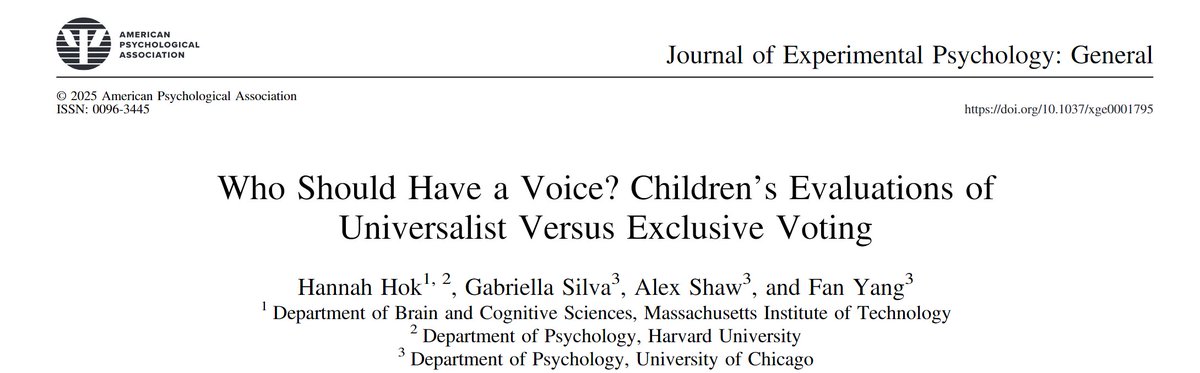
Should everyone be allowed vote on things? Or should we turn it over to philosopher kings? Fascinating new research by Hannah Hok and colleagues in JEP:General on how children think about voting. Kids are pretty sophisticated.
Andy Delton tweet media
English
1
6
14
1.1K
Andy Delton retweetledi
Oleg Urminsky
Oleg Urminsky@OlegUrminsky·
When you collect data online, are the results from humans or AI? In a project led by Booth PhD student Grace Zhang, we estimate the prevalence of AI agents on commonly used survey platforms: osf.io/preprints/psya… 🧵
English
6
62
197
36K
Andy Delton retweetledi
Misha Teplitskiy | Science of Science
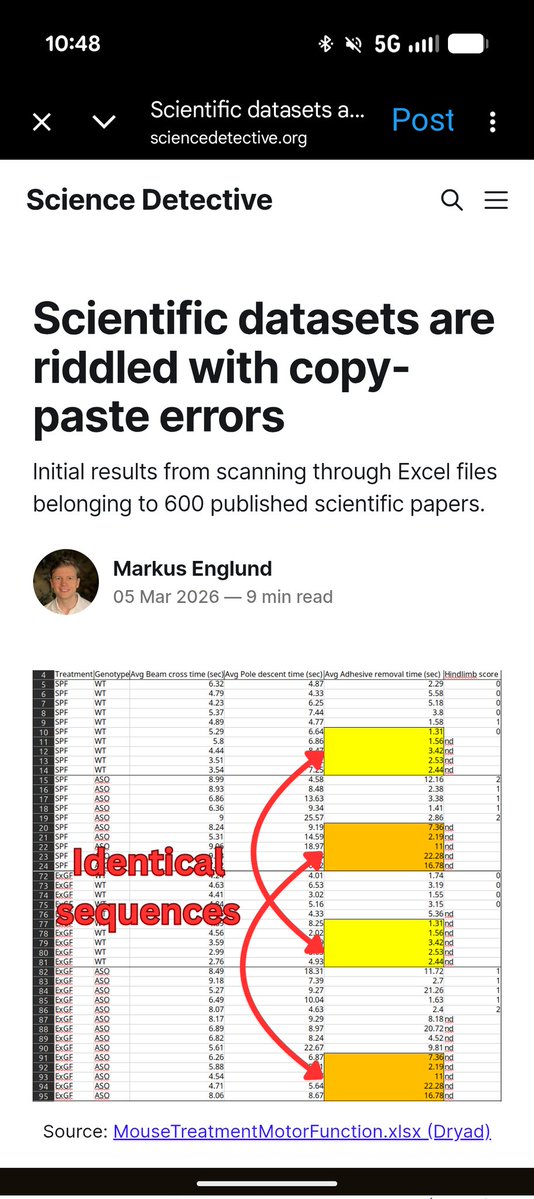
Another lower bound on likely fraud in biomed literature -- using suspicious copy/pasting in Excel files -- comes in at 3%. It feels very uncomfortable but I think we all have to update our priors to fraud being quite common
Misha Teplitskiy | Science of Science tweet media
Misha Teplitskiy | Science of Science@MishaTeplitskiy

How much misconduct/fraud is there in the academic literature? About 0.2% of papers get retracted, but that's obviously a severe underestimate. Probably the best estimate comes from a manual (!!!) inspection of 20K (!!!) Western blot images. Estimate is 3.8% (1/2)

English
11
74
377
45.8K
Andy Delton retweetledi
Dr. Sally Sharif
Dr. Sally Sharif@Sally_Sharif1·
I just gave a closed-book, pen-and-paper midterm exam in my 300-level course at UBC with 100 students. All exams were graded by an experienced graduate-level TA according to a rubric. *** The average was 64/100.*** My class averages at UBC are usually 80-85. Context: • This was the first midterm, covering ONLY 4 weeks of material. • Students had a list of possible questions in advance: no surprise questions. • Questions included (a) 3 concept definitions, (b) 3 paragraph-long questions, and (c) a 1.5-page essay. • I have taught this class multiple times. Nothing in my teaching style changed this semester. • We read entire paragraphs of text in class, so students don't have to do something on their own that wasn't covered during the lecture. • Students take a 10-question multiple-choice quiz at the end of every class (30% of the final grade). • Attendance is 95-99% every class. Attention during lectures and participation in pair-work activities are very high → anticipating the end-of-class quiz. *** But unfortunately, I suspect many students are not reading the material on the syllabus. They are asking LLMs to summarize it instead.*** After the midterm, students reported: • They thought they knew concept definitions but couldn't produce them on paper. • They thought they understood the arguments but struggled to connect them or identify points of agreement and disagreement. My view: It might be “cool” or “innovative” to teach students to summarize readings with ChatGPT or write essays with Claude. But we may be doing them a disservice: reducing their ability to retain material, think creatively, and reason from what they know. If you only read what AI has summarized for you, you don’t truly "know" the material. Moving forward: We have a second midterm coming up. I don't know how to convey to students that the best way to do better on the exam is to rely on and improve their own reading skills.
David Perell Clips@PerellClips

Ezra Klein: "Having AI summarize a book or paper for me is a disaster. It has no idea what I really wanted to know and wouldn't have made the connections I would've made. I'm interested in the thing I will see that other people wouldn't have seen, and I think AI typically sees what everybody else would see. I'm not saying that AI can't be useful, but I'm pretty against shortcuts. And obviously, you have to limit the amount of work you're doing. You can't read literally everything. But in some ways, I think it's more dangerous to think you've read something that you haven't than to not read it at all. I think the time you spend with things is pretty important." @ezraklein

English
522
2.5K
16.1K
3.5M
Andy Delton
Andy Delton@AndyDelton·
But strength barely matters: It does a bit for women and not at all for men. (The vignettes always described the date as being average in physical attractiveness, to avoid cuing attractiveness by mentioning strength.)
English
1
0
7
1.1K
Andy Delton
Andy Delton@AndyDelton·
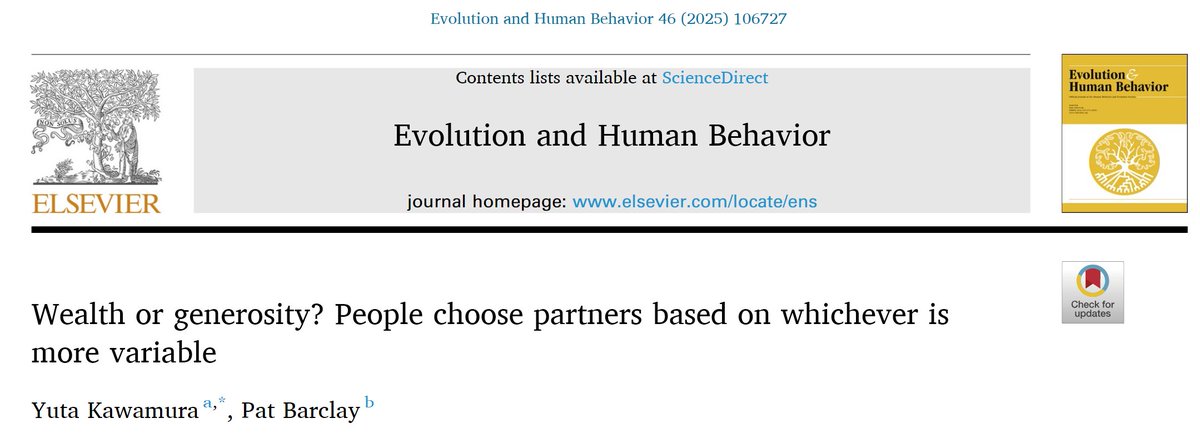
For friends, do we want rich or generous people? Great new study by Yuta Kawamura and Pat Barclay. In general, people prefer generosity, but with important nuance.
Andy Delton tweet media
English
1
7
16
1.2K