
Anthony_Bro retweetledi
Anthony_Bro
1.6K posts



Anthony_Bro retweetledi

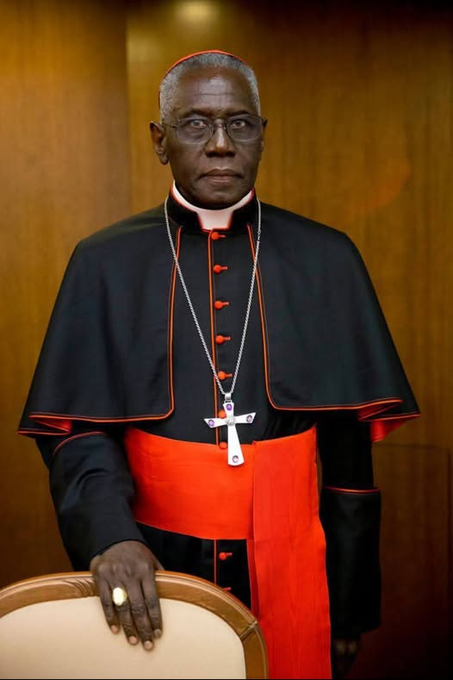
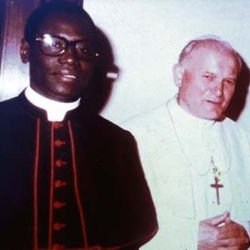
>Be Cardinal Robert Sarah
>Born in a remote village in Guinea, raised by his devout catholic his parents and local missionaries
>Becomes an Archbishop at just 34 years old in the middle of a brutal Marxist dictatorship
>The dictator, Touré, literally puts him on a death list; Sarah doesn't run, and keeps preaching the Gospel
>Touré died unexpectedly of a heart attack in March 1984, just weeks before the planned executions
>Becomes one of the sharpest, most fearless defenders of traditional Catholic faith in the modern era and is made a Cardinal
>Looks at secularized West and warns us: "If Christianity disappears in Europe, the whole world is threatened."
>Writes absolute masterpieces like The Power of Silence
>Delivers banger quotes like: "The West has denied its Christian roots, a tree without root dies"
>"As a bishop, it is my duty to warn the West! The barbarians are already inside the city."
>Keeps telling europeans to have more babies
Unfathomably based
English
Anthony_Bro retweetledi

Anthony_Bro retweetledi

A community college professor taught the same study skills lecture for 30 years, and the video quietly became one of the most watched educational recordings on the internet.
His name is Marty Lobdell. He spent his career as a psychology professor watching students fail not because they were lazy, but because nobody had ever taught them how their brain actually works under the pressure of learning something hard.
The lecture is called "Study Less Study Smart." Over 10 million views. Passed around in Reddit threads, Discord servers, and university study groups for over a decade. And the core insight buried inside it has been sitting in cognitive psychology research for years, waiting for someone to explain it in plain language.
Here is the framework that completely changed how I think about effort.
Your brain does not sustain focus the way you think it does. Studies tracking real students found that the average learner hits a wall somewhere between 25 and 30 minutes.
After that, efficiency doesn't just decline. It collapses. You're still sitting at your desk, still looking at the page, but almost nothing is going in.
Lobdell illustrated this with a student he knew personally. She set a goal of studying 6 hours a night, 5 nights a week, to pull herself out of academic probation. Thirty hours of studying per week. She failed every single class that quarter.
She wasn't failing because she lacked effort. She was failing because she had confused time spent near books with time spent actually learning. The 25-minute crash hit her at 6:30pm every night. She spent the next five and a half hours sitting in the wreckage of her own focus and calling it studying.
The fix sounds almost too simple. The moment you feel the slide, stop. Take five minutes. Do something that actually gives you a small reward. Then go back. That five-minute reset returns you to near full efficiency. Across a six-hour window, the difference is not marginal. It is the difference between thirty minutes of real learning and five and a half hours of it.
The second thing he taught destroyed something I had believed about how memory actually works.
Highlighting feels productive. Going back over your notes and recognizing everything feels like knowing. But recognition and recollection are two completely different cognitive processes, and your brain is very good at making you confuse them.
You can see something you've read before and feel completely certain you understand it, even when you couldn't reconstruct a single sentence from memory if the page were blank.
He proved this live in the room. He read 13 random letters to his audience. Almost nobody could recall them. Then he rearranged the same 13 letters into two words: Happy Thursday. The whole room got all 13 without effort.
Same letters. Same count. The only thing that changed was meaning.
The brain stores meaning. Not repetition. The moment new information connects to something you already understand, the retention changes entirely.
This is what the cognitive psychology literature calls elaborative encoding, and it is the mechanism underneath every effective study technique.
The third principle was the one that hit me hardest, and the one almost nobody applies.
Lobdell cited research showing that 80 percent of your study time should be spent in active recitation, not passive reading. Close the material. Say it back in your own words.
Teach it to someone else, or to an empty chair if no one is around. The struggle of retrieval is where the actual learning happens. Reading your notes again is watching someone else do the work.
His parting line has stayed with me longer than almost anything else I have read about learning.
He told the room that if what he shared didn't change their behavior, they hadn't actually learned it. It would just live in their heads as something they had heard once and felt good about.
He was right. And most people leave every lecture exactly like that.
The students who remember everything aren't putting in more hours.
They stopped confusing the feeling of studying with the fact of it.
English
Anthony_Bro retweetledi

🚨In 1999, psychologists at Carnegie Mellon 180 couples for six years and discovered something that destroys every piece of relationship advice you've ever heard.
Partners who viewed each other through a lens of future potential maintained 87% relationship satisfaction. Those committed to seeing each other realistically broke up 63% of the time within three years.
The researchers called it the Michelangelo Phenomenon, after the sculptor who claimed he didn't carve David from marble but simply revealed the figure that was already trapped inside the stone.
Think about what this actually means for a moment.
We've been conditioned to believe that healthy relationships require radical acceptance of your partner exactly as they exist today. Relationship experts preach this gospel constantly: love means embracing flaws, accepting limitations, seeing past imperfections to the "real person" underneath.
The data suggests this approach is relationship poison.
Couples who practiced this kind of clear eyed realism were systematically unhappier and far more likely to separate. Meanwhile, partners who maintained what psychologists would normally call "positive illusions" about each other's capabilities created relationships that lasted and thrived.
But calling them illusions misses the point entirely.
The couples with higher satisfaction weren't deluding themselves. They were seeing potential that existed but hadn't been actualized yet. They were recognizing capabilities their partners possessed but hadn't fully developed. They were loving the person their partner could become while simultaneously loving who they were in the present moment.
This creates a feedback loop that traditional relationship psychology doesn't account for.
When someone sees your potential consistently, you start to live into it. When someone believes you're capable of growth you haven't achieved yet, you unconsciously begin moving toward that vision. The "illusion" becomes a prediction that fulfills itself.
The Michelangelo Phenomenon reveals that we become who we think others see us as. In relationships, this effect is amplified because romantic partners occupy an outsized role in shaping our self concept. The version of yourself that your partner consistently sees and responds to gradually becomes the version you inhabit.
Which means choosing a partner is less about finding someone compatible with who you are right now and more about finding someone who can see and nurture who you're capable of becoming. And equally important: becoming someone who can see and call forth the best version of the person you're with.
Most people are walking around as rough marble, waiting for someone to see the sculpture inside.
What do you think?
English
Anthony_Bro retweetledi

There's a physicist at Stanford named Safi Bahcall who modeled this exact principle and the math is wild.
He calls it "phase transitions in human networks." When you're stationary, your probability of a lucky event is limited to your existing surface area: the people you already know, the places you already go, the ideas you've already been exposed to. Your opportunity window is fixed.
When you move, your collision rate with new nodes in a network increases nonlinearly. Double your movement (new conversations, new cities, new projects) and your probability of a serendipitous encounter doesn't double. It roughly quadruples. Because each new node connects you to their entire network, not just to them.
Richard Wiseman ran a 10-year study at the University of Hertfordshire tracking self-described "lucky" and "unlucky" people. The single biggest differentiator wasn't IQ, education, or family money. Lucky people scored significantly higher on one trait: openness to experience. They talked to strangers more, varied their routines more, and said yes to invitations at nearly twice the rate.
The "unlucky" group followed the same routes, ate at the same restaurants, and talked to the same 5 people. Their networks were closed loops. No new inputs, no new collisions.
Luck isn't random. Luck is surface area. And surface area is a function of movement.
The lobster emoji is doing more work than most people realize. Lobsters grow by shedding their shell when it gets too tight. The growth requires a period of total vulnerability. No protection, no armor, soft body exposed to the ocean.
That's the cost of movement nobody posts about. You have to be uncomfortable first. The new shell only hardens after you've already moved.
ຸ@D9vidson
a moving man will meet his luck 🥀
English
Anthony_Bro retweetledi
Niegdyś ulubiony dziennikarz MAGA chyba nie wytrzymał
Polski
Anthony_Bro retweetledi

Anthony_Bro retweetledi

Understand this: The movies and shows about the crucifixion have been tame when compared to what He actually went through.
Even The Passion Of The Christ was forced to hold back a little in order to avoid an X rating.
Crucifixion was, and still is, arguably the most excruciating death someone can experience.
The night before in Gethsemane, He was sweating blood. This is known as hematidrosis. This would have caused His skin to become extremely sensitive, thus making the beatings to come even worse.
The fear He felt was the beginning of His feeling the weight of our iniquities being laid on Him.
Yet - in this moment, He didn’t demand that the Father take it from Him. He only asked for the cup to pass Him over if it was within the Father’s will.
Up next came the Cat of Nine Tails, or a Roman Flagrum. This was a weapon with long leather “tails”, each embedded with sharp bones and metal.
He was flogged 39 times as Jewish law mandated “40 minus one”, because 40 was said to kill a man.
This flogging wasn’t like being punished by your father’s leather belt.
Every strike tore flesh, every strike exposed muscle. Every strike exposed nerve endings. Every strike tore flesh to the bone.
This would be like getting struck with razor blades over and over again, leading to hypovolemic shock from blood loss.
Oh, and the crown of thorns? These weren’t rose thorns. These were thorns which were 2-3 inches long. Beaten into his skull.
These thorns would have pierced his skull, tripping the trigeminal nerve, thus causing unimaginable pain and even more blood loss from the dozens of head wounds.
At this point, extreme nausea and dizziness would begin to set in.
What came next? Carrying the cross. Which weighed around 300lbs. This would be like carrying two full kegs on your back.
Splinters and wood grating against the open flesh on His back. And He had to carry it 650 yards, or close to a half mile.
Imagine carrying a log on your back after being skinned alive.
Up next? He was nailed to the cross with spikes 5-7in in length. Piercing His wrists - this no doubt pierced the median nerve, causing extreme burning sensations up and down His arms.
A spike was driven through his ankles - severing nerves and tendons. This would have felt like standing on broken glass every time He pushed Himself up in order to breathe.
He suffered for 6 hours.
His chest muscles collapsing, making every single breath a fight for life.
His shoulders were dislocated, His arms stretching unnaturally long.
His heart was struggling to pump blood.
He was extremely dehydrated, His lips cracking.
His heart more than likely literally ruptured from the stress.
And on top of all of that, He had to feel a separation with the Father for a period of time in order to REALLY bear the weight of our sin.
He took up this burden for ALL sin before Him, and ALL sin which came after Him.
HE DID IT ALL FOR US.
To free us. To defeat sin. To give us a pathway to the Kingdom.
Every sin we commit is exactly why He had to do it.
And the real kicker? He knew what was coming when He rode into Jerusalem … and He didn’t turn around. He kept going.
For us.
English
Anthony_Bro retweetledi

It’s not every day that one gets to listen to a former British Prime Minister recite from memory the opening passages of The Iliad in Ancient Greek, with no notes, in response to a random question from an undergraduate—and all while wearing what appear to be Thomas The Tank Engine socks. But today was one such day.
My thanks to my good friend Brad LaMorgese for the opportunity to see the colorful and comic Boris Johnson speak tonight at the University of Dallas.


English
Anthony_Bro retweetledi

Anthony_Bro retweetledi

Anthony_Bro retweetledi

Panowie Tusk i Sikorski, wyciągnijcie notesy i uczcie się! Tak właśnie powinno wyglądać wystąpienie PRAWDZIWEGO patrioty za granicą. Zero zakompleksienia i zero przepraszania, że żyjemy. 🇵🇱🇺🇸
PS. Mały apel do panów polityków - jak już będziecie kraść ten filmik na swoje profile, to miejcie chociaż odrobinę klasy i zostawcie followa! 😉👇
#CPAC
@NawrockiKn @prezydentpl @BoguckiZbigniew
Polski
Anthony_Bro retweetledi

Superb political ad. One of the best you’ll see.
This is better, and resonates more, than anything coming from Labour or the Tories.
English
Anthony_Bro retweetledi

Rozporządzenie UE w sprawie powrotów imigrantów zaproponowane przez AfD właśnie zostało UCHWALONE
To NAJLEPSZY plan deportacji, jaki kiedykolwiek przedstawiono Parlamentowi UE, doprowadzający lewicę unijną do całkowitego załamania...
REIMIGRACJA JEST NIEUNIKNIONA 🫡
Polski
Anthony_Bro retweetledi

A reporter asks Tucker Carlson if Israel has a “right to exist.”
Tucker flips the question right back and asks her to define what “right to exist” means.
And then this happened.
English
Anthony_Bro retweetledi

“Hey what lvl conspiracy are you on?”
Me:
English
Anthony_Bro retweetledi

Absolute Amazing Video
How can you not be inspired by this?
We are going to Restore Britain 🇬🇧
Together
English
Anthony_Bro retweetledi
