Fabio Anzà

225 posts

Fabio Anzà banner
Fabio Anzà

Fabio Anzà

@AnzaFabio

Science of Information || Assistant Professor & Entrepreneur @ https://t.co/VTffMoIomX || Bridging business needs and technical talk

Baltimore, Maryland, US Katılım Nisan 2017
578 Takip Edilen701 Takipçiler
Fabio Anzà
Fabio Anzà@AnzaFabio·
Dependent Type Theory — Why #Lean Can't Lie 👇 🚀 I have learned how to use #Lean 4 to prove theorems. It's fair to ask: why should you trust Lean in the first place? 🎯 When the compiler says "proof verified" — what guarantees it's not just confidently wrong? The answer sits in the foundations of mathematics itself, and it's one of the coolest and elegant ideas I've ever encountered in math 💡 What's the problem? In the early 1900s, Bertrand Russell blew up naive set theory with one question: consider the set of all sets that don't contain themselves. Does it contain itself? If yes — it shouldn't. If no — it should. Contradiction. And in classical logic, a single contradiction is fatal — the principle of explosion says that from a contradiction you can prove anything. Literally anything. Your formal system becomes useless: every statement is simultaneously true and false. Unrestricted self-reference doesn't just create a paradox — it burns the entire house down 🔥 🔥 Dependent type theory is the fix. Instead of one flat universe where anything can reference anything, you get a hierarchy. Types at level 0. Types of types at level 1. Types of types of types at level 2. And the rule is strict — a type at level N can only contain types from levels below N. Self-reference? Structurally impossible. ⚡ This is what Lean is built on. It's not just a programming language with a type checker — it's an implementation of the Calculus of Inductive Constructions, a dependent type theory where every well-typed term is a valid proof. If it compiles, logical consistency is guaranteed by the architecture itself. Not by testing. Not by peer review. By construction 🧠 Most people hear "type system" and think programming convenience — catch a bug or prevent a null pointer. In Lean, the type system IS the mathematics. It's doing the deepest foundational work there is: making sure your universe is logically consistent and does not eat itself This is why I trust Lean. Not because someone told me it works — because the theory underneath makes inconsistency inexpressible 🔒. Now, you can obviously still write bad code... But that's a different story 😀 🐰 Here are some readings to go deeper: 📜 Russell's Paradox: the original crisis that broke naive set theory, explained properly: plato.stanford.edu/entries/russel… 📜 Type Theory: the full picture of how types became the foundation of modern proof systems: plato.stanford.edu/entries/type-t… 📜 Dependent Type Theory — Theorem Proving in Lean 4: Lean's own documentation on how dependent types and the universe hierarchy work under the hood: #dependent-type-theory" target="_blank" rel="nofollow noopener">lean-lang.org/theorem_provin… Welcome to THE rabbit hole, Alice 🐰. Please don't refer to your own types: it's dangerous🧨
Fabio Anzà tweet media
English
0
0
1
96
Fabio Anzà
Fabio Anzà@AnzaFabio·
🔬 DIFFERENTIAL GEOMETRY – one technical language to rule them all! A guided path to learn it 🧠⚡ 🎯 The deeper I get into studying nature through physics, the more I realize differential geometry is like a connective tissue of the entire discipline. From general relativity to quantum field theory to dynamical systems, the same structures keep showing up: manifolds, connections, curvature, fiber bundles, and more.... Once you speak this language, doors open everywhere — including data analysis and ML. Here's the path I'd recommend👇 📖 SPIVAK - "Calculus on Manifolds": Start here. Differential forms, Stokes' theorem, the language of manifolds — all in under 150 pages. Dense but clean. My first encounter, where my intuition got formalized 💡 🛠️ ISHAM - "Modern Differential Geometry for Physicists": Careful, pedagogical — great for building rigorous foundations. Chapter 3 on vector fields and n-forms is an absolute gem!! 📜 FECKO - "Differential Geometry and Lie Groups for Physicists": The book I wish I had found earlier. ~700 pages, all built with physical intuition. THE reference I keep coming back to. Incredibly well done! 🔥 📜 POISSON - "A Relativist's Toolkit". See differential geometry in action: Black holes, geodesics and more Differential Geometry shows up everywhere ⚡ In Quantum Mechanics, the space of quantum states IS a manifold. Distance and Curvature encode the physics 🔥 QFT & the Standard Model: Covariant derivatives, gauge symmetries, fiber bundles — Yang-Mills theory is the theory of connections on principal bundles 🌀 Dynamical Systems: Phase spaces are manifolds, flows are vector fields, attractors are geometric. ARNOLD - "Mathematical Methods of Classical Mechanics" is gold. One of the books I went through in Marseille. Symplectic geometry feels inevitable Bonus topic for the data/ML side: The Fisher metric turns probability spaces into Riemannian manifolds. Natural gradient? That's geometry. Where to start to dig in? 📖 AMARI & NAGAOKA - "Methods of Information Geometry": THE reference. Full geometric machinery on probability spaces — Fisher metric, α-connections, duality. Connects to statistics, information theory, QM, and neural networks 📖 BRONSTEIN, BRUNA, COHEN & VELIČKOVIĆ - "Geometric Deep Learning": Shows how CNNs, GNNs, and Transformers connect to geometric principles. Free on arXiv: lnkd.in/eeYwsPKa Whenever a theory has a space of states, that space has geometric structure. The phenomenology lives there and has its roots in that geometry!! Welcome to THE rabbit hole, Alice 🐰. You'll need geometry to understand what's going on 🔥 hashtag#DifferentialGeometry hashtag#Physics hashtag#QuantumMechanics hashtag#GeneralRelativity hashtag#QuantumFieldTheory
Fabio Anzà tweet media
English
0
0
2
118
Fabio Anzà
Fabio Anzà@AnzaFabio·
👩‍🎓 Student's questions can be wild and deep 🤠 After a decade researching the foundations of thermodynamics and statistical mechanics, I'm re-reading Callen's "Thermodynamics and an Introduction to Thermostatistics" while teaching Thermodynamics 🌡️ Two takeaways from the first week: 1️⃣ What is heat? Most think heat is energy that "flows" between objects. But in classical mechanics, there's no such thing as heat - only kinetic energy, potential energy, and work. Heat emerges when you adopt a macroscopic description of your system: it's the energy bookkeeping that occurs through the microscopic degrees of freedom you're not able to control. When you compress a gas, you do work. But molecules bounce chaotically, and you can't track every collision. Some organized motion (your piston) converts to disorganized molecular motion you're not following. When that disorganized energy transfers between systems, we call it heat. Heat isn't a "flowing thing" - it's the price you pay for energy conservation when using a coarse-grained description. This is why heat engines have efficiency limits, why friction is irreversible, and why thermal problems are different from mechanical ones. 2️⃣ Weekly feedback forms as teaching tools At the end of class, I send a Google Form with four questions: • 📜 Summarize today's lecture in a few sentences • ✅ Something you clearly understood • ❓ Something you clearly not understood • 🔙 General feedback (anything) Students get anonymous space to admit confusion without embarrassment and I get to see which concepts landed, and can address confusion 😶‍🌫️ before it compounds. Even more importantly, they can see their concerns are heard. Setting it up takes less than a minute ⏱️ and it provides a huge upside 📈
Fabio Anzà tweet media
English
0
1
2
129
Fabio Anzà
Fabio Anzà@AnzaFabio·
🚀 POSTDOC OPPORTUNITY 🚀 Join the cutting-edge @quthermo_comp group at @UMBC to work with Sebastian Deffner, co-founder of the Maryland Quantum Thermodynamics Hub: qtd-hub.umd.edu The Quantum Thermodynamics group (quthermo.umbc.edu) at UMBC Physics is seeking a brilliant 💎 postdoctoral researcher to work on Quantum information scrambling and its relevance to molecular memories ⚡ Beyond the main topic, you'll be exposed to research and expertise in • Quantum thermodynamics of information processing • Classical objectivity and quantum Darwinism 🎯 • Open quantum dynamics and decoherence theory • Information scrambling in quantum systems • Quantum speed limits • Non-linear quantum systems🔥 📈We're growing fast! UMBC has made 3 new quantum experimental hires plus 1 theoretical hire (yours truly) in just the past two years. And, we recently established the congressionally-funded Quantum Science Institute qsi.umbc.edu So, you'll be joining an expanding quantum ecosystem! 🌐 Plus access to the entire Maryland quantum area: Joint Quantum Institute (JQI), UMD College Park, NIST, and the Maryland Quantum Thermodynamics Hub. The perfect environment for collaborative breakthroughs 💯 Perfect for researchers with expertise in: Open Quantum Dynamics | Quantum Information Theory | Statistical Physics | Decoherence | Quantum Darwinism The group is highly active with 2-3 graduate students and 4-5 undergrads at any time - you'll be joining a vibrant research community tackling some of physics' most fundamental questions! 🌟 🎯Apply through Interfolio: lnkd.in/da5BKkkV #QuantumPhysics #QuantumThermodynamics #PostdocPosition #UMBC #QuantumInformation #StatisticalPhysics #QuantumDarwinism #AcademicJobs #TheoricalPhysics #research
Fabio Anzà tweet media
English
0
2
6
372
Fabio Anzà
Fabio Anzà@AnzaFabio·
🚀 Symposium Reminder 🚀 Next week, within the 2025 @APSphysics March Meeting, I'll chair a symposium on #QuantumThermalization - Understanding the dynamical foundation of #QuantumThermodynamics". 🔗 Details: lnkd.in/dMKDUvzH 🌟We will discuss five critical points in thermalization, with a speaker for each of them - @AnatoliPolkovn1 on Eigenstate Thermalization - Peter Reimann on Dynamical Typicality - @ScarpaLodovico on Observable Thermalization - Lea Santos on Timescales and Quantum Chaos - @lpgarciapintos on Dynamical Equilibration 📅 Date: 20th March 2025, 3:00 - 6:00 pm 📍 Location: Anaheim Hilton, California A (Ballroom Level) Looking forward to it!
Fabio Anzà tweet media
English
0
2
10
733
Fabio Anzà
Fabio Anzà@AnzaFabio·
🔬 New insights in Biological Information Processing! #PhysicsOfInformation helps uncover nature's hidden strategies for processing info in noisy, non-equilibrium environments. Nicoletti & Busiello’s latest work shows organisms can boost info harvesting, even beyond ideal conditions, at the cost of higher dissipation. 📖 PopSci by Ciarchi & Di Terlizzi: lnkd.in/dWCu-Rru 📜 Paper: 10.1103/PhysRevLett.133.158401
Fabio Anzà tweet media
English
0
1
2
358
Fabio Anzà
Fabio Anzà@AnzaFabio·
🚀 The Complex Quantum Systems group at @UMBC is live! 🌀 We focus on theoretical quantum information science at the interface of quantum info and complex systems. 💻 Learn more [cqs.umbc.edu] 📧 PhD/Postdoc positions available! Contact me at [fanza@umbc.edu] #ComplexQuantumSystems #Quantum
English
0
5
20
1.8K
Dr Maria Violaris
Dr Maria Violaris@maria__violaris·
I finished my PhD!! Officially a Dr!
Dr Maria Violaris tweet mediaDr Maria Violaris tweet mediaDr Maria Violaris tweet media
English
3K
959
35.6K
908K
Fabio Anzà
Fabio Anzà@AnzaFabio·
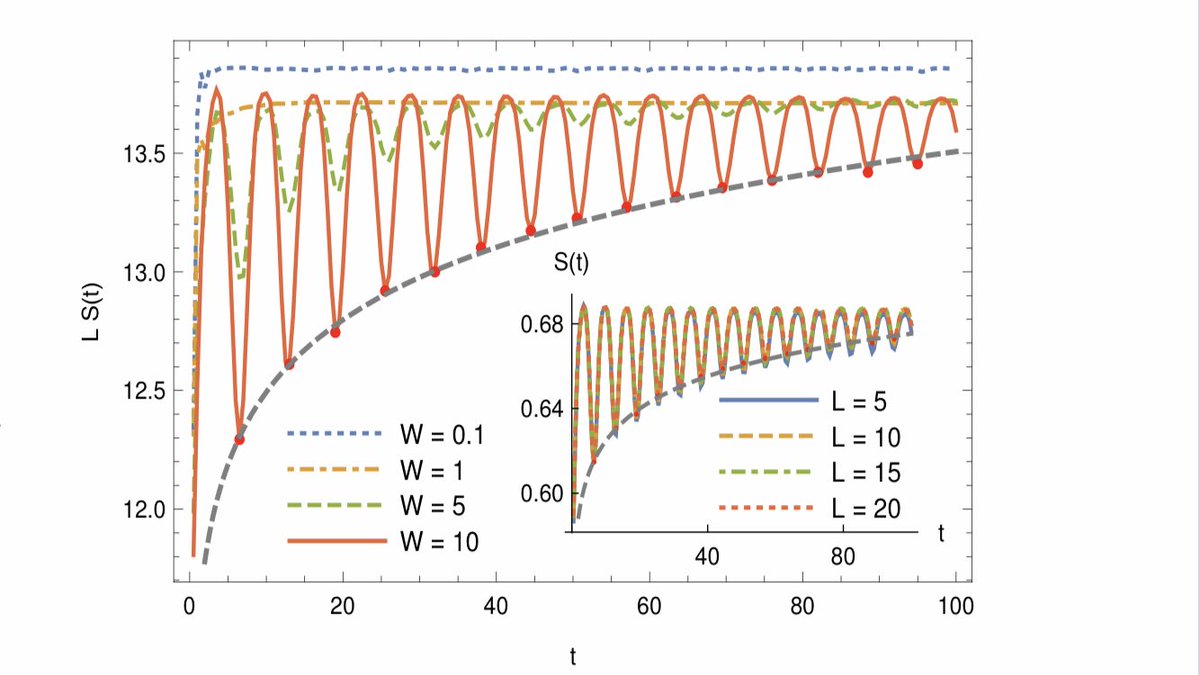
🚀 Observable Statistical Mechanics (OSM) 🔬 A new approach to equilibration and thermalization, focused on measurement outcome statistics rather than the entire quantum state. 🔑 Key points - Uses a new, observable-specific notion of energy - The Maximum Observable Entropy Principle and Equilibrium Equations are practical ways to compute stationary distributions - Proven accuracy ~0.1% to ~1% in 1D systems spin-1/2 systems 📖 Learn more: lnkd.in/dHM-D6Mm #Quantum #Thermodynamics #StatisticalMechanics #Physics #Research
Fabio Anzà tweet media
English
0
2
11
679
Fabio Anzà
Fabio Anzà@AnzaFabio·
The goal is to discuss five core theoretical frameworks for quantum thermalization - @AnatoliPolkovn1 on ETH - L. Santos on Quantum Chaos - P. Reimann on Typicality - @lpgarciapintos on Dynamical Equilibration - @ScarpaLodovico on Observable Thermalization
English
0
0
0
134
Fabio Anzà
Fabio Anzà@AnzaFabio·
🚀 Symposium Announcement 🚀 Quantum Thermalization - Understanding the dynamical foundation of quantum thermodynamics 📍 Event: @APSphysics March Meeting 2025 📅 Date: March 20th, 2025 🔗 Register here: lnkd.in/dTd73srj See below for our list of speakers!!
English
1
2
7
666
Fabio Anzà
Fabio Anzà@AnzaFabio·
@arxiv Any chance this has something to do with this? I keep getting this error while going on ArXiv
Fabio Anzà tweet media
English
0
0
0
206
arXiv.org
arXiv.org@arxiv·
Attention authors! If you're planning a submission to arXiv soon, we have some temporary changes to the announcement schedule in the upcoming weeks / months. More on the blog: blog.arxiv.org/2024/05/15/att…
English
2
5
23
9.2K