Sabitlenmiş Tweet
Aran Yogesh
66 posts

Aran Yogesh
@AranYogesh
incoming Applied AI @intapp prev @LangChain & @AionLabs Interested in agents, movies, cameras
Katılım Mayıs 2020
1K Takip Edilen122 Takipçiler
Aran Yogesh retweetledi

I use OpenSWE multiple times a day directly from slack. Makes it super easy to go from conversation -> code
Harrison Chase@hwchase17
Sierra isn't the first to build this - Ramp, Stripe, CoinBase also have If you want an open source version - check out OpenSWE: github.com/langchain-ai/o… We use it internally (mostly for coding). Model agnostic, fully OSS but integrates seamlessly with LangSmith for o11y
English

@BraceSproul I had the most fun working on this one. Super cool seeing it actually get heavy usage internally 🔥
English
Aran Yogesh retweetledi

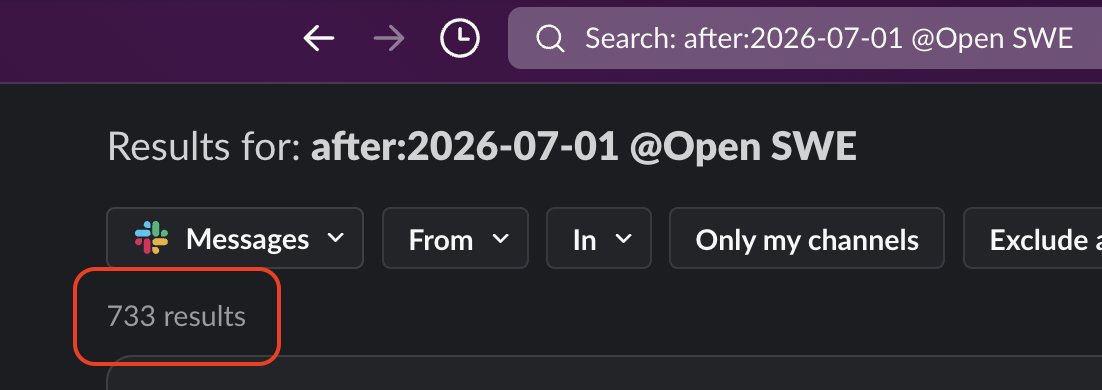
OpenSWE is one of our most widely used agents throughout the company. Since July 1st it's been tagged over 700 times in Slack!
This doesn't even count the reviewer agent, tagging it in GitHub, or tagging it from Linear tickets
It's 100% open source too

Harrison Chase@hwchase17
Sierra isn't the first to build this - Ramp, Stripe, CoinBase also have If you want an open source version - check out OpenSWE: github.com/langchain-ai/o… We use it internally (mostly for coding). Model agnostic, fully OSS but integrates seamlessly with LangSmith for o11y
English
Aran Yogesh retweetledi

We've built a coding agent factory inside LangChain, and fully open sourced every component of it
OpenSWE has:
- coding agent that runs in the cloud
- can tag it from Slack, GitHub or Linear
- fully sandboxed, supporting @LangChain LangSmith Sandboxes, @daytonaio, @e2b, @modal and @RunloopAI
- a frontier code review agent that automatically reviews GitHub PRs
- GitHub OAuth support
- A full UI web app for coding sessions and reviews
- much much more
We've been iterating on OpenSWE for over a year now, so you could say we know what we're doing here

English

Quick one that actually helped me a ton with LLMs:
Context isn’t something you just pile stuff into — it’s a limited budget. Too much noise and the model gets distracted from what matters.
“Lost in the middle” is very real. Keep key instructions near the start or end.
Go for clean precision over dumping tons of chunks.
For agents, learning what to summarize or drop is everything.
When something breaks, read the exact context you sent, it usually shows the real issue.
The model is fixed. The context you build is what actually runs the show.
Anyone else figure this out the fun way? 🙂
English

One powerful pattern for long-running coding agents: validator subagents.
Classic failure mode: the same agent implements the feature and writes its own tests. Its interpretation of the spec inevitably leaks into the validation.
Separate the roles.
Let a validator subagent see only the original requirement. It defines strict acceptance criteria before any implementation starts.
Builder focuses on execution.
Validator focuses on what “correct” actually means.
Clear separation = less bias, better alignment with user intent.
This simple split can significantly improve reliability in autonomous coding systems.

English

I've been running a lot of evals lately, and one insight keeps standing out, the most powerful move is turning your users into part of the test suite.
Offline evals are excellent at validating what we already expect. They're built around carefully crafted test cases that reflect our assumptions. But the moment a model ships to production, real users start surfacing the edge cases, ambiguous prompts, and failure modes we never anticipated.
This is exactly where online evals shine. They let you observe and measure how the model actually behaves on live, unpredictable usage—capturing all the messy grey areas that offline benchmarks miss.
English

I have been using both user invoked and model invoked skills for the past few days, and one thing has stood out.
Model invoked skills feel like magic when they work. But they also introduce more uncertainty. They can overcomplicate a simple request or miss a skill that should have been used, and you often only notice after the response is generated.
With user invoked skills, I know exactly what is running and why. Less uncertainty. More predictable.
It is not about which approach is smarter. When I am building and shipping, I value control and predictability over clever automation.
English

@adambcohen93 Hey i built OpenSWE at langchain and it recently reached 10k stars in github github.com/langchain-ai/o…
English

@Brennan_Lup Hey i built OpenSWE at langchain it reached 9.9k stars in github github.com/langchain-ai/o…
English

Hiring AI engineers. 150-250k base + equity. Comment below with something you've built before, sign up at workweave.dev and I'll reach out!
English

@AnthropicAI Its like @AnthropicAI just gave Claude its own thought subtitles
absolute cinema 😂
English