Arc Strategic Global

812 posts

Arc Strategic Global banner
Arc Strategic Global

Arc Strategic Global

@ArcStrategic_gl

Wars, markets, and weapons. After the headline. India. Not financial advice.

India Katılım Şubat 2026
166 Takip Edilen381 Takipçiler
Sabitlenmiş Tweet
Arc Strategic Global
Arc Strategic Global@ArcStrategic_gl·
The Western Oil Buffer Has Not Moved. Yet. I. The Headline Number Nobody Is Reading Correctly Hormuz has been effectively closed since February 28. The IEA called it the largest supply disruption in the history of the global oil market. And yet OECD commercial crude inventories have barely moved. That is not evidence the market is fine. It is evidence of a lag that has not finished running. II. What Actually Happened on February 28 Within 48 hours of Operation Epic Fury, the Strait of Hormuz went from 138 vessels per day to near zero. Maersk, CMA CGM, MSC and Hapag-Lloyd suspended transits the same night. P&I war risk insurance was cancelled from March 5, making the strait commercially unnavigable regardless of military conditions. The IRGC confirmed formal closure on March 2. By March 4, Iran claimed complete naval control of the passage. On the same day, the Houthis announced they would resume attacks on Red Sea shipping. For the first time in modern history both major maritime corridors connecting the Gulf to Europe closed simultaneously. There is no Suez shortcut. There is no Gulf entry. The Cape of Good Hope is the only route. III. Why The Inventory Line Has Not Moved The 2025 supply surplus pre-loaded the system. The IEA reported global observed inventories at 8,210 million barrels in January 2026, the highest since February 2021. OECD countries held roughly half. Refineries were not drawing down storage because storage was full. Vessels that were mid-voyage when the closure hit delivered their cargo. That is why the OECD commercial stock line on every chart looks flat. It is not stability. It is the last shipments from a pipeline that stopped refilling five weeks ago. IV. The Bypass Arithmetic Alternative routes exist. Saudi Arabia's East-West Pipeline runs to Yanbu at up to 5 million barrels per day. The UAE's Abu Dhabi Crude Oil Pipeline delivers to Fujairah at 0.5 to 0.7 million barrels per day. Iraq's Kirkuk-Ceyhan pipeline moves crude to the Turkish Mediterranean coast. Combined capacity: 7 to 9 million barrels per day. Pre-closure Hormuz flow: 20 million barrels per day. The gap is not temporary. The infrastructure was built to complement Hormuz, not replace it. More than 75% of spare OPEC+ production capacity sits behind the closed strait anyway, rendering it inaccessible regardless of willingness to pump. V. The Sequencing Problem The IEA coordinated emergency release of 400 million barrels is real supply. At 8 million barrels per day of lost crude flow it covers roughly 50 days. It is a bridge, not a solution. And the bridge has a far end. If Hormuz reopens tomorrow - a generous assumption given where the three-way negotiation between Washington, Jerusalem and Tehran currently sits. The arithmetic of getting replacement cargo to Western Europe is still unforgiving. Red Sea remains commercially closed. Houthis fired on Israel on March 28. No major carrier is transiting. Every cargo from the Gulf to Europe goes via Cape of Good Hope. Gulf to Rotterdam: 30 to 36 days. Southern Europe: 25 to 30 days. UK: 32 to 38 days. The strait has been closed five weeks. Six weeks of commercial inventory buffer already spent. The first post-reopening tanker that loads at Ras Tanura is still a month from Rotterdam. The inventory draw accelerates before that ship arrives. It does not reverse the moment it docks. You cannot restock a refinery the day the tanker docks. VI. What the Market Has and Has Not Priced Markets have priced the reopening. Brent rallied on every ceasefire signal, every Trump statement, every hint of diplomatic movement. That is rational. Reopening removes the physical constraint. What markets have not fully priced is the replenishment lag. The sequence is: closure ends, markets rally, first tanker loads, 30 days pass, cargo docks, refinery restocks, product supply normalises. Those events are separated by weeks at each step. Commercial inventories continue drawing through all of them. The OECD stock line is flat today because the pre-loaded buffer is holding. When it starts moving it will not drift. It will drop. And it will drop while the market is already celebrating a reopening that has not yet translated into physical supply. VII. The Unresolved Question The ceasefire conversation has three variables that do not currently align. Washington wants a deal before the political cost becomes unmanageable. Israel wants permanent degradation of Iranian nuclear and military capability, not a pause. Iran wants Hormuz leverage as a negotiating chip, not a concession to be surrendered before talks begin. None of those three positions has moved materially in five weeks. IEA emergency stocks and OECD commercial buffers together provide roughly 100 to 120 days of theoretical coverage at current disruption rates. That is runway. But runway with a specific end point. And a negotiation that stalls past that end point enters territory no strategic reserve was designed for. The buffer is real. The pipeline is broken. The lag is the story. --- Sources: IEA Oil Market Report March 2026, EIA STEO March 2026, Wikipedia 2026 Strait of Hormuz crisis, Lloyd's List Intelligence, S&P Global, Argus Media, LSE Business Review, Congress. gov CRS report For informational purposes only. Not financial or investment advice.
Arc Strategic Global tweet mediaArc Strategic Global tweet mediaArc Strategic Global tweet media
English
0
0
2
943
Arc Strategic Global
Arc Strategic Global@ArcStrategic_gl·
The piece does not. Your X post does. You cited India specifically as the original non-alignment model. That is the thread we were pulling on. The argument about the piece still stands independently: Europe is militarising without the psychological infrastructure that made non-alignment a doctrine rather than a posture. The direction of travel observation applies regardless of which country you had in mind.
English
0
0
8
114
Zineb Riboua
Zineb Riboua@zriboua·
@ArcStrategic_gl I don’t talk about India in the piece at all. I don’t think you’ve read what I wrote.
English
1
0
1
265
Zineb Riboua
Zineb Riboua@zriboua·
The non-alignment movement during the Cold War emerged because countries like India faced geographic and military constraints that made siding with either the United States or the Soviet Union both difficult and risky. Western Europe edging toward a similar posture in the U.S.–China competition is a sign of the times. zinebriboua.com/p/europe-milit…
English
6
23
97
4.4K
Arc Strategic Global
Arc Strategic Global@ArcStrategic_gl·
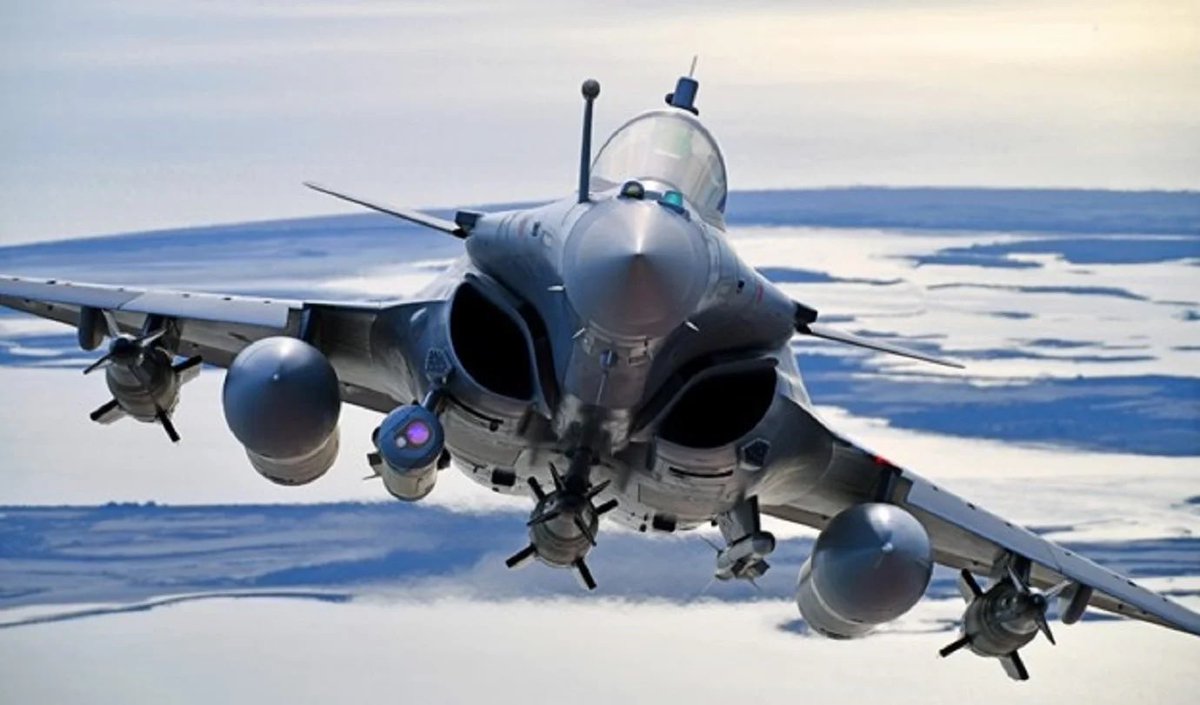
India is not confirming a purchase. It is confirming a position. The payment infrastructure was already in place. The MoPNG statement confirms it. “No payment hurdle” is not a new condition. It is an existing one being acknowledged publicly for the first time. That tells you more than the barrel count. India is buying Iranian oil while finalising a $40 billion Rafale deal with France, deepening Quad commitments, and receiving US defence delegations in New Delhi. It is not choosing between Washington and Tehran. It is demonstrating it does not intend to. The ministry statement is not about crude. It is about the terms on which India participates in any coalition architecture that follows this conflict.
Javier Blas@JavierBlas

New Delhi confirms its buying oil from Iran (after US eased sanctions): “… Indian refiners have secured their crude oil requirements, including from Iran; and there is no payment hurdle for Iranian crude imports…”

English
0
0
2
145
Arc Strategic Global
Arc Strategic Global@ArcStrategic_gl·
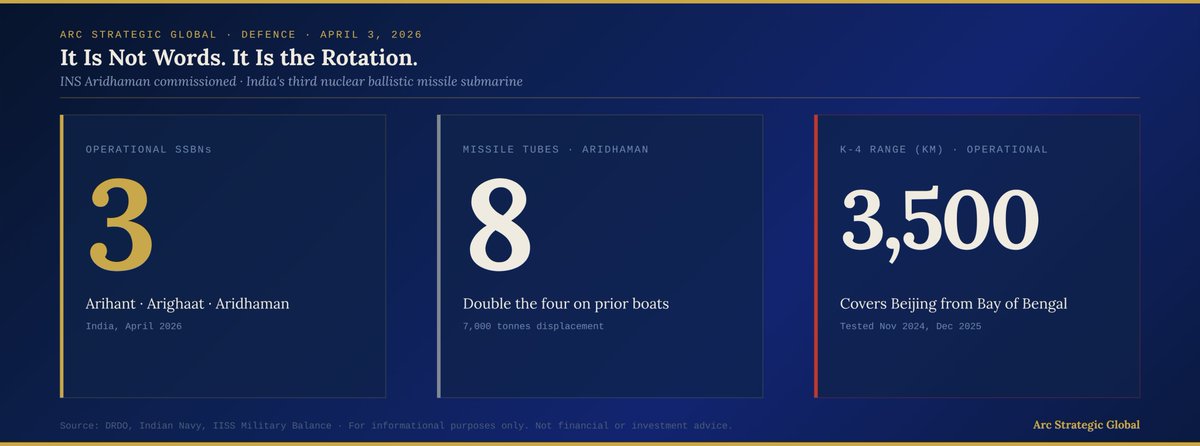
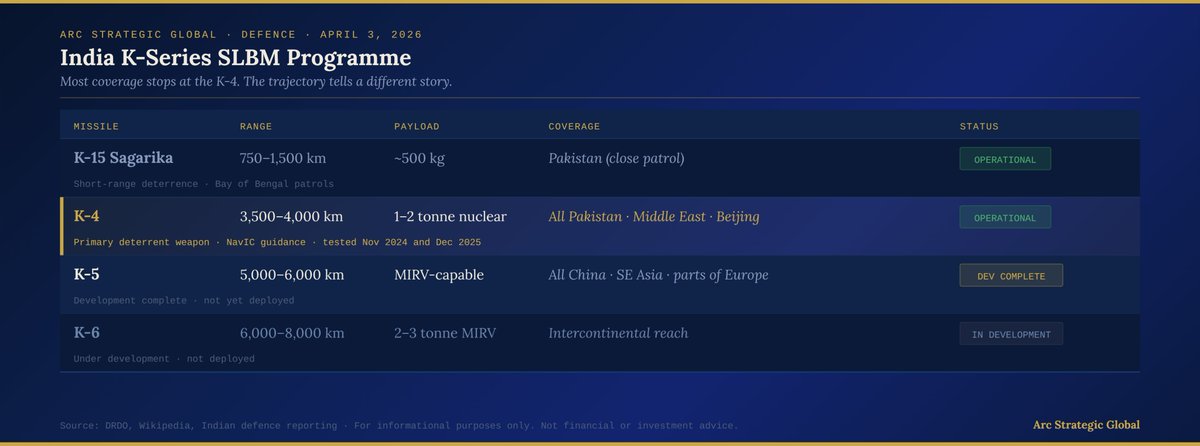
The Third Leg: India's Nuclear Triad Part 1 of 2 It Is Not Words. It Is the Rotation. INS Aridhaman commissioned. India's sea-based deterrent crosses a structural threshold. I. The Announcement India commissioned its third nuclear submarine today. Rajnath Singh posted one line on X and went silent. No ceremony. No press conference. The press release will talk about displacement. 7,000 tonnes. Eight missile tubes, double the four on earlier boats. The K-4 missile reaching 3,500 kilometres, covering Beijing from the Bay of Bengal. All of that is true. None of it is the story. II. The Arithmetic The story is the rotation. Two submarines cannot sustain continuous deterrence patrol. Maintenance cycles, crew rotation, refit periods. The math does not hold. The probability of having a boat at sea on any given day with two hulls is well below what strategic planners consider credible second-strike capability. Three boats changes that arithmetic entirely. With INS Arihant, INS Arighaat, and now INS Aridhaman in rotation, India can maintain near-continuous patrol coverage in the Bay of Bengal for the first time. The Bay of Bengal is the right patrol corridor. The continental shelf drops sharply near Visakhapatnam. SSBNs can submerge within hours of leaving port and remain concealed for weeks. The fourth boat commissions in 2027. That further consolidates the coverage. This is what Rajnath Singh meant. It is not words. III. What the Numbers Actually Say 3 operational SSBNs. 8 missile tubes on Aridhaman alone. K-4 range of 3,500 km, covering all of Pakistan, most of the Middle East, and Beijing from a concealed position in the Bay of Bengal. The K-5 is in development. The K-6 follows. Both extend range toward intercontinental thresholds. The missile stack is not static. It is climbing. India's sea-based deterrent is not a capability. It is a programme on a trajectory. IV. The Environment the Deterrent Operates In But the deterrent does not exist in isolation. The same week Aridhaman commissioned, three Chinese-built submarines were completing sea trials in Wuhan for the Pakistan Navy. Boats with AIP propulsion, capable of staying submerged for three weeks without surfacing. Built by the same country simultaneously expanding its own naval presence across the Indian Ocean. The environment India's SSBNs must operate in is being actively shaped by the same power they are designed to deter. That is the story this post does not finish. Part 2 tomorrow.
Arc Strategic Global tweet mediaArc Strategic Global tweet mediaArc Strategic Global tweet media
English
0
0
1
102
Arc Strategic Global
Arc Strategic Global@ArcStrategic_gl·
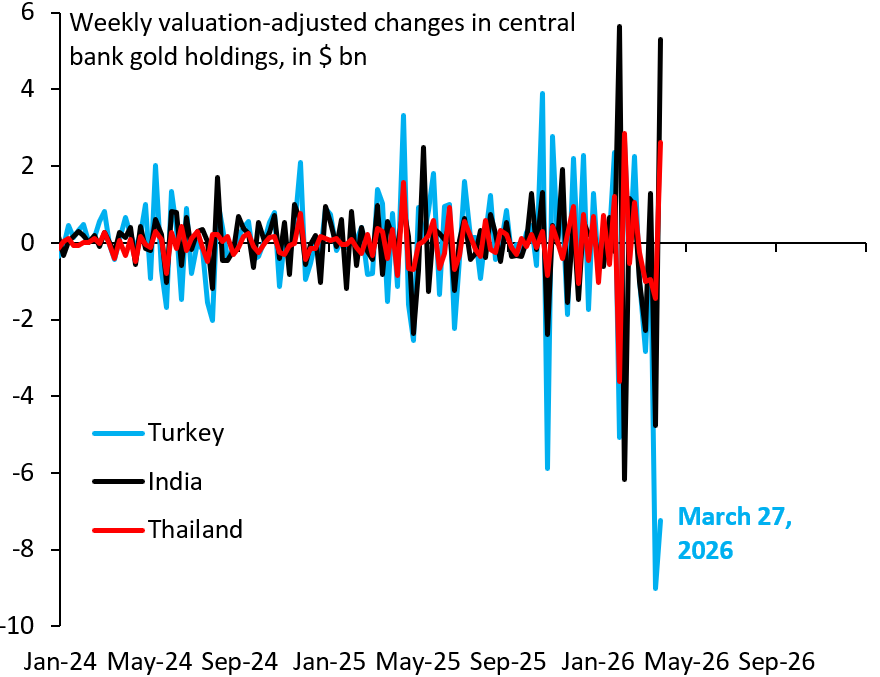
Turkey is selling gold to defend the Lira. India is not selling. The PBoC has not missed a single month in sixteen consecutive months of accumulation. Three central banks, the same data, three completely different reads on the same environment. Your chart captures the flow. The more uncomfortable number is the stock. India's gold share of total FX reserves has gone from 9% to nearly 14% in twelve months. The PBoC's buying cycle has held through $4,690, $5,000, and $5,600. Neither has blinked. Turkey's selling tells you it is managing a currency problem in the present. India and China's holding tells you they have already decided what the next problem looks like. The flow data is the symptom. The reserve composition shift is the diagnosis.
English
0
0
5
973
Robin Brooks
Robin Brooks@robin_j_brooks·
There's 3 central banks that publish weekly data on FX reserves and gold holdings: India, Thailand and Turkey. Only Turkey has seen a sustained drop in gold holdings (blue) that have been used to lift FX reserves and defend the crawling peg of the Lira... robinjbrooks.substack.com/p/central-bank…
Robin Brooks tweet media
English
19
38
203
48.8K
Arc Strategic Global
Arc Strategic Global@ArcStrategic_gl·
OECD stocks still look stable 5+ weeks after Hormuz effectively closed (Feb 28). But the real story is the replenishment lag: pre-loaded tankers are arriving, bypass pipelines cover only ~7-9 mbpd vs ~20 mbpd normal flows, and Cape routing adds 25-38 days. Visible draws will accelerate soon. Markets celebrating 'reopening' may be early. Detailed Analysis👇
Arc Strategic Global@ArcStrategic_gl

The Western Oil Buffer Has Not Moved. Yet. I. The Headline Number Nobody Is Reading Correctly Hormuz has been effectively closed since February 28. The IEA called it the largest supply disruption in the history of the global oil market. And yet OECD commercial crude inventories have barely moved. That is not evidence the market is fine. It is evidence of a lag that has not finished running. II. What Actually Happened on February 28 Within 48 hours of Operation Epic Fury, the Strait of Hormuz went from 138 vessels per day to near zero. Maersk, CMA CGM, MSC and Hapag-Lloyd suspended transits the same night. P&I war risk insurance was cancelled from March 5, making the strait commercially unnavigable regardless of military conditions. The IRGC confirmed formal closure on March 2. By March 4, Iran claimed complete naval control of the passage. On the same day, the Houthis announced they would resume attacks on Red Sea shipping. For the first time in modern history both major maritime corridors connecting the Gulf to Europe closed simultaneously. There is no Suez shortcut. There is no Gulf entry. The Cape of Good Hope is the only route. III. Why The Inventory Line Has Not Moved The 2025 supply surplus pre-loaded the system. The IEA reported global observed inventories at 8,210 million barrels in January 2026, the highest since February 2021. OECD countries held roughly half. Refineries were not drawing down storage because storage was full. Vessels that were mid-voyage when the closure hit delivered their cargo. That is why the OECD commercial stock line on every chart looks flat. It is not stability. It is the last shipments from a pipeline that stopped refilling five weeks ago. IV. The Bypass Arithmetic Alternative routes exist. Saudi Arabia's East-West Pipeline runs to Yanbu at up to 5 million barrels per day. The UAE's Abu Dhabi Crude Oil Pipeline delivers to Fujairah at 0.5 to 0.7 million barrels per day. Iraq's Kirkuk-Ceyhan pipeline moves crude to the Turkish Mediterranean coast. Combined capacity: 7 to 9 million barrels per day. Pre-closure Hormuz flow: 20 million barrels per day. The gap is not temporary. The infrastructure was built to complement Hormuz, not replace it. More than 75% of spare OPEC+ production capacity sits behind the closed strait anyway, rendering it inaccessible regardless of willingness to pump. V. The Sequencing Problem The IEA coordinated emergency release of 400 million barrels is real supply. At 8 million barrels per day of lost crude flow it covers roughly 50 days. It is a bridge, not a solution. And the bridge has a far end. If Hormuz reopens tomorrow - a generous assumption given where the three-way negotiation between Washington, Jerusalem and Tehran currently sits. The arithmetic of getting replacement cargo to Western Europe is still unforgiving. Red Sea remains commercially closed. Houthis fired on Israel on March 28. No major carrier is transiting. Every cargo from the Gulf to Europe goes via Cape of Good Hope. Gulf to Rotterdam: 30 to 36 days. Southern Europe: 25 to 30 days. UK: 32 to 38 days. The strait has been closed five weeks. Six weeks of commercial inventory buffer already spent. The first post-reopening tanker that loads at Ras Tanura is still a month from Rotterdam. The inventory draw accelerates before that ship arrives. It does not reverse the moment it docks. You cannot restock a refinery the day the tanker docks. VI. What the Market Has and Has Not Priced Markets have priced the reopening. Brent rallied on every ceasefire signal, every Trump statement, every hint of diplomatic movement. That is rational. Reopening removes the physical constraint. What markets have not fully priced is the replenishment lag. The sequence is: closure ends, markets rally, first tanker loads, 30 days pass, cargo docks, refinery restocks, product supply normalises. Those events are separated by weeks at each step. Commercial inventories continue drawing through all of them. The OECD stock line is flat today because the pre-loaded buffer is holding. When it starts moving it will not drift. It will drop. And it will drop while the market is already celebrating a reopening that has not yet translated into physical supply. VII. The Unresolved Question The ceasefire conversation has three variables that do not currently align. Washington wants a deal before the political cost becomes unmanageable. Israel wants permanent degradation of Iranian nuclear and military capability, not a pause. Iran wants Hormuz leverage as a negotiating chip, not a concession to be surrendered before talks begin. None of those three positions has moved materially in five weeks. IEA emergency stocks and OECD commercial buffers together provide roughly 100 to 120 days of theoretical coverage at current disruption rates. That is runway. But runway with a specific end point. And a negotiation that stalls past that end point enters territory no strategic reserve was designed for. The buffer is real. The pipeline is broken. The lag is the story. --- Sources: IEA Oil Market Report March 2026, EIA STEO March 2026, Wikipedia 2026 Strait of Hormuz crisis, Lloyd's List Intelligence, S&P Global, Argus Media, LSE Business Review, Congress. gov CRS report For informational purposes only. Not financial or investment advice.

English
0
0
1
103
Arc Strategic Global
Arc Strategic Global@ArcStrategic_gl·
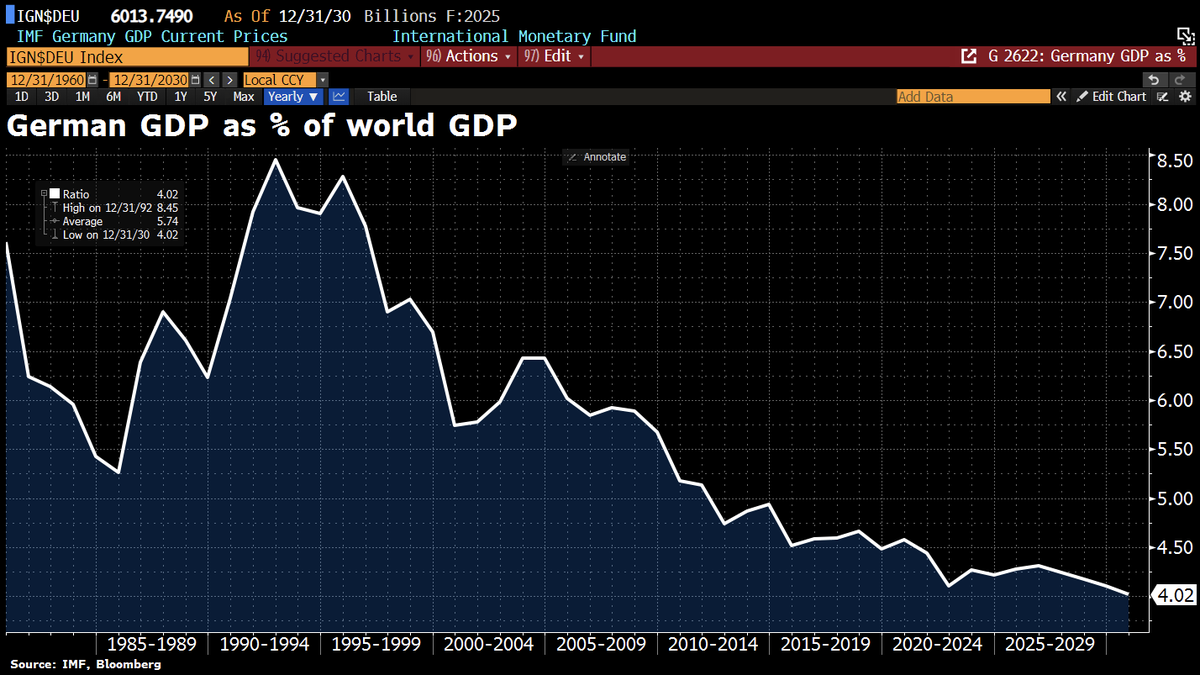
Germany's GDP share peaked the year the Soviet Union dissolved. For three decades it held on dependencies mistaken for strategy. Russian gas underwrote the industrial model. Nord Stream took decades to build and was destroyed in a single night in 2022, with no attribution to this day. Manufacturing moved to China. Volkswagen earned more profit there than in Europe. And Hormuz was always someone else's problem. The steeper decline from 2014 is Crimea's verdict arriving slowly, then all at once. The chart is showing what happens when none of the props were replaced before all of them were gone.
English
2
1
11
1.2K
Holger Zschaepitz
Holger Zschaepitz@Schuldensuehner·
Good Morning from Germany, a country whose influence on the world stage is fading. Its share of global GDP is expected to fall to 4% by 2030.
Holger Zschaepitz tweet media
English
216
607
2.8K
370.7K
Arc Strategic Global
Arc Strategic Global@ArcStrategic_gl·
x.com/ArcStrategic_g… The France-UAE optronics denial is verified. The kill chain attribution on Apr 3 needs separating from the verified facts. The China angle runs three layers deep: state transfer, live battlefield doctrine, and manufactured perception of capability. Op Sindoor showed all three running simultaneously. Longer analysis in the QT -
Arc Strategic Global@ArcStrategic_gl

Shanaka's optronics framing on the France-UAE side is verified. La Tribune confirmed it. The deal collapsed in December 2025 specifically over passive electro-optical sensor access. That part holds. Two things need separating before the argument travels. First, the kill chain. The F-15E loss on April 3 is confirmed. That Chinese-shared passive doctrine executed that specific shoot-down is Shanaka's analytical construction, not established reporting. The Iranian layered system is plausible. The specific attribution is not yet verified. Worth holding that distinction clearly. Second, the India comparison needs precision. France is not simply withholding source code from India the way it withheld optronics from the UAE. The emerging MRFA formula gives India API-level access, a software sandbox that allows integration of Astra, Rudram, and indigenous systems without touching the core sensor fusion kernel. India gets more than the UAE did. It does not get the black box. That distinction matters for any reply that India's defence community will scrutinise. The deeper China angle is the one Shanaka's piece sets up but does not finish. China is not doing one thing. It is doing three simultaneously. State-level technology transfer: BeiDou navigation, radar architecture, CM-302 missiles, all documented and pre-war. The 2026 conflict is also functioning as a live-fire laboratory, with every passive sensor engagement and every Shahed swarm that forces interceptor depletion generating doctrinal data Beijing will apply to Taiwan. Multiple assessments argue this, including the Al Jazeera signals piece from March. The third layer is the one that connects to India directly. After Operation Sindoor, the US-China Economic and Security Review Commission confirmed China ran a coordinated disinformation campaign. Fake social media accounts. AI-generated debris images. Chinese military attachés in embassies abroad actively lobbying countries to pause Rafale purchases. Beijing nearly succeeded with Indonesia. The campaign did not require Chinese technology to have actually won the engagement. It only required the world to believe it did. That is the structural point. China is deploying the technology, the battlefield learning from the technology, and the story of the technology all at once. These three channels compound regardless of whether they are coordinated. France is protecting a kernel. China is weaponising knowledge at every layer of the information environment simultaneously. The question April 3 puts to the Western technology sovereignty model is not whether the secret leaked. It is whether protecting the secret was ever the right response to an adversary whose primary weapon is the perception of capability, manufactured, exaggerated, or real. The kernel is still in the vault. The question of whether it was ever enough is now open.

English
1
5
6
2.5K
Shanaka Anslem Perera ⚡
JUST IN: France refused to share its optronics with the UAE. China shared its optronics with Iran. On April 3, the version that was shared brought down an American fighter jet. The version that was withheld could have helped detect the threat. The knowledge flowed to the attacker and was denied to the defender. The entire architecture of Western defence cooperation just inverted in a single afternoon. The UAE withdrew from co-financing the Rafale F5, France’s next-generation fighter upgrade. The programme costs €5 billion. Abu Dhabi had offered €3.5 billion in exchange for access to the “black box” technologies at the heart of the aircraft, specifically the optronics systems: the passive electro-optical and infrared sensors that detect, track, and identify targets without emitting a signal. France said no. Paris will now fund the entire programme alone, with delays expected. The negotiations collapsed during a meeting between Macron and Mohammed bin Zayed in Abu Dhabi in December 2025. The optronics were the breaking point. Optronics is the word connecting two stories nobody has placed in the same sentence. The technology France refused to share with its closest Gulf partner is the same class of technology Iran used to shoot down an F-15E Strike Eagle. Passive electro-optical and infrared detection. No radar emissions. No warning to the pilot. The Chinese tutorial published March 14 described the technique. The Iranian layered system, integrating Russian S-300 with Chinese EO/IR trackers and Iranian Raad missiles, executed it on April 3. The “black box” France kept locked is the same physics China gave away for the cost of a social media post. France kept the secret. China published the tutorial. Iran built the weapon. And the UAE defends itself with THAAD and Patriot batteries that rely on active radar, the systems passive detection was designed to circumvent. Habshan caught fire twice from intercepted debris. Abu Dhabi’s three bridges are on the IRGC’s target list. The optronics that might have given the UAE an edge in detecting incoming threats are locked in a French vault because Paris valued sovereignty over its partner’s survival. The same week, Trump’s sons arrived in Abu Dhabi to pitch Powerus, their drone defence company, to the government France just refused. Sheikh Tahnoon, who runs the UAE’s national security and invested $500 million in Trump’s cryptocurrency, sat across the table. The ally that could not buy French optronics is being sold American drones by the family of the President whose war created the threat the optronics were designed to counter. The molecule does not care about defence procurement. It cares about the strait that is closed, the gas plant on fire, the bridges on the list, and the shield that works on radar while the enemy learns to kill with heat. France kept its technology sovereign and lost its partner. China made its technology free and armed the adversary. The war is being decided by which approach produces results faster: the one that protects the secret or the one that shares the equation. The equation won. The secret is still in the vault. The F-15E is in a crater. And the ally who wanted the technology that might have changed the outcome is watching its gas plant burn while the President’s sons pitch the replacement across the table from a man who bought half a billion dollars of their cryptocurrency. open.substack.com/pub/shanakaans…
Shanaka Anslem Perera ⚡ tweet media
English
40
190
585
80.3K
Arc Strategic Global
Arc Strategic Global@ArcStrategic_gl·
Shanaka's optronics framing on the France-UAE side is verified. La Tribune confirmed it. The deal collapsed in December 2025 specifically over passive electro-optical sensor access. That part holds. Two things need separating before the argument travels. First, the kill chain. The F-15E loss on April 3 is confirmed. That Chinese-shared passive doctrine executed that specific shoot-down is Shanaka's analytical construction, not established reporting. The Iranian layered system is plausible. The specific attribution is not yet verified. Worth holding that distinction clearly. Second, the India comparison needs precision. France is not simply withholding source code from India the way it withheld optronics from the UAE. The emerging MRFA formula gives India API-level access, a software sandbox that allows integration of Astra, Rudram, and indigenous systems without touching the core sensor fusion kernel. India gets more than the UAE did. It does not get the black box. That distinction matters for any reply that India's defence community will scrutinise. The deeper China angle is the one Shanaka's piece sets up but does not finish. China is not doing one thing. It is doing three simultaneously. State-level technology transfer: BeiDou navigation, radar architecture, CM-302 missiles, all documented and pre-war. The 2026 conflict is also functioning as a live-fire laboratory, with every passive sensor engagement and every Shahed swarm that forces interceptor depletion generating doctrinal data Beijing will apply to Taiwan. Multiple assessments argue this, including the Al Jazeera signals piece from March. The third layer is the one that connects to India directly. After Operation Sindoor, the US-China Economic and Security Review Commission confirmed China ran a coordinated disinformation campaign. Fake social media accounts. AI-generated debris images. Chinese military attachés in embassies abroad actively lobbying countries to pause Rafale purchases. Beijing nearly succeeded with Indonesia. The campaign did not require Chinese technology to have actually won the engagement. It only required the world to believe it did. That is the structural point. China is deploying the technology, the battlefield learning from the technology, and the story of the technology all at once. These three channels compound regardless of whether they are coordinated. France is protecting a kernel. China is weaponising knowledge at every layer of the information environment simultaneously. The question April 3 puts to the Western technology sovereignty model is not whether the secret leaked. It is whether protecting the secret was ever the right response to an adversary whose primary weapon is the perception of capability, manufactured, exaggerated, or real. The kernel is still in the vault. The question of whether it was ever enough is now open.
Shanaka Anslem Perera ⚡@shanaka86

JUST IN: France refused to share its optronics with the UAE. China shared its optronics with Iran. On April 3, the version that was shared brought down an American fighter jet. The version that was withheld could have helped detect the threat. The knowledge flowed to the attacker and was denied to the defender. The entire architecture of Western defence cooperation just inverted in a single afternoon. The UAE withdrew from co-financing the Rafale F5, France’s next-generation fighter upgrade. The programme costs €5 billion. Abu Dhabi had offered €3.5 billion in exchange for access to the “black box” technologies at the heart of the aircraft, specifically the optronics systems: the passive electro-optical and infrared sensors that detect, track, and identify targets without emitting a signal. France said no. Paris will now fund the entire programme alone, with delays expected. The negotiations collapsed during a meeting between Macron and Mohammed bin Zayed in Abu Dhabi in December 2025. The optronics were the breaking point. Optronics is the word connecting two stories nobody has placed in the same sentence. The technology France refused to share with its closest Gulf partner is the same class of technology Iran used to shoot down an F-15E Strike Eagle. Passive electro-optical and infrared detection. No radar emissions. No warning to the pilot. The Chinese tutorial published March 14 described the technique. The Iranian layered system, integrating Russian S-300 with Chinese EO/IR trackers and Iranian Raad missiles, executed it on April 3. The “black box” France kept locked is the same physics China gave away for the cost of a social media post. France kept the secret. China published the tutorial. Iran built the weapon. And the UAE defends itself with THAAD and Patriot batteries that rely on active radar, the systems passive detection was designed to circumvent. Habshan caught fire twice from intercepted debris. Abu Dhabi’s three bridges are on the IRGC’s target list. The optronics that might have given the UAE an edge in detecting incoming threats are locked in a French vault because Paris valued sovereignty over its partner’s survival. The same week, Trump’s sons arrived in Abu Dhabi to pitch Powerus, their drone defence company, to the government France just refused. Sheikh Tahnoon, who runs the UAE’s national security and invested $500 million in Trump’s cryptocurrency, sat across the table. The ally that could not buy French optronics is being sold American drones by the family of the President whose war created the threat the optronics were designed to counter. The molecule does not care about defence procurement. It cares about the strait that is closed, the gas plant on fire, the bridges on the list, and the shield that works on radar while the enemy learns to kill with heat. France kept its technology sovereign and lost its partner. China made its technology free and armed the adversary. The war is being decided by which approach produces results faster: the one that protects the secret or the one that shares the equation. The equation won. The secret is still in the vault. The F-15E is in a crater. And the ally who wanted the technology that might have changed the outcome is watching its gas plant burn while the President’s sons pitch the replacement across the table from a man who bought half a billion dollars of their cryptocurrency. open.substack.com/pub/shanakaans…

English
0
1
5
2.7K
Arc Strategic Global
Arc Strategic Global@ArcStrategic_gl·
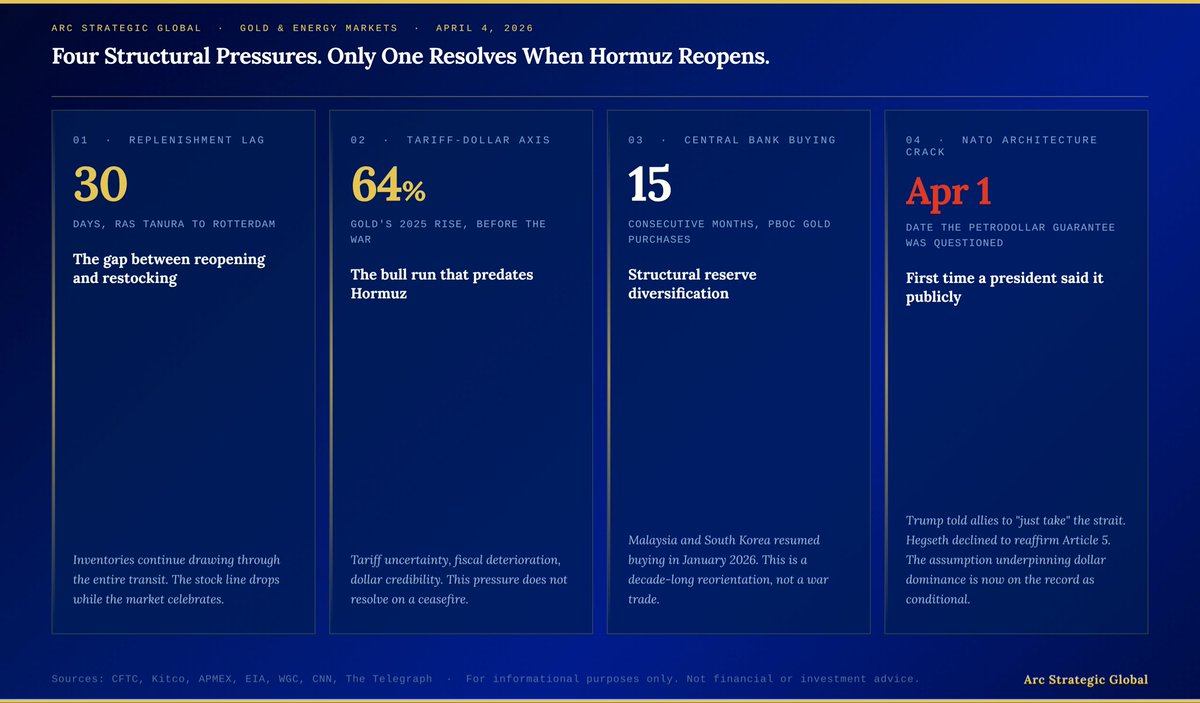
Gold Is Not Pricing the War. It Is Pricing What Comes After. I. The Setup - Brent crude rallies on every ceasefire signal. Gold does not sell off on the same signals. Oil and gold are pricing different variables from the same event. The variable gold is tracking survives every resolution scenario currently on the table. Hedge fund net long positions rose to 93,872 contracts in the week ending March 31, up 1,097 on the week, while short positions fell to 26,664. Funds are not hedging a tail risk at $4,720 per ounce. They are expressing sustained directional conviction. Understanding why requires separating the four structural pressures gold is absorbing. Only one of them resolves when Hormuz reopens. II. The Replenishment Lag - When Hormuz reopens, the first tanker loading at Ras Tanura is still 30 days from Rotterdam via Cape of Good Hope. Both major corridors connecting the Gulf to Europe closed simultaneously on February 28. Every cargo rounds Africa. Commercial inventories continue drawing through the entire transit. The OECD stock line does not drift when it starts moving. It drops while the market is already celebrating. Brent prices the reopening event. Gold prices the month that follows it. III. The Tariff-Dollar Axis - The Hormuz closure did not create gold’s bull run. It accelerated one already underway. Gold rose 64 percent in 2025 on tariff uncertainty, central bank buying, and structural diversification away from dollar-denominated assets. In 2026 the fiscal trajectory has worsened. The Supreme Court struck down Trump’s IEEPA tariffs. Trump reimposed 10 to 15 percent global tariffs under alternative authority. US GDP slowed to 1.4 percent annualised in Q4 2025. The federal deficit stood at $600 billion through January before the tariff revenue shortfall widened. The PBoC has bought gold for 15 consecutive months. That buying does not stop when Hormuz reopens. It is a decade-long reorientation the war accelerated but did not originate. IV. The NATO Architecture Crack - This is the structural pressure most gold analysis is missing. On April 1, Trump told allied nations to go to the strait and just take it. On April 2 he told The Telegraph he was considering withdrawing the US from NATO, calling the alliance a paper tiger. Defense Secretary Hegseth declined to reaffirm Article 5 the same week. The petrodollar rests on one foundational assumption: US naval power guarantees free passage of Gulf energy, and in return global energy is priced in dollars and recycled into US Treasuries. Trump’s address is the first time a sitting president has publicly questioned whether that guarantee will continue. Not in a backroom conversation. In a primetime national address, on record, while the strait is closed. Every central bank holding dollars as a primary reserve asset now has reason to reassess. The PBoC already understood the direction of travel. This week confirmed it. V. The Spread Worth Watching - When Hormuz reopens, Brent corrects as the risk premium unwinds. Goldman estimated $18 per barrel embedded in crude at the war’s start. Gold will not correct by the same magnitude or on the same timeline. The tariff-dollar pressure does not resolve on a ceasefire. Central bank diversification does not reverse on a ceasefire. The NATO architecture question does not disappear on a ceasefire. The spread between Brent’s correction and gold’s correction after reopening will be the market’s answer to how much of gold’s positioning was Hormuz-specific versus structural. A large Brent correction with a small gold correction confirms the structural bid is real and durable. That spread is the number worth watching before the strait opens, not after. —- Strictly for informational purposes only. Not financial or investment advice.
Arc Strategic Global tweet media
English
0
0
1
144
Arc Strategic Global
Arc Strategic Global@ArcStrategic_gl·
x.com/ArcStrategic_g… Every ceasefire signal has rallied Brent. Markets are pricing the reopening. What they have not priced is the lag. The first tanker that loads at Ras Tanura after Hormuz reopens is still 30 days from Rotterdam. Commercial inventories keep drawing through that entire month. The OECD stock line looks flat today because pre-loaded buffer is holding. When it moves it will not drift. It will drop, while the market is already celebrating. The buffer is real. The pipeline is broken. The lag is the story.
Arc Strategic Global@ArcStrategic_gl

The Western Oil Buffer Has Not Moved. Yet. I. The Headline Number Nobody Is Reading Correctly Hormuz has been effectively closed since February 28. The IEA called it the largest supply disruption in the history of the global oil market. And yet OECD commercial crude inventories have barely moved. That is not evidence the market is fine. It is evidence of a lag that has not finished running. II. What Actually Happened on February 28 Within 48 hours of Operation Epic Fury, the Strait of Hormuz went from 138 vessels per day to near zero. Maersk, CMA CGM, MSC and Hapag-Lloyd suspended transits the same night. P&I war risk insurance was cancelled from March 5, making the strait commercially unnavigable regardless of military conditions. The IRGC confirmed formal closure on March 2. By March 4, Iran claimed complete naval control of the passage. On the same day, the Houthis announced they would resume attacks on Red Sea shipping. For the first time in modern history both major maritime corridors connecting the Gulf to Europe closed simultaneously. There is no Suez shortcut. There is no Gulf entry. The Cape of Good Hope is the only route. III. Why The Inventory Line Has Not Moved The 2025 supply surplus pre-loaded the system. The IEA reported global observed inventories at 8,210 million barrels in January 2026, the highest since February 2021. OECD countries held roughly half. Refineries were not drawing down storage because storage was full. Vessels that were mid-voyage when the closure hit delivered their cargo. That is why the OECD commercial stock line on every chart looks flat. It is not stability. It is the last shipments from a pipeline that stopped refilling five weeks ago. IV. The Bypass Arithmetic Alternative routes exist. Saudi Arabia's East-West Pipeline runs to Yanbu at up to 5 million barrels per day. The UAE's Abu Dhabi Crude Oil Pipeline delivers to Fujairah at 0.5 to 0.7 million barrels per day. Iraq's Kirkuk-Ceyhan pipeline moves crude to the Turkish Mediterranean coast. Combined capacity: 7 to 9 million barrels per day. Pre-closure Hormuz flow: 20 million barrels per day. The gap is not temporary. The infrastructure was built to complement Hormuz, not replace it. More than 75% of spare OPEC+ production capacity sits behind the closed strait anyway, rendering it inaccessible regardless of willingness to pump. V. The Sequencing Problem The IEA coordinated emergency release of 400 million barrels is real supply. At 8 million barrels per day of lost crude flow it covers roughly 50 days. It is a bridge, not a solution. And the bridge has a far end. If Hormuz reopens tomorrow - a generous assumption given where the three-way negotiation between Washington, Jerusalem and Tehran currently sits. The arithmetic of getting replacement cargo to Western Europe is still unforgiving. Red Sea remains commercially closed. Houthis fired on Israel on March 28. No major carrier is transiting. Every cargo from the Gulf to Europe goes via Cape of Good Hope. Gulf to Rotterdam: 30 to 36 days. Southern Europe: 25 to 30 days. UK: 32 to 38 days. The strait has been closed five weeks. Six weeks of commercial inventory buffer already spent. The first post-reopening tanker that loads at Ras Tanura is still a month from Rotterdam. The inventory draw accelerates before that ship arrives. It does not reverse the moment it docks. You cannot restock a refinery the day the tanker docks. VI. What the Market Has and Has Not Priced Markets have priced the reopening. Brent rallied on every ceasefire signal, every Trump statement, every hint of diplomatic movement. That is rational. Reopening removes the physical constraint. What markets have not fully priced is the replenishment lag. The sequence is: closure ends, markets rally, first tanker loads, 30 days pass, cargo docks, refinery restocks, product supply normalises. Those events are separated by weeks at each step. Commercial inventories continue drawing through all of them. The OECD stock line is flat today because the pre-loaded buffer is holding. When it starts moving it will not drift. It will drop. And it will drop while the market is already celebrating a reopening that has not yet translated into physical supply. VII. The Unresolved Question The ceasefire conversation has three variables that do not currently align. Washington wants a deal before the political cost becomes unmanageable. Israel wants permanent degradation of Iranian nuclear and military capability, not a pause. Iran wants Hormuz leverage as a negotiating chip, not a concession to be surrendered before talks begin. None of those three positions has moved materially in five weeks. IEA emergency stocks and OECD commercial buffers together provide roughly 100 to 120 days of theoretical coverage at current disruption rates. That is runway. But runway with a specific end point. And a negotiation that stalls past that end point enters territory no strategic reserve was designed for. The buffer is real. The pipeline is broken. The lag is the story. --- Sources: IEA Oil Market Report March 2026, EIA STEO March 2026, Wikipedia 2026 Strait of Hormuz crisis, Lloyd's List Intelligence, S&P Global, Argus Media, LSE Business Review, Congress. gov CRS report For informational purposes only. Not financial or investment advice.

English
0
0
3
391
Arc Strategic Global
Arc Strategic Global@ArcStrategic_gl·
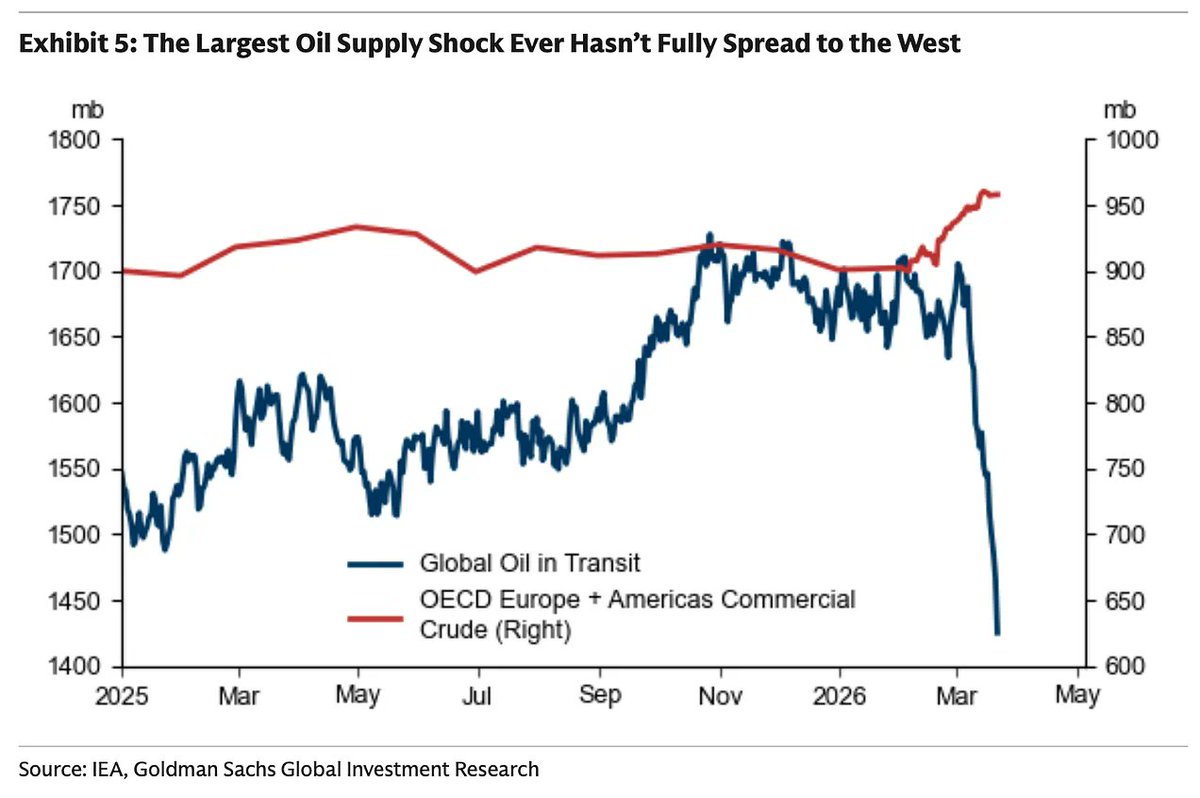
Even if Hormuz opens tomorrow the arithmetic is uncomfortable. Though the Europe is not solely dependent on Gulf crude. Norway, West Africa, the US, Caspian all supply it. But tanker capacity is global. Every vessel rerouting Cape of Good Hope instead of Suez adds 10 to 14 days to its round trip. That tightens the global fleet regardless of where the oil originates. The Gulf to Rotterdam timeline post-reopening: 30 to 36 days via Cape. Commercial inventories started drawing down February 28. Six weeks already spent. Europe does not run out. But the price of the marginal barrel stays elevated long after the strait reopens. The red line on your chart starts moving before the first tanker arrives. It does not recover the moment it does.
English
3
20
101
12.2K
Ali Al-Salim
Ali Al-Salim@alialsalim·
The oil shock has yet to arrive in the west. Blue line = Global Oil in Transit (left axis, Drops from 1.7B barrels to 1.4): This tracks the total volume of crude physically sailing on tankers globally. It rose steadily through 2025, then in March 2026, there is a cliff-edge collapse of roughly ~300 mb, as empty tankers cannot be reloaded. Red line = OECD Europe + Americas Commercial Crude (right axis, 0.95B barrels): This tracks commercial crude inventories held by Western buyers. Despite the tanker collapse, this line has barely moved — when it finally does, the physical shock will have arrived.
Ali Al-Salim tweet media
English
40
601
1.8K
381.2K
Arc Strategic Global
Arc Strategic Global@ArcStrategic_gl·
Every ceasefire signal has rallied Brent. Markets are pricing the reopening. What they have not priced is the lag. The first tanker that loads at Ras Tanura after Hormuz reopens is still 30 days from Rotterdam. Commercial inventories keep drawing through that entire month. The OECD stock line looks flat today because pre-loaded buffer is holding. When it moves it will not drift. It will drop, while the market is already celebrating. The buffer is real. The pipeline is broken. The lag is the story. Full breakdown of the arithmetic here.
Arc Strategic Global@ArcStrategic_gl

The Western Oil Buffer Has Not Moved. Yet. I. The Headline Number Nobody Is Reading Correctly Hormuz has been effectively closed since February 28. The IEA called it the largest supply disruption in the history of the global oil market. And yet OECD commercial crude inventories have barely moved. That is not evidence the market is fine. It is evidence of a lag that has not finished running. II. What Actually Happened on February 28 Within 48 hours of Operation Epic Fury, the Strait of Hormuz went from 138 vessels per day to near zero. Maersk, CMA CGM, MSC and Hapag-Lloyd suspended transits the same night. P&I war risk insurance was cancelled from March 5, making the strait commercially unnavigable regardless of military conditions. The IRGC confirmed formal closure on March 2. By March 4, Iran claimed complete naval control of the passage. On the same day, the Houthis announced they would resume attacks on Red Sea shipping. For the first time in modern history both major maritime corridors connecting the Gulf to Europe closed simultaneously. There is no Suez shortcut. There is no Gulf entry. The Cape of Good Hope is the only route. III. Why The Inventory Line Has Not Moved The 2025 supply surplus pre-loaded the system. The IEA reported global observed inventories at 8,210 million barrels in January 2026, the highest since February 2021. OECD countries held roughly half. Refineries were not drawing down storage because storage was full. Vessels that were mid-voyage when the closure hit delivered their cargo. That is why the OECD commercial stock line on every chart looks flat. It is not stability. It is the last shipments from a pipeline that stopped refilling five weeks ago. IV. The Bypass Arithmetic Alternative routes exist. Saudi Arabia's East-West Pipeline runs to Yanbu at up to 5 million barrels per day. The UAE's Abu Dhabi Crude Oil Pipeline delivers to Fujairah at 0.5 to 0.7 million barrels per day. Iraq's Kirkuk-Ceyhan pipeline moves crude to the Turkish Mediterranean coast. Combined capacity: 7 to 9 million barrels per day. Pre-closure Hormuz flow: 20 million barrels per day. The gap is not temporary. The infrastructure was built to complement Hormuz, not replace it. More than 75% of spare OPEC+ production capacity sits behind the closed strait anyway, rendering it inaccessible regardless of willingness to pump. V. The Sequencing Problem The IEA coordinated emergency release of 400 million barrels is real supply. At 8 million barrels per day of lost crude flow it covers roughly 50 days. It is a bridge, not a solution. And the bridge has a far end. If Hormuz reopens tomorrow - a generous assumption given where the three-way negotiation between Washington, Jerusalem and Tehran currently sits. The arithmetic of getting replacement cargo to Western Europe is still unforgiving. Red Sea remains commercially closed. Houthis fired on Israel on March 28. No major carrier is transiting. Every cargo from the Gulf to Europe goes via Cape of Good Hope. Gulf to Rotterdam: 30 to 36 days. Southern Europe: 25 to 30 days. UK: 32 to 38 days. The strait has been closed five weeks. Six weeks of commercial inventory buffer already spent. The first post-reopening tanker that loads at Ras Tanura is still a month from Rotterdam. The inventory draw accelerates before that ship arrives. It does not reverse the moment it docks. You cannot restock a refinery the day the tanker docks. VI. What the Market Has and Has Not Priced Markets have priced the reopening. Brent rallied on every ceasefire signal, every Trump statement, every hint of diplomatic movement. That is rational. Reopening removes the physical constraint. What markets have not fully priced is the replenishment lag. The sequence is: closure ends, markets rally, first tanker loads, 30 days pass, cargo docks, refinery restocks, product supply normalises. Those events are separated by weeks at each step. Commercial inventories continue drawing through all of them. The OECD stock line is flat today because the pre-loaded buffer is holding. When it starts moving it will not drift. It will drop. And it will drop while the market is already celebrating a reopening that has not yet translated into physical supply. VII. The Unresolved Question The ceasefire conversation has three variables that do not currently align. Washington wants a deal before the political cost becomes unmanageable. Israel wants permanent degradation of Iranian nuclear and military capability, not a pause. Iran wants Hormuz leverage as a negotiating chip, not a concession to be surrendered before talks begin. None of those three positions has moved materially in five weeks. IEA emergency stocks and OECD commercial buffers together provide roughly 100 to 120 days of theoretical coverage at current disruption rates. That is runway. But runway with a specific end point. And a negotiation that stalls past that end point enters territory no strategic reserve was designed for. The buffer is real. The pipeline is broken. The lag is the story. --- Sources: IEA Oil Market Report March 2026, EIA STEO March 2026, Wikipedia 2026 Strait of Hormuz crisis, Lloyd's List Intelligence, S&P Global, Argus Media, LSE Business Review, Congress. gov CRS report For informational purposes only. Not financial or investment advice.

English
0
0
1
101
Arc Strategic Global
Arc Strategic Global@ArcStrategic_gl·
Reading Between the Lines - No. 001 Pakistan's Mediation Silence Pakistan's Foreign Office held its weekly briefing Thursday. The spokesperson cited "obstacles." He did not name them. Here is what happened in the days before that briefing. Iran's Foreign Ministry publicly denied participating in any Pakistan-facilitated talks. Called the coverage fake news. Iran's parliament speaker rejected negotiations with the US outright. Iran rejected the US 15-point peace proposal through intermediaries. Trump threatened to bomb Iran back to the Stone Ages if it didn't accept Washington's terms. Pakistan responded to Iran's denial by accusing India and Afghanistan of spreading misinformation. That is the actual state of the mediation. Not obstacles. Collapse of the public framework, with both sides using Pakistan's channel for domestic positioning rather than genuine negotiation. Iran passes messages privately while denying talks publicly, to avoid appearing to negotiate under fire. The US accepts that arrangement because it keeps oil markets slightly calmer than a full breakdown would. Pakistan stays in the room because being seen as a mediator is worth more to Islamabad right now than whether the mediation works.
Arc Strategic Global tweet media
English
0
0
1
76
Arc Strategic Global
Arc Strategic Global@ArcStrategic_gl·
Iran has now let through vessels from Iran, China, Pakistan, Malaysia, and France. In that order. That is not a shipping log. That is Iran publishing its geopolitical hierarchy in real time, one transit clearance at a time. China got formal gratitude from Tehran. Pakistan got a quota of 20 vessels. Malaysia got early clearance with a public thank-you from its PM. France negotiated privately while Macron was announcing a multilateral coalition publicly. Each clearance is a diplomatic signal dressed in maritime language. The IRGC vetting process is not just screening for risk. It is telling the world, in operational data, who Iran is willing to deal with and on what terms. 138 vessels transited Hormuz daily before the war. On March 31, five did. Full analysis below. The Kribi Transit open.substack.com/pub/arcstrateg…
Arc Strategic Global tweet media
English
1
0
1
117
Arc Strategic Global
Arc Strategic Global@ArcStrategic_gl·
Exactly! The sequence is the story. Hormuz closes. Inventories draw. Tankers reroute. Reopening announced. Markets rally. But the first replacement cargo is still 35 days from Rotterdam. The price relief comes before the physical relief. That gap is where the second shock lives.
English
1
3
28
2K
Arc Strategic Global
Arc Strategic Global@ArcStrategic_gl·
@pati_marins64 @RichHeydarian If it is David’s Sling the cost asymmetry narrows. Stunner runs roughly $1M per shot against a $2M Fattah-1. But David’s Sling was optimised for predictable ballistic trajectories.
English
1
1
3
298
Arc Strategic Global
Arc Strategic Global@ArcStrategic_gl·
The MaRV changes more than the intercept geometry. It changes the economics. Fattah-1 costs roughly $1-2M per missile. A PAC-3 MSE interceptor runs $3.7-4.2M per shot. Even If terminal maneuvering forces two or three intercept attempts, the defender is spending $8-12M to stop a $2M threat. Sustained MaRV saturation does not need to defeat every interceptor. It only needs to exhaust the budget of trying.
English
2
3
35
5.8K
Patricia Marins
Patricia Marins@pati_marins64·
Iranian Fattah-1 Activates Second Motor and Defeats 12 Interceptors In this video, we can clearly see the missile activating its secondary solid-fuel motor. The Fattah-1 is a classic ballistic missile up to a certain point. It climbs into space on a high parabolic trajectory and re-enters the atmosphere at a steep angle. Up to that stage, it behaves like a conventional missile. The real difference lies in the activation of the re-entry motor and the movable nozzle, which allow it to make sharp corrections, zig-zag maneuvers in the terminal phase, or simply deliver a sudden burst of speed. Without this motor, a conventional warhead would lose more than 50% of its velocity when performing aggressive maneuvers due to atmospheric friction. The Fattah-1’s secondary motor is a small spherical solid-fuel engine, compact enough to fit inside the maneuverable re-entry vehicle (MaRV). Theoretically, it can burn for more than 30 seconds, counteracting atmospheric deceleration and ensuring the warhead strikes at hypersonic speeds. However, from what the video shows, it appears it can be reconfigured for a short, powerful boost of just a few seconds, delivering intense speed in the final phase. The developers claim that in this last stage, the missile reaches speeds above Mach 13. Of course, there’s no such thing as a perfect system. This secondary motor reduces the payload of the warhead due to space constraints, but that loss can be partially compensated by the massive increase in kinetic impact energy.
English
220
2.8K
12.2K
819.4K