Lugal Arch retweetledi
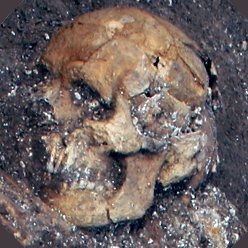
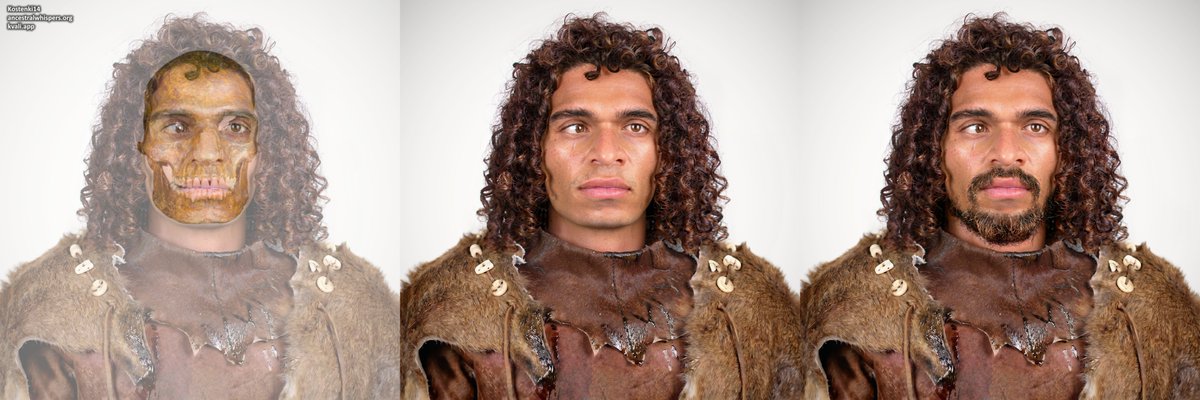
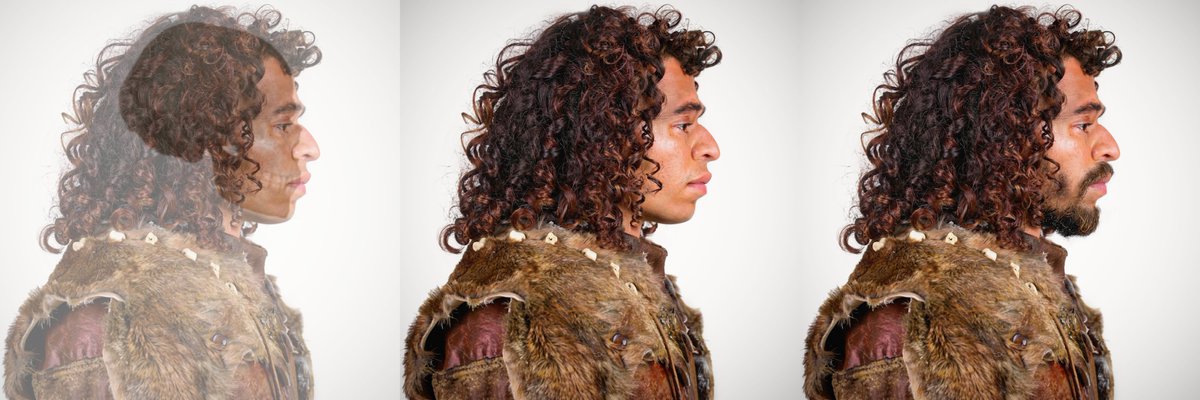
Facial reconstruction of Kostenki14, a 35,000-year-old man from Voronezh
The man from the Upper Paleolithic site of Kostenki 14 (Markina Gora) represents one of the oldest known Homo sapiens burials in Europe. His skeleton is exceptionally well preserved, comparable only to the famous Sungir burials.
He was buried in a shallow oval grave without grave goods, though nearby layers contained early Upper Paleolithic stone tools. Anthropological analysis showed that he was unusually short for his era - about 160 cm tall. His cranial capacity was likewise very small, at around 1200 cm³.
The description of the skull is published by G. F. Debets in the article “Paleoanthropological finds in Kostenki,” where he notes features of an equatorial type, both in the structure of the skull and in the bones of the skeleton of the individual from Markina Gora. One cannot fail to note the great similarity of the skeletons from the Grimaldi grotto with the skeleton from Markina Gora; it is appropriate to recall the very similar form of burial practice in these archaeologically distant sites.
Researchers identified numerous health abnormalities. His long bones had extremely reduced marrow cavities, and he likely suffered from calcium deficiency, sensory disorders, vision problems, chronic pain, cramps, and numbness. He also had serious spinal damage caused by blunt-force trauma, possibly from an animal attack or a fall. Additional injuries to the head and jaw may have come from the same event.
Despite these conditions, his skeleton shows clear signs of intense hunting activity. He was likely a skilled spear or dart thrower, right-handed (characteristic of the Stone Age, when left-handed individuals were practically not encountered), and physically active like other Stone Age hunters. Tooth wear and isotope analysis indicate a diet of tough foods typical of Paleolithic hunter-gatherers.
Further study suggested chronic inflammation affecting the brain, especially the right hemisphere. Researchers proposed that he may have experienced cognitive or behavioral impairments, such as speech difficulties, problems understanding others, and social isolation.
Examination of the pelvis revealed that he most likely died from a deep abdominal wound that caused massive blood loss shortly before death.
His burial posture was highly unusual: the legs were tightly drawn to the abdomen and the arms pressed against the chest, suggesting the body had been tightly wrapped or restrained. Ochre was heavily concentrated around the head. Researchers believe the burial reflects either a unique ritual practice or his unusual social status. Some have suggested that his severe condition and behavior in his final days may even have led to his death at the hands of his own group.
(Mednikova M. B., Moiseev V. G., Khartanovich V. I., 2014), (Khartanovich V. I., Moiseev V. G., Mednikova M. B. et al., 2016), (Trinkaus E., Buzhilova A. P., Mednikova M. B., and Dobrovolskaya M. V., 2014), (Caffey M. D., 1967), (Tilley L., 2015), (Trinkaus E., Buzhilova A. P., 2018), (M.M. Gerasimov, 1955), (Наука из первых рук, 2019, Vol. 82, No. 2)
English