IA_817

3.8K posts

IA_817 banner
IA_817

IA_817

@Arena_817

RT isn’t an endorsement and doesn’t reflect the views of my employer; often, it’s to revisit a post

New York, NY Katılım Ekim 2013
6.2K Takip Edilen408 Takipçiler
IA_817 retweetledi
Zephyr
Zephyr@zephyr_z9·
Interconnect Bottleneck ;)
Aaron@Aaronwei3n

With most major AI accelerators starting their production ramp in 2H26, high-end copper foil demand is surging. _ GS: The TAM for high-end copper foil is on an upward trajectory; we expect it to reach US$2.4bn by 2028E, driven by mass adoption starting in 2H26. Most mainstream AI server projects are slated to adopt HVLP4 beginning in 2H26, and high-end copper foil (HVLP3 and above) is projected to account for 9%, 21%, and 33% of the total PCB copper foil TAM in 2026, 2027, and 2028E, respectively, to meet stricter requirements for AI server connectivity and speed. Furthermore, regarding the industry supply-demand outlook, we anticipate a shortage ratio of ~25–40% for HVLP3+ grade materials between 2026 and 2028, pointing to significantly higher utilization rates (UTR) and a stronger pricing environment in the coming years. As the key second-qualified supplier for high-end AI copper foil, we forecast Co-Tech’s earnings to grow 10x by 2028 compared to 2025 (a 120% CAGR for 2025–28E), driven by a doubling of capacity and a 1x increase in ASP. Notably, HVLP3+ ASPs are 2x higher than those of standard HTE copper foil. While HTE/RTF copper foil has contributed ~50% of the company’s revenue over the past four years, HVLP3+ offers superior profitability, with gross margins typically ranging from 40–60%+, compared to just 0–10% for HTE. Moreover, even though Mitsui Kinzoku (5706.T; Buy) remains the primary supplier for most AI projects, we believe Co-Tech’s HVLP3+ capacity will run at ~100% UTR, given the industry-wide 25–40% supply deficit. Considering Co-Tech’s proactive pricing strategy, we expect the company to begin raising processing fees in 2H26, with an estimated price hike of at least 3–5% per quarter starting in 2Q26.

English
4
5
108
32.7K
IA_817 retweetledi
dylan ツ
dylan ツ@demian_ai·
Semianalysis published a table last night that does more for the demand side narrative than 6 months of analyst commentary lol. Token cost vs human labor cost on 9 real internal workflows. and EVERY SINGLE ONE had ROI over 10x (most landed between 60 and 90x) The workflow that stuck was an initiation note on $HPE, covering roadmap, balance sheet, and capex sustainability. The cost in tokens was 21,33$. The cost in analyst time, at 20 hours and 50 dollars an hour, was 2k dollars (so ROI of 93x) You can argue about how generalizable a single workflow is but it's hard to argue with the moment the analyst sees the receipt. The workflow does not go back. The senior analyst will not return to a process that costs 90 times more, and the junior will not be allowed to. The reason this is not cyclical demand is the reason the cotton gin did not roll back. Once the labor cost of a task drops by 90 plus percent, the unit of work changes. The old workflow is not slow, its gone. The buyers of intelligence at every desk in finance, law, consulting, and biotech are about to spend the next 2 years rediscovering that they have been paying 100x more than the new floor for the same answer. The other line in the SemiAnalysis post that stuck out was that banks are not using this yet. Most enterprises are not. The token bill of the next 24 months is going to be funded by people who saw a 21 dollar receipt and could not unsee it. The demand curve does not bend until the supply curve does
dylan ツ tweet media
English
16
69
539
83.7K
IA_817 retweetledi
X Freeze
X Freeze@XFreeze·
Elon Musk on why tunnels became reality: “Everyone thought it was a joke. We made it a company” The idea behind The Boring Company is actually simple physics and geometry: Cities are becoming vertically 3D with massive skyscrapers and dense urban centers, yet transportation systems are still mostly trapped in 2D surface streets That mismatch creates unavoidable congestion A fully 3D transport network with tunnels running beneath cities could theoretically scale to almost any traffic level while dramatically reducing surface congestion Elon says there’s still enormous opportunity in tunneling and surprisingly only few companies taking it seriously
English
656
1.1K
7.2K
8M
IA_817 retweetledi
post rich
post rich@0xpostrich·
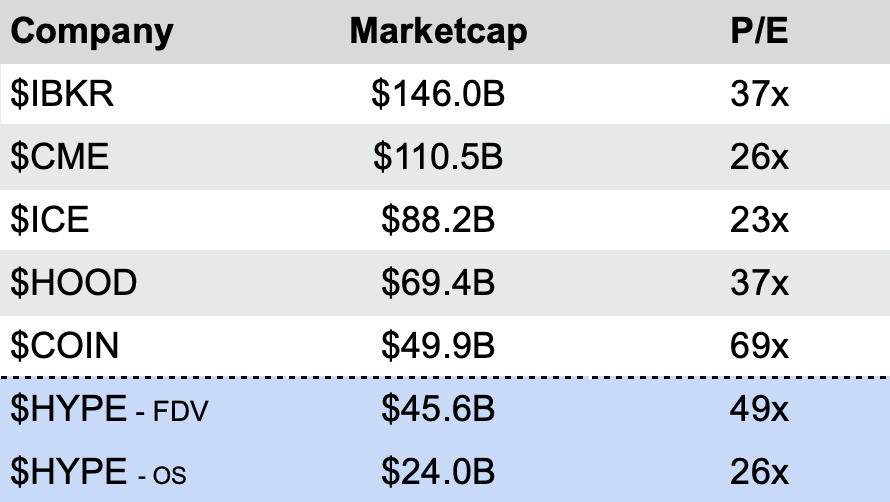
Hyperliquid TradFi Comparables Using TTM earnings with two valuation bases for HYPE, FDV and outstanding supply. $HOOD - 37x / $69.4B $COIN - 69x / $49.9B $CME - 26x / $110.5B $IBKR - 37x $146.0B $ICE - 23x / $88.2B $HYPE (FDV) - 49x / $45.6B $HYPE (OS) - 26x / $24.0B Based on outstanding supply, HYPE trades broadly in line with TradFi exchange multiples, despite being in a higher-growth phase with strong tailwinds.
post rich tweet media
post rich@0xpostrich

x.com/i/article/2054…

English
7
8
94
14.5K
IA_817 retweetledi
LucknowCapital
LucknowCapital@Lucknowcapital·
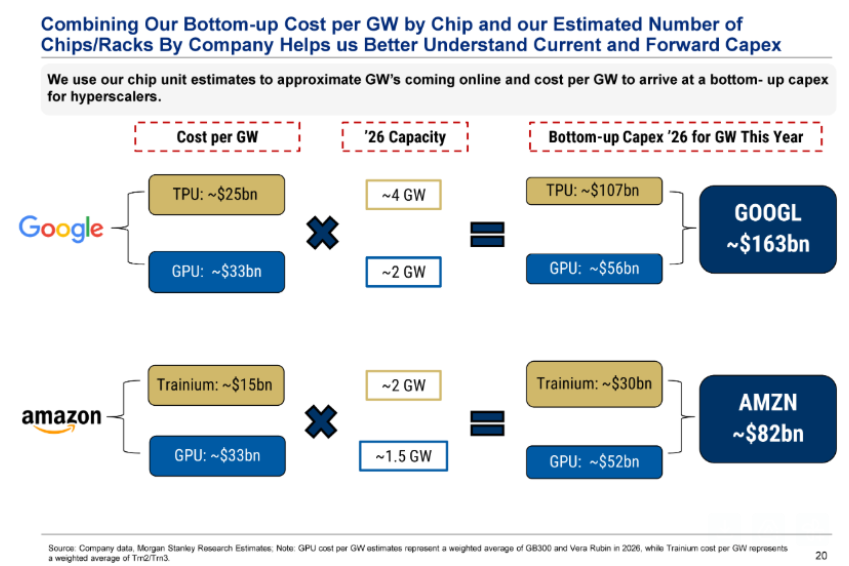
Good chart from MS on hyperscalers spend
LucknowCapital tweet media
English
4
37
274
24.4K
IA_817 retweetledi
IA_817 retweetledi
Anjney Midha
Anjney Midha@AnjneyMidha·
Compute isn’t venture. It’s infra with venture demand curves and utility contract structures The right comp is 90s era independent power producers, except the offtakers have stronger balance sheets and steeper demand than anything in energy history Most investors will miss it
English
10
9
174
17.7K
IA_817 retweetledi
TheValueist
TheValueist@TheValueist·
$MRAM EXECUTIVE INVESTMENT VIEW The Kerrisdale short thesis is directionally coherent and analytically strongest on 3 points: Everspin’s MRAM technology is not the same memory category driving hyperscale AI capex, the company’s historical financial profile does not support a sudden AI-infrastructure re-rating, and the current valuation appears to capitalize speculative future adoption well ahead of observable commercial traction. The report is not merely arguing that Everspin is overvalued; it is arguing that the market has assigned Everspin the economics of HBM, high-bandwidth DRAM, and AI accelerator memory without evidence that MRAM is a direct beneficiary of that demand cycle. That core distinction is valid. MRAM’s value proposition is persistence, endurance, reliability, low standby power, and harsh-environment data retention, whereas the AI memory bottleneck is bandwidth, density, capacity, and proximity to GPU/accelerator compute. On that basis, Everspin appears more analogous to a specialized industrial and embedded memory supplier than to a scaled AI memory vendor. Kerrisdale’s conclusion that the stock has re-rated faster than fundamentals is supported by the company’s historical revenue base, its current end-market mix, the finite nature of the $40 million defense subcontract, and the absence of disclosed hyperscale AI accelerator design wins.  The investment debate should not be framed as whether MRAM is technically useful. MRAM clearly has attractive characteristics and commercially relevant use cases. The correct question is whether Everspin’s current market value appropriately reflects the probability, timing, margin structure, and competitive capture of those use cases. On that standard, the valuation burden appears high. At a recent quoted price of $33.35, Everspin carried a market capitalization of approximately $772 million, despite FY2025 revenue of $55.2 million, GAAP net loss of $0.6 million, and non-GAAP net income of $5.2 million.  Kerrisdale’s model, based on 26 million diluted shares, $40 million of cash, $3 million of lease liabilities, and approximately $832 million of enterprise value at a $34 share price, implies roughly 10.1x 2027E revenue and 37.6x 2027E EBITDA, despite a 2027E revenue estimate of only $83 million and a 2027E EBITDA estimate of $22 million.  Against management’s own long-term target of $100 million+ revenue by FY2029, the equity appears to be discounting a level of strategic relevance and operating leverage that has not yet been demonstrated in reported results.  SOURCE BIAS AND EVIDENTIARY QUALITY The source material should be treated as advocacy, not neutral research. Kerrisdale discloses that it is short Everspin, may transact after publication, may hold long, short, or neutral positions at any later point, and has no obligation to update the report.  That disclosure does not invalidate the analysis, but it requires a higher evidentiary standard for causal claims, especially claims about speculative excess, insider motivation, and customer behavior. The strongest parts of the report rely on verifiable facts: Everspin’s revenue scale, gross margin, product positioning, end-market mix, 2026 guidance, the terms of the $40 million defense subcontract, insider Form 4 sales, and the technical distinction between MRAM and AI accelerator memory. The weaker parts rely more heavily on interpretation: that recent trading was mainly retail and momentum-driven, that insiders sold specifically because they believed the valuation was irrational, and that broader MRAM adoption would necessarily accrue primarily to larger semiconductor companies. Those interpretations are plausible but not independently proven by the report. The report’s rhetoric is intentionally sharp, which increases readability but weakens perceived objectivity. The phraseology around speculative investors, “wrong kind of memory,” and “memory stock they will ultimately wish they could forget” reflects a short-seller communication style rather than institutional research neutrality. The underlying factual thesis remains separable from the tone. The investment committee-level read is that Kerrisdale has identified a genuine valuation dislocation, but its report should be used as a short thesis input rather than as a complete underwriting document. The key incremental work is to test whether Everspin’s product roadmap, design-win conversion, defense relevance, and domestic supply-chain scarcity can justify a structurally higher multiple than Kerrisdale assigns. TECHNOLOGY ASSESSMENT The most important analytical distinction is that MRAM is not HBM. Modern AI training and inference infrastructure is constrained by the ability to feed accelerators with extremely large volumes of data at very high bandwidth. Micron describes HBM as memory designed to accelerate next-generation AI systems, HPC, and AI workstations, with HBM4 delivering 36GB 12-high stacks, greater than 11 Gb/s pin speeds, and more than 2.8 TB/s of memory bandwidth.  Micron separately describes HBM3E 12-high stacks as delivering 1.2 TB/s of bandwidth for advanced 2026 AI accelerators, with high-capacity, high-bandwidth memory improving GPU and accelerator utilization by reducing bottlenecks.  JEDEC’s HBM4 standard similarly emphasizes generative AI, HPC, high-end graphics, and servers, with up to 8 Gb/s across a 2,048-bit interface and total bandwidth up to 2 TB/s.  These are the memory architectures being pulled directly by hyperscale AI capex. Everspin’s MRAM solves a different problem. The company’s 10-K describes Everspin as a commercial MRAM company with more than 20 years of development and commercialization history, serving industrial, medical, automotive, aerospace, defense, and data center markets through discrete MRAM products and related embedded MRAM manufacturing arrangements.  Kerrisdale’s description is consistent with that framing: Toggle MRAM is positioned as a low-density, highly reliable replacement for battery-backed RAM, NOR flash, and related legacy technologies, while STT-MRAM is a higher-density offering intended to address broader embedded and storage-related applications.  The technical attributes are real, but they map primarily to persistence and reliability rather than to AI cluster memory bandwidth. The stock’s recent narrative appears to have compressed “memory” into a single category, while semiconductor architecture makes the category distinction economically decisive. Everspin’s own UNISYST launch illustrates both the bull case and the limitation. The company states that UNISYST is intended to unify code storage and data memory in a high-density nonvolatile architecture for edge AI, industrial, and mission-critical designs. The announced product targets read bandwidth up to 400 MB/s, write throughput of roughly 90 MB/s, up to 10x NOR endurance, 10-year data retention, and sampling in Q4 2026.  Relative to NOR flash, those metrics may be strategically meaningful in embedded systems. Relative to HBM3E/HBM4, they are not in the same performance domain. HBM3E at 1.2 TB/s is roughly 3,000x a 400 MB/s read-rate device on a simple throughput comparison, and Micron’s cited HBM4 bandwidth above 2.8 TB/s is roughly 7,000x. That comparison is not intended to imply functional substitutability; it highlights precisely why the products are not substitutable. UNISYST can be relevant for edge AI boot, configuration, code storage, and mission-critical persistence, while HBM is relevant for feeding accelerators in AI training and high-throughput inference clusters. Everspin’s opportunity is therefore more accurately characterized as edge, embedded, industrial, space, aerospace, defense, and selected storage-controller persistence, not hyperscale AI memory. That still may be commercially valuable, but the growth algorithm is different. MRAM adoption usually requires design qualification, customer validation, and long replacement cycles. Everspin’s own 10-K states that sales cycles may range from 3 to 18 months and that customers can require months or years to test, evaluate, and adopt products, with delays between investment and revenue recognition.  This supports Kerrisdale’s point that MRAM adoption is more likely to unfold through gradual design-win conversion than through the type of explosive volume pull-through visible in HBM and AI accelerator supply chains. END-MARKET REALITY VERSUS AI NARRATIVE The company’s end-market mix is materially more prosaic than the recent share-price action implies. Kerrisdale cites 2025 revenue exposure in which casino gaming and enterprise each contributed roughly 30%, while low Earth orbit satellite exposure represented approximately 10%. It also notes more than 200 million units shipped to over 2,000 customers across nearly 2 decades, reflecting broad but fragmented adoption rather than concentration in scaled AI platforms.  Everspin’s April 2026 investor presentation similarly emphasizes 20+ years in production, 200 million+ MRAM units shipped, 700+ patents and applications, and 2,000+ customers.  That profile is consistent with a durable niche franchise, not necessarily a sudden critical bottleneck in AI infrastructure. The bullish counterpoint is that Everspin is not static. The company reported 238 design wins in 2025, up from 178 in 2024, with management expecting those wins to ramp in 2026 and 2027.  The design-win base provides some basis for revenue acceleration, particularly across industrial automation, aerospace, defense, transportation, data center storage, and edge applications. However, design wins are not equivalent to production revenue, and the company’s historical financials show that design activity has not yet translated into a sustained step-change in scale. The 10-K reinforces this caution by noting that design wins may not result in actual sales and that adoption cycles can be lengthy.  The correct inference is not that design wins are irrelevant; it is that current valuation appears to be discounting a conversion curve that reported numbers have not yet validated. The data center label also requires precision. Everspin has data center exposure, but the nature of that exposure matters. MRAM may replace battery-backed memory or serve as persistent memory in storage, RAID controller, or mission-critical buffering applications. Kerrisdale argues that this is peripheral to core AI compute memory, and that argument is supported by the functional distinction between persistence-oriented MRAM and high-bandwidth AI accelerator memory.  A data center exposure claim alone is insufficient to justify AI-infrastructure multiples; the exposure must be tied to the high-growth spend vector. No disclosed evidence in the reviewed materials establishes Everspin as a material supplier into GPU-attached HBM, AI accelerator memory stacks, or hyperscale model-training memory subsystems. FINANCIAL PROFILE AND OPERATING LEVERAGE The reported financial profile is the central weakness in the long case at current levels. FY2025 revenue was $55.2 million, up from $50.4 million in FY2024 but still below the $63.8 million level cited for FY2023 in Kerrisdale’s historical summary. Product sales improved to $48.3 million from $42.2 million, while licensing, royalty, patent, and other revenue declined to $6.9 million from $8.2 million. Gross margin was 51.2%, down modestly from 51.8% in FY2024, GAAP operating expenses rose to $34.8 million from $33.2 million, and GAAP net income swung to a $0.6 million loss from $0.8 million of income.  These are not distressed numbers, but they are also not hypergrowth semiconductor numbers. Q1 2026 results were better but still not sufficient to support an AI-style re-rating in isolation. Revenue was $14.9 million versus $13.1 million in Q1 2025, product sales were $14.1 million versus $11.0 million, gross margin was 52.7% versus 51.4%, GAAP net loss was $0.3 million, non-GAAP net income was $2.6 million, and cash was $40.5 million. Management cited strength in industrial automation, transportation, data center, and Japan recovery, as well as the new $40 million contract with a U.S. prime contractor.  This quarter supports the view that the business is improving, particularly product revenue, but it does not show the magnitude of acceleration necessary to bridge the gap between historical revenue scale and current equity value. The company’s Q2 2026 guidance of $15.5 million to $16.5 million, excluding the new subcontract, implies a baseline annualized revenue run rate around $62 million to $66 million before contract uplift.  That range remains consistent with Kerrisdale’s argument that the underlying business has spent years in a roughly $50 million to $65 million band.  The $40 million defense subcontract is strategically significant but should not be mischaracterized. Everspin describes the agreement as a 2.5-year arrangement with a U.S. prime contractor to provide state-of-the-art Toggle MRAM process technology and engineering services for U.S. Defense Industrial Base customers, in connection with Microchip’s Foundry Services Agreement and expanded U.S.-based manufacturing capability.  This validates MRAM’s role in domestic, mission-critical, aerospace, and defense applications. It also reinforces Everspin’s scarcity value as a U.S.-linked MRAM knowledge holder. However, the contract appears to be engineering, process technology, and foundry services oriented, not a disclosed high-volume recurring product order. Kerrisdale’s skepticism is therefore reasonable: if the contract is recognized ratably, it contributes approximately $16 million per year over 2.5 years, but it does not by itself prove a scalable product-demand inflection. Operating leverage remains uncertain. Kerrisdale’s model assumes total revenue rising from $55 million in 2025 to $72 million in 2026E and $83 million in 2027E, with EBITDA rising from $9 million to $14 million and then $22 million.  That improvement is plausible if product revenue grows, contract revenue is recognized at acceptable margins, and operating expenses are controlled. However, the company’s GAAP expense base is meaningful relative to revenue scale, and recent gross margins around the low-50% range limit the speed at which small revenue increases convert into large earnings. The equity market is effectively capitalizing future operating leverage before it is proven. VALUATION Valuation is where the short thesis is most compelling. Kerrisdale’s fair-value framework applies 4.0x 2027E revenue of $83 million, producing $330 million of enterprise value, adding $40 million of net cash, and dividing by 26 million diluted shares to reach $14 per share. The same framework implies approximately 14.9x 2027E EBITDA.  A 4.0x EV/revenue multiple is not punitive for a niche semiconductor company with low-50% gross margins, modest growth, positive cash, and strategic defense relevance. It may even be generous if the company remains subscale and cyclically exposed. Conversely, it may be too low if Everspin proves that MRAM is transitioning from niche replacement memory into a broader edge AI, aerospace, secure systems, and industrial embedded platform. At $33.35, the implied valuation appears to require more than base-case execution. The market is assigning a scarce-asset premium, a memory-cycle premium, an AI-adjacent premium, and a defense-supply-chain premium simultaneously. The issue is not that 1 of those premia is indefensible; the issue is that all of them are being layered onto a business that generated $55.2 million of FY2025 revenue and guided Q2 2026 revenue of only $15.5 million to $16.5 million excluding the new subcontract.   If Kerrisdale’s $14 value is compared with the recent $33.35 share price, the downside is approximately 58%. The report itself states downside figures ranging from approximately 57% to 63% depending on the reference price and page, an internal inconsistency that should be noted but does not change the broad valuation conclusion.  Relative valuation is also unfavorable. Kerrisdale’s comparable table shows Everspin at 10.1x 2027E revenue and 37.6x 2027E EBITDA, while several larger memory and storage peers with more direct AI, data center, and storage-cycle exposure trade at lower 2027E EBITDA multiples despite materially higher forecast revenue growth.  This does not automatically mean Everspin should trade below all larger peers, because scarcity, float, balance sheet quality, domestic MRAM positioning, and optionality can produce unusual small-cap valuations. However, it makes the burden of proof unusually high. A small company with unproven acceleration must show either rapid design-win conversion, a differentiated margin structure, or strategic value that larger peers cannot replicate. Without that evidence, the multiple appears to be discounting narrative rather than numbers. INSIDER ACTIVITY AND MARKET TECHNICALS Insider selling is supportive of the short thesis but should not be over-weighted. SEC filings show that CEO Sanjeev Aggarwal sold 28,459 shares on 05/04/2026 at $19.58, CFO William Cooper sold 11,000 shares on 05/06/2026 at $21.75, director Darin Billerbeck sold 30,000 shares at a weighted-average price of $37.16 after exercising options at $8.52, and director Glen Hawk sold 48,563 shares across weighted-average prices from $37.10 to $39.97.     These transactions are consistent with insiders monetizing a sharp re-rating. They are not conclusive evidence that insiders view the long-term strategy as impaired. Insider sales can reflect diversification, tax planning, option exercise economics, or prearranged trading programs. Still, the timing and magnitude are incrementally negative for sentiment because they occurred into a rally that materially exceeded historical trading ranges and sell-side price targets cited by Kerrisdale. The trading setup appears unusually speculative. Kerrisdale states that Everspin had historically traded around $2 million to $3 million of daily value and then traded more than $1 billion of value in a single session on 05/11, while the stock moved from a 2-year range of approximately $6 to $10 into a parabolic rally.  If accurate, that degree of volume expansion is more consistent with rapid shareholder-base turnover, momentum participation, options activity, and thematic crowding than with a conventional fundamental re-underwriting process. The presence of a credible short report can catalyze reassessment, but it can also increase volatility and squeeze risk if borrow becomes constrained, if retail flow remains active, or if the company issues incremental commercial announcements. BULL CASE The strongest long-case argument is that Everspin is a scarce, technically credible MRAM supplier with 20+ years of production experience, 200 million+ units shipped, 700+ patents and applications, and a broad customer base across applications where reliability and persistence matter.  The technology is not a science project; it is shipping and has established applications. In an environment where defense electronics, space systems, automotive electronics, secure edge devices, and industrial automation increasingly require nonvolatile, high-endurance memory, MRAM can gain share from NOR flash, battery-backed SRAM, nvSRAM, and other legacy solutions. Everspin’s 2025 design-win growth from 178 to 238 indicates that customer engagement is increasing.  If those wins convert at higher ASPs or volumes, revenue could exceed the historical range. The defense angle is also more important than the Kerrisdale tone suggests. A $40 million U.S. prime contractor subcontract for domestic Toggle MRAM process technology and engineering services is not a trivial validation event for a company of Everspin’s size.  It could strengthen Everspin’s role in trusted, onshore, mission-critical memory supply chains and create follow-on opportunities with government, aerospace, satellite, and defense electronics customers. The strategic value of domestic semiconductor capability is not always captured by near-term product revenue alone. Small-cap semiconductor companies can also receive disproportionate valuation support when they are viewed as scarce assets in strategically important technology categories. The edge AI roadmap provides additional optionality. Everspin’s investor presentation identifies PERSYST and UNISYST products, a served-market opportunity growing from $1.1 billion in 2024 to $4.3 billion in 2029, and a path to $100 million+ revenue by FY2029 at roughly a 15% CAGR from FY2025.  UNISYST targets edge AI, military/aerospace, automotive, industrial, and casino gaming applications, and the company highlights fast boot, rapid updates, predictable performance, endurance, and reliability.  If edge inference architectures proliferate across ruggedized and embedded systems, Everspin could participate in a secular market rather than merely a replacement cycle. This is the most credible challenge to the short thesis: the market may not be valuing Everspin as an HBM supplier; it may be valuing it as a scarce edge AI and defense nonvolatile memory supplier before the revenue inflection appears.
Kerrisdale Capital@KerrisdaleCap

We are short $MRAM (Everspin Technologies), a niche industrial memory chipmaker whose stock has soared 300%+ as speculative investors pile into anything remotely associated with “memory” and AI. Report at kerr.co/mram (1/8)

English
3
1
6
5K
IA_817 retweetledi
JUNK BOND ANALYST
JUNK BOND ANALYST@junkbondanalyst·
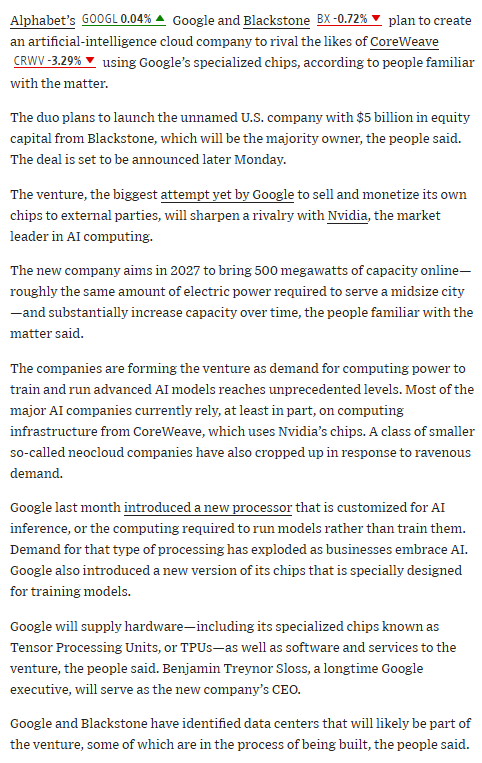
Google and Blackstone are teaming up to launch a new AI cloud venture, funded by $5 billion equity from Blackstone. The venture will use Google's TPUs to challenge CoreWeave & Nvidia. Compute demand is only going up. Target: 500 MW capacity by 2027, enough to power a city.
JUNK BOND ANALYST tweet mediaJUNK BOND ANALYST tweet mediaJUNK BOND ANALYST tweet mediaJUNK BOND ANALYST tweet media
English
3
9
105
13K
IA_817 retweetledi
Firestorm
Firestorm@Firestorm_Labs·
Forbes called 3D printing the Pentagon's most vital asset. We'd have to agree — and we're proud xCell is featured as a solution to contested logistics. We initially built xCell to be a drone factory at the edge. It has since become something far bigger. Today, xCell is deployed across the globe and the demand goes far beyond drones. Operators are using it to build and repair equipment, fabricate custom parts on the spot, and solve logistics problems that used to take months to route through a supply chain. Read about it: forbes.com/sites/zitaball…
English
3
7
36
5.1K
IA_817 retweetledi
Matt Harney
Matt Harney@SaaSletter·
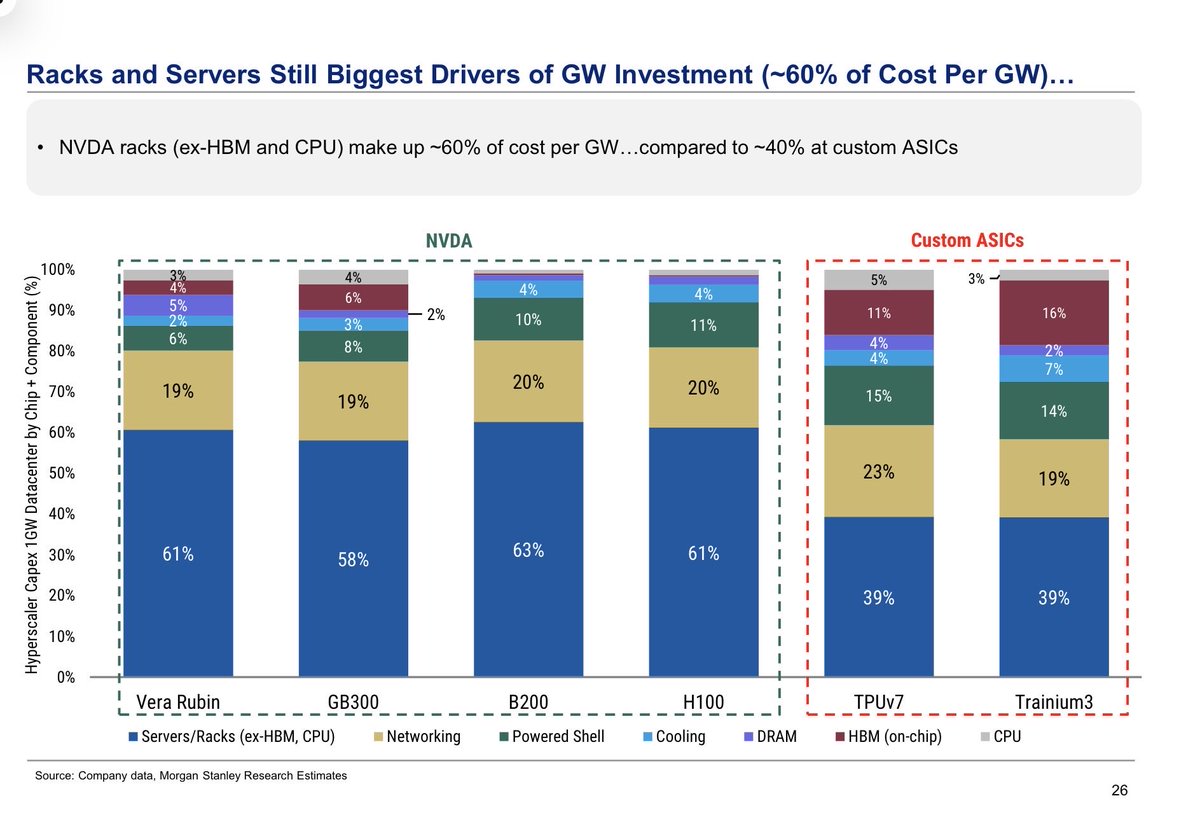
👀 strong new primer from MS… at least for *aspiring semi tourists like me* “How Much Capacity Will $2 Trillion of Hyperscaler Capex Bring By 2027?” = 58 pages
Matt Harney tweet mediaMatt Harney tweet mediaMatt Harney tweet mediaMatt Harney tweet media
English
5
37
370
52.6K
IA_817 retweetledi
Ansem
Ansem@blknoiz06·
bro is on an insane heater
MP@MoneyPrinter0x

"Capitalizing on The Biggest IPO Season In History" $PURR calls thesis by @MoneyPrinter0x. historically, mNAV in a bull market lies between 1.5x-2.3x, re: $MSTR $BMNR its pretty obvious by now that $HYPE is the main thing of this coming cycle, the question is: "whats the ceiling, and how much has been priced in" 1. so far, the market is in progress of pricing the forward-looking adoption of equity perps on hyperliquid eco, which is the primary driving catalyst of the onchain finance cycle. 2. how much has been priced in: not anywhere near full. the hip-4 launch (fortunately unoptimized at first iteration if not there would be another pump on launch getting rid of opportunities of entry) provides a good landscape for entry right about now. why now and not immediately after the hip-4 launch retracement? 3. because, people don't realize this but the $CBRS IPO today is the first market-validated proof that $HYPE has found PMF not just on equity perps but on pre-IPO trading as well. $CBRS, an IPO with mass mindshare among those outside of crypto and those within crypto SUCCESSFULLY brought price exploration and with it, mindshare, to $HYPE. today is the first instance of the market choosing $HYPE as the Primary Venue of Pre-IPO trading. what are the criterias of Pre-IPO trading success? -> Mass mindshare of the asset being IPO'ed. -> Mass buyside liquidity propped up of the asset being IPO'ed. -> Mass telegraphing and leadup to the asset being IPO'ed. Guess when is the biggest IPO season in history? Q3-Q4, This Year. SpaceX, 1.75Trillion. Anthropic, 1.2Trillion. OpenAI, 850Billlion. what we saw today with $CBRS, how it attracted even more mindshare to $HYPE as the best venue for pre-IPO trading, is only but a drop in the bucket. $CBRS IPO valuation is only 40billion, the three companies above alone are nearly 100x that at 4trillion. the mindshare and volume which would be routed to $HYPE as the primary venue of Pre-IPO price exploration & trading, assuming no black swans, is most likely going to be nothing like we've seen so far. if you think that the cbrs ipo today is bullish hyperliquid, know that we have literally 100x of that already lined up in the next two quarters. $PURR is currently trading at a very rare ~1.2x mNAV to $HYPE. in other words, you would be buying it at distressed mNAV levels right before us entering the biggest IPO season in history where the index asset $HYPE is the market-chosen Pre-IPO trading venue of choice. mNAV will most likely not be 1.2x in such conditions. and mNAV wont be below 1x either. hence for every % $HYPE gains, $PURR would multiply that as mNAV expands. the play is Q3 and Q4 in-the-money calls on $PURR as an asymmetric bet while mNAV is sitting near-parity. if you want to hedge, OTM hype puts as insurance is ok. HYPE is currently $43 and PURR is $6.80 (mNAV = ~1.2) if HYPE goes to $80, then PURR goes to 25$ (mNAV = 2) above numbers are theoreticals, but you get the point that mNAV expansion would reward HYPE bets, and right now we're sitting at mNAV floor - mNAV wont go below 1 in these market conditions. in the case that it does, it would be because of PURR selling HYPE to pump its own stock - so PURR price is protected. the only other failure mode is if some unpredictable black swan happens and brings hype price so much that even PURR selling hype to protect stock price cant save it, to hedge for that one can try hype otm puts - but personally, I wont engage in such sins in any way - the trade comes out almost net +ev. hyperliquid is set to dominate. With all things being said, I still think that holding $HYPE itself is the BEST vehicle for long-term growth expression on HL. But for those of you degens who want a bit of excess risk on top of a $HYPE bag in exchange for convex returns, then purr calls is the instrument for you - who knows, we might even get new stock-native entrants into the HL ecosystem itself. this is how we can turn the biggest IPO season in history into a tradeable play. bullish on Hyperliquid and Onchain Finance. MoneyPrinter0x NFA DYOR. as always, manage risk!

English
75
14
469
142.7K
IA_817 retweetledi
Molly O’Shea
Molly O’Shea@MollySOShea·
Coatue hired a Claude Genius. aka "AI Mad Scientist" His name is Frank (@fyxlong) “He’s the one trying everything out there that is new, creative, on the cutting edge.” “Figuring out how do we implement it. How do we as an organization utilize our 20 years of data that we’ve been collecting to give us another leg up against the competition & allow us to succeed.” @coatuemgmt
Molly O’Shea@MollySOShea

NEW: Exclusive Interview with Jaimin Rangwalla, Chief Investment Officer of Public Investments at Coatue In @coatuemgmt's Spring 2026 Investor Update, Jaimin walks through the unexpected winners of the AI cycle: memory, optical, CPUs, & the infrastructure layer quietly outperforming the Mag 7. We cover: - Why Coatue is "following the gigawatts" - Private companies breaking into the global top 25 pre-IPO (OpenAI, Anthropic, SpaceX) - Cash flow transferring from hyperscalers to AI infrastructure - The $12T funding engine behind the AI buildout - Sellers of shortage vs. buyers of shortage - The Token Economy - The CPU/GPU flip reshaping compute demand - Coatue's $6T+ AI market estimate - Agents launching agents / "1,000 analysts working 24/7" Read the full deck & watch the update replay below 𝐓𝐈𝐌𝐄𝐒𝐓𝐀𝐌𝐏𝐒 (00:00) Jaimin Rangwalla, CIO of Public Investments at Coatue (00:56) Inside Coatue HQ (02:48) Investor Update Kickoff (04:36) Mapping the AI Stack (06:02) Why Supply Stays Tight (07:03) How Jaimin's Became CIO (10:43) Private Giants vs Mag 7 (12:40) Market Breadth and Reordering (15:24) Where AI Revenue Comes From (17:04) Tokens and Economy (19:43) Agents Change Everything (21:58) OpenClaw Explained (24:49) Memory Demand Explosion (27:12) Architecture Shifts Ahead (27:24) Agents Gain Memory (27:58) CPU Demand Surge (28:38) CPU GPU Ratio Flip (30:21) Key Chip Players (30:45) Intel Comeback Thesis (31:41) Semis Go Mainstream (33:24) Nvidia Mania and GTC (33:59) Tracking Data Center Buildouts (35:21) Jobs Lost and Created (37:30) Sellers Versus Buyers (40:54) Optical Breakouts (41:27) Bottlenecks Everywhere (44:48) Sentiment Versus Fundamentals (47:10) Handling Volatility (49:17) Finding New Leaders (51:18) Trillion Dollar IPOs (52:48) Risks and Disruptions (55:00) Coatue Growth Story (55:58) Staying Curious to Win

English
14
22
280
76.7K
IA_817 retweetledi
TheValueist
TheValueist@TheValueist·
$TE T1 Energy: Vertical Integration, U.S. Solar Execution Strategy, and Investment Thesis. T1 Energy is pursuing vertical integration in U.S. solar manufacturing at a moment when domestic content premiums and federal tax credits make that strategy financially compelling — if the execution holds. The G2 Austin cell facility is the central milestone. Completing it by late 2026 is not just an operational target; it's the prerequisite for capturing the pricing premiums and IRA-linked incentives that underpin the entire 2027 earnings inflection thesis. The facility is the thesis. Recent results show genuine operational improvement and meaningful revenue growth, which provides some early evidence that the business is moving in the right direction. The caution is that the current financial profile doesn't provide much cushion. Debt is heavy, customer concentration is extreme, and past internal control weaknesses introduce a layer of execution and governance risk that is difficult to fully discount. Any one of those factors would warrant monitoring in isolation — together, they define a setup with very limited margin for error. Management comes primarily from capital markets backgrounds rather than manufacturing operations, which is a relevant distinction for a company attempting a technically complex vertical integration. The financial engineering required to structure tax credit monetization and project financing is well within that team's capability. Whether the same team can manage construction timelines, equipment qualification, and yield ramp-up at a new cell facility is a different and less certain question. The policy environment is both the opportunity and a source of risk. Domestic content premiums and tax incentives are real and material, but federal energy policy has demonstrated volatility, and a business model built around regulatory incentives carries exposure to political and legislative shifts that are outside management's control. The upside scenario is large and the downside is binary. If G2 Austin delivers on schedule and at projected specifications, the earnings inflection is credible and the current valuation likely understates the outcome. If the facility faces meaningful delays or cost overruns, the combination of debt load, customer concentration, and limited liquidity creates a fragile financial position. There is not much middle ground here — this is a milestone-driven story where the next twelve months will determine whether the thesis is intact or impaired.
TheValueist@TheValueist

x.com/i/article/2056…

English
1
1
21
7.1K
IA_817 retweetledi
IA_817 retweetledi
Sam
Sam@0xCryptoSam·
SpaceX pre-IPO trading could very likely be another breakout moment for Hyperliquid. HYPE ran up 70% from $22 -> $38 when SILVER was trading billions in daily volume earlier this year. Now imagine how much attention Hyperliquid could get when it's the primary venue to trade the largest, most news-driven IPO of all time. A potentially pivotal moment for Hyperliquid and all of perps.
English
24
23
372
39.6K