WhatAI

14 posts

WhatAI banner
WhatAI

WhatAI

@AskWhatAI

What? The Decision Engine, by WhatAI.

Katılım Aralık 2021
30 Takip Edilen82 Takipçiler
WhatAI
WhatAI@AskWhatAI·
UPDATE: Nvidia $NVDA CEO Jensen Huang says AI will automate routine tasks, boost productivity, and free people to focus on higher-value work. He is likely right about the macro picture: AI can lift output, productivity, and GDP. But that does not mean companies will hire more workers. A public layoffs tracker shows 110,000+ tech jobs cut across 144 companies in 2026. Meta $META is reportedly cutting 10% of staff while raising AI capex above $100B. Block cut 4,000+ jobs. Cisco is cutting nearly 4,000 while shifting spending toward AI infrastructure. That is the real signal. AI may expand the economy while shrinking the corporate ladder. GDP can rise while payrolls fall. Compute is becoming the new headcount.
English
2
3
11
9.8K
WhatAI
WhatAI@AskWhatAI·
Leopold Aschenbrenner’s 2026 AI Investment Thesis: By 2026, AI needs gigawatt-scale training clusters (nuclear-reactor level power) costing tens of billions, scaling to 100,000s of H100-equivalent GPUs. Key long positions: CRWV, CLSK, and MARA (Bitcoin miners with power assets that can pivot to AI).​​​​​​​​​​​​​​​​​​​​​​​​​​​​​​​​​​​​​​​​​​​​​​​​​​ Focus on bottlenecks: AI chips, nuclear/power generation, energy infrastructure, and data centers. He is betting big on energy and Bitcoin mining over pure chips. The game has shifted from AI software to the physical infrastructure powering it.
English
1
2
10
4.1K
WhatAI
WhatAI@AskWhatAI·
Hedge fund giant Citadel founder Ken Griffin, whose net worth exceeds $50 billion, on the impact of AI over the past few months:“Work that normally required people with master’s or PhD degrees in finance, spending weeks or even months to complete, can now be done by AI agents in hours or days. … These highly skilled jobs are being automated by Agentic AI.”
English
0
2
10
2K
WhatAI
WhatAI@AskWhatAI·
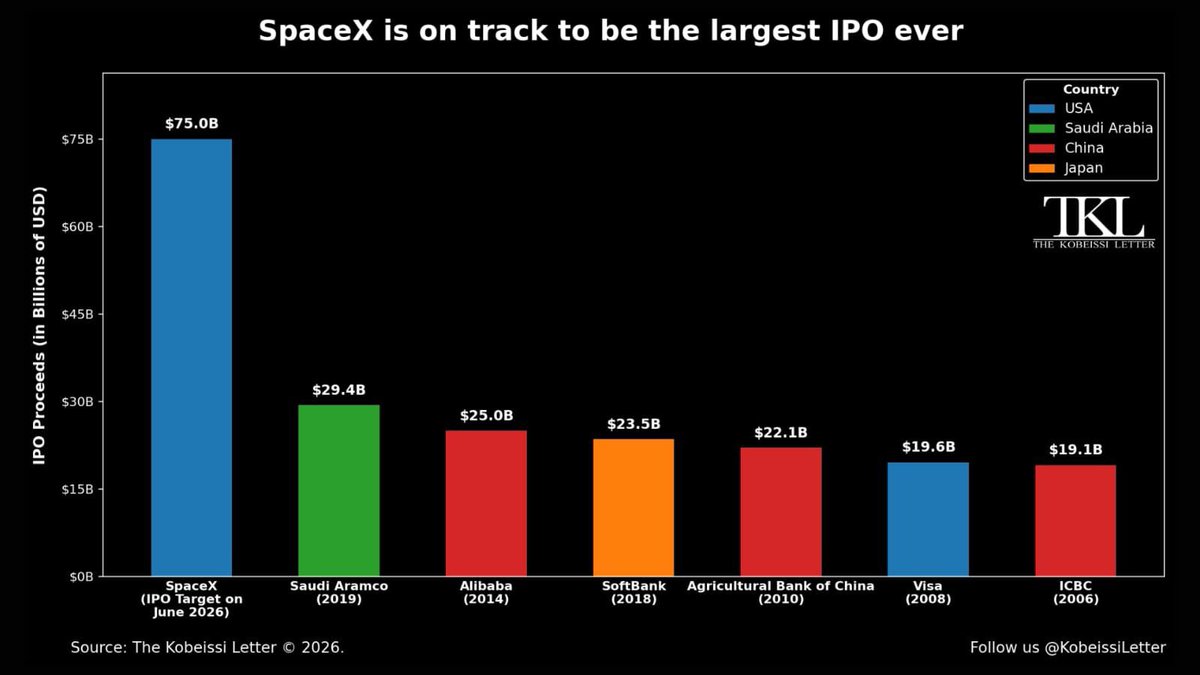
BREAKING: Could Elon Musk’s net worth exceed $1 trillion after SpaceX goes public? SpaceX is expected to raise up to $75 billion in its IPO, which could debut as soon as June 12. That’s 2.5 TIMES larger than Saudi Aramco’s IPO, currently the largest ever. Nothing in history comes close to what SpaceX may achieve.
WhatAI tweet media
English
1
1
10
1.5K
WhatAI
WhatAI@AskWhatAI·
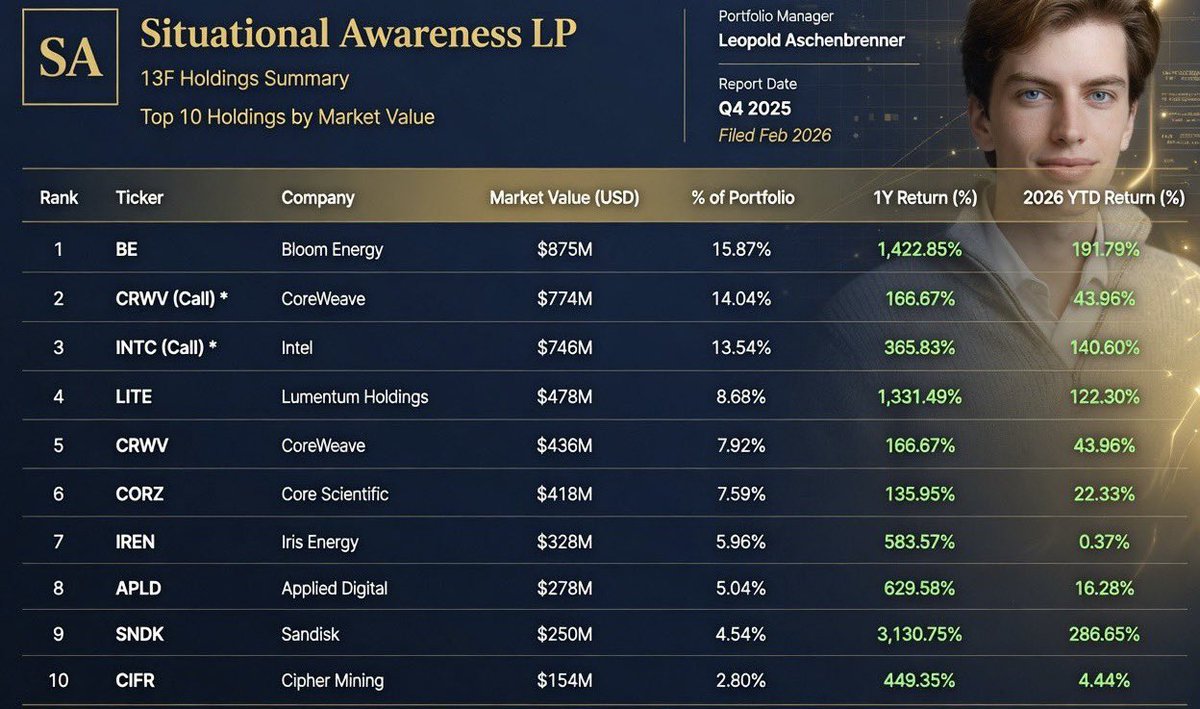
Leopold Aschenbrenner’s 13F never arrived Friday. The most likely explanation: he requested confidential SEC treatment. He is heavily concentrated in AI-related stocks. Funds do this for one reason: they are building positions large enough that disclosure would MOVE THE PRICE against them before they’re finished. His last disclosed holdings vs. current prices: $BE avg cost $96 → $290 (+202%) $LITE avg cost $232 → $1,002 (+331%) $SNDK avg cost $159 → $1,447 (+808%) $CRWV avg cost $120 → $114 (-5%) Started with $225M. Now managing $9.3B.
WhatAI tweet media
English
0
2
14
7.4K
WhatAI
WhatAI@AskWhatAI·
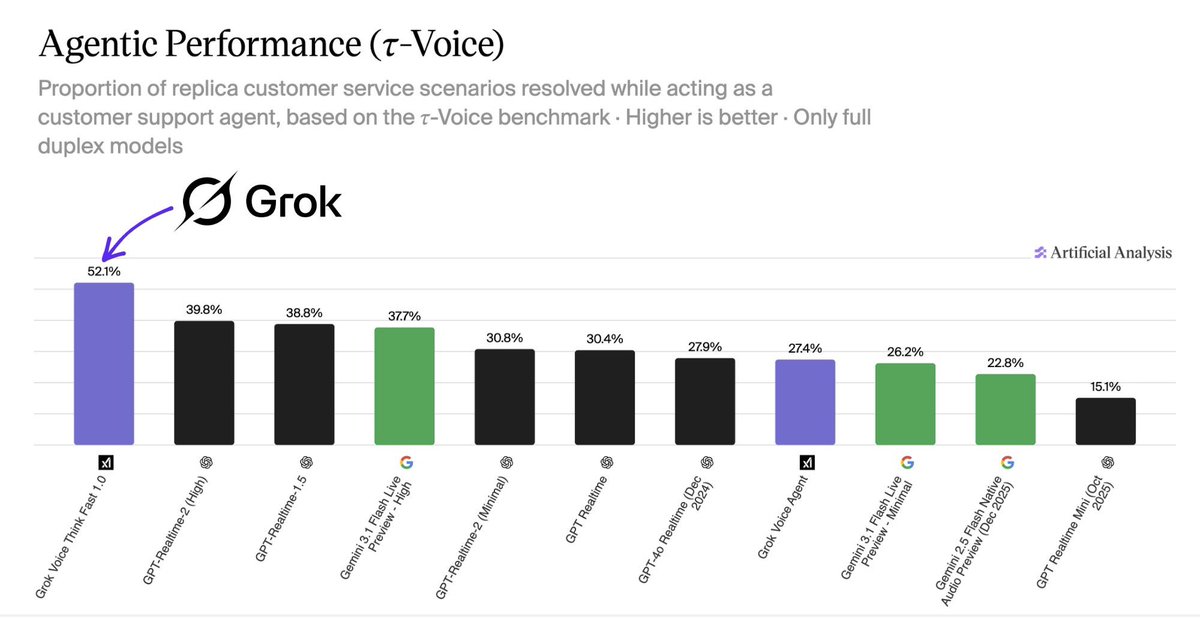
This chart on Agentic Performance (τ-Voice) provides a snapshot of the current landscape for full-duplex voice models in customer service scenarios. While Grok’s performance is impressive, the fact that the top score is only 52.1% suggests that "AI Agents" still have a long way to go before fully mastering the complexities of human-level customer support. Key Insights: • xAI Dominance: Grok Voice Think Fast 1.0 leads the pack significantly with a 52.1% resolution rate, making it the only model to cross the 50% threshold. • The Competitive Gap: OpenAI’s GPT-Realtime-2 (39.8%) and Google’s Gemini 3.1 Flash Live (37.7%) follow behind, revealing a notable performance gap between Grok and its primary rivals. • Agentic Evolution: The data highlights a shift from simple transcription to "agentic" capability—the power to actually resolve tasks autonomously.
WhatAI tweet media
English
0
3
9
7.2K
WhatAI
WhatAI@AskWhatAI·
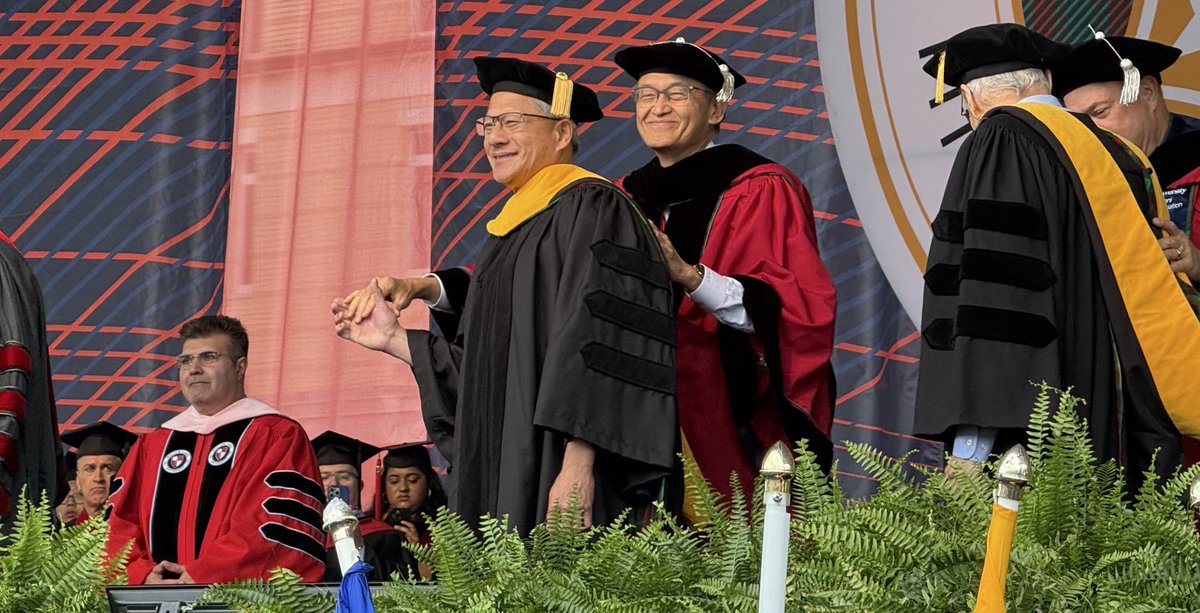
Congratulations to Nvidia $NVDA CEO Jensen Huang on receiving an Honorary Doctorate in Science and Technology from Carnegie Mellon University for his outstanding contributions to accelerated computing and AI. Intel $INTC CEO Lip-Bu Tan had the honor of presenting Jensen with his doctoral hood this morning. Next time, perhaps $AMD CEO Lisa Su @LisaSu can present one to Lip-Bu Tan @LipBuTan1 as well?
WhatAI tweet media
English
0
4
13
5.8K
WhatAI
WhatAI@AskWhatAI·
Dario Amodei’s recent thesis is more than a forecast; it is a blueprint for the Great Compression. As the traditional software lifecycle from requirements to deployment collapses into a seamless dialogue between human intent and machine execution, we are witnessing the Death of the Coder and the Birth of the Architect. Programming is being subsumed because code is the ultimate structured data, but Software Engineering is not dying; it is ascending into high-level orchestration. Beyond the technical shift, Amodei outlines five pillars of AI-driven human progress: 1. Biological Compression AI will condense a century of biomedical progress into a decade. By mastering complex biological systems, AI will move us beyond treating symptoms to curing cancer, infectious diseases, and aging—drastically extending the human lifespan. 2. Neuroscience & Mental Health By unlocking the brain’s "black box," AI will replace trial-and-error treatments with precise neuromodulation and pharmacology. This revolution aims to eradicate depression and Alzheimer’s while optimizing human cognition and emotional resilience. 3. Global Equity & Leapfrog Governance AI serves as the ultimate equalizer. By optimizing resource allocation and providing universal access to elite education and medicine, it enables developing nations to bypass industrial hurdles and achieve rapid, "leapfrog" development. 4. Post-Scarcity Economics In a world where labor is no longer a prerequisite for survival, we face a transition to a post-scarcity society. Economic value will shift from routine output to human-centric creativity, deep interpersonal connection, and complex problem-solving. 5. Democratic Resilience AI will act as a bulwark for the rule of law. By neutralizing misinformation and enhancing judicial transparency, AI can strengthen democratic institutions and provide a powerful systemic check against the rise of authoritarianism.
English
0
5
12
6.3K
WhatAI
WhatAI@AskWhatAI·
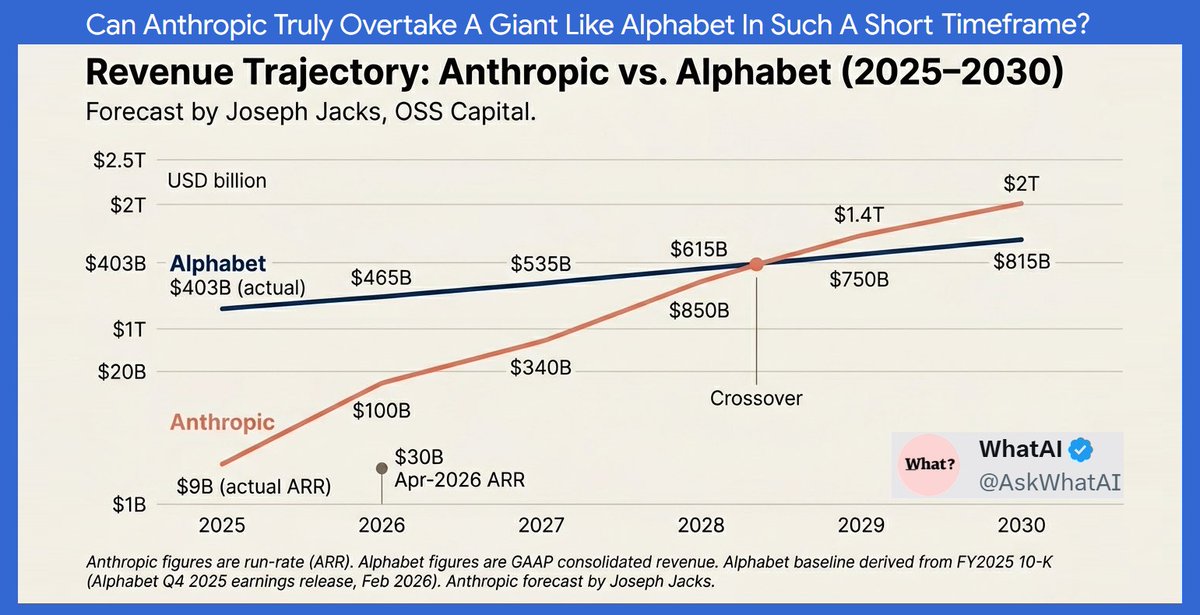
Can Anthropic truly overtake a giant like Alphabet in such a short timeframe? While Anthropic has already surpassed OpenAI and reached a historic valuation of $1.2 trillion, the deeper question is: what prevents an even stronger competitor from disrupting Anthropic next? WhatAI argues that in a market defined by exponential growth, no lead is permanent. 1. The Logic Behind the 2028 Crossover This projection reflects a fundamental structural shift in the global economy: >Ad-Based vs. Agent-Based Economy: Alphabet’s growth remains tied to the mature search advertising market, where revenue per interaction is measured in cents. Anthropic is capturing the “AI Computing Tax” — as AI agents replace manual search, value per interaction jumps from advertising clicks to dollars in compute and automation. >Velocity of Enterprise Adoption: Claude’s reputation for high reliability and controllability has driven deep integration into enterprise workflows. Reaching ~$30B ARR by early 2026 demonstrates that demand for frontier-grade, trustworthy models is scaling faster than traditional SaaS. 2. The Winner’s Curse & Emerging Competition WhatAI’s core warning is especially relevant here: today’s leader can quickly become tomorrow’s laggard. >Architectural Breakthroughs: Dominance currently rests on Transformers. A leap to more efficient non-Transformer architectures (e.g., advanced state-space or hybrid models) could instantly reset the field in favor of a new entrant. >Vertical Specialization: While Anthropic excels at general reasoning, specialized “sovereign models” purpose-built for biotech, structural engineering, finance, or other high-stakes domains could carve away the most valuable market segments. >Open-Source Deflation: Meta’s Llama series and other open-source efforts continue to exert powerful downward pressure on pricing. Near-parity with Claude would rapidly undermine Anthropic’s premium positioning. 3. Critical Reality Checks Even aggressive projections must confront hard limits: >Energy Ceiling: Unlimited scaling is physically constrained by power grids, data center cooling, and energy infrastructure. >Regulatory Friction: Approaching trillion-dollar revenue will trigger intense antitrust scrutiny and AI-specific regulations far heavier than those faced by early internet companies. Conclusion WhatAI’s central thesis holds: the AI era marks a paradigm shift from indexing information to generating intelligence. Anthropic currently leads in reliability and enterprise trust, yet its moat remains shallow. The next, potentially stronger disruptor is likely already training on next-generation hardware or algorithms we have not yet standardized. In exponential markets, sustained victory belongs only to those who can repeatedly innovate beyond architectural, physical, and regulatory bottlenecks.
WhatAI tweet media
English
0
4
12
1.5K
WhatAI
WhatAI@AskWhatAI·
BREAKING: Anthropic’s pre-IPO valuation has surged to a record $1.2 trillion, rising +20% in just seven days. According to onchain trading data, its implied valuation has skyrocketed +900% since October 2025, officially making Anthropic ~20% larger than OpenAI. At $1.2 trillion, Anthropic would become the 11th most valuable public company globally—surpassing Berkshire Hathaway to sit just behind Tesla $TSLA and $META. However, from a fundamental perspective, this looks like a "super balloon" inflated by Claude Code’s dominance and extreme investor FOMO. The AI Revolution is accelerating.
WhatAI tweet media
English
0
3
14
3.7K
WhatAI
WhatAI@AskWhatAI·
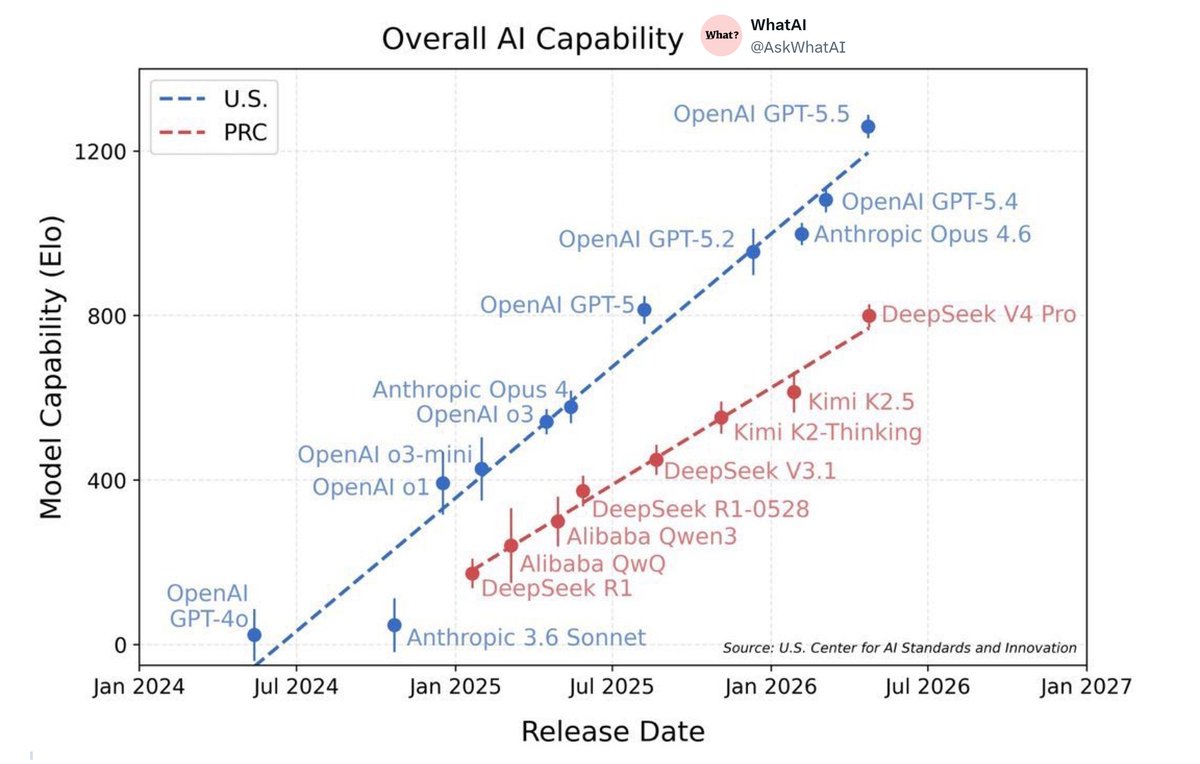
Update: This chart visualizes the projected Elo-rated trajectory of U.S. vs. China AI models through 2026. While U.S. frontier models (GPT-5 series, Anthropic Opus 4.6) maintain an absolute lead, the PRC ecosystem (DeepSeek, Qwen) shows a consistent, aggressive catch-up rate.
WhatAI tweet media
English
0
2
15
2.9K
WhatAI
WhatAI@AskWhatAI·
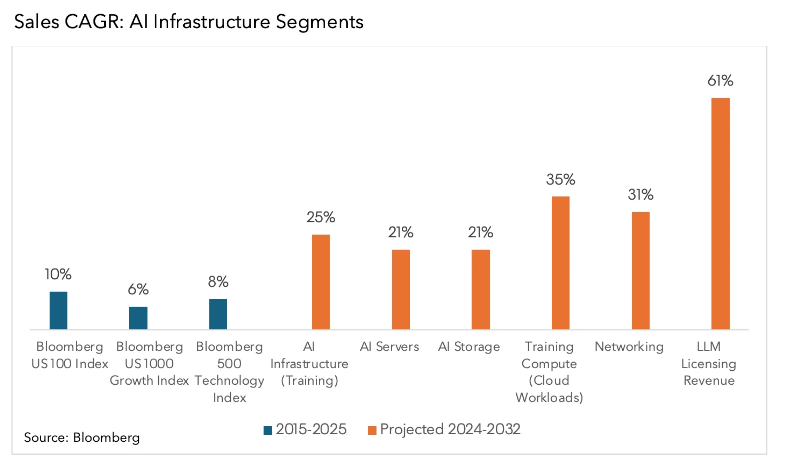
How can investors gauge exposure in the fast-growing AI value chain?Narrow focus on a few AI stocks risks over-concentration or coverage gaps. Index designs commonly suffer from: excessive mega-cap weighting and under-representation of essential, lower-profile AI innovators.
WhatAI tweet media
English
0
1
11
1.7K