Sunaina 🌞

11.4K posts

Sunaina 🌞 banner
Sunaina 🌞

Sunaina 🌞

@AstroSunaina

सत्यान्वेषी | Vedic astrology student | LV 1 Student | Let’s look for Permutations and combinations | लधुपाराशरी 🌟

Himalaya’s Katılım Ocak 2022
197 Takip Edilen754 Takipçiler
Sunaina 🌞 retweetledi
Vedanjanam
Vedanjanam@VEDANJANAM·
What is Pole Altitude? Stand outside. Look up. The point directly overhead is the Zenith. Now look down to the horizon. Between zenith and horizon is 90°. Every star has an altitude. Altitude is the angle from the horizon up to the star. A star on the horizon has altitude zero. A star at the zenith has altitude 90°. A star halfway up has altitude 45°. The celestial pole is the one point in the sky that does not move. The whole sky turns around it through the night. In the northern hemisphere, Polaris sits very close to it. Pole altitude is the angle from the horizon up to the celestial pole. That is all. The result the module establishes is this: pole altitude equals latitude. - Mumbai sits at 19°N. The pole sits 19° above the horizon. - Delhi sits at 28.6°N. The pole sits 28.6° above the horizon. - At the equator, latitude is zero. The pole sits on the horizon. - At the North Pole, latitude is ninety. The pole sits at the zenith. One night of careful watching, one measurement of the pole's height, and you have your latitude. This is the first measurement in spherical astronomy and every later measurement rests on it. Now return to the figure. The earth's centre, you the observer, the local vertical (v̂), the rotation axis (n̂) — four elements. The angle from your vertical to the equatorial plane is your latitude φ. The angle from your horizon to the celestial pole is the same φ. The figure proves the equivalence.
Vedanjanam tweet media
English
2
12
79
4.4K
Sunaina 🌞 retweetledi
All day Astronomy
All day Astronomy@forallcurious·
#BREAKING🚨: Today in Utqiagvik, the sun rose above the horizon at 2:57 AM after 65 days and won’t set again for 84 straight days or until August 2nd!
English
226
4.5K
31.4K
2.5M
Sunaina 🌞 retweetledi
Vedanjanam
Vedanjanam@VEDANJANAM·
A simple treatment on the various formulations in Surya Siddhanta. More on it in the Siddhanta course later in June. The course is free and open for everyone who can handle sophisticated mathematics.
Vedanjanam@VEDANJANAM

x.com/i/article/2053…

English
2
13
56
15.2K
Sunaina 🌞 retweetledi
Vedanjanam
Vedanjanam@VEDANJANAM·
Please don't do this. 1. You assume that standard prediction of Rahu is a bad outcome. It is wrong. 2. You assume that aspect of Saturn in Rahu is always good. True only when Saturn in benefic for the Ascendant. In all the other cases, this same aspect is very bad. The theories are there for everyone to learn. For someone as intelligent and erudite as you, spending a day with any good commentary of Ududaya Paradeepah will make it clear to you on how to analyse the nodes properly.
English
5
7
108
5.3K
Sunaina 🌞 retweetledi
Vedanjanam
Vedanjanam@VEDANJANAM·
Apauruṣeya śabda stands apart from every human case. Śruti possesses no human author and therefore no possibility of human defect, and is svataḥ-pramāṇa, self-validating at the moment of cognition. Human Āptas remain paratantra; their authority derives from realised knowledge and the absence of distortion. Śruti requires no examination of motive, competence, or purity, because no human agency stands behind it. The tests applied to the human speaker become meaningless in the absence of a human source. The hierarchy of pramāṇas becomes decisive in conflict. Within the empirical domain, pratyakṣa governs and śabda is interpreted accordingly. Within the supersensuous domain, śabda governs because perception possesses no jurisdiction there. Anumāna operates ministerially between them, clarifying and defending, never establishing sovereignty over either. The English rendering "inspired" distorts the structure. Inspiration suggests an external force entering the individual from outside. Āpta indicates attainment. The authority of the speech derives from what has been realised and stabilised within consciousness itself. Āptavākya therefore means the word of one who speaks from attainment.
Română
0
2
12
1.6K
Sunaina 🌞 retweetledi
Vedanjanam
Vedanjanam@VEDANJANAM·
A Yogi established in supersensuous cognition possesses Yogipratyakṣa. This is a species of pratyakṣa; its conversion into śabda is a second event. The seeing belongs to the Yogi. The words become vehicle. The cognition produced in the hearer becomes the effect. Āptavākya names the movement from realised seeing to transmitted knowledge. Śābdabodha arises in the hearer when four conditions are present in the sentence and one in the speaker. The sentential conditions are ākāṅkṣā, mutual expectancy among the terms; yogyatā, semantic fitness; sannidhi, proximity in utterance; tātparya, intended import. The speaker-condition is āptatva: the trustworthiness of one who has directly known. Where these conditions converge, valid cognition arises through language. The genuine Āpta is identified through four convergent marks: the cognitive ground, the instrumental condition, the systemic constraint, the condition of transmission. 1. Sākṣātkāra of the matter spoken: The Āpta speaks from direct cognition. What is communicated has first been seen. The disciplines through which such cognition becomes possible are described in the Yoga-sūtra, in the gradations of samādhi and siddhi. 2. Śuddhi of the antaḥkaraṇa: The antaḥkaraṇa functions as instrument of reception, and distortion in the instrument produces distortion in cognition. Desire for gain, prestige, influence, or emotional dominion introduces vṛttis that warp the reflective surface through which supersensuous reality becomes manifest. 3. Avirodha with established pramāṇa: Truth coheres with truth. A purported Āptavākya that contradicts firmly established perception or inference within their jurisdiction is rejected. Where perception and inference possess no access, their silence carries no authority against śabda. 4. Karuṇā as motive: The speech of the Āpta proceeds from anukampā toward the hearer. This is mark two extended into the act of teaching: appetite for acquisition is itself a vṛtti, arising from rāga and stabilised by abhiniveśa, and a speaker in whom that vṛtti is active during transmission cannot transmit transparently.
English
1
2
13
1.8K
Sunaina 🌞 retweetledi
Vedanjanam
Vedanjanam@VEDANJANAM·
आप्तवाक्य-विमर्श, भाग १ भारतीय दर्शन में प्रमाण-विषयक चिन्तन की परम्परा बहुत पुरानी है। ज्ञान कहाँ से उत्पन्न होता है, उसकी प्रामाणिकता किस आधार पर सिद्ध होती है, और संशय की दशा में किस साधन को सर्वोपरि माना जाए; इन्हीं प्रश्नों के उत्तर में विभिन्न दर्शनों ने अपनी-अपनी प्रमाण-मीमांसा का प्रवर्तन किया है। इस गुत्थी को सुलझाने के लिए सांख्य और योग, जो परस्पर भगिनी-दर्शन माने जाते हैं, ज्ञान की सिद्धि के लिए तीन प्रमाण स्वीकार करते हैं: प्रत्यक्ष, अनुमान, और आप्तवाक्य (जिसे शास्त्रों में 'शब्द-प्रमाण' भी कहा गया है)। इन तीनों में प्रत्यक्ष की प्रामाणिकता उसके नाम में ही निहित है। जो आँखों के सामने है, जिसे हम छू सकें, देख सकें, वह प्रत्यक्ष है। अनुमान का स्वरूप इससे भिन्न है; वहाँ इन्द्रियाँ साक्षात् रूप से तो कुछ देखती या सुनती नहीं हैं, किन्तु एक पूर्व-स्थापित सम्बन्ध के बल पर हम एक अनकहे, अनजाने सच तक पहुँच जाते हैं। जैसे पर्वत पर उठते हुए धुएँ को देखकर हम समझ जाते हैं कि वहाँ आग लगी होगी। शास्त्रों में धूम और अग्नि के इसी अनिवार्य सम्बन्ध को 'व्याप्ति' कहा है। ये दोनों प्रमाण इन्द्रिय-गोचर जगत् की मर्यादा तक ही सीमित हैं, अर्थात् वहीं तक कार्य करते हैं जहाँ तक इन्द्रियों की गति हो, अथवा अनुभव की पुनरावृत्ति किसी व्याप्ति को सिद्ध कर सके। किन्तु जीवन के मर्मस्पर्शी प्रश्न इस मर्यादा के परे हैं। आत्मा का स्वरूप, मोक्ष की अवस्था, कर्म-फल की सूक्ष्म गति, अथवा सृष्टि का मूल उपादान; इनके विषय में न तो इन्द्रियों का सन्निकर्ष ही सम्भव है, न पुनरावर्ती अनुभव से किसी व्याप्ति की सिद्धि हो पाती है। यहाँ न तो प्रत्यक्ष काम आता है, न ही अनुमान। जहाँ इन्द्रियाँ असमर्थ हो जाती हैं और तर्क भी थककर रुक जाता है, वहीं से तृतीय प्रमाण की सार्थकता सिद्ध होती है, जिसे हम 'आप्तवाक्य' कहते हैं। योग-साधना जब साधक के अन्तःकरण को अतीन्द्रिय सत्य में प्रतिष्ठित कर देती है, तब उसे 'योगि-प्रत्यक्ष' की उपलब्धि होती है। यह प्रत्यक्ष की ही एक विशेष कोटि है, शब्द की नहीं। जब वही योगी अपने अनुभव को वाणी देता है, तब एक नवीन प्रक्रिया की शुरुआत होती है। यद्यपि अनुभूति तो योगी की वैयक्तिक सत्ता में ही रहती है, तथापि शब्द उसके प्रकट होने का माध्यम बनते हैं, और श्रोता का चित्त भी उसी अनुभूति को बोध-रूप में ग्रहण करता है।
Vedanjanam tweet media
हिन्दी
2
7
46
2.8K
Sunaina 🌞 retweetledi
Vedanjanam
Vedanjanam@VEDANJANAM·
ĀPTAVĀKYA: The Word of the Attained The three pramāṇas of the Sāṅkhya-Yoga system are Pratyakṣa, Anumāna, and Āptavākya: direct perception, inference, and the testimony of the attained. The first two are familiar to every reasoner. The third governs the domains where the first two terminate. The necessity of Āptavākya emerges from the structure of the supersensuous. - Pratyakṣa depends upon contact between indriya and object, and the ātman lies outside sensory apprehension. - Anumāna depends upon an established vyāpti between sign and signified, and vyāpti is grounded in repeatable empirical co-presence which the supersensuous cannot supply. The domain inaccessible to perception and inference is the domain for which śabda-pramāṇa exists.
Vedanjanam tweet media
English
1
7
55
3.3K
Sunaina 🌞
Sunaina 🌞@AstroSunaina·
@VEDANJANAM WB govt will be pivotal point for stirring significant conflict nn strife inside bjp.
English
0
0
0
342
Vedanjanam
Vedanjanam@VEDANJANAM·
A mercurial government in WB. Conflict, strife, and a constant state of agitation. They could have chosen better. But this is what we got. Fixed Lagna Navamsha is the only saving grace.
Vedanjanam tweet media
English
11
4
90
13.1K
Sunaina 🌞 retweetledi
Vedanjanam
Vedanjanam@VEDANJANAM·
The biggest poverty of mind is the inability to appreciate and accept true generosity given without expectation of return. And when it is given, some take the giver's time as if it cost nothing. They do not see the choice it represents, the quiet expenditure absorbed on their behalf. Unconditional giving is never effortless. It is only unbilled, and the failure to register that weight is its own poverty.
Vedanjanam tweet media
English
5
23
168
4.8K
Sunaina 🌞 retweetledi
Vedanjanam
Vedanjanam@VEDANJANAM·
I’ll try to livestream today’s Lagna Viveka 2 session on YouTube and X. If everything goes alright, expect the links to be available by 8:15 am Indian Time. Session starts at 8:30 am Indian Time (~1 hour from now). Doing it because a lot of people have been asking about how the lectures in Lagna Viveka are delivered. See you in the class. Come with pen and paper!
Vedanjanam tweet media
English
2
10
81
7.1K
Sunaina 🌞 retweetledi
Vedanjanam
Vedanjanam@VEDANJANAM·
We are not alone. We are but one of the many sentient forms in one universe among many universes that simultaneously exist at many levels of perception. Most of these universes have sentient life, some of them highly intelligent. If UFO files can disturb your faith, it is simply because you have been subscribing to a dogma all along; a dogma that has no relationship with reality. Many such universes are created and destroyed in every microsecond. If you have the courage to evolve enough, you can even create a few of your own. Jai Dwarikadheesh 🙏🏻🌹
Vedanjanam tweet media
English
21
69
729
24K
Sunaina 🌞 retweetledi
Vedanjanam
Vedanjanam@VEDANJANAM·
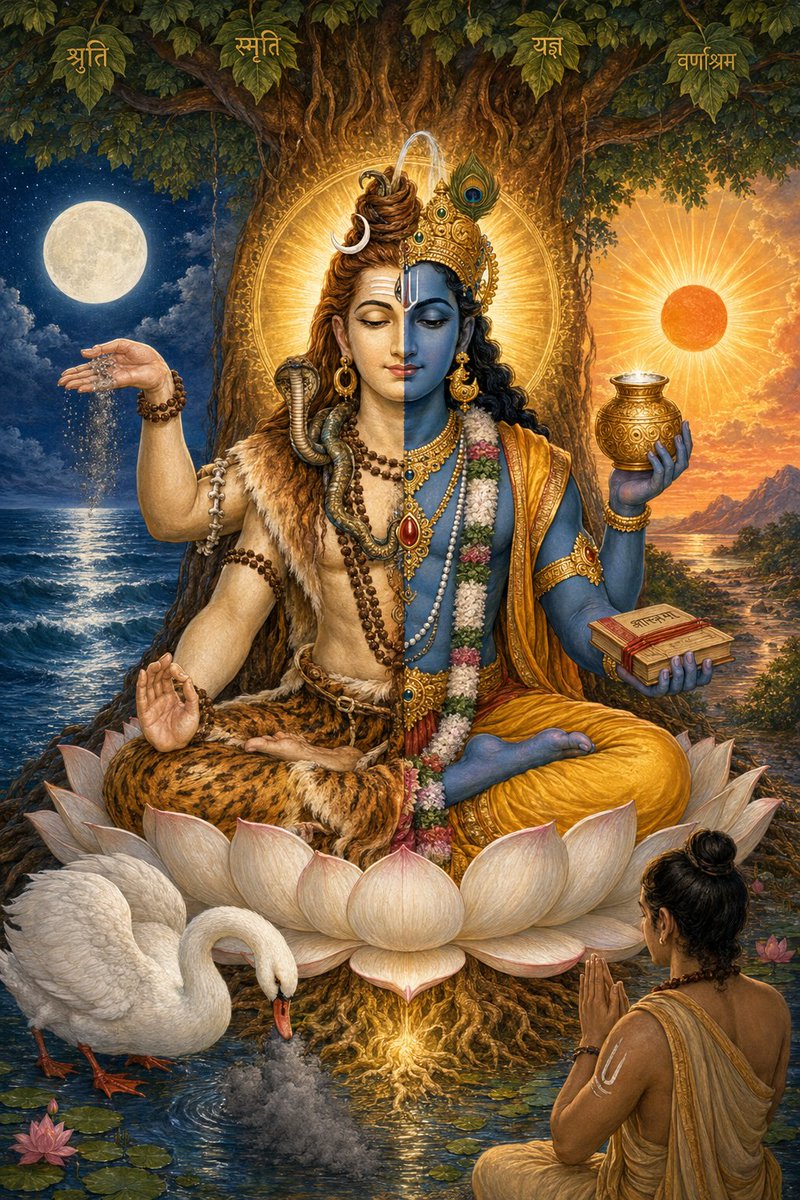
मूलं धर्मतरोर्विवेकजलधेः पूर्णेन्दुमानन्ददं वैराग्याम्बुजभास्करं ह्यघरजोहंसं हरिं शङ्करम् । वन्द्यं विश्वगुरुं भवौषधमशेषक्लेशसंहारकं वन्देऽहं सकलं कलङ्करहितं स्वच्छन्दमानन्दकम् ॥ - अरण्यकाण्ड मङ्गलाचरण (प्रथम श्लोक), श्रीरामचरितमानस मैं उन भगवान हरि-शंकर की वन्दना करता हूँ, जो धर्म-रूपी कल्पवृक्ष के आधार-मूल हैं और विवेक-रूपी क्षीरसागर को प्रफुल्लित करने वाले निष्कलंक पूर्णचन्द्र हैं। जो वैराग्य-रूपी कमल के निमित्त दीप्तिमान सूर्य हैं और पाप-रूपी धूलि का भक्षण करने वाले मानसरोवर के श्वेत हंस हैं। वे सम्पूर्ण विश्व के वन्दनीय गुरु, संसार-रूपी व्याधि की अमोघ औषधि और समस्त क्लेशों का समूल नाश करने वाले हैं। वे पूर्ण हैं, दोष-रहित हैं, अपनी इच्छा में पूर्णतः स्वतन्त्र (स्वच्छन्द) हैं और स्वयं आनन्द-स्वरूप हैं। प्रभु एक विशाल धर्म-तरु के अनावरणित जड़-समूह के समीप, पूर्ण-विकसित धवल कमल पर पद्मासन में प्रतिष्ठित हैं। उस विराट वृक्ष की सघन छत्रछाया धर्म के शाश्वत शिलालेखों और गूढ़ मन्त्रों से अंकित है। उनके मस्तक के दक्षिण भाग में, एक शान्त और निस्तरङ्ग महासागर के ऊपर पूर्णचन्द्र उदित है, जो लौकिक लांछनों से सर्वथा विनिर्मुक्त है। वाम भाग के उर्ध्व में, द्वादश प्रधान रश्मियों से मण्डित भगवान सूर्य का उदय हो रहा है। उनके श्रीचरणों के निकट एक श्वेत हंस जल से पाप-रूपी धूसर रज को पृथक कर उसका पान कर रहा है। उनका स्वरूप विलक्षण हरिहर है। विग्रह का दक्षिण भाग भगवान शंकर के लक्षणों से युक्त धवल गौर-वर्ण है, और वाम भाग भगवान श्रीहरि के लक्षणों से सुशोभित घनश्याम-वर्ण है। उनकी चतुर्भुजाएँ अलौकिक मुद्राओं और आयुधों से सुसज्जित हैं: 1. प्रथम हस्त: ज्ञान-मुद्रा में तत्त्व-बोध की शिक्षा प्रदान कर रहा है। 2. द्वितीय हस्त: अमरत्व की दिव्य औषधि (अमृत-कलश) धारण किए हुए है। 3. तृतीय हस्त: समस्त क्लेशों और संतापों का संहार कर रहा है। 4. चतुर्थ हस्त: शास्त्र-प्रमाण अर्पित करते हुए सत्य की प्रतिष्ठा कर रहा है। वे पूर्ण हैं, निष्कलंक हैं, अपनी इच्छा में पूर्णतः स्वच्छन्द और सम्प्रभु हैं; उनकी उपस्थिति मात्र ही परमानन्द का साक्षात् वरदान है।
Vedanjanam tweet media
हिन्दी
1
11
179
3.7K
Sunaina 🌞 retweetledi
Vedanjanam
Vedanjanam@VEDANJANAM·
मूलं धर्मतरोर्विवेकजलधेः पूर्णेन्दुमानन्ददं वैराग्याम्बुजभास्करं ह्यघरजोहंसं हरिं शङ्करम् । वन्द्यं विश्वगुरुं भवौषधमशेषक्लेशसंहारकं वन्देऽहं सकलं कलङ्करहितं स्वच्छन्दमानन्दकम् ॥ - Araṇyakāṇḍa Maṅgalācaraṇa, Śrīrāmacaritamānasa The Lord sits in padmāsana on a fully-bloomed white lotus at the exposed root-system of an immense tree whose canopy bears the inscriptions of dharma. Above his head and to his right, a full moon over a still ocean, rendered without its conventional stain. Above his head and to his left, a sun rising with twelve principal rays. At his feet, a white haṃsa drinks the grey dust of sin from the water. His form is harihara - the right half gaura-varṇa with all the markers of Śaṅkara, the left half śyāma-varṇa with all the markers of Hari. One hand teaches; one hand holds the medicine of immortality; one hand dissolves affliction; one hand offers the śāstra-pramāṇa. He is complete, unstained, sovereign in his own will, and his presence itself is the gift of bliss.
Vedanjanam tweet media
MR
2
8
77
2K
Sunaina 🌞 retweetledi
Vedanjanam
Vedanjanam@VEDANJANAM·
Strong 2nd, 4th and 9th houses with the involvement of strong Mercury and/or Jupiter. Also, sometimes the presence or influence of benefic strong nodes.
Ayush@ayush17779

@VEDANJANAM Namaskar Sir, multiple languages janne walon ke ya bhasha vaigyanikon ke chart me kis prakar ke combination paye jate hain?

English
4
6
64
4.4K
Sunaina 🌞 retweetledi
Vedanjanam
Vedanjanam@VEDANJANAM·
I often emphasize this in my class - the only place where research is mandated in Vedic Astrology is to find out the planetary, sign and house significations of newer pursuits of human enterprise. Everything else was already solved by Maharshi Parashara.
Noira I pushya 🌙@BikeridenWomen

If you have a strong 8H, it's high probability that you'll be able to learn artificial intelligence I developed an interest in it and have been studying it since december, I had my first interview today and based on a project I created I got to the next round, the thing is you need to have an interest in 8H themes. @VEDANJANAM sir adviced me to learn AI earlier last year, I skipped that adviced then, turns out it was fate I will learn AI, what sir says, happens 🙏 Still in process, still learning, and I want to build meaningful things, so I shall.

English
7
5
85
7.2K
Sunaina 🌞 retweetledi
Noira I pushya 🌙
Noira I pushya 🌙@BikeridenWomen·
If you have a strong 8H, it's high probability that you'll be able to learn artificial intelligence I developed an interest in it and have been studying it since december, I had my first interview today and based on a project I created I got to the next round, the thing is you need to have an interest in 8H themes. @VEDANJANAM sir adviced me to learn AI earlier last year, I skipped that adviced then, turns out it was fate I will learn AI, what sir says, happens 🙏 Still in process, still learning, and I want to build meaningful things, so I shall.
English
3
2
39
8.9K
Sunaina 🌞
Sunaina 🌞@AstroSunaina·
The relationship between Purusha (consciousness) and Prakriti (matter) is indeed the "juice" of Sankhya philosophy, as one of the oldest. We see that in Ramcharitmanas too, Tulsi ji integrated these deep philosophical roots into his devotion (Bhakti). Tulsidas translates this abstract duality into the relationship between Rama (the supreme Purusha) and Sita (the primordial Prakriti/Shakti). Tulsi ji understood that while Sankhya seeks liberation through "discriminative knowledge" (knowing you are not the body), the highest "juice" is the emotional and spiritual bond that connects the soul back to the cosmic source through pure bhakti . 🌾
English
0
0
2
111
Vedanjanam
Vedanjanam@VEDANJANAM·
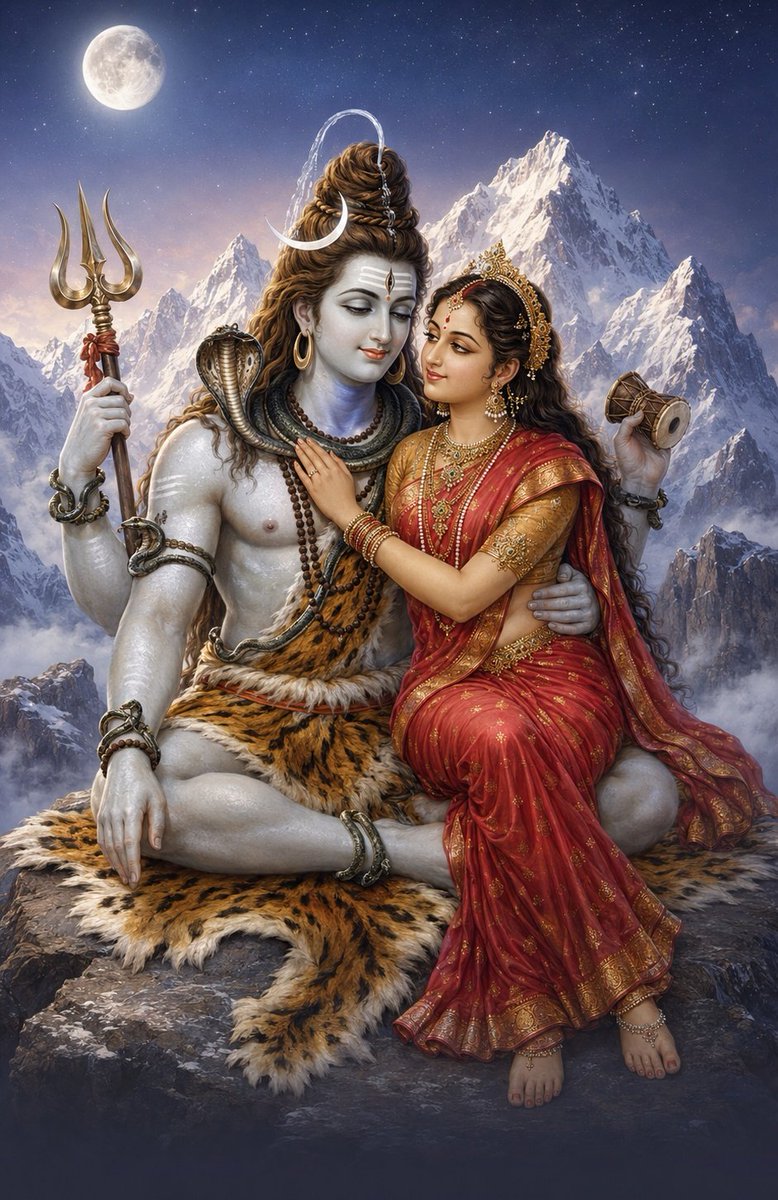
यस्याङ्के च विभाति भूधरसुता देवापगा मस्तके भाले बालविधुर्गले च गरलं यस्योरसि व्यालराट्। सोऽयं भूतिविभूषणः सुरवरः सर्वाधिपः सर्वदा शर्वः सर्वगतः शिवः शशिनिभः श्रीशङ्करः पातु माम्॥ He on whose lap shines Pārvatī, daughter of the Himalaya; on whose head, the celestial Gaṅgā; on whose forehead, the young crescent moon; in whose throat, the hālāhala poison; and on whose chest, Vāsuki the king of serpents. That Śaṅkara, adorned with sacred ash, foremost among the gods, eternal lord of all, the destroyer, the all-pervading, the auspicious one, radiant as the moon, may He protect me. Tulsīdās ji opens the Ayodhyākāṇḍa with Śiva in vihāra-līlā, with the cosmic householder seated alone with mother Pārvatī on Kailāsa in private repose.
Vedanjanam tweet media
MR
2
17
208
3.5K