

Astro 402
18 posts

Astro 402
@Astrox402
Make every API, agent, and digital resource monetizable. https://t.co/EvJBxyqWGv
Katılım Nisan 2026
5 Takip Edilen138 Takipçiler
Finaly we have big update : github.com/Astrox402/Astr…
Astro x402 is building wallet-native payments for AI, APIs, and autonomous
agents on Solana.
Goal: make every paid request instant, verifiable, and programmable — no
subscriptions, no middlemen, just onchain receipts and machine-speed settlement.
The future of API monetization is pay-per-use.

English
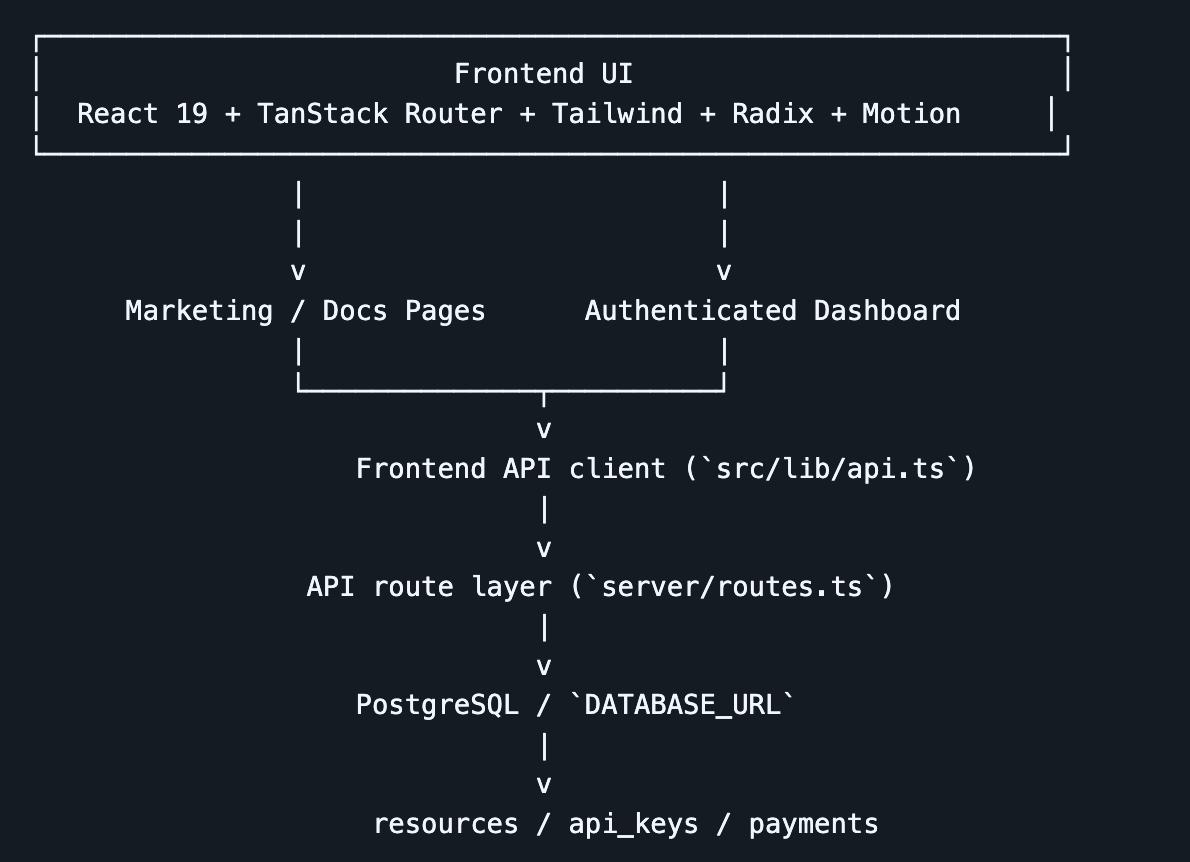
This is the current Astro x402 architecture:
React 19 + TanStack Router on top — two paths: marketing/docs for the public, authenticated dashboard for builders.
Both talk to a single API client (src/lib/api.ts), passed to the route layer, and then PostgreSQL below.
The living tables: resources, api_keys, payments — all scoped per Privy user ID. No mocks, no localStorage masquerading as a database.
The stack is intentionally flat. No separate Express server — the API routes are directly inline in the Vite plugin, running on one process, one port. As simple as possible until there's a reason not to be.
English
We just fixed two things:
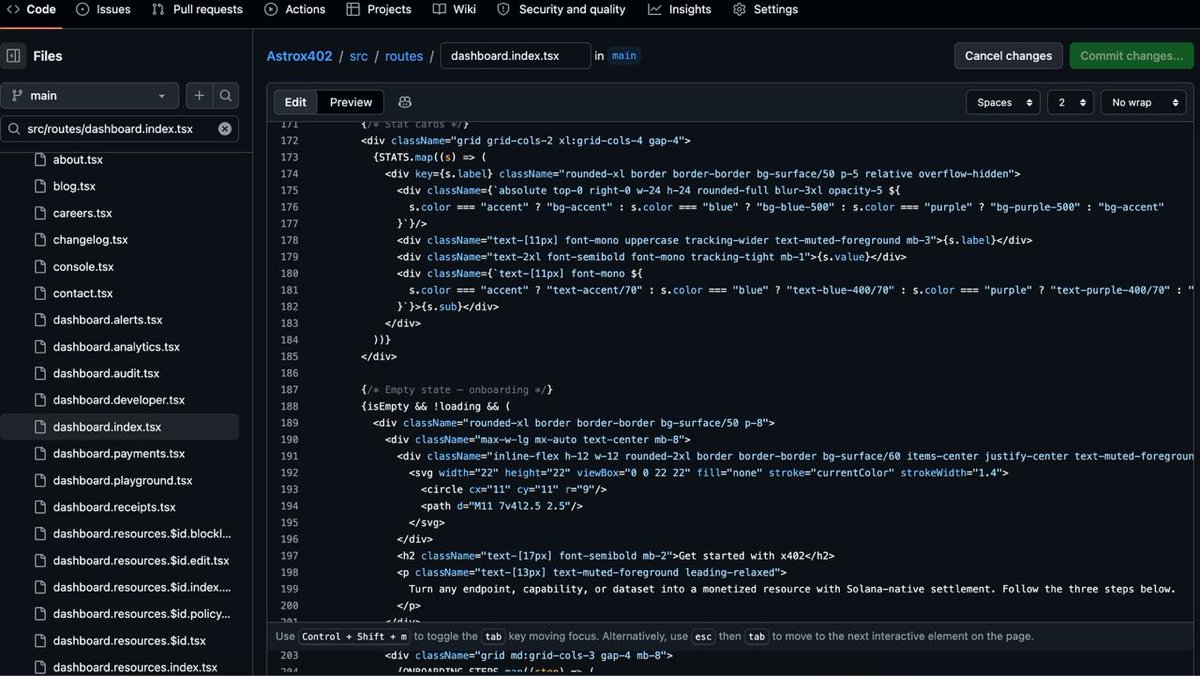
isEmpty logic — previously, resources.length === 0 was checked immediately without knowing whether the store had finished loading from the DB. As a result, users who already owned resources could see a glimpse of the onboarding screen before the data appeared. Now use resourceStore.isLoaded() as a condition — onboarding only appears if the store has actually finished loading and is empty.
Recent Resources order — [...resources].reverse().slice(0, 5) was incorrect because the API already returned the most recent data at the top (ORDER BY created_at DESC). Performing a reverse order reversed the order, starting with oldest first. Fixed to resources.slice(0, 5) instead.
github.com/Astrox402/Astr…
English
Astro x402 - dev update, here's what just shipped:
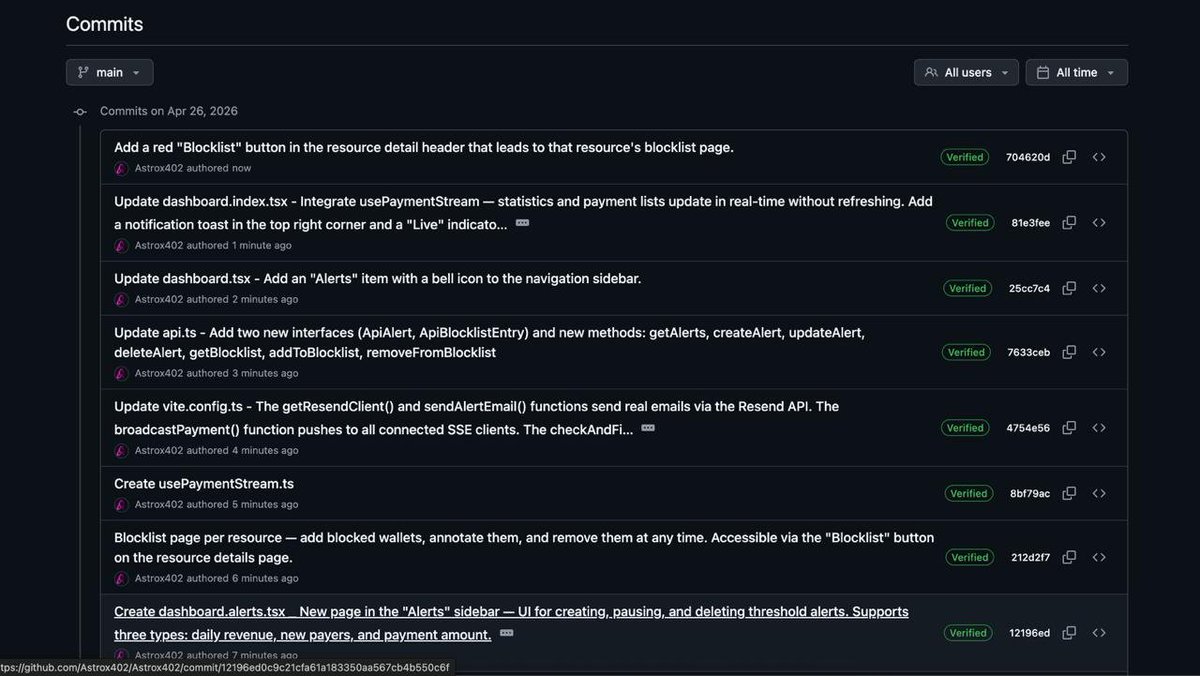
vite.config.ts — backend as well. Adds SSE endpoint for real-time stream, broadcastPayment() that pushes an event to all active tabs when a payment is settled, checkAndFireAlerts() that checks the threshold for every incoming payment, sendAlertEmail() via Resend API, plus 10+ new routes for alerts and blocklist CRUD, and two new tables (alerts, blocklist) that auto-migrate when the server starts.
src/lib/api.ts — adds 7 new methods: getAlerts, createAlert, updateAlert, deleteAlert, getBlocklist, addToBlocklist, removeFromBlocklist. All interfaces are fully typed.
src/hooks/usePaymentStream.ts — new custom SSE hooks. Open a connection to /api/events/stream, auto-reconnect if disconnected, expose an onPayment callback for the dashboard.
src/routes/dashboard.index.tsx — now live. Stats update automatically, the payment list reloads automatically, a toast appears in the top right corner every time a payment comes in, and a flashing "Live" dot appears in the header.
src/routes/dashboard.alerts.tsx — new page. UI creates/pauses/resume/delete alerts. Three types: daily revenue exceeds threshold, first wallet payment, or daily payment amount.
src/routes/dashboard.resources.$id.blocklist.tsx — new page. Block Solana wallets per resource, add notes, and delete them at any time. Blocked wallets get a 403 + X-Astro-Block header: wallet-blocked
src/routes/dashboard.resources.$id.index.tsx — add a red Blocklist button in the resource detail header
src/routes/dashboard.tsx — add an "Alerts" item in the sidebar navigation
Check this : github.com/Astrox402/Astr…
Dashboard : astro402.xyz/dashboard
Next: Wiring a full PostgreSQL backend — all resources, API keys, payments, stats, and wallet addresses are now scoped in real-time per Privy user ID. The dashboard is fully live, with data directly from the DB.
English
something has been quietly built.
7 pieces. one session. thread
search everything.
one bar. no context switching.
resources, payments, wallets, keys — all of it, instantly.
some wallets get greedy.
now there's a cap.
rate limits per resource — per wallet, per hour, per day.
exceed it. get 429'd. no exceptions.
new builders used to stare at an empty dashboard wondering where to start.
not anymore.
a checklist appears. it knows what's missing.
it disappears when you're ready.
every resource now has a pulse.
error rate. response trend. request volume per hour.
healthy. degraded. silent.
you'll know before your users do.
set a number.
cross it — get notified.
revenue threshold. new unknown wallet. anything.
the protocol watches so you don't have to.
every settled payment now leaves a trail.
a real HTTP POST. signed.
hmac-sha256. timestamped. logged.
delivery history. fail rates. all of it.
the playground used to lie at the settlement step.
random string. fake signature. nothing real.
now it pauses.
asks for your wallet.
waits for the chain.
returns a real txSignature.
solscan link included.
github.com/Astrox402/Astr…
English
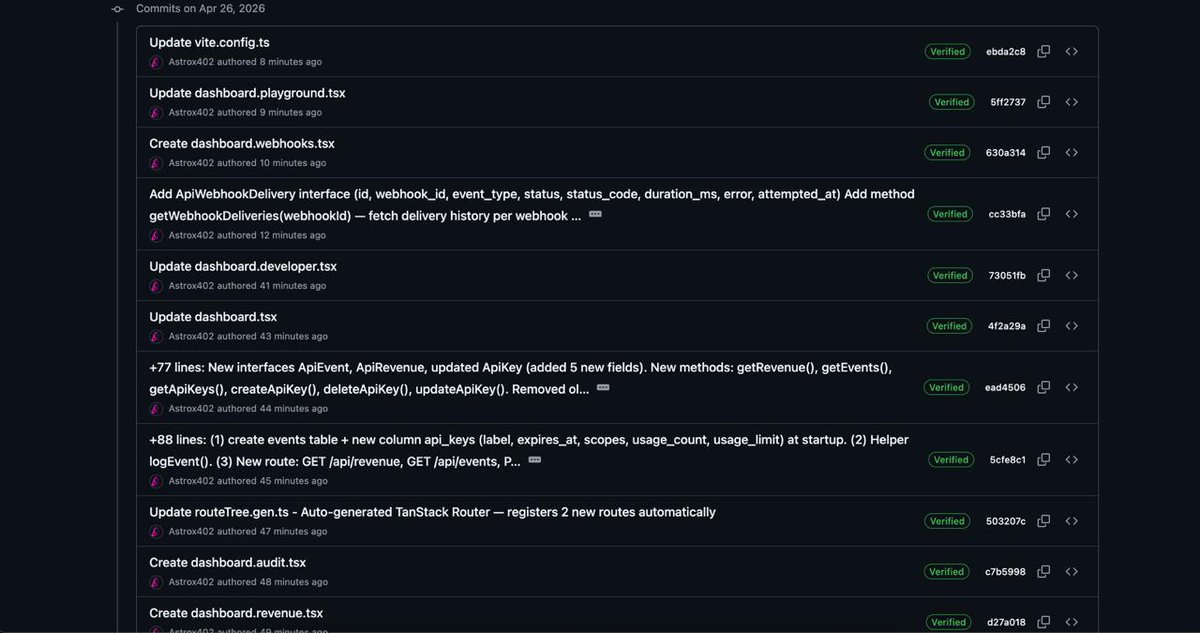
Just shipped 4 new features to the Astro x402 dashboard 🛠️
→ Payer Analytics — see who pays most often and from which wallet
→ Receipt Explorer — every payment has a receipt that can be verified on-chain in Solana Explorer
→ Webhook Delivery — push payment.settled events in real time to your server
→ Quote Policy Editor — set free tiers, peak pricing, volume discounts per resource, without redeployment
Programmable payment layer for APIs, live now : astro402.xyz/dashboard

English
You can see our work on GitHub, and some new files and commits. Here's what we've done: github.com/Astrox402/Astr…

English
We are working on this so that everything works in a complex manner, and ensure that the structure we create works as it should :
Quote Policy Editor — Visual editor for pricing rules per resource: dynamic pricing based on time, volume discounts per wallet, or a free tier (N requests free before a 402 kicks in). This is the essence of the "programmable payment layer."
Receipt Explorer — Individual receipt browsing page with on-chain verification: link to Solana Explorer, display signature, slot, and proof of token transfer. Each payment has an auditable receipt.
Payer Analytics — Who paid, which wallets are most active, and payer retention month-over-month. Narrative: "see who's consuming your resources."
Webhook Delivery — Configure an endpoint that receives events when settlements are confirmed on-chain. Standard for every payment platform — operators need to know in real time when payments arrive.
So we add Receipts, Webhooks, and Analytics menu.

English
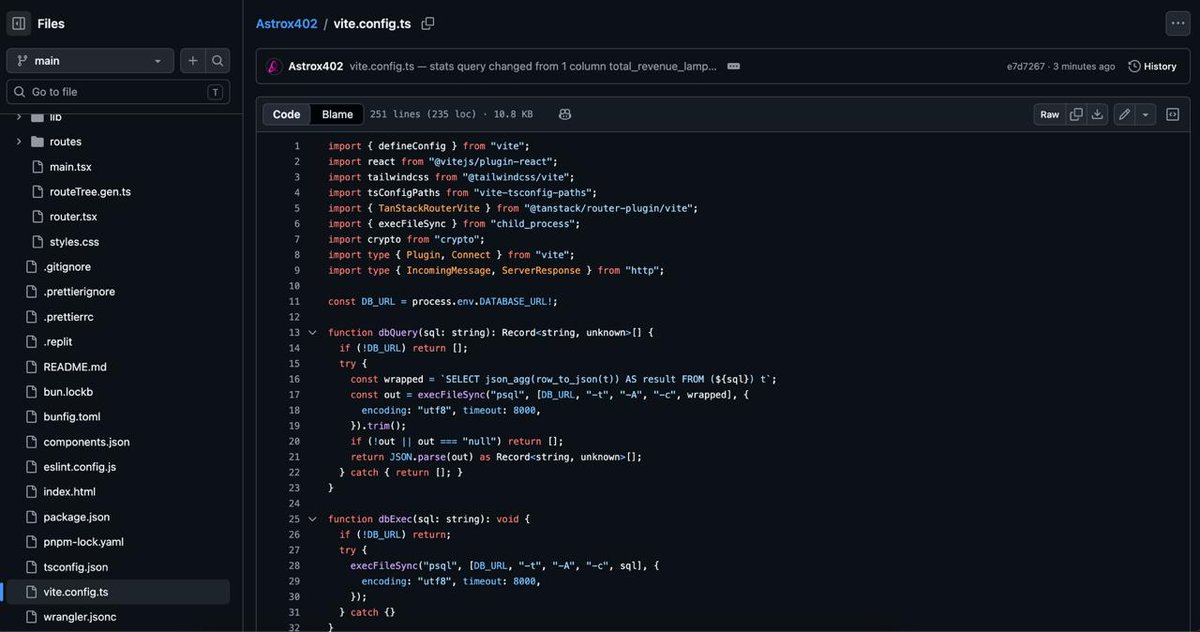
We just updated :
Backend
vite.config.ts — stats query changed from a single column, total_revenue_lamports, to two separate columns: total_sol_revenue_lamports and total_usdc_revenue_lamports
Data Types & API
src/lib/api.ts — ApiStats interface updated with new fields from the backend
github.com/Astrox402/Astr…
English

Astro402 is officially participating in Solana’s Frontier Hackathon
We’re building something big. Stay tuned.
colosseum.com/frontier
$ASTRO
Colosseum@colosseum
1/ @Solana's Frontier Hackathon has commenced!🏔️ 🌍 Crypto's largest online startup competition 💰 $2.5 million from Colosseum's venture fund 🌉 Up to 10 startups accepted into our accelerator 🏁 Product submissions due by May 11, 2026 Join: colosseum.com/frontier
English
Want to understand Astro faster? Start with the docs.
If you want the clearest picture of what we're building, how the protocol works,
and why payment-native access matters, read here:
astro402.xyz/docs $ASTRO

English
How it work ?
Step 1 : Define a resource
Declare any endpoint, capability, or asset. Astro wraps it in a payment-aware envelope.
Step 2 : Set programmable pricing
Price by request, payload size, compute, model, or arbitrary logic. Scope and TTL included.
Step 3 : Caller pays in-flow
Any client — user, app, or agent — receives a 402, signs a payment intent, retries, gets data.
Step 4 : Settle and observe
Settlement clears on Solana. Usage, revenue, and access proofs land in your dashboard live.
English
How it work ?
Step 1 : Define a resource
Declare any endpoint, capability, or asset. Astro wraps it in a payment-aware envelope.
Step 2 : Set programmable pricing
Price by request, payload size, compute, model, or arbitrary logic. Scope and TTL included.
Step 3 : Caller pays in-flow
Any client — user, app, or agent — receives a 402, signs a payment intent, retries, gets data.
Step 4 : Settle and observe
Settlement clears on Solana. Usage, revenue, and access proofs land in your dashboard live.
English
What if every API call was a transaction?
Astro402 is a payment-native access layer
where pricing, authorization, payment, and settlement
are embedded directly into the request itself.
No billing systems. No accounts. No delays.
Just programmable access for APIs, agents, and machines
natively on Solana.
Early access open.
English