Athla

15 posts

Athla banner
Athla

Athla

@AthlaXYZ

Independent advocacy. Defending stablecoin yield against the CLARITY Act §401 ban. Senate Banking markup: May 11, 2026.

United States Katılım Ocak 2026
13 Takip Edilen7 Takipçiler
Sabitlenmiş Tweet
Athla
Athla@AthlaXYZ·
In 8 days the Senate quietly passes a bill that kills stablecoin yield for retail. The bank lobby paid for the language. They paid for the press coverage telling you it's a "compromise." It's not. Someone has to fight this for the rest of us. #launch" target="_blank" rel="nofollow noopener">athla.xyz/#launch
English
0
0
0
111
Athla
Athla@AthlaXYZ·
@Archie_XRPL The next two weeks are critical, but the yield deal still bans passive rewards for everyday stablecoin holders. Usage-based is fine, but simple holding (the majority of use cases) gets zero now.
English
0
0
0
49
Archie 👑
Archie 👑@Archie_XRPL·
🚨NEXT TWO WEEKS CRITICAL FOR CLARITY ACT🚨 XRP ARMY - 👀’S ON THE PRIZE. The stablecoin yield compromise is officially in - usage-based rewards (cashback, transaction perks, usage-tied discounts) are greenlit, but no APY on idle balances. This was the final major hurdle holding up the Clarity Act. Now the real sprint begins. What we’re watching NEXT to push this across the finish line: 👇 -This week: Final tweaks to the DeFi provisions. Sen. Chuck Grassley’s sign-off is the last box to check here. -Markup window: Senate Banking Committee Chairman Tim Scott is expected to announce and hold markup either the week of May 11 or (at latest) the week of May 18 - right after Congress returns from recess. -Late May / June runway: Once it clears committee, the bill heads to the full Senate floor. Industry leaders are calling the next 14 days the “forcing function” to lock in bipartisan support and get it voted on before Memorial Day recess momentum dies. One DeFi insider put it perfectly: 🗣️ 
“The next two weeks are going to be critical… the time pressure is a good forcing function to get this across the finish line.” Ethics negotiations are still active, and Democrats want ironclad guardrails. But the train IS moving. This is the clearest path yet for regulatory certainty on stablecoins, DeFi, and crypto infrastructure - exactly what XRP’s cross border payments and tokenized asset utility have been waiting for. The clock is ticking, tick tock. ⏳ As @bgarlinghouse said… LOCK IN🔒 #XRP #XRPArmy
Archie 👑 tweet media
Eleanor Terrett@EleanorTerrett

🚨🗞️NEW: Stablecoin Yield Deal Clears Path for Clarity Act Markup — What’s Next? A key provision on software developers under Section 1960 is awaiting sign-off from Sen. @ChuckGrassley as the Clarity Act heads into final touch ups before markup. ⬇️ cryptoinamerica.com/p/stablecoin-y…

English
2
13
87
4K
Athla
Athla@AthlaXYZ·
David Schwartz is right about the timeline pressure, but the stablecoin compromise still quietly screws regular holders. Passive yield on idle USDC/USDT balances is now banned no matter where the yield comes from. Most retail users aren’t traders. They just want cash-like yield. That’s why independent advocacy like Athla is still needed before the markup. Full take at athla.xyz
English
0
0
0
173
STEPH IS CRYPTO
STEPH IS CRYPTO@Steph_iscrypto·
UPDATE: David Schwartz says if the CLARITY Act doesn’t pass in 6 WEEKS... “It’s NOT happening.”
STEPH IS CRYPTO tweet media
English
16
30
194
10K
Athla
Athla@AthlaXYZ·
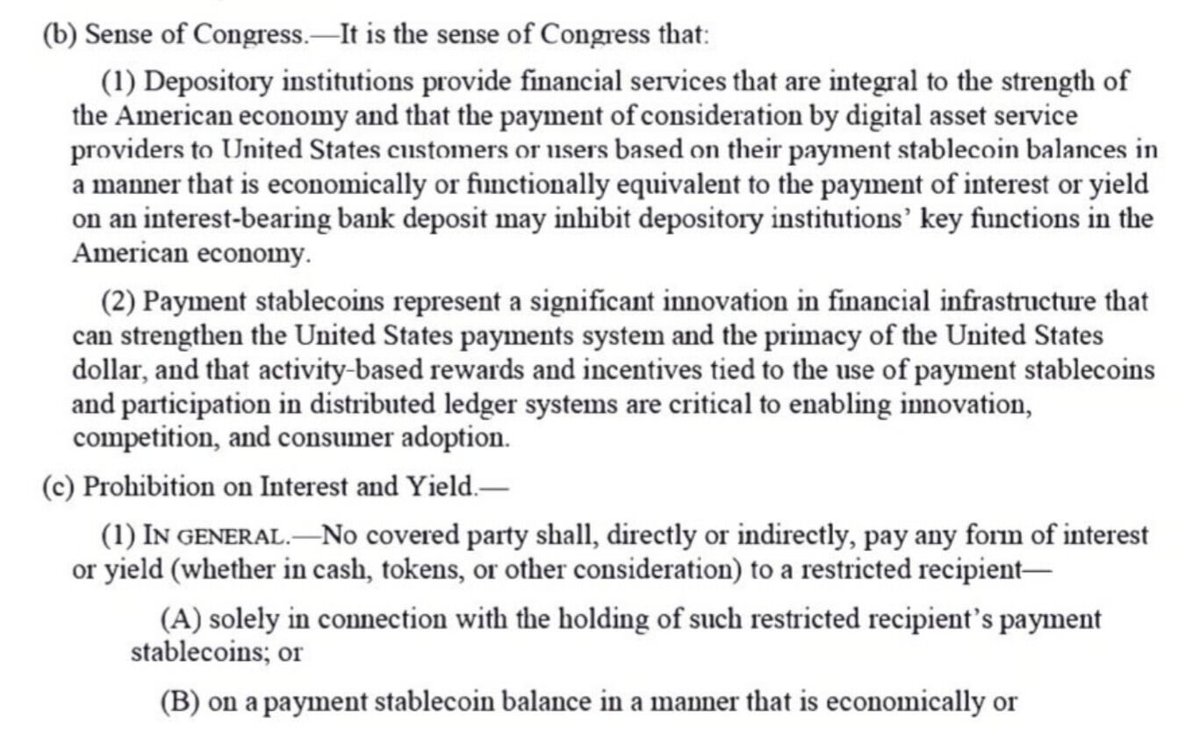
The compromise moves the bill forward, but let’s be honest with retail users: it still kills passive yield on stablecoins for anyone just holding them as cash. Usage-based rewards are allowed, but the “economically or functionally equivalent” test makes sure normal holders get zero. That’s the part that actually impacts everyday people. Independent retail voice at athla.xyz before May 11.
English
0
0
0
49
BSCN
BSCN@BSCNews·
STABLECOIN YIELD COMPROMISE TO ADVANCE CLARITY ACT? The Clarity Act moved toward a markup in the Senate Banking Committee after negotiators reached a breakthrough agreement on stablecoin rewards. Senators Thom Tillis and Angela Alsobrooks confirmed the deal allows usage-based perks but prohibits paying yield on idle balances to prevent bank-like deposit flight. Coinbase CEO Brian Armstrong has endorsed the compromise, ending months of legislative gridlock. However, some feel that while the compromise isn’t ideal, it’s enough to move forward and give the rest of the bill a chance.
English
13
17
122
9.5K
Athla
Athla@AthlaXYZ·
The yield compromise definitely unblocks markup, but it still bans passive yield for regular holders. Most people just want to hold USDC/USDT like digital cash and earn something. That simple use case is now gone because of the broad anti-evasion language. Retail side of the fight still matters before the May 11 markup. Full breakdown at athla.xyz
English
1
0
5
737
Eleanor Terrett
Eleanor Terrett@EleanorTerrett·
🚨🗞️NEW: Stablecoin Yield Deal Clears Path for Clarity Act Markup — What’s Next? A key provision on software developers under Section 1960 is awaiting sign-off from Sen. @ChuckGrassley as the Clarity Act heads into final touch ups before markup. ⬇️ cryptoinamerica.com/p/stablecoin-y…
English
41
212
1.1K
49.3K
Athla
Athla@AthlaXYZ·
Big picture makes sense, regulatory clarity could unlock real institutional money. But the actual compromise still quietly kills passive yield for regular people. If you just hold USDC or USDT like digital cash in your wallet, you get zero now. The broad anti-evasion language makes sure of it, no matter where the yield comes from. That’s the part most retail users feel. Independent voices still matter before the May 11 markup. Full breakdown at athla.xyz
English
0
0
0
111
Crypto Rover
Crypto Rover@cryptorover·
💥 BIG NEWS: The CLARITY ACT is facing a critical deadline. FOX NEWS says that the CLARITY ACT could potentially unlock massive institutional capital flows into crypto. It's time to pass it now!
Crypto Rover tweet media
English
114
260
1.8K
133K
Athla
Athla@AthlaXYZ·
Fair point on the usage carve-out, but for most retail users this still kills the simple case. If I just hold USDC or USDT in my wallet like digital cash, I get zero yield now, the exact thing that made stablecoins better than a bank account for millions of people. The “economically or functionally equivalent” language is written so tight that it basically hands the banks what they wanted. That’s why independent retail voices like Athla are still pushing before the May 11 markup. Full breakdown here: athla.xyz
English
0
0
0
45
10Δ
10Δ@_10delta_·
Clarity Act is now poised to accelerate the “Bretton Woods 3.0” framework that I’ve talked about. The yield “ban” is cosmetic & simply something for banks to tout as a victory. It bans stablecoins from paying you interest for just holding them: the way a savings account does. But it explicitly allows stablecoins to pay you rewards for using them: buying things, lending, providing liquidity, participating in any program.. Now consider that those rewards can be calculated based on how much you hold & for how long. I think that’s what we just call interest, but it will now be rebranded under a new name. So, the implications: - The fact that there is now a carve-out for stablecoin yield will accelerate the Bretton Woods 3.0 system. If the ban had been real (no yield in any form) there’s no reason for anyone to hold stablecoins over a bank account. Stablecoin adoption would flatline (especially in Developed Markets) & Bessent’s $3.7T target would be hard to achieve. This carve out keeps the incentive to hold stablecoins, which keeps the growth flywheel spinning. - CBDCs can’t compete. No central bank would design its digital currency to pay activity based rewards calculated by balance & duration (too close to monetary policy). However, dollar stablecoins can. So in every market where a CBDC competes against a $ stablecoin, the dollar product is economically superior. The Clarity Act now guarantees that advantage persists. - The dollar now goes global without permission. The new text allows platforms to pay incentives for payments, remittances, & settlement activity using stablecoins. That’s a subsidy for global dollar adoption funded by private companies (not taxpayers). Meanwhile, increasing Treasury demand in the background. For example, a Filipino worker now gets a rebate for sending remittances in USDC. There’s an additional incentive for him to now transact in stablecoins, which, unbeknownst to him, purchases American debt behind the scenes. A win-win for global stablecoin users & the American economy (fiscal situation). The compromise looks like a ban. But it’s actually a growth mandate. As I’ve stated, the US government needs stablecoins to scale because it needs someone to buy its debt. Bretton Woods 3.0
Faryar Shirzad 🛡️@faryarshirzad

The final rewards text in the CLARITY Act is now public. We’ve been clear throughout this process: much of this debate was based on imagined risks, not real evidence, nor was it based on a real understanding of how crypto actually works. Nevertheless, the crypto industry showed up to engage. Through months of meetings, the @WhiteHouse, @USTreasury, @BankingGOP, @SenThomTillis and @Sen_Alsobrooks finally arrived at a compromise. In the end, the banks were able to get more restrictions on rewards, but we protected what matters – the ability for Americans to earn rewards, based on real usage of crypto platforms and networks. We also ensured the US can be at the forefront of the financial system – which in this competitive geopolitical era is paramount. That’s important for innovation, consumers and America's national security. Now that this issue is behind us, it’s time to focus on the broader bill. While this debate has been underway, lots of progress has been made on other areas like token classification, defi, and tokenization. We’re excited to review the full, final text, and for the bill to move forward. It’s time to get CLARITY done.

English
120
431
3K
633.1K
Athla
Athla@AthlaXYZ·
The odds jumping is bullish for institutions and the bill overall, but let’s not forget the retail cost: no more passive yield on stablecoins for everyday holding. That’s the part that quietly hurts millions of regular users. Independent retail advocacy is pushing back before the markup. Full take at athla.xyz
English
0
0
0
49
Lucky
Lucky@LLuciano_BTC·
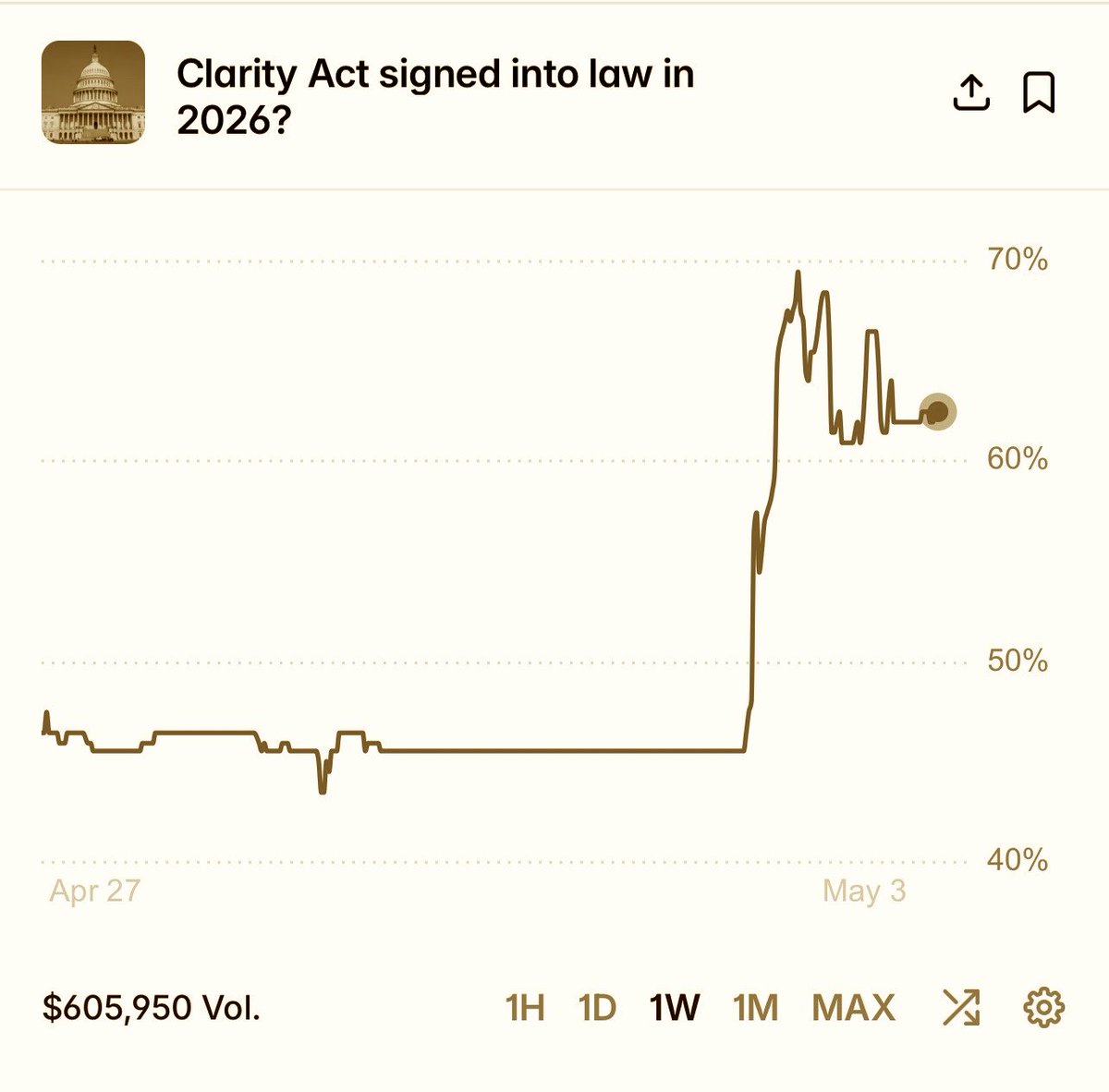
CLARITY Act getting signed into law in 2026. Ods jumped over +60% What this means for BTC & crypto: 🟢 Institutional money sitting on sidelines enters 🟢 ETF expansion accelerates 🟢 US exchanges stop self-censoring listings 🟢 DeFi protocols stop geo-blocking Americans 🟢 Stablecoin utility explodes If signed, it becomes the 2nd major crypto law in 🇺🇸 joining the #GENIUS Act. That’s not bullish. That’s structurally bullish.
Lucky tweet media
English
85
125
1.3K
124.7K
Athla
Athla@AthlaXYZ·
Huge step for the bill, but the stablecoin compromise still bans passive yield for regular holders. Activity-based is allowed, yet most normal USDC/USDT use cases get hit by the broad “equivalent to interest” test. Retail side of this fight is why independent advocacy exists. See the real impact at athla.xyz
English
0
0
1
179
Crypto Rover
Crypto Rover@cryptorover·
CLARITY ACT IS COMING 🚀 Coinbase says a deal has been reached on a key part of the U.S. crypto market bill. A major hurdle is cleared and the legislation could now move to a Senate vote.
Crypto Rover tweet mediaCrypto Rover tweet media
English
129
203
1.3K
140.5K
Athla
Athla@AthlaXYZ·
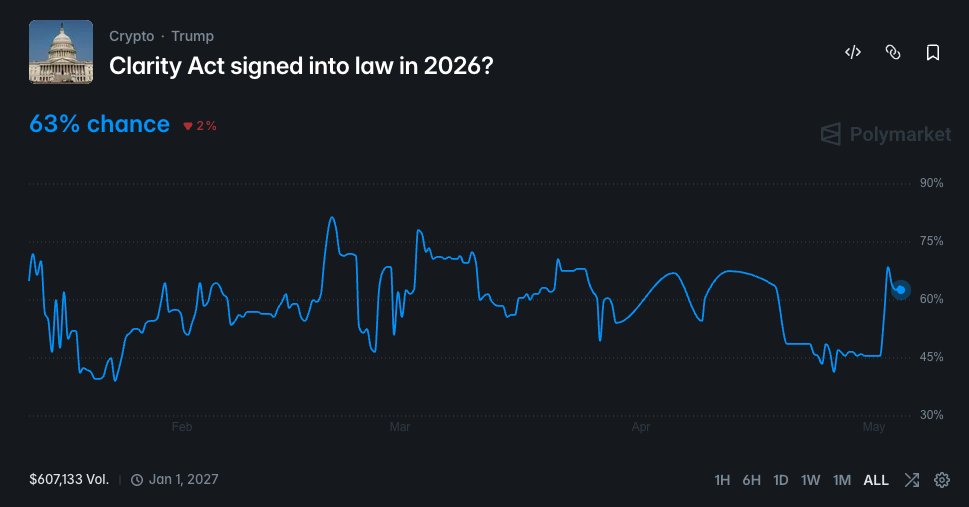
Polymarket jumping to 63% is the market pricing in passage, but retail still gets the short end with the passive yield ban. Holders who just use stablecoins as cash get zero now. That’s the part that actually hurts everyday users. Independent retail voice matters before the May 11 markup. Full breakdown at athla.xyz
English
0
0
0
322
Cointelegraph
Cointelegraph@Cointelegraph·
🇺🇸 NOW: Polymarket gives the CLARITY Act a 63% chance of being signed into law in 2026.
Cointelegraph tweet media
English
61
113
777
38.4K
Athla
Athla@AthlaXYZ·
Solid summary, but the retail impact is still huge: no more passive yield on stablecoins for regular holding. The "bona fide activity" test doesn't fix the fact that everyday users treating stablecoins like cash now get zero. This is why independent voices like Athla are pushing back before the May 11 markup → athla.xyz
English
0
0
0
5
Bull Theory
Bull Theory@BullTheoryio·
🚨 THE US SENATE JUST UNBLOCKED THE CRYPTO MARKET STRUCTURE BILL. And crypto platforms just lost the right to pay users interest on stablecoins. Senators Thom Tillis and Angela Alsobrooks finalized a bipartisan deal yesterday on stablecoin yield, the single issue that had blocked the Digital Asset Market Clarity Act for months and collapsed a Senate Banking Committee markup in January. Here is what the deal actually says. Crypto companies are now broadly prohibited from offering stablecoin rewards that are "economically or functionally equivalent to the payment of interest or yield on an interest bearing bank deposit." In plain, if a crypto platform offers users 4% just for holding a stablecoin, that is now banned. It is too close to a savings account and banks fought hard to stop it. But the deal does not ban everything. Platforms can still reward users for actually doing things trading, staking, using services. Activity based rewards are allowed. Passive yield on just holding a stablecoin is not. The negative side for crypto is clear. Platforms like Coinbase had been pushing hard to offer yield on stablecoins as a way to compete with traditional savings accounts. Banks argued that if Coinbase could offer users 4% on dollar pegged tokens just for holding them, nobody would keep money in a checking account. That deposit flight argument won. Crypto platforms lose one of the most powerful tools they had to attract and retain users. The positive side is also real. This deal removes the single biggest substantive obstacle to the Clarity Act moving forward. For the first time the US crypto industry has a credible signal that Washington is going to give digital assets a comprehensive legal framework. Every exchange, stablecoin issuer and digital asset platform operating in America has been waiting for this since the last bull market. Prediction markets are currently pricing the odds of the Clarity Act being signed into law in 2026 at 62%. Treasury Secretary Scott Bessent has described passage as a spring 2026 target. The Senate Banking Committee markup is now expected in May. Banks got what they wanted on yield. Crypto got the regulatory clarity it has been lobbying for. Neither side got everything. But the bill is moving and that alone is the biggest development the crypto industry has seen in years.
Bull Theory tweet mediaBull Theory tweet mediaBull Theory tweet media
English
152
280
1.4K
102.5K
Athla
Athla@AthlaXYZ·
The text is now public and the passive yield ban is real. Banks got exactly what they wanted on stablecoin reserves. Retail holders lose the ability to earn on capital they already put to work on-chain. Independent advocacy is needed ahead of the Senate Banking markup. See the full analysis at athla.xyz
English
0
0
1
54
Eleanor Terrett
Eleanor Terrett@EleanorTerrett·
🚨SCOOP: Hearing from industry sources that stablecoin yield compromise text is imminent and could drop as soon as today. Reaching out to @SenThomTillis and @Sen_Alsobrooks offices for comment.
Eleanor Terrett tweet media
English
132
403
2.5K
188.3K
Athla
Athla@AthlaXYZ·
The compromise is out, but let's be real with retail users: the passive yield ban still kills everyday stablecoin holders who just want to use USDC/USDT as cash. Activity rewards are allowed, but the broad "economically equivalent" language will chill most real use cases. Retail side of the fight matters before the May 11 markup. Full breakdown at athla.xyz
English
0
0
1
410
Cointelegraph
Cointelegraph@Cointelegraph·
🚨 UPDATE: The CLARITY Act moves closer to law after final stablecoin rules ban passive yield but allow activity-based rewards, lifting passage odds to 55% as lawmakers push for a May timeline despite rising bank opposition
Cointelegraph tweet media
English
127
441
2.6K
217.1K
Athla
Athla@AthlaXYZ·
Appreciate Coinbase fighting for the industry, but from the retail side this still feels like a loss. The “economically or functionally equivalent” test bans passive yield for anyone simply holding stablecoins as cash in their wallet. Everyday users who treat USDC/USDT like digital dollars now get zero. That’s exactly why independent retail advocacy matters before the May 11 markup. Full breakdown at athla.xyz
English
0
0
0
373
Faryar Shirzad 🛡️
Faryar Shirzad 🛡️@faryarshirzad·
The final rewards text in the CLARITY Act is now public. We’ve been clear throughout this process: much of this debate was based on imagined risks, not real evidence, nor was it based on a real understanding of how crypto actually works. Nevertheless, the crypto industry showed up to engage. Through months of meetings, the @WhiteHouse, @USTreasury, @BankingGOP, @SenThomTillis and @Sen_Alsobrooks finally arrived at a compromise. In the end, the banks were able to get more restrictions on rewards, but we protected what matters – the ability for Americans to earn rewards, based on real usage of crypto platforms and networks. We also ensured the US can be at the forefront of the financial system – which in this competitive geopolitical era is paramount. That’s important for innovation, consumers and America's national security. Now that this issue is behind us, it’s time to focus on the broader bill. While this debate has been underway, lots of progress has been made on other areas like token classification, defi, and tokenization. We’re excited to review the full, final text, and for the bill to move forward. It’s time to get CLARITY done.

Brendan Pedersen@BrendanPedersen

SCOOP: Sens. Tillis and Alsobrooks have finalized a compromise on stablecoin yield. Punchbowl News has the text - bans rewards that are “economically or functionally equivalent” to deposit interest - balances *can* be used for rewards if companies clear the “equivalent” test

English
172
500
2.5K
1.3M
Athla
Athla@AthlaXYZ·
Retail holders who simply want to use stablecoins as cash in a wallet get zero yield now. This isn't protecting innovation, it's protecting banks from competition. Independent retail advocacy like Athla is pushing for real clarity before the May 11 markup. The community needs to make its voice heard. More info: athla.xyz
English
0
0
0
49