
Aureus Macro
921 posts

@AureusMacro
🏛️ Institutional-grade macro intelligence 📉 Global markets | Fixed income | Asset allocation💡Bridging data and capital preservation 🏦 Clarity in complexity


🧵 1/Rates at the highest since Feb 2025. Consumer confidence just hit an all-time low. The Fed is openly discussing hikes. The S&P 500 just posted its 8th straight week of gains. Something doesn't add up. Or maybe it does.

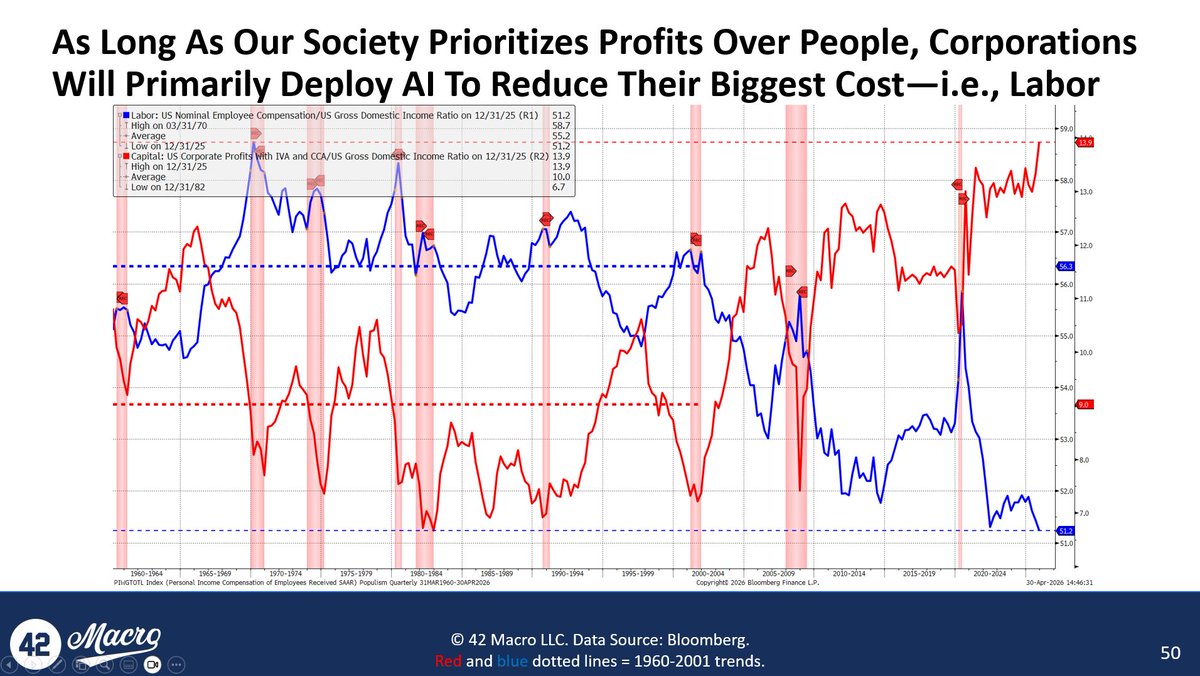
6/So when does this framework break? Not when the Fed hikes. Not when CPI stays elevated. Not when sentiment hits new lows. It breaks when AI CapEx stops generating returns that justify the cost of capital. When the capacity race becomes a capacity glut. That inflection won't be announced. Watch for it in hyperscaler CapEx guidance revisions. Data center utilization rates. Nvidia's forward order cycle. Those are the real leading indicators now. Not the Fed minutes.


🧵 1/Rates at the highest since Feb 2025. Consumer confidence just hit an all-time low. The Fed is openly discussing hikes. The S&P 500 just posted its 8th straight week of gains. Something doesn't add up. Or maybe it does.

JUST IN: 50% chance S&P 500 hits 8,000 this year

🧵 1/Rates at the highest since Feb 2025. Consumer confidence just hit an all-time low. The Fed is openly discussing hikes. The S&P 500 just posted its 8th straight week of gains. Something doesn't add up. Or maybe it does.


SpaceX chose private markets for a decade. Choosing public markets now is the signal. SpaceX has not been waiting for the right moment to go public. It has been actively choosing not to. That distinction matters more than the $2 trillion valuation or the $75 billion raise. For most of the past decade, private capital was a structurally superior financing environment for a company like SpaceX. Zero interest rates made duration assets the most sought-after product in institutional portfolios. Sovereign wealth funds, crossover funds, late-stage venture, and dedicated growth equity all competed to own long-duration narratives with asymmetric upside. SpaceX had the strongest narrative in private markets: launch monopoly, Starlink optionality, defense contracts, Starship, and Musk himself as a premium. Private investors lined up to fund all of it without requiring quarterly disclosures, GAAP scrutiny, analyst coverage, or governance concessions. Private markets also evolved to look increasingly like public ones. Tiger, Coatue, Fidelity, T. Rowe Price, and sovereign funds moved aggressively into late-stage private equity. Secondary markets deepened. Tender offers created liquidity. Valuation discovery happened continuously without a public listing. For a company running sovereign-scale capital projects over decade-long timelines, this was the ideal structure. Public markets bring quarterly earnings pressure, activist risk, and disclosure requirements that are genuinely hostile to the kind of long-duration, high-burn, extreme-capex projects that define SpaceX's core business. Starship is not a product that survives well under traditional public market frameworks. So the question is not why SpaceX stayed private. The question is why that calculus has now changed. The answer is capital density. The internet era was a software scaling story. Marginal costs were low, infrastructure burden was absorbed by cloud providers, and private capital could comfortably fund the growth cycle. SpaceX represents something structurally different: rockets, satellites, launch cadence, orbital infrastructure, and a sovereign-grade communications network. The combination of duration, scale, and capex burn has begun to exceed what private capital pools can absorb at the pace the business now requires. This is not a story about private markets running out of money. It is a story about the AI and physical infrastructure cycle being categorically heavier than the software cycle that preceded it. The same dynamic is visible across the broader market: AI-related financing is increasingly showing up as sovereign involvement, infrastructure debt, strategic capital pools, and public market issuance. Because the capital density required to build the next layer of technological infrastructure cannot be fully funded through the mechanisms that worked for the last one. Public markets are no longer just the exit venue for growth companies. They are being reactivated as an infrastructure financing layer. SpaceX going public is the clearest single data point for that thesis. When the most successful private company in history, with the strongest narrative in private markets, with a founder who has explicitly avoided public market constraints, decides that the public balance sheet is now necessary, the cycle has shifted. The S-1 could land today. Read the Starlink unit economics and the Starship capex line when the numbers are confirmed. But the filing itself, before a single number is verified, is already the macro signal.


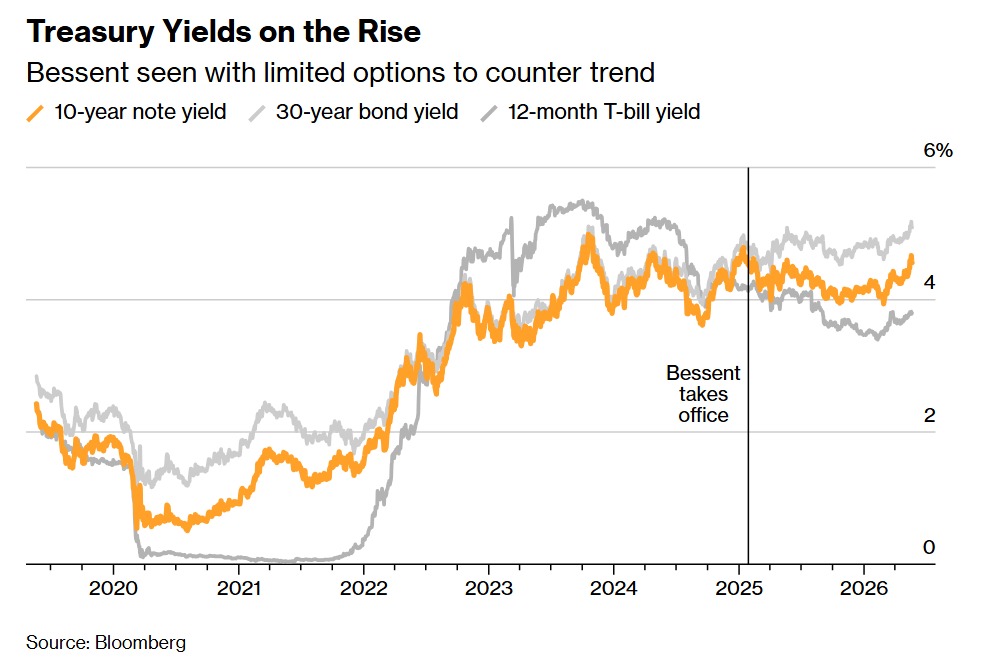
Kevin Warsh walks into the Fed on Friday believing AI is disinflationary. The bond market disagrees. Warsh spent months arguing that AI-driven productivity gains would create a significant disinflationary force, giving the Fed room to cut. The argument was elegant: technology compresses costs, raises output per worker, reduces price pressure across the economy. It is also, for now, wrong in the direction that matters. The 5-year, 5-year real rate, the market's best estimate of where the neutral rate sits over the medium term, is running roughly 2 percentage points above inflation. With the Fed funds rate at 3.6% and inflation still above that level, monetary policy remains stimulative. Warsh inherits a central bank that is, by this measure, still adding fuel while the fire is already burning. The mechanism is not complicated. Four hyperscalers alone are deploying over $700 billion in capex this year into data centers, semiconductors, and power infrastructure. That is not a productivity dividend. That is a demand shock. Capital chasing the same pool of chips, land, power contracts, and skilled labor does not compress prices. It bids them up. The second channel is chipflation. DRAM prices up 17-fold in a year. Computer software and accessories up 14% in April year-over-year. Microsoft and Meta raising product prices. The AI buildout is not deflationary at the input level. It is inflationary at every layer of the supply chain it touches, until the productivity gains from the technology it is building eventually arrive, and that timeline is measured in years, not quarters. This is the bind. Warsh's disinflationary thesis is probably correct in the long run. AI will compress costs, raise productivity, and eventually ease price pressure across the economy. But monetary policy operates on a 12 to 18 month transmission lag, and the bond market is pricing what is happening now: $700 billion in annual capex, AI-related bond issuance putting pressure on Treasuries, 30-year yields near two-decade highs, and futures traders beginning to price rate hikes by December. The neutral rate is not a fixed star. It moves with the investment cycle. And right now the investment cycle is running hotter than any period since the postwar infrastructure buildout. Warsh's first problem is not inflation expectations. It is that the technology he bet on to solve his inflation problem is, in the near term, making it worse.


Kevin Warsh walks into the Fed on Friday believing AI is disinflationary. The bond market disagrees. Warsh spent months arguing that AI-driven productivity gains would create a significant disinflationary force, giving the Fed room to cut. The argument was elegant: technology compresses costs, raises output per worker, reduces price pressure across the economy. It is also, for now, wrong in the direction that matters. The 5-year, 5-year real rate, the market's best estimate of where the neutral rate sits over the medium term, is running roughly 2 percentage points above inflation. With the Fed funds rate at 3.6% and inflation still above that level, monetary policy remains stimulative. Warsh inherits a central bank that is, by this measure, still adding fuel while the fire is already burning. The mechanism is not complicated. Four hyperscalers alone are deploying over $700 billion in capex this year into data centers, semiconductors, and power infrastructure. That is not a productivity dividend. That is a demand shock. Capital chasing the same pool of chips, land, power contracts, and skilled labor does not compress prices. It bids them up. The second channel is chipflation. DRAM prices up 17-fold in a year. Computer software and accessories up 14% in April year-over-year. Microsoft and Meta raising product prices. The AI buildout is not deflationary at the input level. It is inflationary at every layer of the supply chain it touches, until the productivity gains from the technology it is building eventually arrive, and that timeline is measured in years, not quarters. This is the bind. Warsh's disinflationary thesis is probably correct in the long run. AI will compress costs, raise productivity, and eventually ease price pressure across the economy. But monetary policy operates on a 12 to 18 month transmission lag, and the bond market is pricing what is happening now: $700 billion in annual capex, AI-related bond issuance putting pressure on Treasuries, 30-year yields near two-decade highs, and futures traders beginning to price rate hikes by December. The neutral rate is not a fixed star. It moves with the investment cycle. And right now the investment cycle is running hotter than any period since the postwar infrastructure buildout. Warsh's first problem is not inflation expectations. It is that the technology he bet on to solve his inflation problem is, in the near term, making it worse.