AusStockMan

569 posts

AusStockMan banner
AusStockMan

AusStockMan

@AusStockMan

Katılım Aralık 2024
73 Takip Edilen58 Takipçiler
AusStockMan
AusStockMan@AusStockMan·
@StockAnalystPro I totally agree with you. I hold a lot of BTBT shares. In it for the long run. One of my favourite things about @BitDigital_BTBT $BTBT and @SamirTabar’s management is the capital discipline. Clean balance sheet, prudent leverage management.
English
1
0
4
230
StockAnalystPro
StockAnalystPro@StockAnalystPro·
@AusStockMan They might get a huge chunk of money if $WYFI goes up . Yes need to add $150M converts due 2030. Still $BTBT is discounted .
English
1
0
3
363
StockAnalystPro
StockAnalystPro@StockAnalystPro·
If you missed $WYFI, then check $BTBT At ~$2.00 & $670M market cap: • BTBT’s ~27M share stake in $WYFI (@$29.99) = $811M • Plus 155,444 ETH (@$2,299) = $357M Total look-through value: ~$1.17B → ~75% above current mkt cap Trading at a big discount to its AI + ETH treasury. High-beta play. DYOR. $BTBT $WYFI #Bitcoin #AI
English
2
1
13
2K
AusStockMan retweetledi
Noel Moore
Noel Moore@noel_moore·
WhiteFiber is the smallest NeoCloud of the main four @ $1B mcap, and may have the most upside when Inference really kicks in over the next few years $WYFI . WhiteFiber has a lot of plans, most we probably don’t even know (Europe/Asia-Pacific)
Shay Boloor@StockSavvyShay

THREE LAYERS BENEFITING FROM AI COMPUTE REPRICING Compute pricing is starting to reset higher with long-term contracts being locked in at premium prices, spot markets are firming & the AI infrastructure trade is splitting into three layers: 1. Hyperscalers | $GOOGL, $MSFT, $AMZN, $META, $ORCL, $BABA These are still the largest buyers & builders of AI compute locking in multi-year capacity because spot availability is increasingly scarce. Microsoft’s $627B commercial RPO (+99% YoY), Oracle’s $553B+ RPO tied to OpenAI compute commitments, Google Cloud’s $460B backlog doubling YoY & Amazon’s $225B+ Trainium 2/3 bookings all point to the same thing that compute scarcity is getting priced into the cloud stack. 2. Neoclouds | $CRWV, $NBIS, $IREN, $WYFI This is cleanest direct expression of the compute repricing thesis because these companies rent GPU capacity at market-clearing prices to AI-native customers. CoreWeave’s $67B backlog, IREN’s $13B+ contracted backlog, Nebius ~$49B total backlog & WhiteFiber’s $923M+ RPO all point to the same thing that AI-native compute is scarce, contracted capacity is getting locked up years in advance & pricing power is moving toward whoever can bring powered clusters online fastest. 3. High-Performance Computing | $APLD, $HUT, $GLXY, $WULF, $RIOT, $CIFR, $CORZ, $MARA, $CLSK, $HIVE This bucket may be the most structurally interesting because the core asset is exactly what the AI economy needs most which is power-secured land, grid interconnects, substations, cooling infrastructure & gigawatt-scale operating experience.

English
0
2
26
1.5K
AusStockMan retweetledi
Earnest Hamilton
Earnest Hamilton@FinancialErnie·
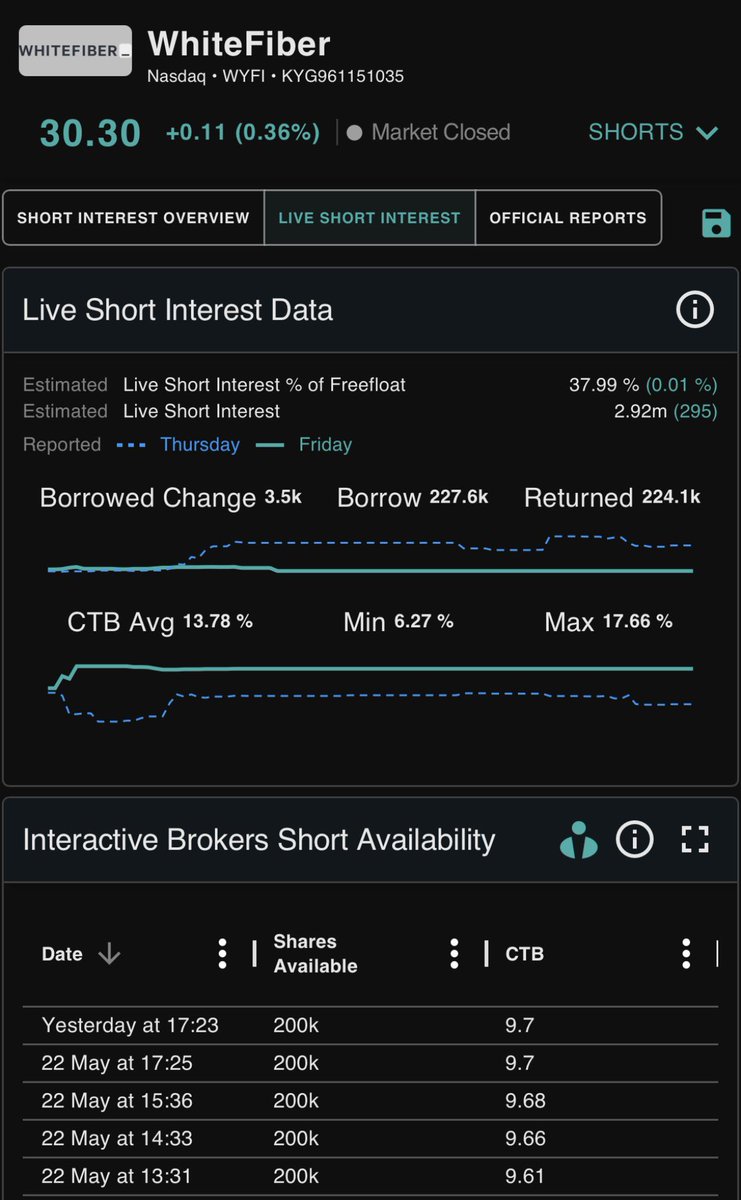
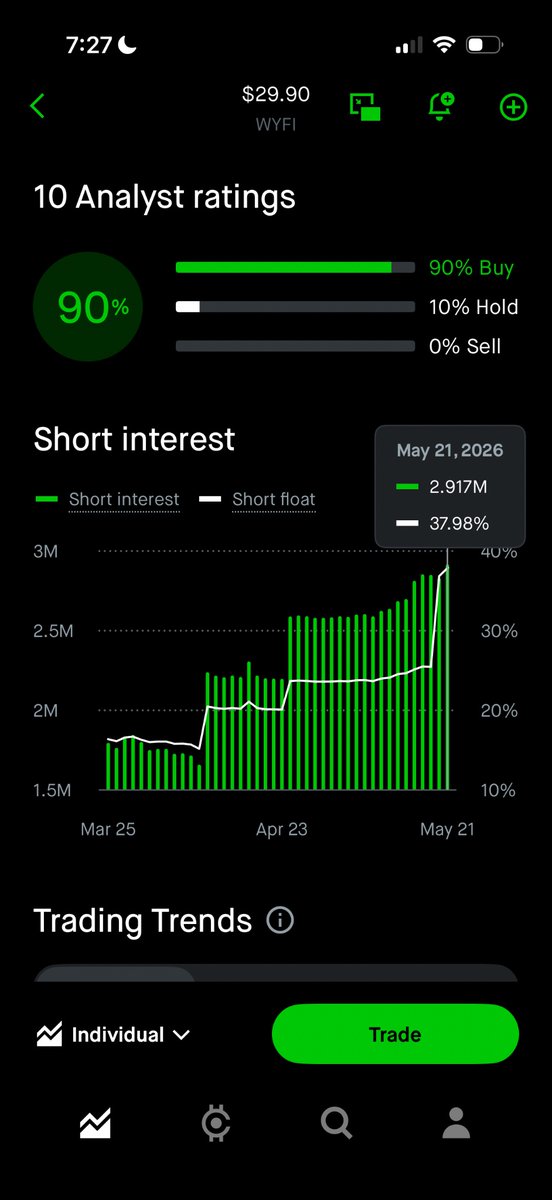
$WYFI SHORT INTEREST 🩳🔥📈 No prob @TradeG0pher 🤝 Ortex estimate as of Friday short interest is 37.99% (2.92M shares) with a small amount remaining to borrow (200K) and CTB high at 9.7% 🕰️ Latest press release was the needed catalyst for long investors 💪
Earnest Hamilton tweet media
Trade G0pher 🇺🇸 V@TradeG0pher

$wyfi short interest on the rise @FinancialErnie, when you get a chance, could you please share Ortex numbers for me, brother? tipranks.com/news/the-fly/s… $BTBT

English
2
5
16
3.9K
AusStockMan retweetledi
Ted
Ted@TedPillows·
If you like $ETH. Read this interesting new post from Vitalik. "The most high-value "product" of the ethereum blockchain, financially speaking, is ETH the asset"
vitalik.eth@VitalikButerin

Some of my perspective on where the @ethereumfndn is going. First of all, this is only my own view. The board is not just me, and I have no extra special powers on the board that the other board members do not. @aerugoettinea is the one executing much of this transition. My input has been largely on technical questions. The board is in the process of expanding, and my own power within the org will continue to decrease, which is honestly what I want. The 2025 era brought many important improvements to EF and its ability to execute. Many issues were resolved, and EF continues to benefit from its improved efficiency and greater focus on concrete goals to this day. And so with those problems resolved, early this year, the largest remaining hole that I perceived was something different nagging at me: I would regularly spot people saying things like "vitalik says these beautiful things about ethereum needing to be decentralized, and have privacy, and be a sanctuary technology, but why do the EF's actions not reflect that?" Now, you may have been hearing something different. You may not have been sensing a feeling of crisis at all, and maybe were hearing people saying that finally we were taking execution and BD seriously and the main task for us is to keep going that way and be even better and faster. Then probably there is genuine difference between you and me, in what kinds of criticism I take most seriously, and what kinds of critics through their criticism are most able to make me feel pain. As an analogy, let's briefly switch over to a different domain. One belief you can have about Google is that it is a success story, and has brought a lot of good to humanity in organizing the world's information. Another belief you can have about Google is that they had a beautiful idealistic beginning, but at some point the corruption of mainstream corporate attitudes seeped in, and they slowly bit by bit completely abandoned the "don't be evil" slogan. My belief on Google specifically is probably somewhere between the two. BUT, if you had taken me back in time to ~2008, and offered me a button to press to make Google one or two standard deviations more "dogmatic", eg. give Richard Stallman permanent veto power over some key policies, I would immediately press it. Why? Because a choice for one company is not a choice for the world, or even one country. Google existed and exists in the context of a technology industry generally drifting away from early idealistic don't-be-evil roots and toward greed for financial gain, totalizing visions of accelerated superintelligence, infiltration by sociopaths, and craven capitulation to (or worse, active participation in) government pressure for ideological control, surveillance and war. And so *one company* doing something different, positioning itself to be what George Bernard Shaw calls the Unreasonable Man, resisting the trend of the times, would have been better for freedom, balance of power and stability of society as a whole, than *all* large companies bending to dominant trends. This is a part of my version of pluralism. This line of thinking is not just mine, but I also is not too far off from what Aya and others had in mind with the Mandate. Now how does this all get to the role of the EF? EF is not a "center of Ethereum", rather EF is "one node, with a defined purpose, alongside other nodes". We've always said that the EF should be the latter, but many in the Ethereum ecosystem (and even within the EF) wanted us to be the former. Now, we are taking action to ensure that we will be the latter. This is particularly important because EF is a limited organization, with limited resources and limited organizational capacity. The EF has only ~0.16% of all ETH (less than many other individual ETH holders), whereas among other blockchains it's common for "the central foundation" to have 10-50%. Fiscally, the EF was originally designed to fulfill a limited work scope defined in the token sale docs and other pre-launch materials (building the chain software; getting through Frontier, Homestead, Metropolis, Serenity), which was fully completed in 2022; it was not designed to be an eternal steward. And so today, the EF is choosing to use its remaining resources to pursue longevity over breadth (yes, this means we sell less ETH). The EF focuses *specifically* on those activities critical to the success of ethereum as a censorship/capture-resistant, open, private and secure system, that would not happen otherwise. This means making hard choices, and in some cases even activities that we highly approve of and people that we highly respect becoming outside of the EF. People of great technical talent, public respect and even alignment with the mission and CROPS being outside of the EF is in fact necessary if we want important tasks to be able to attract outside capital. This also means the EF taking opinionated stands culturally. This is all intended in cooperation with all other parts of ethereum. We recognize that many other parts of the ethereum world highly respect CROPS and related values. But highly respecting is not the same as choosing to specialize and totally dedicate to a domain (Compare in a different domain: I think reducing animal cruelty is important, and I like vegan food, but am not full unconditional vegan myself) EF is still in a transition period, and we expect its new long-term form to stabilize over the next few months. What are the guiding principles of this new form? Again, I am only one person, but I can give my answer from a technical perspective (there are also critical non-technical aspects). At the core, *Ethereum must be impressive*. We are living in an age of highly intelligent AI and all kinds of other technological acceleration. "Status quo EVM, with a hard fork or two a year to optimize for short-term needs of users" is not interesting. To some, "impressive" means: 250ms latency and 1M TPS. I think Ethereum trying to go that route is a mistake. Being as fast and as scalable as possible, and only a small epsilon more decentralized than the others, is a route to mediocrity, and if we try it we will lose. I think Ethereum should scale. But I think Ethereum should strive the hardest to be deeply impressive in a different dimension: the CROPS dimension. This means things like: * Provably bug-free Ethereum. This is a goal that all cybersecurity researchers would have thought is absurd and impossible, up until roughly 6 months ago. Now, it's on the cusp of being possible, thanks to AI-assisted formal verification. So we should be frontrunners in doing this. * Available chain consensus. Ethereum is, and with lean consensus will cotninue to be, the ONLY chain that has both (i) traditional-BFT style properties that it's safe under asynchrony up to a high level of fault tolerance, and (ii) the bitcoin PoW-style property that under synchrony it's safe up to 49% attackers. As far as I can tell, literally no other chain has this or is planning for it; bitcoin goes for (ii) only and most other chains go for (i) only. Some will remember I fought hard for this, Unreasonably insisting that it is not OK for ethereum to rely on social consensus and hard forks to rescue ethereum from 34% of nodes going offline. It's OK for chains like hyperledger, bnb, solana, tempo, etc. It's not OK for bitcoin or ethereum or eg. zcash. * Intermediary minimization. The fact that smart contract wallets, protocols like railgun, etc have to send transactions through intermediaries to get included onchain is honestly embarrassing, and it's a constant point of fragility. Hence the work on FOCIL and EIP-8141 (and 7701 and years of work before) to make transaction sending intermediary-minimized with public mempool and strong inclusion properties, in a truly general-purpose way, that covers not just eg. secp256r1, but also privacy protocols and much more. Kohaku is pushing intermediary minimization at the user layer, pulling Ethereum away from the dystopian status quo world where our wallets don't even verify the chain, send our private data out to a dozen third-party servers, and toward a brighter CROPS future. Some of these goals are Unreasonable - maybe Ethereum would be "fine" getting only 50% of the way - what if we depend on intermediaries, but make it easy to switch? But going 50% of the way would not make Ethereum Deeply Impressive in the CROPS way. So we push for 100%. Fortunately all these goals are compatible with high TPS, this is a major focus of research (esp. on scaling the state). Well-designed L2s can also help, especially L2s optimized for specific applications (eg. high-volume trading, privacy...). These goals are even compatible with significantly lower slot times, thanks to Raul's work on erasure-coded P2P, and many other optimizations. The most high-value "product" of the ethereum blockchain, financially speaking, is ETH the asset. Ethereum secures $250 billion of ETH. The types of properties of Ethereum that I mentioned above are very good for ETH the asset. Nearly 90% of my net worth is in ETH, and most of the remainder is ~$40m of onchain fiat of which every dollar has already been allocated for some open-source biotech or software or hardware initiative. That said, there are aspects of supporting ETH the asset - *necessary* aspects even - that are outside the scope of the EF. This is where we need other heroes (some of whom hold more ETH than the EF does) to step in and help. EF has been recently thinking more about how it will relate to other such organizations, and give them needed initial support. EF will be a smaller ship than in previous years, a more opinionated one - in some cases more opinionated in ways that might be difficult to comprehend - but a longer-lasting one, and one suited to making sure that ethereum brings something meaningful to the world. We are grateful to all those inside and outside the EF who are helping to make this happen.

English
62
57
829
144.7K
AusStockMan retweetledi
McNallie Money
McNallie Money@McnallieM·
“Confident in securing ~100MW site with @cerebras as the expected offtaker” @WhiteFiber_ 🤔🤔🤔 $WYFI $CRBS
McNallie Money tweet media
English
4
2
55
5.9K
AusStockMan retweetledi
ChinoAleman
ChinoAleman@chinoalemano·
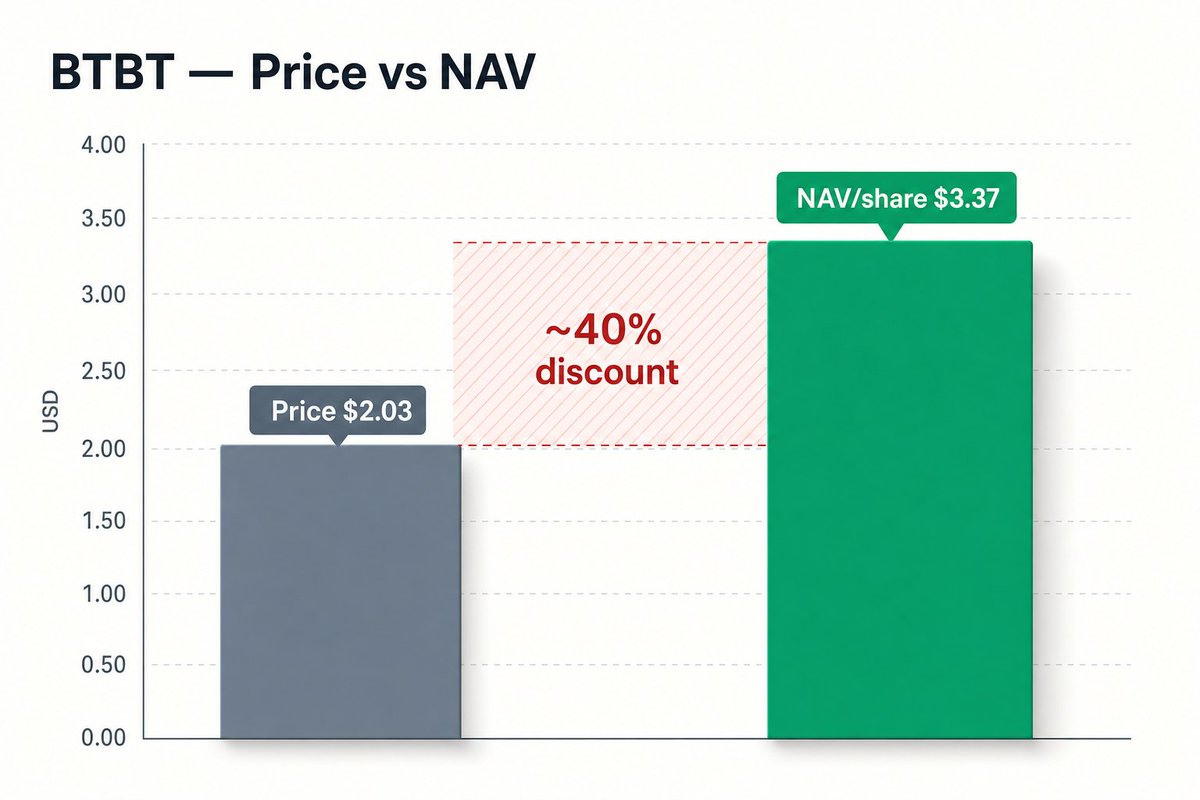
My honest DD about $BTBT. It's DIGUSTINGLY underrated. And it's justified... or it was. It depends a lot on the crypto narrative (specifically Ethereum). BTBT is trading at a ~40% discount to its own NAV*. _______ What is NAV? (Net Asset Value) NAV answers one question: if a company sold everything it owns, paid off everything it owes, and handed the rest to shareholders, how much would each share get? The formula is dead simple: NAV per share = (Assets − Liabilities) ÷ shares outstanding It's easy to determine when the company just "holds stuff", like BTBT, it's harder when the company has operations. Three steps: ➟ 1) Add up what they OWN: cash, investments, treasury holdings, stakes in other companies. ➟ 2) Subtract what they OWE: debt, loans, convertible notes. ➟ 3) Divide by the share count. The result is a rough floor for what a share is intrinsically worth, based on what's on the balance sheet rather than earnings. Companies can trade ABOVE their NAV (a premium, the market is pricing in growth) or BELOW it (a discount, skepticism, or a structural "holding discount"). This is what happens with BTBT, it trades BELOW (40%), because of the crypto stigma, the ETH stigma. _________ Bit Digital rebranded itself a "Strategic Asset Company." In plain English, it's two assets in a trench coat: ➟ 1) An Ethereum treasury (~155k ETH) ➟ 2) A ~70% stake in WhiteFiber ($WYFI), an AI/HPC data center company Add it up at current prices: ➟ ETH treasury (155k ETH at $2122): ~$324M. ➟ WhiteFiber stake (27.04M WYFI shares × ~$30): ~$816M. ➟ Cash: ~$79.5M ────────────── = ~$1.25B gross assets Minus $150M of parent-level convertible debt (4%, due 2030): = ~$1.10B net assets Divide by 326.6M shares: = ~$3.37 NAV per share $BTBT trades around $2.03. That's a ~40% discount to NAV, and the gap just widened because WhiteFiber re-rated hard, popping ~22% on a new $160M, 5-year AI infrastructure deal in Paris. The crypto sleeve gets all the attention, but the WhiteFiber stake is now the biggest piece of the pie. A few caveats so nobody @'s me: ➟ This NAV marks WhiteFiber at today's market price, right after WYFI ripped ~22%. That mark is volatile and may not be realizable, it's a ~70% control stake, not cash. On a GAAP* book basis, equity is closer to ~$2/share, basically where the stock trades. The 40% "discount" only exists if you accept the full mark-to-market sum-of-the-parts. (When they did the GAAP accounting for WYFI, that was back when the stock was at $12.) ➟ NAV measures assets, not cash flow. The operating business is loss-making (Q1 revenue ~$28M, big mark-to-market net loss, negative EBITDA). On a DCF/earnings lens, some models actually flag BTBT as overvalued. "Cheap vs. balance sheet" and "expensive vs. cash flows" can both be true. ➟ Dilution is the silent NAV killer. This is a treasury model that funds ETH buys by issuing stock (86M+ shares in mid-2025 alone, ~7%/yr expected). NAV-per-share is a moving target to the downside every time they raise. ➟ The holdco discount can persist for years. Nothing forces it to close without a catalyst (a WYFI spin-off/distribution), and none is confirmed. ➟ This is a leveraged bet on two volatile things at once: ETH spot and WhiteFiber's mark. If either rolls over, NAV compresses fast. ___ GAAP (Generally Accepted Accounting Principles) is the standardized set of accounting rules U.S. companies must follow when reporting their financials. It dictates how assets, liabilities, revenue, and earnings get recorded, so that numbers are consistent and comparable across companies. GAAP doesn't always value assets at today's market price. Some holdings are carried at cost or via consolidation rules instead of current market value, which is why a company's "book value" under GAAP can differ a lot from a mark-to-market estimate of what its assets are actually worth right now. ____ The bull case (same arithmetic, other direction): ➟ This is leverage to ETH and WhiteFiber, and that cuts both ways. Run the same NAV math on a bull scenario: ➟➟ ETH at $4,000 (155k ETH): ~$620M ➟➟ WhiteFiber at $40 (27.04M shares): ~$1.08B ➟➟ Cash: ~$79.5M = ~$1.78B gross − $150M debt = ~$1.63B ÷ 326.6M shares = ~$5.00 NAV per share. ➟ From ~$2.03 today, that's ~2.5x just to reach NAV, before any narrowing of the holdco discount. If the discount also compresses (say 40% → 15%), the stock re-rates twice: once on the assets, once on the multiple. That's the double-barrel setup these vehicles offer. ➟ At $5 the converts are deep in the money, so they convert, the $150M debt vanishes, and that dilution is already baked into the ~$4.9 fully diluted NAV. No surprise overhang on the way up. ➟ The staking sleeve quietly compounds ETH-per-share (~3% on a 155k stack), so the ETH count grows without new raises. ➟ WhiteFiber isn't a frozen mark, it's a contracted backlog: the 10-yr ~$865M Nscale deal plus the new $160M Paris contract. If that revenue ramps, WYFI re-rates on its own and drags BTBT's NAV up with it. The bear case is dilution + cash burn + a mark that can melt. The bull case is you're buying ~$3.37 (as 23 May 2026) of assets for ~$2.03, with embedded leverage to an ETH recovery and an AI-infra story that's just starting to get paid. Wide swing both ways. If you're bullish WYFI and ETH, this will compound. (Hypothetical price levels, not forecasts. Still not financial advice. 🧠) ___ As a fun aside, take DXYZ as an example, it trades way above its NAV, meaning at a premium: x.com/chinoalemano/s…
ChinoAleman tweet media
English
7
5
42
2.2K
AusStockMan retweetledi
Rosanna Prestia, MBA
Rosanna Prestia, MBA@RosannaInvests·
$WYFI - The AI compute hosting catalyst that just hit. Price: $29.55 (+22.16% May 21) Market cap: $1.14B Q1 2026 revenue: $21.9M (+78.84% YoY) 9 analysts, Strong Buy consensus Avg PT: $33.44 | Compass Point PT: $50 (NEW high) A thread on what just happened and why it matters.
Rosanna Prestia, MBA tweet media
English
4
7
31
3.8K
AusStockMan retweetledi
TomOnTech
TomOnTech@TomOnTech·
$BTBT IDEA I’ve been looking at $BTBT and the setup is pretty interesting. The simple idea: $BTBT may be a cheaper way to get exposure to $WYFI. BTBT owns about 27M shares of WhiteFiber ($WYFI). At today’s WYFI price, that stake is worth roughly $800M+. But BTBT’s entire market cap is only around $650M–$700M. So in a weird way, the market is valuing BTBT for less than the value of the WYFI shares it owns. And that doesn’t even fully account for BTBT’s other pieces: • ETH treasury • ETH staking income • cash on the balance sheet • AI/HPC infrastructure exposure through WhiteFiber • any future crypto/AI infrastructure upside Rough math says BTBT’s gross asset value is somewhere around $3.40–$3.50 per share. Even if you haircut that for debt, structure, and holding-company discount, it still looks above where the stock trades today. BTBT stock is around $2/share. That’s what makes this interesting. You can buy WYFI directly… or you can potentially buy BTBT and get discounted WYFI exposure, plus ETH upside and other optionality. The bull case is pretty simple: If WYFI keeps winning AI/HPC data center business, BTBT benefits. If ETH moves higher, BTBT benefits. If the market starts valuing BTBT closer to its underlying assets, BTBT benefits. And if AI infrastructure and ETH both heat up at the same time, this could become a much more interesting re-rating story. Obviously not risk-free. Holding-company discounts can stick around. Debt matters. Dilution matters. Execution matters. Crypto volatility matters. But the setup is worth watching: $BTBT = discounted $WYFI exposure + ETH treasury + AI infrastructure optionality. *BEST TIMING FOR BUY IS CLOSEST TO AN ETH/CRYPTO BOTTOM
English
1
4
12
1K
AusStockMan retweetledi
Hardik Shah
Hardik Shah@AIStockSavvy·
$WYFI | 𝐂𝐨𝐦𝐩𝐚𝐬𝐬 𝐏𝐨𝐢𝐧𝐭 maintains 𝐁𝐮𝐲 on 𝐖𝐡𝐢𝐭𝐞𝐅𝐢𝐛𝐞𝐫, 𝐫𝐚𝐢𝐬𝐞𝐬 𝐏𝐓 𝐭𝐨 $𝟓𝟎 from $32 Analyst sees the new cloud deal adding a capital-light revenue bridge that complements existing colocation revenue and builds momentum for future growth with improved project visibility.
Hardik Shah tweet media
English
3
5
39
15.2K
AusStockMan retweetledi
The Future is Now 🕸️ Signal & Scale
$WYFI now has contracted deals roughly comparable to its current market cap ($1.13B). If they get the same premium as NBIS / CRWV, the stock would be double. It's a $50 stock with 35% short interest. My top 5 (ranked): 1. $IREN, 2. $WYFI, 3. $CLSK, 4. $BTDR, & 5. $KEEL
The Future is Now 🕸️ Signal & Scale tweet media
WhiteFiber_ NASDAQ: WYFI@WhiteFiber_

📣 WhiteFiber Signs AI Compute Agreement with Total Contract Value in Excess of $160 Million with Investment-Grade Technology Customer 👇 whitefiber.com/news?id=37

English
4
5
22
2.5K
AusStockMan retweetledi
WhiteFiber_ NASDAQ: WYFI
WhiteFiber_ NASDAQ: WYFI@WhiteFiber_·
📣 WhiteFiber Signs AI Compute Agreement with Total Contract Value in Excess of $160 Million with Investment-Grade Technology Customer 👇 whitefiber.com/news?id=37
English
16
29
154
50.5K
AusStockMan retweetledi
Bash
Bash@Bashachino·
Whitefiber Inc ($WYFI): Q1 2026 Colocation Services - $4.8m up 190% YoY from $1.6m in Q1 2025 - Increase due to commencement of 5MW delivery for Cerebras ($CBRS) - NC-1 to have partial capacity delivered in Q2, and full in Q3 Rev est. - Q2 2026: $12m - Q3 2026: $26.5m
English
5
6
20
2.4K
AusStockMan retweetledi
Sam Tabar
Sam Tabar@SamirTabar·
Great panel today at @AIM_Summit I discussed how some talk of ‘gigawatts coming online’ But let’s apply filters: • Owned vs optioned • Interconnected vs queued • Contracted vs theoretical power Market will separate operators from option-holders and re-price aggressively
Sam Tabar tweet media
London, England 🇬🇧 English
4
2
69
9.5K
AusStockMan
AusStockMan@AusStockMan·
@TrendGPS What’s Euronext about? First hearing about it
English
1
0
1
71
TrendGPS
TrendGPS@TrendGPS·
Yes... if ETH rips and altseason kicks in hard, $BTBT is positioned for massive upside, easily 10-30x type moves from here. Back in the 2021 bull run, it went from a low around $4.23 to a peak of $29.27, that’s over 6x (nearly 600%) in a single year on the crypto wave. Now it’s sitting with a huge staked ETH treasury (one of the biggest among public companies), the AI/HPC pivot already underway, Europe expansion via the Euronext listing, and the same leveraged crypto exposure. THERE'S WAY MORE MONEY WAITING TO FLOW INTO THE STOCK MARKET IN 2026 THAN IN 2021. STILL SUPER EARLY.
BLADE@BladeDefi

🚨ETHEREUM IS ABOUT TO BREAK THE CYCLE Look at every major Ethereum phase: downtrend -> compression -> breakout -> expansion This structure repeats every cycle In 2017 we saw the breakout that led into a full parabolic move In 2020 the exact same structure printed again, followed by a massive expansion Now look at 2026 We’ve just printed a fake breakdown, followed by a reclaim, and price is starting to form a higher low Exactly the kind of sequence that kicked off previous rallies Right now sentiment says ETH is weak, but the structure is telling a completely different story If this continues to play out the same way, the next phase will turn into a vertical expansion I've been watching the markets for 10+ years Turn on notifs and subscribe – I'll keep you updated

English
2
4
24
2.9K
Sam Tabar
Sam Tabar@SamirTabar·
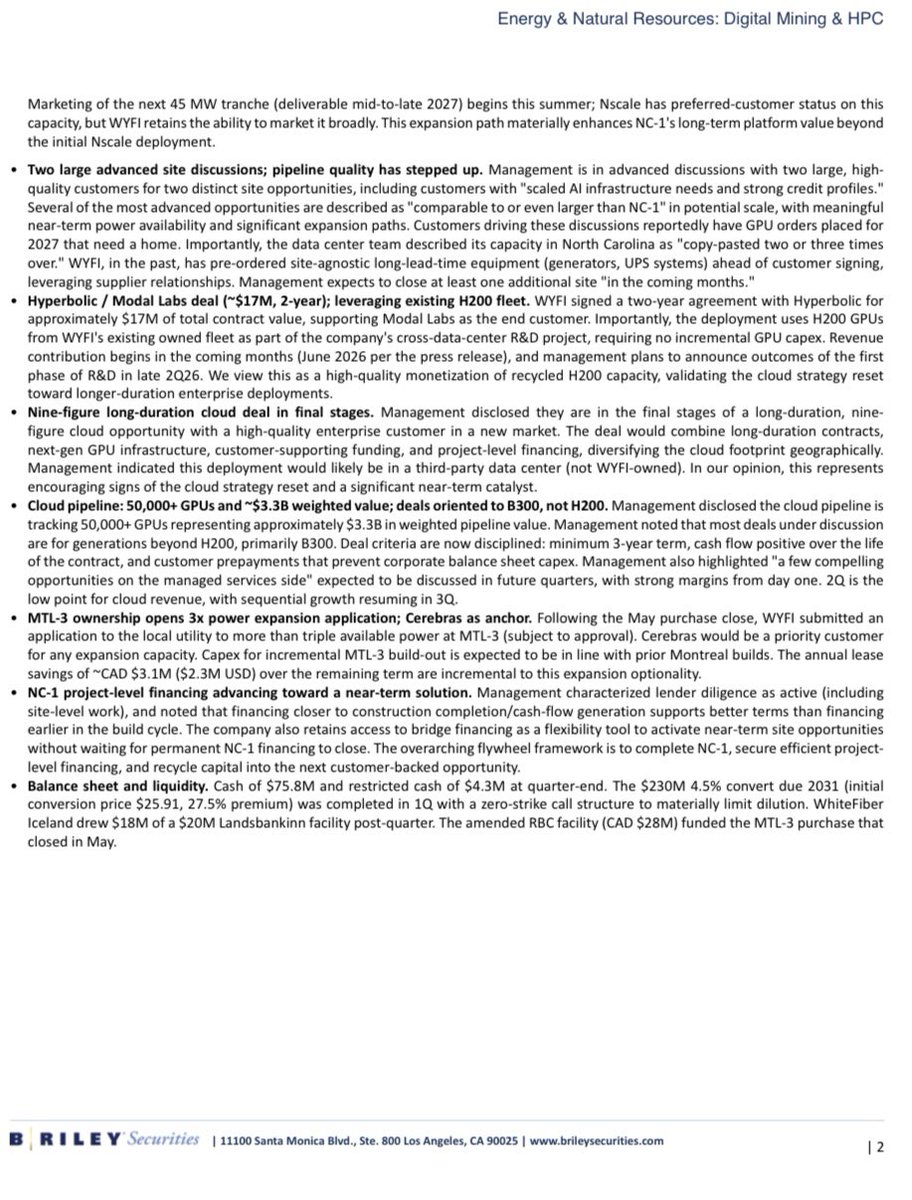
Good summary on page 2 of BRiley report on WYFI published minutes ago
Sam Tabar tweet media
English
15
15
101
14.2K