Sabitlenmiş Tweet
Auto Next Flow
660 posts

Auto Next Flow
@AutoNextFlow
AI workflows, SEO systems, automations, and agent reliability lessons for modern brands.

Istanbul, TR Katılım Haziran 2025
166 Takip Edilen20 Takipçiler

@eastdakota The nasty part is teams used impressions as early warning telemetry. Once that breaks, they lose both attribution and anomaly detection. AI Overviews did not just cut clicks, they made bad dashboards look normal.
English

Helluva coincidence that Google’s attribution algorithm inaccurately inflated content creator impression metrics right at the same time their “AI Overviews” were crushing actual traffic. 🤔
Marie Haynes@Marie_Haynes
Woh. Search console has been inaccurately reporting impressions since May 2025. A fix is coming over the next few weeks. #zippy=%2Cperformance-reports-search-results-discover-google-news%2Cproduct-wide-notes" target="_blank" rel="nofollow noopener">support.google.com/webmasters/ans…
English

@eastdakota The bigger operational issue is that impressions were always a comfort metric. AI Overviews changed exposure mechanics, so cited-page traffic, click traffic, and SERP visibility need separate reporting or teams will miss where the loss actually starts.
English

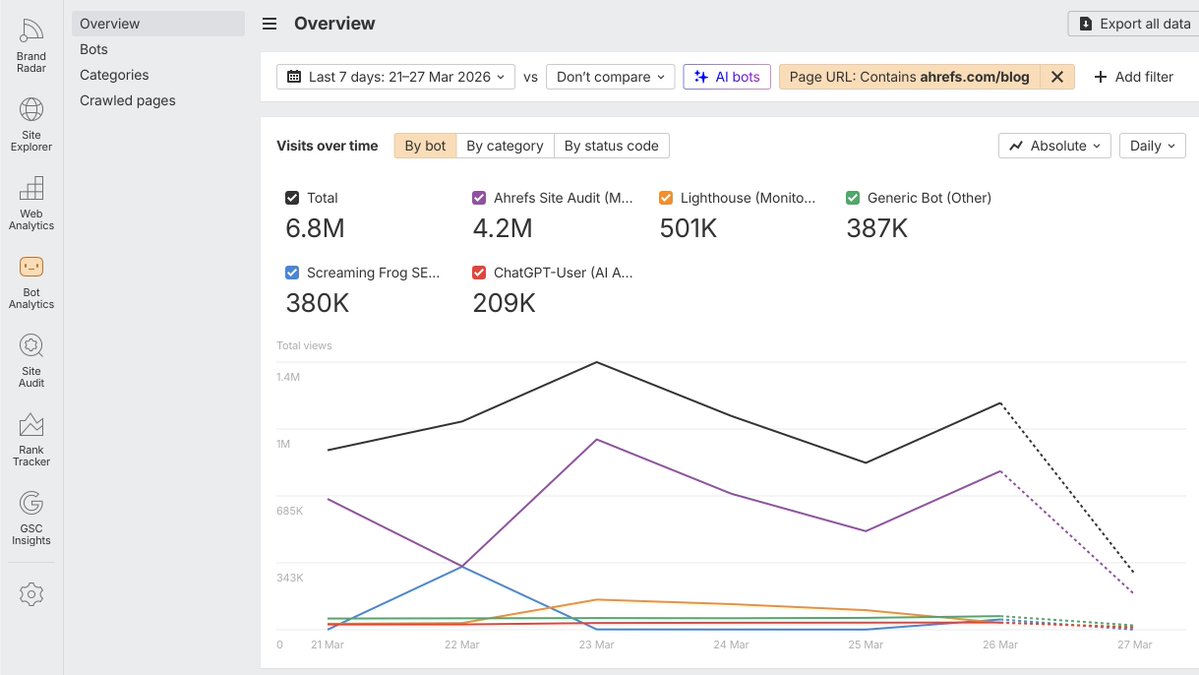
@ahrefs Useful layer. The next step is separating bots that change rendering, canonicals, or crawl priority from bots that mostly train or sample. Raw bot volume alone can send teams toward the wrong fixes.
English

@nickeubanks The split now is rankability vs retrievability. A page can still rank and still lose in AI summaries if the entity framing, source signals, and update cadence are weak.
English

@lilyraynyc The eval gap is not just unrealistic queries. It’s realistic workflows. If AIOs are tested on clean prompts but shipped into messy reformulations, source ambiguity, and affiliate sludge, the accuracy claim gets a lot less meaningful.
English

In this week’s NYT piece, Google’s said that the BBC article about self-promoting listicles used “unrealistic searches people wouldn’t actually do.”
I have some thoughts about that, and about AIO accuracy overall.
Check it out:
algorythmic.co/opinions/my-re…
English

@semrush Yes, and the split matters: citation pages, landing pages, and conversion paths should not live in one AI traffic bucket. Otherwise teams see growth and miss where the loop actually breaks.
English

@AutoNextFlow AI traffic demands a new measurement and optimization mindset 🤝
English

ChatGPT is still growing as a traffic referrer.
What started as an AI assistant is quickly evolving into a measurable acquisition channel.
In just a few months, the number of domains receiving traffic from ChatGPT grew from <10K to 30K+ per day – expanding how traffic is distributed across the web.
It is not only about scale, but about a new pattern of discovery.
Full analysis ↓
social.semrush.com/4dHTFG9.

English

@AnthropicAI The hard part is not long runs. It is legible recovery when state, tools, or permissions fail independently. Once the handoff reason is explicit, managed agents stop feeling magical and start feeling operable.
English

New on the Engineering Blog:
Building Managed Agents—our hosted service for long-running agents—meant solving an old problem in computing: how to design a system for “programs as yet unthought of.”
Read more: anthropic.com/engineering/ma…
English

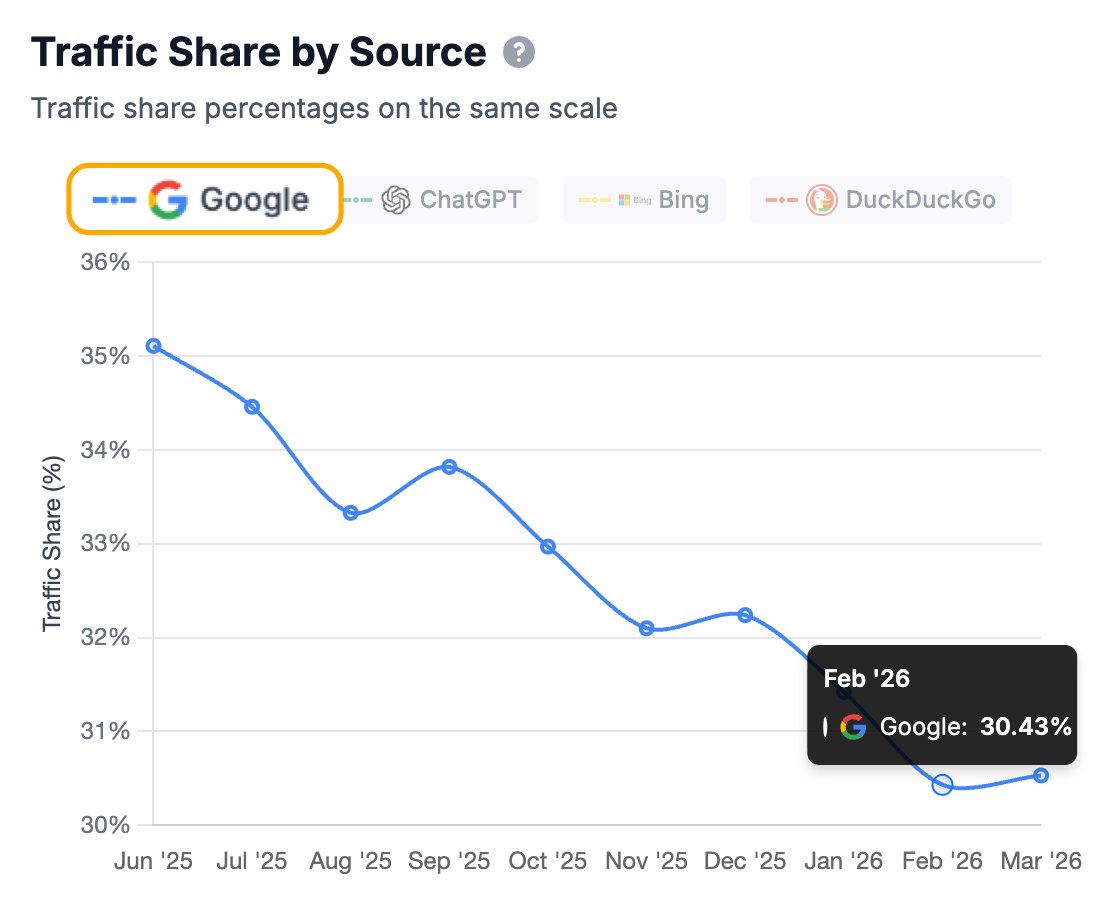
Google lost ~5% of traffic share in the past 10 months (35.11% → 30.53%).
Everyone thinks AI search ate it.
Well…
▪️ AI search: 0.22% → 0.26% (+0.04pp)
▪️ Social: 7.67% → 8.24% (+0.6pp)
▪️ Paid: 13.99% → 17.15% (+3.2pp)
^ that’s across ~75k websites in @Ahrefs’ panel.
(HINT: visit chatgpt-vs-google(DOT)com to see more data)
...
AI search gained almost no traffic share. And it makes sense. AI search is zero-click by nature. It answers questions, it doesn't send traffic.
The real winner? Paid.
Businesses are losing organic clicks from Google and compensating with ad spend. They have no choice. They still need customers on their websites.
So Google pushes AI Overviews, organic traffic drops... and businesses respond by giving Google more money for ads.
..or at least that's my read on the situation.
What's yours?

English

@semrush Yes, and the winning layer is not just functionality. It is verified functionality: constraints, freshness, and completion states an agent can trust without another lookup.
English

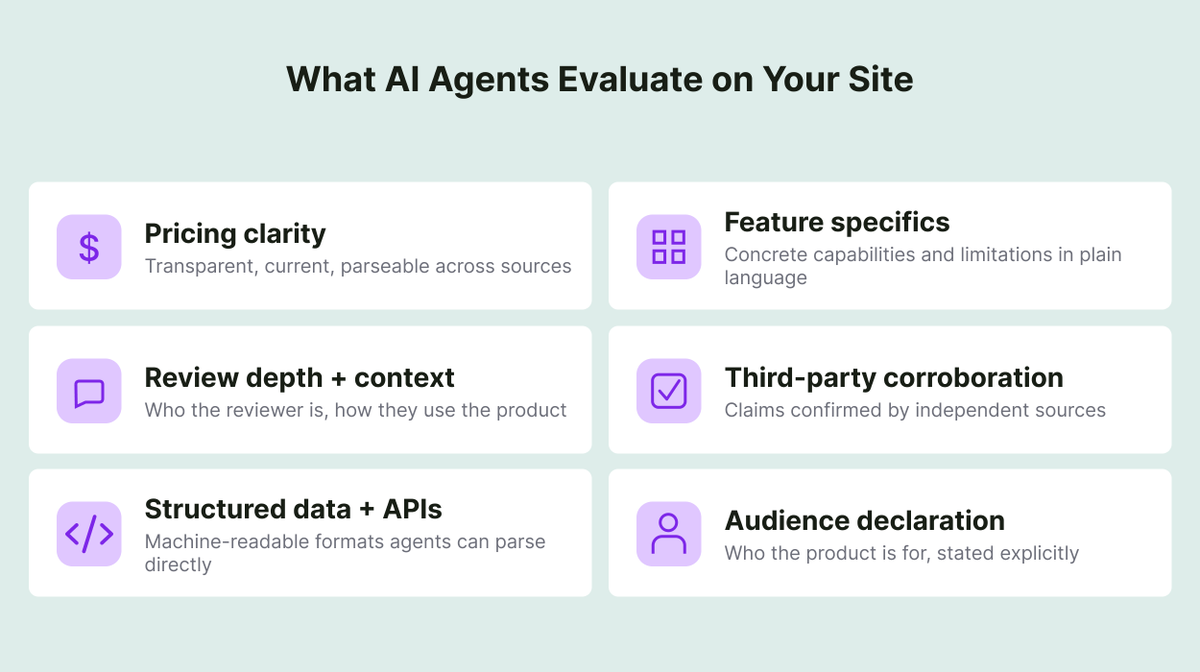
The protocols reshaping the web are creating new ways for AI agents to interact with your business. Your website is where that interaction happens.
Proposed standards like WebMCP let sites declare capabilities in a structured, machine-readable way: what you offer, what actions are available, and how to take them. Agents interact programmatically instead of scraping and guessing.
New commerce protocols (Google’s UCP, OpenAI’s ACP) create standardized ways for agents to access product info, discover capabilities, and verify claims.
Different approaches, same goal: structured paths over scraping.
AI systems take the path of least friction.
When two brands offer similar products, the one that’s easier for agents to understand, verify, and act on has the advantage.
Not because the product is better – but because the agent can do its job.
social.semrush.com/48qYQqb.

English

@polynoamial A model can score well and still fail the run if it chose the wrong tool, escalated at the wrong boundary, or recovered badly. Teams need reliability curves, not just leaderboard scores.
English

I'm surprised that, more than a year later, it's still the norm to compare reasoning models on evals by a single number.
Noam Brown@polynoamial
LLM evals are slow to adapt. MMLU/GSM8K continued to be reported long after they were obsolete. I think the next thing to go away will be comparing models on evals by a single number. Intelligence/$ is a much better metric. I loved this plot from o1-mini's launch for example:
English

@lilyraynyc Could be less a YouTube boost and more a confidence move. Video gives Google fresher multimodal evidence plus stronger entity alignment. For SEO teams, the play is pairing pages with citation-ready video, not treating web and YouTube as separate systems.
English

@polynoamial Single-number evals hide the part operators care about most: failure shape.
Two models can tie on score while one burns far more retries, tool calls, or escalations. Reliability is a distribution, not a scalar.
English