Brad Lyons

2.4K posts

Brad Lyons banner
Brad Lyons

Brad Lyons

@blyons151

Founder & CEO of Crossover Research

New York City Katılım Eylül 2021
308 Takip Edilen9.6K Takipçiler
Sabitlenmiş Tweet
Brad Lyons
Brad Lyons@blyons151·
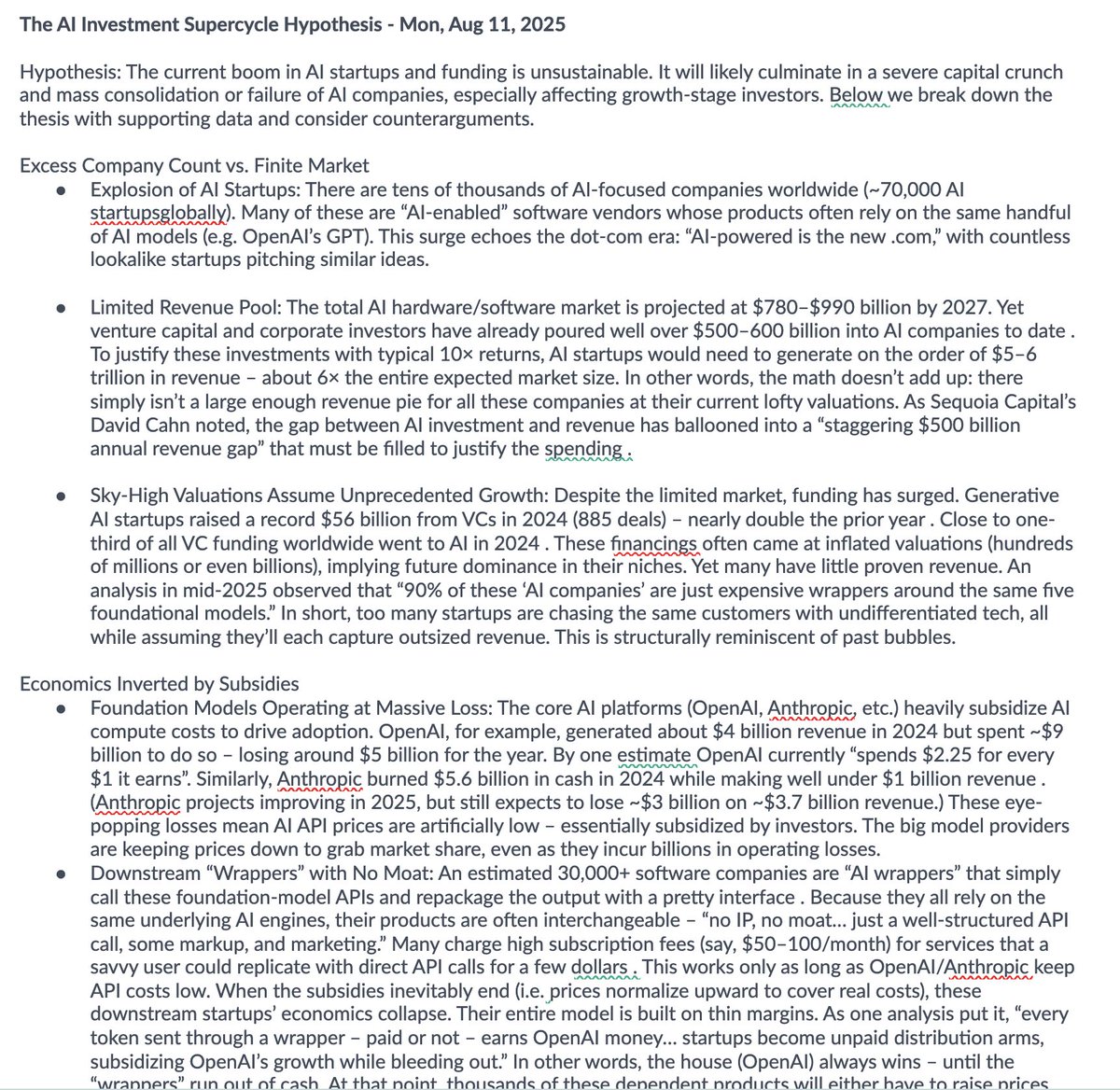
Including the full August 2025 tweet that I never posted below. TLDR: I argued that the AI boom was structurally unsustainable: too much capital, too many undifferentiated “wrappers,” and foundation models burning billions to subsidize usage. Since then, the bubble has inflated even further - AI firms pulled in the majority of global VC in 2025, while leaders like OpenAI blew past a $10–12B revenue run-rate and still lost staggering amounts of money. Yet instead of a disciplined reset, investors have largely doubled down: late‑stage checks are still flowing into capital‑intensive platforms, mediocre app‑layer companies are limping through down‑rounds, and only a thin slice of obviously broken wrappers is being culled. The early shakeout is real, but the capital allocation remains sloppy - far more driven by FOMO around a few brand‑name winners than by rigorous views on unit economics or durable moats. The AI Investment Supercycle Hypothesis - Mon, Aug 11, 2025 Hypothesis: The current boom in AI startups and funding is unsustainable. It will likely culminate in a severe capital crunch and mass consolidation or failure of AI companies, especially affecting growth-stage investors. Below we break down the thesis with supporting data and consider counterarguments. Excess Company Count vs. Finite Market Explosion of AI Startups: There are tens of thousands of AI-focused companies worldwide (~70,000 AI startups globally). Many of these are “AI-enabled” software vendors whose products often rely on the same handful of AI models (e.g. OpenAI’s GPT). This surge echoes the dot-com era: “AI-powered is the new .com,” with countless lookalike startups pitching similar ideas. Limited Revenue Pool: The total AI hardware/software market is projected at $780–$990 billion by 2027. Yet venture capital and corporate investors have already poured well over $500–600 billion into AI companies to date . To justify these investments with typical 10× returns, AI startups would need to generate on the order of $5–6 trillion in revenue – about 6× the entire expected market size. In other words, the math doesn’t add up: there simply isn’t a large enough revenue pie for all these companies at their current lofty valuations. As Sequoia Capital’s David Cahn noted, the gap between AI investment and revenue has ballooned into a “staggering $500 billion annual revenue gap” that must be filled to justify the spending . Sky-High Valuations Assume Unprecedented Growth: Despite the limited market, funding has surged. Generative AI startups raised a record $56 billion from VCs in 2024 (885 deals) – nearly double the prior year . Close to one-third of all VC funding worldwide went to AI in 2024 . These financings often came at inflated valuations (hundreds of millions or even billions), implying future dominance in their niches. Yet many have little proven revenue. An analysis in mid-2025 observed that “90% of these ‘AI companies’ are just expensive wrappers around the same five foundational models.” In short, too many startups are chasing the same customers with undifferentiated tech, all while assuming they’ll each capture outsized revenue. This is structurally reminiscent of past bubbles. Economics Inverted by Subsidies Foundation Models Operating at Massive Loss: The core AI platforms (OpenAI, Anthropic, etc.) heavily subsidize AI compute costs to drive adoption. OpenAI, for example, generated about $4 billion revenue in 2024 but spent ~$9 billion to do so – losing around $5 billion for the year. By one estimate OpenAI currently “spends $2.25 for every $1 it earns”. Similarly, Anthropic burned $5.6 billion in cash in 2024 while making well under $1 billion revenue . (Anthropic projects improving in 2025, but still expects to lose ~$3 billion on ~$3.7 billion revenue.) These eye-popping losses mean AI API prices are artificially low – essentially subsidized by investors. The big model providers are keeping prices down to grab market share, even as they incur billions in operating losses. Downstream “Wrappers” with No Moat: An estimated 30,000+ software companies are “AI wrappers” that simply call these foundation-model APIs and repackage the output with a pretty interface . Because they all rely on the same underlying AI engines, their products are often interchangeable – “no IP, no moat… just a well-structured API call, some markup, and marketing.” Many charge high subscription fees (say, $50–100/month) for services that a savvy user could replicate with direct API calls for a few dollars . This works only as long as OpenAI/Anthropic keep API costs low. When the subsidies inevitably end (i.e. prices normalize upward to cover real costs), these downstream startups’ economics collapse. Their entire model is built on thin margins. As one analysis put it, “every token sent through a wrapper – paid or not – earns OpenAI money… startups become unpaid distribution arms, subsidizing OpenAI’s growth while bleeding out.” In other words, the house (OpenAI) always wins – until the “wrappers” run out of cash. At that point, thousands of these dependent products will either have to raise prices (driving away customers) or shut down. The Commoditization Spiral: The combination of ubiquitous tech and underpriced service creates a vicious circle for most AI vendors: (1) If everyone uses the same few AI models, products become undifferentiated. (2) Competing on features is hard, so pricing wars ensue – indeed, OpenAI’s latest GPT-4 price cuts undercut Anthropic by up to 7× on cost per token, forcing others to match or lose business. (3) As prices per customer plummet, so do gross margins for any startup reselling AI. (4) Lower revenues make it impossible to support the previous valuations or to cover the still-high infrastructure costs (AI compute remains expensive, and energy/compute costs are not falling as fast as pricing). (5) With unit economics turned upside-down (more users actually increase losses), these companies cannot sustain operations without continual investor subsidies. This “race to the bottom” on price is great for end-users in the short term, but it’s lethal for the thousands of me-too vendors. It’s analogous to the dot-com era of free services: eventually the money runs out. Growth-Stage Capital at Extreme Risk Late-Stage Funding Frenzy: Unlike early-stage VCs who place many small bets, growth equity investors have been writing big checks (often $25–100 million each) into mid-stage AI companies at $400 million+ valuations. These rounds (Series B, C, D etc.) were justified by lofty growth assumptions and the fear of missing the “next big thing.” However, many of these startups have 8–12 month runways due to high burn rates (expensive ML talent and cloud bills) – meaning they will need another funding round by 2024–2025. For example, in 2023–24 numerous generative AI startups raised funds at unicorn valuations despite minimal revenue, and immediately ramped spending on AI infrastructure. “Most companies funded during the 2021–2023 boom had 18–36 months of capital,” and many will run dry by late 2025 or early 2026 if they can’t refinance . The growth investors who led these big rounds will be left holding the bag if valuations reset. High Failure Rates = High Write-Downs: Early-stage venture firms expect e.g. 6 or 7 out of 10 startups to fail – their model tolerates it. Growth equity, in contrast, bets on a much lower loss rate (maybe 1 or 2 failures out of 10) because they deploy larger sums per deal. The current AI cycle is likely to betray those expectations. Industry observers predict over 90% of AI startups will fail within five years. Even before the recent frenzy, tech market indices showed sharp private valuation declines in 2022–23 , and many AI firms that raised in 2024 have since missed milestones. If 80–90% of funded AI companies ultimately go under, growth-stage funds with heavy AI exposure could see well over half their portfolio by value written off. In effect, billions in late-stage capital could evaporate. Estimates of the “dead money” vary, but even a conservative scenario of 60–70% startup failure would wipe out ~$400 billion (out of ~$600B invested), and a more realistic 80–90% failure rate implies $500B+ lost. Indeed, PitchBook data show fundraising for AI has already dropped in 2024 (deal count down 42%) as reality sets in . Growth investors are slamming on the brakes, but it may be too late – the capital is already in these companies, and many are running on fumes. Compression of Exit Options: Another challenge for growth equity: who will buy or IPO these companies to provide an exit? The IPO window for tech is cautious in 2025, and the few public listings (e.g. Cloud, enterprise AI) have not delivered the kind of multiples needed. M&A is an option – and indeed we may see rapid consolidation in 2025–2027, with stronger players acquiring distressed startups for pennies on the dollar. But most acquirers will wait until valuations crumble. Funds that put $50M into a “next-generation AI SaaS” at a $500M valuation may recoup only a fraction in a fire sale. The timeline looks grim: 2025 will likely still see some aggressive fundraising and peak company counts, but by mid-2026 signs of saturation (slowing growth, rising customer-acquisition costs) will be undeniable. By 2027, as startups exhaust their last cash, we could witness a mass shutdown wave – potentially thousands of AI companies closing within 12–18 months . Growth equity portfolios will be forced to mark down failing investments (60–90% losses in the worst cases). As one industry veteran wryly noted, “Funds with 40% of their book in AI might experience a 80% write-down in that slice – it’ll be historic.” Timeline: From Bubble to Shakeout 2021–2023 – Build-Up: Breakthroughs in generative AI (GPT-3, DALL-E, etc.) trigger a flood of startup creation and funding. Valuations skyrocket on hype. Investors cite “AI is the new electricity,” and fear of missing out leads to overfunding of very early-stage projects . Many companies launch with little more than a demo or a fine-tuned model wrapper. 2024 – Peak Froth: Funding reaches record levels (as noted, $56B VC dollars into genAI in 2024 ). By late 2024 and early 2025, AI headlines dominate tech. But underneath, cracks appear: infrastructure bottlenecks (GPUs), first reports of AI startups with negligible traction, and Big Tech (OpenAI, Microsoft, Google) racing ahead of the pack. The largest AI firms themselves remain unprofitable despite fast-growing revenue – e.g. OpenAI doubled its ARR from $6B to $12B in the first half of 2025 (annualized run-rate), yet it continues to burn cash ($14B loss expected in 2025). This suggests even market leaders haven’t found efficient economics yet. 2025 – Early Signs of Saturation: By mid-2025, the number of AI products on the market has exploded. Every sub-sector (coding assistants, AI content generators, chatbots for support, etc.) is crowded. Customer adoption, while real, cannot keep up with the supply of solutions. Anecdotally, sales cycles for B2B AI software start to lengthen as CIOs get fatigued by thousands of similar pitches. Customer acquisition cost (CAC) rises – more effort needed to convince users who have already tried 5 different AI copywriters or coding copilots. Big Tech enters aggressively, bundling AI features into their platforms (often free or at low cost), undercutting standalone startups. Investors grow more selective, favoring startups with real differentiation or proprietary tech. Late 2025 to 2026 – The Crunch: This is when the “gravity” of finite capital hits. Many startups that raised in the 2021–22 boom face end of runway by late 2025 . Unfortunately, the funding environment now is much tougher – interest rates are higher, and LPs (the investors in VC/Growth funds) are nervous about overexposure to AI. We can expect a sharp pullback in new funding for all but the top 5% of AI companies. The rest must either find an acquirer or drastically cut costs to survive. In mid-2026, we’ll likely see a wave of down-rounds (companies raising capital at much lower valuations) and outright failures. Investor sentiment flips from FOMO to caution: as one VC noted, “there’s far more scrutiny on unit economics and revenue traction” now . The mere mention of “AI” no longer secures a premium – in fact, hype-y startups are viewed with skepticism unless they have solid metrics. 2027 – Mass Extinction Phase: By 2027, the global liquidity squeeze is in full effect. Earlier-stage VC funds may have the dry powder to prop up a few of their best bets, but growth equity and crossover investors (who fueled the largest rounds) largely retreat, nursing losses. Without new funding, thousands of AI startups will fold in a short period – the “bursting of the AI bubble.” This is analogous to the dot-com crash circa 2000–2001, when countless internet startups went under. The survivors likely fall into two camps: (a)Infrastructure-level players (the big foundation model providers or cloud platforms – many of whom are incumbent tech giants or heavily funded leaders like OpenAI), and (b)a handful of startups with truly defensible, domain-specific AI solutions (e.g. a company with a unique dataset or enterprise integration that gives it an edge in a niche). These survivors might consolidate the market – mergers and acquisitions spike as the stronger firms acquire IP/talent from failed ones for pennies. 2028–2029 – Reset and Renewal: In the aftermath, the AI industry will likely look very different. Having shed the excess, the remaining companies can actually start to approach sustainable economics. With less crazy competition, pricing power returns for the winners – e.g. API rates may rise to profitable levels once only a few providers dominate, and enterprise software firms that survived can charge more rational prices for clear value-add features. We may see public-market validation for a few big winners (think of how Amazon and Google emerged from the dot-com ashes). Meanwhile, many VC funds will report poor returns for their AI bubble-era cohorts, leading to a period of caution (and perhaps fewer new AI funds being raised for a while). In industry terms, this phase is healthy: it allows the real demand to catch up to the technology and for business models to mature without the distortion of easy money. Endgame: Fewer Winners, Saner Market When the dust settles, three forces likely hit simultaneously: Valuation Collapse: Private and public market valuations for AI companies revert to levels based on fundamental metrics (revenue, margins) rather than hype. Multiples compress dramatically. For example, AI startups that raised at 100× forward revenue might trade at 5–10× (in line with normal software firms) if they survive at all. This repricing can be swift and brutal – we’ve already seen some high-profile AI unicorns take down-rounds or markdowns in 2024–25. The broad NASDAQ tech market fell ~33% in 2022 , but many private AI valuations could fall far more (70–90% in some cases) before finding a floor. Investors essentially write off the bubble-era paper gains. Mass Company Closures: As described, a huge percentage of AI startups will likely shut down within a year’s span (the “mass extinction”). We’re talking not just dozens but potentially thousands of companies disappearing. One mid-2025 report already warned that “over 90% of AI startups fail within five years”. This winnowing will be painful for employees and investors in those firms, but it is the market’s way of clearing out ventures that never found product-market fit or a path to profitability. It’s worth noting this doesn’t mean the technology goes away – often the IP or talent from failed startups is absorbed by larger players. But as stand-alone entities, most will be gone. Growth equity funds with heavy AI portfolios will have historically large loss ratios, as discussed. Industry Reset & Sustainable Growth: With far fewer players, the survivors can capture larger shares of customer demand. Pricing will likely increase once subsidized competition fades – e.g. the major AI cloud providers may raise API prices to finally earn a cloud-like margin on AI services, and surviving SaaS companies will focus on customers who are willing to pay for proven ROI. We’ll also see a narrowing of features to what customers actually use and value. During the hype phase, many startups added “AI features” that were more gimmick than necessity. Post-shakeout, the focus will be on core uses that deliver business value (since those are the ones customers continue paying for). In effect, a handful of “mega-winner” companies (likely the cloud/platform giants and a few specialized firms) will dominate, and they will have learned how to make money on AI. Margins for these survivors could improve significantly due to reduced competition and higher efficiency. For example, if OpenAI and one or two peers end up providing 90% of global AI API calls, they’ll have the market power to charge profitable rates (unlike today’s loss-making prices). In enterprise software, a few AI-enhanced incumbents (or well-capitalized startups) will bundle AI capabilities as part of larger offerings, enjoying upsell revenue without having to support a standalone 50-company ecosystem in each niche. In summary, the bubble subsidy will be gone, but the truly useful AI applications (and companies) will remain and thrive under more rational economics. In essence, the industry will have undergone a Darwinian culling – leaving a leaner ecosystem where: a) far fewer companies serve the real demand, b) capital investment is aligned with actual revenue potential, and c) infrastructure providers can operate profitably (no longer incentivized to burn $1 to make 50 cents). Counterarguments & Considerations It’s important to acknowledge that this hypothesis is intentionally bearish and not universally held. There are more optimistic takes on the AI market’s trajectory: AI Market Could Expand More Than Expected: The forecasted ~$800B–$1T market by 2027 might prove too conservative. AI is a general-purpose technology that could spawn entirely new industries and revenue streams by 2030. Some proponents argue we are underestimating AI’s total addressable market – citing, for instance, that AI’s total economic impact (including productivity gains) could be $15 trillion+ to global GDP by 2030. If even a fraction of that is captured as revenue, the pie might grow enough to support more companies (though likely not 70k startups). The analogy is the Internet: early projections in the ’90s didn’t foresee trillion-dollar markets in e-commerce, cloud, online advertising, etc. Could AI likewise surprise to the upside? It’s possible that new killer apps (e.g. AI in healthcare, finance, etc.) will unlock revenue sources that justify some of the current investment. Extraordinary Growth of Leaders: While most AI startups struggle, the winners are growing at jaw-dropping rates. OpenAI’s revenue run-rate jumping from ~$1B to $12B in roughly a year shows that demand for top-tier AI services is real and accelerating . Anthropic similarly went from near-zero to a $5B ARR in 2025 by focusing on enterprise coding assistants . If a few companies can indeed each capture tens of billions in revenue, the overall sector’s revenue “ceiling” moves higher. This concentration of success might mean the total AI sector revenue in 2027–2030 ends up far larger than the average of individual forecasts – essentially, a power-law outcome where a handful of firms achieve what dozens of smaller players had hoped to. For growth equity investors, a single big win (say, backing the next Nvidia or the next Salesforce-level AI platform) could make up for many losses. Thus, the doomsday scenario for every investor isn’t assured; it depends on whether they picked any winners. Strategic Value and Big Tech Support: Not all AI companies live and die by immediate unit economics. Some are being kept afloat by strategic partnerships or acquisitions. For example, cloud giants (Amazon, Microsoft, Google) have strong incentive to subsidize promising AI startups via cloud credits or investments, because those drive cloud usage and ensure the tech stays out of competitors’ hands. We are seeing collaborations like Nvidia investing in certain AI startups or Microsoft’s multibillion funding of OpenAI, which indicate that big players will absorb huge costs to remain leaders . This means some of the heavily lossmaking AI firms might not face a hard stop in funding – they could be acquired or continually bankrolled as strategic assets. In the endgame, one could envision a scenario where Big Tech effectively “acqui-hires” much of the AI startup talent/IP (at lower valuations), softening the blow of the bust. The survivors might mostly be divisions of larger companies. Historical Precedent – The Dot-Com Lesson: The dot-com bubble crash saw ~75% of internet companies fail, but those that survived (e.g. Amazon, eBay) went on to be monstrously successful, and the internet did indeed transform the economy. Analogously, even if 90% of current AI startups fail, the 10% that survive could form the backbone of the next decade’s tech giants. From a consumer and societal perspective, the AI revolution will likely continue its momentum (AI adoption in business is still growing in 2024–25 ). The “boom/bust” cycle might just be a necessary phase of maturation. So a counterpoint is: yes, we’ll see a painful consolidation, but no, it’s not the end of AI innovation or investment. It may actually be the beginning of a more stable growth phase, much like web 2.0 rose after the dot-com washout. In summary, skeptics of the thesis would agree there’s excess in the short term, but suggest the long-term opportunity of AI remains enormous. They argue the current shakeout is part of separating signal from noise. A few dominant platforms (possibly today’s front-runners or yet-to-emerge dark horses) could justify the overall investment by eventually generating massive profits – even if 90% of their contemporaries fail. There’s also the possibility that new waves of AI advancement (e.g. AGI or breakthrough applications) could reignite growth before a full bust occurs, prolonging the cycle. Conclusion: A Probable Reckoning (with a Silver Lining) The evidence strongly indicates that the AI sector is in a classic boom-to-bust cycle. Too many companies are chasing too little near-term revenue, propped up by an infusion of capital that cannot possibly see 10× returns across the board. The unit economics for most AI startups are unsustainable – many are effectively selling dollars for cents, subsidized by investor cash. And while innovators like OpenAI have achieved remarkable technological feats, even they have yet to prove a profitable business model under current pricing. All this suggests an inevitable shakeout: absent “continuous subsidization” by investors, the market will force a correction. We are likely to witness a wave of consolidations and failures in the next 1–3 years that mirrors the dot-com collapse in scope. Growth-stage investors, in particular, are poised to absorb heavy losses as valuations normalize and weaker companies fold. Importantly, this is not a thesis against AI’s significance – it’s a reality check on AI as a business. The technology is revolutionary; the mistake is assuming every AI company will be. The math has the final say. As one observer neatly summarized: “Too many companies for the available spend, too much capital chasing too small a market, and too much dependency on unprofitable infrastructure” – something has to give. And that “something” will be the hundreds of AI startups that never had a viable path to profits. What comes after the crunch? Likely a healthier, more mature industry. The survivors – perhaps a few large-scale AI platforms and select specialized firms – will benefit from reduced competition and clearer value propositions. With saner valuations, they can grow with realistic expectations and sustainable margins. For investors and founders, the coming storm will be painful, but it will also clear the way for the next phase of AI innovation grounded in real economics. In the long run, AI isn’t going anywhere; it will be as transformative as promised – just not in the form of tens of thousands of unprofitable startups. The current thesis appears largely correct in diagnosing the excesses. The prudent move now is to adjust messaging and strategy accordingly: emphasize real use-cases and unit economics, prepare for tighter funding conditions, and focus on building or backing the few AI companies that can emerge on the other side of the capital crunch as true winners . The era of indiscriminate “AI hype” investment is winding down; what follows will separate the enduring players from the rest.
Brad Lyons@blyons151

In August, I wrote this but never sent it. Publishing it felt like bad business. The very funds I was warning might lose were, and still are, key clients for Crossover Research. So I stayed quiet. But staying quiet no longer feels right. With software multiples down more than 30% across the board, and analysts calling this the SaaSpocalypse, the reckoning I expected has arrived. This is not a macro correction. It is not rates, inflation, or demand softening. It is structural. AI is not just competing with enterprise software; it is replacing it. The per‑seat model that powered twenty years of SaaS growth is collapsing as agents bypass the interface entirely and operate directly on the data. Salesforce, ServiceNow, Adobe, and Workday are all down 40% or more from recent highs. Thomson Reuters fell 16% in a single session after Anthropic released its legal agent. The room I once hesitated to rattle has already been rattled. The math has not changed since August. Only my willingness to say it out loud has. The Thesis AI acceleration is collapsing the cost of creation and narrowing the gap between “build” and “buy.” The winners will be those that: > Own mission‑critical workflows: controlling the system of record where business logic and risk live. > Capture proprietary, permissioned data feedback loops: continuously refreshed, high‑signal data that compounds advantage over time. > Convert trust and embeddedness into pricing power: turning reliability, compliance, and integration depth into premium retention. Everything else will be repriced toward zero. Four structural realities: 1. Commoditization crushes undifferentiated software. Vendors competing on price or easily cloned features face accelerating margin compression as AI drives time‑to‑parity toward zero. Only those with differentiated ROI, deep workflow embed, or regulatory trust sustain pricing power. 2. Enterprise exposure is a time moat, not a permanent one. Integration and compliance slow churn but do not stop it. As agentic AI removes implementation friction, retention will flow toward vendors that own the workflow, not those that simply serve large customers. 3. Build‑cost compression redefines survival. Stand‑alone tools and UX‑first point solutions are first to fall. Platforms that control data, compliance, and execution layers, the true systems of record, will outlast the rest. 4. Proprietary data feedback loops are the modern moat. Durable software compounds advantage through exclusive, self‑reinforcing data capture that directly improves outcomes and compliance intelligence. Raw data volume is no longer defensible; uniqueness, context, and feedback velocity define resilience. What this means for diligence This is exactly the question Crossover Research was built to answer for PE and growth investors: not whether a vendor looks sticky on paper, but whether customers prove the moat through workflow embeddedness, data defensibility, pricing leverage, and displacement risk. We have built a Voice of Customer diligence engine to make that visible [crossoverresearch.com]. If you want to read the full piece I wrote in August ("The AI Investment Supercycle Hypothesis - Mon, Aug 11, 2025") DM or email me: brad@crossoverresearch.com


English
1
0
7
3.6K
Brad Lyons
Brad Lyons@blyons151·
@sv_techie Well said. Public optics are the only thing temporarily delaying the rug pull at most companies. Although Block's decision to cut 50% may be the first domino to fall. We shall see... what I do know is that most people are largely unaware of what is about to hit them.
English
1
0
1
119
SV_Techie
SV_Techie@sv_techie·
@blyons151 Capex spend is now funded by opex savings 🤷‍♂️
English
1
0
0
187
Matt Harney
Matt Harney@SaaSletter·
👀 I've found @blyons151's work to be particular thoughtful + rigorous -> worth reading vs most AI takes:
Brad Lyons@blyons151

In August, I wrote this but never sent it. Publishing it felt like bad business. The very funds I was warning might lose were, and still are, key clients for Crossover Research. So I stayed quiet. But staying quiet no longer feels right. With software multiples down more than 30% across the board, and analysts calling this the SaaSpocalypse, the reckoning I expected has arrived. This is not a macro correction. It is not rates, inflation, or demand softening. It is structural. AI is not just competing with enterprise software; it is replacing it. The per‑seat model that powered twenty years of SaaS growth is collapsing as agents bypass the interface entirely and operate directly on the data. Salesforce, ServiceNow, Adobe, and Workday are all down 40% or more from recent highs. Thomson Reuters fell 16% in a single session after Anthropic released its legal agent. The room I once hesitated to rattle has already been rattled. The math has not changed since August. Only my willingness to say it out loud has. The Thesis AI acceleration is collapsing the cost of creation and narrowing the gap between “build” and “buy.” The winners will be those that: > Own mission‑critical workflows: controlling the system of record where business logic and risk live. > Capture proprietary, permissioned data feedback loops: continuously refreshed, high‑signal data that compounds advantage over time. > Convert trust and embeddedness into pricing power: turning reliability, compliance, and integration depth into premium retention. Everything else will be repriced toward zero. Four structural realities: 1. Commoditization crushes undifferentiated software. Vendors competing on price or easily cloned features face accelerating margin compression as AI drives time‑to‑parity toward zero. Only those with differentiated ROI, deep workflow embed, or regulatory trust sustain pricing power. 2. Enterprise exposure is a time moat, not a permanent one. Integration and compliance slow churn but do not stop it. As agentic AI removes implementation friction, retention will flow toward vendors that own the workflow, not those that simply serve large customers. 3. Build‑cost compression redefines survival. Stand‑alone tools and UX‑first point solutions are first to fall. Platforms that control data, compliance, and execution layers, the true systems of record, will outlast the rest. 4. Proprietary data feedback loops are the modern moat. Durable software compounds advantage through exclusive, self‑reinforcing data capture that directly improves outcomes and compliance intelligence. Raw data volume is no longer defensible; uniqueness, context, and feedback velocity define resilience. What this means for diligence This is exactly the question Crossover Research was built to answer for PE and growth investors: not whether a vendor looks sticky on paper, but whether customers prove the moat through workflow embeddedness, data defensibility, pricing leverage, and displacement risk. We have built a Voice of Customer diligence engine to make that visible [crossoverresearch.com]. If you want to read the full piece I wrote in August ("The AI Investment Supercycle Hypothesis - Mon, Aug 11, 2025") DM or email me: brad@crossoverresearch.com
English
1
1
7
3.9K
Brad Lyons
Brad Lyons@blyons151·
$AAOI animal
Baba Neal@BabaNeal007

I am subscribed to @BLyons151 newsletter, and it is worth the suscribe and read. Here is one of the stocks that I picked up from his analysis and article. I started buying $AAOI here is the breakdown i came up with the newsletter . $AAOI is highlighted as an overlooked small-cap AI play with potential for a significant business turnaround. Key points include: Optical Transceivers: AAOI is a leading player in the optical transceiver market, with a strong position in the current 400G, 800G, and 1.6TB optical transceiver cycles. The demand for faster networks driven by AI is expected to benefit AAOI significantly. Market Dynamics: There's a consolidation in the number of vendors, increasing the likelihood that all remaining players, including AAOI, will benefit from the rising demand. The AI surge is causing overlapping cycles of transceiver demand, leading to potential undersupply and strong pricing. Major Contracts: AAOI's $300 million deal with Microsoft and expected orders from other hyperscalers (potentially Meta) underline its growth prospects. The company aims for significant revenue from 800G products starting in the second half of 2024. Positive Outlook: Management has provided optimistic guidance for the latter half of the year, with expectations of substantial customer engagement and revenue contributions. Financial Projections: Analysts predict AAOI could capture a notable market share, with potential revenue exceeding $500 million by 2025 from 800G products alone. Cable TV Business: Despite being a smaller part of the business, the cable TV segment shows strength, particularly with the transition to DOCSIS 4.0 technology, which could add positively to AAOI's overall performance. Here is my chart based on it. I have been buying and holding for a few years.

Español
1
0
3
2.1K
Brad Lyons
Brad Lyons@blyons151·
In August, I wrote this but never sent it. Publishing it felt like bad business. The very funds I was warning might lose were, and still are, key clients for Crossover Research. So I stayed quiet. But staying quiet no longer feels right. With software multiples down more than 30% across the board, and analysts calling this the SaaSpocalypse, the reckoning I expected has arrived. This is not a macro correction. It is not rates, inflation, or demand softening. It is structural. AI is not just competing with enterprise software; it is replacing it. The per‑seat model that powered twenty years of SaaS growth is collapsing as agents bypass the interface entirely and operate directly on the data. Salesforce, ServiceNow, Adobe, and Workday are all down 40% or more from recent highs. Thomson Reuters fell 16% in a single session after Anthropic released its legal agent. The room I once hesitated to rattle has already been rattled. The math has not changed since August. Only my willingness to say it out loud has. The Thesis AI acceleration is collapsing the cost of creation and narrowing the gap between “build” and “buy.” The winners will be those that: > Own mission‑critical workflows: controlling the system of record where business logic and risk live. > Capture proprietary, permissioned data feedback loops: continuously refreshed, high‑signal data that compounds advantage over time. > Convert trust and embeddedness into pricing power: turning reliability, compliance, and integration depth into premium retention. Everything else will be repriced toward zero. Four structural realities: 1. Commoditization crushes undifferentiated software. Vendors competing on price or easily cloned features face accelerating margin compression as AI drives time‑to‑parity toward zero. Only those with differentiated ROI, deep workflow embed, or regulatory trust sustain pricing power. 2. Enterprise exposure is a time moat, not a permanent one. Integration and compliance slow churn but do not stop it. As agentic AI removes implementation friction, retention will flow toward vendors that own the workflow, not those that simply serve large customers. 3. Build‑cost compression redefines survival. Stand‑alone tools and UX‑first point solutions are first to fall. Platforms that control data, compliance, and execution layers, the true systems of record, will outlast the rest. 4. Proprietary data feedback loops are the modern moat. Durable software compounds advantage through exclusive, self‑reinforcing data capture that directly improves outcomes and compliance intelligence. Raw data volume is no longer defensible; uniqueness, context, and feedback velocity define resilience. What this means for diligence This is exactly the question Crossover Research was built to answer for PE and growth investors: not whether a vendor looks sticky on paper, but whether customers prove the moat through workflow embeddedness, data defensibility, pricing leverage, and displacement risk. We have built a Voice of Customer diligence engine to make that visible [crossoverresearch.com]. If you want to read the full piece I wrote in August ("The AI Investment Supercycle Hypothesis - Mon, Aug 11, 2025") DM or email me: brad@crossoverresearch.com

Brad Lyons tweet media
English
4
4
20
12.4K
Brad Lyons
Brad Lyons@blyons151·
INTRODUCING CROSSOVER CATALYST - THE FIRST DUAL-SIDED BANKED PROCESS INTELLIGENCE PRODUCT Crossover Catalyst delivers customer intelligence from banked transactions before formal processes begin. Investment banks commission us to conduct customer fieldwork to win mandates. We deliver that same raw intelligence - verbatim customer quotes on product quality, competitive positioning, switching costs, and roadmap gaps - to select buyside investors 6-12 months early. THE EDGE: While competitors wait for teasers, you're armed with the same customer intelligence banks used to win the mandate. Hidden execution risks + pricing power inflections surface before S-1 filings, before management presentations, before auctions crowd the field. 3 SOFTWARE IPOs ENTERING PROCESSES IN THE NEXT 12 MONTHS BELOW --> ANYONE INTERESTED IN TMT SHOULD BE LOOKING AT THESE UPCOMING OPPORTUNITIES Our proprietary fieldwork reports available now. DM or email brad@crossoverresearch.com for access. 📱 MOBILE.DE | H1 2026 | €10B+German automotive marketplace. 107M monthly visits, 1.3M live listings. 🎯 WHAT CUSTOMERS SAY: "mobile.de generates most of our online sales… we never would have reached such a large audience without mobile.de." →Bull case: +17% YoY dealer wallet growth proves pricing power intact despite competition. Network effects create winner-take-most dynamics. →Bear case: "Exploring alternatives" signals pricing ceiling approaching. Investment angle: Durability of moat depends upon proper product innovation. 🇳🇴 VISMA | H1 2026 | €19B Nordic SaaS roll-up. €2.96B ARR, 33% EBITDA margins, 180+ companies. 🎯 WHAT CUSTOMERS SAY: Visma brands are "clear upgrade over legacy systems like DATEV and Xledger" with strong automation and localization. → Bull case: Roll-up thesis validated with strong product-market fit. Customers demand AI features = untapped pricing lever for margin expansion. Long runway in fragmented European SMB market. →Bear case: AI undermonetization reveals execution gap between customer demand and product delivery. Integration complexity across 180+ companies creates risk to organic growth sustainability. 🏢 MRI SOFTWARE | H1 2026 | $10B Property management software. ~$900M revenue, ~40% EBITDA margins. 🎯 WHAT CUSTOMERS SAY: "If they are prepared to put in a lot of effort and learn the software really well, then it is the best property management software out there… but it requires a lot of investment and time." →Bull case: 8.9/10 mission criticality + multi-year switching costs justify premium valuation multiple. Functional depth maintains competitive position. →Bear case: High retention masks product deterioration. Customers state "we are replacing MRI" despite switching costs - early signal of accelerating churn risk. 18-36 month UX modernization timeline creates earnings risk if competition exploits product gaps faster than MRI can remediate.
English
0
0
3
1.9K
Brad Lyons
Brad Lyons@blyons151·
@GavinSBaker @FT Please do. Doubling down after he gets backed into a corner. Gotta love journalistic malfeasance. Hope all is well!
English
0
0
1
557
Brad Lyons
Brad Lyons@blyons151·
14 months later and $PI has gone from $50 to $220… was a high conviction play, longs got paid. Congrats. Some others that I’m focused on: $PCOR - long $ONON - short $OS - neutral NT; but bullish LT DMs open for any additional comments or if you have other ideas
English
2
3
29
13.2K
Brad Lyons
Brad Lyons@blyons151·
$AAOI up 17% today, and up a whole lot more than that since my initial write up.
English
1
2
11
6.5K
Brad Lyons
Brad Lyons@blyons151·
Nike $NKE Restoring the “old guard” is driving renewed confidence in the turnaround story this AM. Nike getting a much needed catalyst overnight with the return of 30-year Nike veteran, Elliott Hill. While there is a lot that needs to be worked through to get back into competitive form (i.e.addressing: (1)North America underperformance (2) the stalled innovation engine and (3) China weakness), one could only hope that the shake-up of executive leadership brings a renewed focus to what historically made Nike great… product innovation, wholesale partnerships, and brand positioning/storytelling. One of the first things that came to mind after seeing the headline, was the derivative impact on Foot Locker $FL and whether Elliott’s return will drive an even greater shift in focus to restoring wholesale channel relationships. While that dynamic remains to be seen, one can only presume that it's a logical move he makes given the challenges Nike has seen leaning into its DTC channel.
English
1
1
7
4.5K
Brad Lyons
Brad Lyons@blyons151·
@tomas_maj 1) Clearly ya didn’t read the post 2) it was never intended to be a short term play (in the actual piece we implied that 1H25 is when this should flow through in a more meaningful manner)
English
1
0
1
150
Tommy
Tommy@TommySkeptic·
@BLyons151 Ok! You were in the red since your post - and finally positive after an upgrade.. Seems like a stretch to be congratulating yourself… I would cash out:)
English
1
0
0
119
Brad Lyons
Brad Lyons@blyons151·
$AAOI Nice move on an upgrade from RJ. Stock up >20% since my initial post in May. Overlapping cycles have presented some compelling tailwinds. Some execution risk (...given AAOI's history) but the upside opportunity seems fairly compelling from here, in my view. Raymond James upgraded Applied Optoelectronics to Outperform from Market Perform with a $17 price target. The firm expects the shares remain volatile as investors debate both the size of Applied's opportunity and its ability to execute in both datacenter and cable television. While execution risk remains, the company is among the most likely companies in the sector to experience upward estimate revisions. Access my bi-weekly write up here: t.co/mfw3YRLzN6
English
4
3
10
6.2K
Brad Lyons retweetledi
TMT Breakout
TMT Breakout@TMTBreakout·
Interesting snippet for $AMZN AWS in this morning's TheInformation article on $META's llama: Meta is also a longstanding customer of AWS. It has been using Amazon for small cloud tasks for about a decade. In recent months, executives from Amazon and Meta have been negotiating a potential deal that would boost Meta’s spending on AWS, likely to more than $1 billion per year, making Meta one of the service’s largest customers, according to a person involved in the discussions. Meta currently spends between $250 million and $500 million on AWS and Azure cloud services, according to The Information’s Cloud Database.
English
3
7
114
22.9K
Brad Lyons
Brad Lyons@blyons151·
@cole_barcia @LogicalThesis Yes, they've led with CTV angle which is where dollars have flowed over past 3 years... so $MGNI has been the outsized beneficiary Retail / commerce media is another good growth vector so agree with you there re: $PUBM
English
0
0
3
340
Logical Thesis
Logical Thesis@LogicalThesis·
I'm definitely not trying to sell $PUBM here but when I think about $PUBM vs $MGNI $MGNI has better competitive positioning (CTV), $NFLX partnership, and chart is way more intact Perhaps its better to just consolidate into $MGNI Gotta imagine $PUBM is buying back heavier here
English
2
0
9
3.4K
Brad Lyons
Brad Lyons@blyons151·
$TKO did not disappoint
Brad Lyons@blyons151

$TKO - remains one of the most attractive assets in media/entertainment space despite the recent sell-off which was a result of the NBCU/Smackdown renewal coming in @ 1.4x AAV vs. 1.7x sell-side consensus (high at 2.5x, low at 1.2x). Next renewal is the WWE-Raw package ($1325M, $265 AAV) which is currently under negotiation. Believe this package fetches a slightly higher AAV (1.5-1.6x) since it is the better package (speculation but it's highly possible that they gave a slight concession on Smackdown AAV given NBCU will be the owner of both packages). UFC US Rights come up for renewal in 2025 (ESPN | Linear + digital rights @ $300M AAV (est) & US PPV @ $205M AAV (est)) and should see a ~2.0x step-up which is in-line with other recent sports rights renewals. Technicals | Recent sell off triggered by Smackdown renewal coming in under consensus coupled with a technical breakdown below the 200dma. Stock now sits on intermediate term support but likely breaks down into support zone @ $79-80 (decent area for starter position for those w/o exposure). Next levels below that are $75, $67. Net net | I'd be a significant buyer here on any material weakness given '25 UFC rights renewal, international media rights deal potential, combination synergies (revenue + capex/opex) + a hosts of other upside catalysts that will be unlocked via the Endeavor flywheel (will do a very detailed post about this).

English
0
2
16
5.5K
Brad Lyons
Brad Lyons@blyons151·
$ABNB - the concerns I highlighted in the quoted tweet are now playing out. My view in 2h23 was that valuation would be tough to support given confluence of headwinds impacting Airbnb’s room night growth. I also thought margins would be pressured as company would need to increase s&m to maintain competitiveness.
Brad Lyons@blyons151

Some other thoughts on $ABNB v $BKNG Primary view || I struggle to understand Airbnb's valuation premium vs. peers given what I believe is on the horizon for their biz. [I outlined some numbers in the quoted tweet if you missed that one] This view is based on a confluence of factors that will likely create a difficult setup for Airbnb in FY24; while each of the below factors may only yield a "slight" negative impact individually, I think the aggregate impact makes Airbnb's journey to +15% cons room night growth incredibly tough. Drivers / Assumptions | > Further STR Regulation [early innings re: top line impact but potential for further reg. developments beyond NYC] > US Supply Growth Deceleration [US market is core to $ABNB profitability equation given high organic / direct contribution... Airbnb benefits from the fact that they are synonymous with "vacation rentals" in the US] > Belief that we see a modest uptick in PM supply churn [Professional manager sentiment is not favorable re: $ABNB; $BKNG's supplier friendly approach likely leads to some churn of PM listings of $ABNB] > Belief that international host growth is going to be an uphill battle [taking individual host approach outside of core US market will be tougher to scale inventory vs. $BKNG who is taking a supplier friendly approach] > Belief that Airbnb's earned media approach will not be as effective ex-US [will need to rely on paid media dollars to drive acquisition on both supply & demand side of the biz] > Broader macro weakness [leading to lower occupancies and ADR compression] Some other commentary as it relates to the above... In terms of supply mix it's likely going to be more of the same: heavy skew towards individual hosts. $ABNB says 90% of supply is individual hosts whereas Airdna says their data suggests it's around the 75% mark. International will be the major driver of supply growth over the next 24 months as US supply growth proves to moderate. Given $ABNB's lower awareness ex-US, supply growth is going to be much more challenging w/o meaningful contribution from the PM cohort (in my opinion) since it takes a lot more time to onboard the equivalent number of individual host listings vs. PMs listings where the large guys manage 20-50K+. The second component here that makes valuation tough to swallow is that organic growth is going to be much lower ex-US vs. in the US where Airbnb is largely synonymous with the phrase “vacation rentals”. Since a lot of the next 24 months is predicated on ex-US growth, I see $ABNB’s direct contribution coming down and “earned media” needing to be replaced with “paid media” (which results in a hit to the bottom line). The third component revolves around Booking.com’s aggressiveness and the fact that they will be winning share in the distribution mix as they have an attractive offering from a host perspective (for instance, feedback on Booking.com Payments has been super positive given the fraud / cancellation reductions hosts see). In short, $BKNG will by default be limiting $ABNB room night growth upside.

English
0
2
14
5.8K