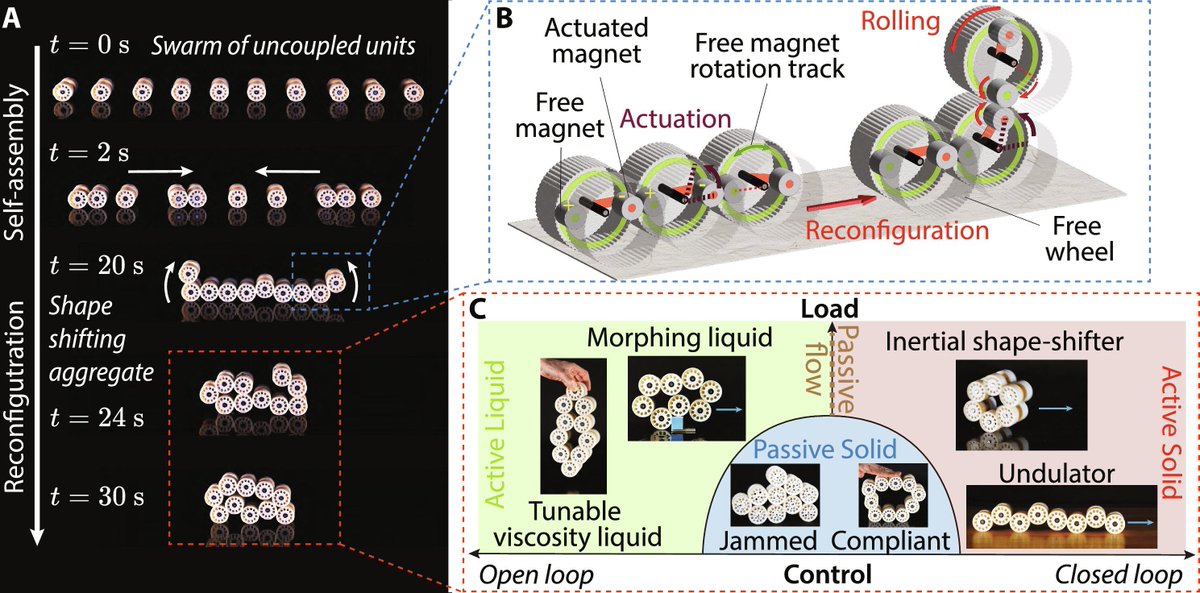
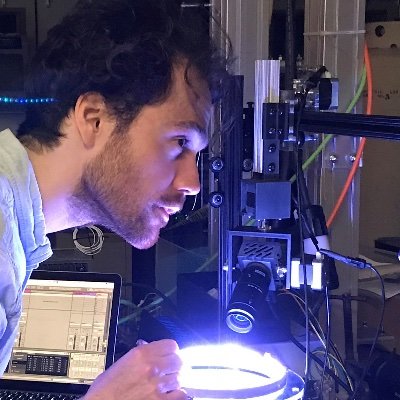
A new robotic system relies on the collective behavior of its distinct units to move and overcome hurdles. Learn more in Science Robotics ⬇️ 📄: scim.ag/5E3 @B_Saintyves @UChicago Focus: scim.ag/5E4 @GeorgiaTech
Baudouin Saintyves
162 posts

@B_Saintyves
Physicist/roboticist/multimedia artist. Researcher @UChicago. In residence at @saic_news.

A new robotic system relies on the collective behavior of its distinct units to move and overcome hurdles. Learn more in Science Robotics ⬇️ 📄: scim.ag/5E3 @B_Saintyves @UChicago Focus: scim.ag/5E4 @GeorgiaTech

Self-organizing robotic aggregate design inspired by flowing and rigid behaviors of sandpiles @SciRobotics techxplore.com/news/2024-03-r…

Fascinating conversation with @B_Saintyves , starting with an intro of soft and swarm robotics and his work on designing Granulobots, self organizing aggregates of small wheels with magnets and a simple motor. We then dive deep into a deep dialogical out-loud thinking about self-organization, self-coordination, synchronization, and emergence. We are both at the edge of what we know, dancing around and with these fascinating subjects. At around the hour mark, I ask @drmichaellevin's three questions: 1) Any surprising system-level behavior? (yes!!) 2) Any way to control the system at the top level? (hard to say but Baudouin really riffs off this) 3) How does the world look like for a Granulobot? (fascinating :) ). The last half an hour is Baudouin's amazing journey, triangulating between art, science, and engineering, a perfect illustration of the perspectival philosophy of science that we discussed with @yoginho in my upcoming next episode. Watch it, and please give it thumbs and sign up at the YouTube channel if you like it, it's a small gesture that could help these sober conversations about AI and science reach more people. youtube.com/watch?v=NmvzEp…


1/7 Excited to share my last publication at @SciRobotics using soft matter physics principles to combine soft, modular, and swarm robotics. We address the challenge of designing robotic systems capable of changing their shape and flexibility to adapt to various environments.

A new robotic system relies on the collective behavior of its distinct units to move and overcome hurdles. Learn more in Science Robotics ⬇️ 📄: scim.ag/5E3 @B_Saintyves @UChicago Focus: scim.ag/5E4 @GeorgiaTech


Opinion: Art-science synergies provides opportunities to improve community resilience and explore solutions to “wicked problems” such as climate change. eos.org/opinions/why-a…