Stephen Ellis

3.8K posts

Stephen Ellis banner
Stephen Ellis

Stephen Ellis

@badgerbites

Katılım Ekim 2012
555 Takip Edilen61 Takipçiler
Stephen Ellis
Stephen Ellis@badgerbites·
@acoyne Your analysis may be right Andrew, but what if a majority of people in a region want to separate but they have no legal ways to do so then the only option is insurrection and possibly violence. We don’t want that either
English
0
0
0
5
Andrew Coyne 🇺🇦🇮🇱🇬🇪🇲🇩
They never do. Read The Morning After, by Chantal Hebert and Jean Lapierre. Twenty years after the 95 referendum, the major players *still* hadn’t figured out what they would have done in the event of a yes vote. It was all just bluff and improv. But anyone who does try to game the thing out with any rigour pretty quickly comes to the conclusion that it can’t be done: not unilaterally/illegally, and not by negotiation/constitutionally. That needs to be communicated to people. But what needs to be communicated even more is that the whole enterprise is illegitimate; that there is not, and cannot be, any such thing as a right to secede from a democratic country (which is why virtually no democratic country recognizes such a right); that threatening to do so to blackmail your fellow Canadians is as morally bankrupt as it is practically futile; that the attempt to invoke democratic principle in its defence is bogus — you cannot vote to help yourself to something that isn’t yours, namely the territory of Canada — while the right of self determination simply folds in on itself: if Albertans or Quebecers have a right to self determination, do Edmontonians or Montrealers? For that matter, do Canadians? Or is the proposition that the vast majority of Canadians must simply stand mute while their country, which tens of millions have built over several centuries, is blown apart by a single vote on a single day by a small fraction of the population? Even if either Alberta or Quebec had been sovereign states prior to entering the federation, that would not hold water: once you’ve dissolved your sovereignty in the larger entity, you can’t reconstitute it. It no longer exists. There’s nothing to reconstitute it with. But it’s just gaga to make such claims with regard to a province that, like Alberta, was itself the creation of an Act of the Parliament of Canada, or like Quebec, of the Parliament of Great Britain — and then only the relatively minor rump that was carved out of the pre-existing Province of Canada at Confederation. Two thirds of the present-day territory of the province of Quebec was added after Confederation — again, by acts of the Parliament of Canada. So there’s no actual likelihood of Canada breaking up, even if there is a referendum in either or both provinces, and even in the vanishingly unlikely event that either or both of them managed to win a “clear majority” on a “clear question.” What is possible is that either or both of them might land themselves in a ruinous, divisive, and possibly violent mess, whose costs would mostly be borne by their own citizens. But we do not make that prospect more likely by rushing to make offers to dissuade them from leaving or going to great lengths to show “the federation works.” The committed hardliners regard such offers with contempt while the cynical blackmailers regard them as a baseline from which to make further demands. Neither is anything achieved by saying “fine, go.” Acquiescing in the theft of Canadian territory and the destruction of the federation hardy counts as a “tough” position. No, the proper stance is to advertise, well in advance, that neither exercise will be regarded as conferring any right to secede of any kind; that whatever we might be willing to talk about afterward, it would not be secession. It might not even be as advantageous as the status quo.
Don Braid@DonBraid

Separatist leaders hate Canada but have no real plan for secession. Why is that? Do they count on the U.S. to step in? Column calgaryherald.com/opinion/column… #ableg #abpoli #cdnpoli #yyc #yeg

English
190
370
1.1K
70.6K
Stephen Ellis
Stephen Ellis@badgerbites·
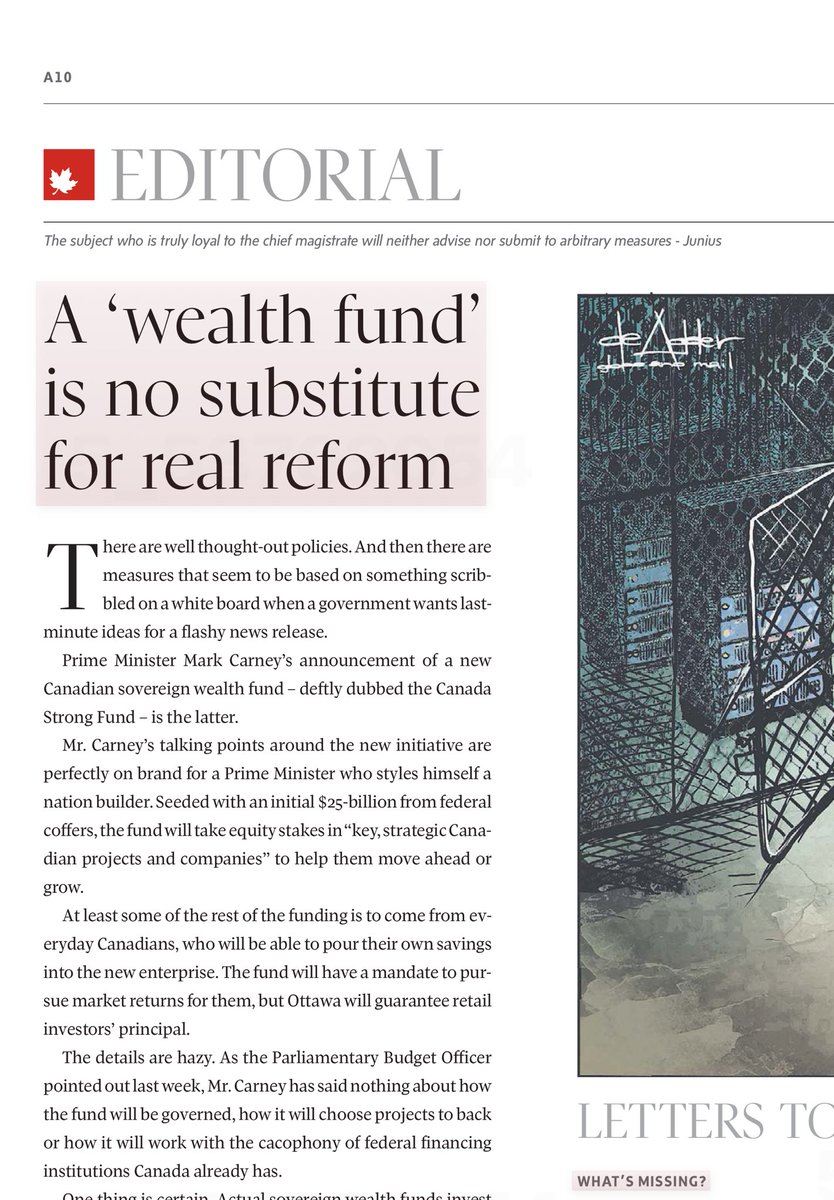
@adamchamb @SandraCobena_ Why stop at $100B? Go all in on every project. This is risk arbitrage which at the limit would eventually end up where returns would equal what the private market would expect, absent the likely misallocation of resources in the interim.
English
0
0
0
142
Adam Chambers
Adam Chambers@adamchamb·
If the Canadian Sovereign Wealth Fund is so great and will produce investment returns, why should the government stop at $25B? Seed it with $100B or $250B. It's capital investment, not operating expenses afterall. Basically free.
English
33
29
291
12.3K
Stephen Ellis
Stephen Ellis@badgerbites·
Read sky at night…
Stephen Ellis tweet media
English
0
0
0
2
Stephen Ellis
Stephen Ellis@badgerbites·
One of the early lessons I learned from my economics prof “if you lean on the equation it will bend”. Another way of saying the same thing.
𝗖𝘂𝗯𝗮 𝗰𝗼𝗻 𝗛 𝗱𝗲 𝗢𝗿𝘁𝗼𝗴𝗿𝗮𝗳𝗶́𝗮@CubaOrtografia

La Ley de Goodhart En las aulas polvorientas de la London School of Economics, a finales de los años 70, el economista Charles Goodhart observaba con ironía cómo los gobiernos intentaban controlar la economía mediante indicadores. Una y otra vez, los mismos números que servían para medir la realidad comenzaban a deformarse en cuanto se convertían en objetivo oficial. De esa observación surgió la Ley de Goodhart, que más tarde el antropólogo Donald Campbell reforzaría con su propia formulación: cuando una medida se convierte en objetivo, deja de ser una buena medida. La ley es cruelmente sencilla. Un indicador, ya sea toneladas de producción, porcentaje de graduados, tasa de empleo o nivel de emisiones, funciona razonablemente bien mientras permanece como señal de algo más profundo. Pero en el momento en que los incentivos se alinean para maximizar ese número, los seres humanos, astutos y adaptativos, comienzan a jugar con él. Ya no persiguen el bienestar, la calidad o la verdad; persiguen el indicador. La medida se corrompe y, con ella, la realidad que pretendía reflejar. La historia soviética ofrece el ejemplo más grotesco y pedagógico. En los años 30, un planificador central ordenó a las fábricas de clavos cumplir una cuota anual en «número de clavos producidos». Las fábricas, ansiosas por cumplir y recibir premios, fabricaron millones de clavos diminutos, casi inútiles, que cabían por millares en una caja. El planificador, enfurecido, cambió la meta al «peso total de clavos». Al año siguiente, las fábricas produjeron unos pocos clavos gigantescos, pesados como lingotes, igualmente inútiles. En ambos casos, el indicador brillaba en los informes, pero la economía real carecía de clavos que sirvieran para clavar. Décadas después, la izquierda post-1968 y sus herederos institucionales abrazaron con entusiasmo la lógica de los objetivos centrales. Convencidos de que la sociedad podía dirigirse como una gran fábrica, multiplicaron las metas numéricas: coeficiente de Gini para medir igualdad, porcentaje de «minorías» en plantillas y aulas, toneladas de CO₂ evitadas, número de leyes aprobadas contra tal o cual discriminación. Cada uno de estos indicadores se transformó rápidamente en objetivo sagrado. En las universidades y empresas occidentales, la meta de «diversidad» medida por cuotas de género, raza o identidad sexual desplazó al mérito y a la competencia real. Los departamentos de recursos humanos y las oficinas de admisión aprendieron a optimizar el indicador: contrataban o admitían según proporciones visibles, aunque ello supusiera bajar estándares, inflar calificaciones o ignorar diferencias reales de preparación. El porcentaje subía, las fotografías institucionales lucían multicolores, pero la calidad educativa y la cohesión interna se degradaban. Los mejores estudiantes y profesionales comenzaban a emigrar hacia entornos menos «optimizados». El indicador triunfaba; la excelencia se marchitaba. En el terreno energético, la obsesión por las «emisiones cero netas» convirtió las toneladas de CO₂ evitadas en el nuevo clavo soviético. Gobiernos y empresas persiguieron el número con subsidios masivos a energías intermitentes, cierres precipitados de centrales nucleares y de carbón, y prohibiciones regulatorias. El indicador mejoraba en los informes internacionales, pero la realidad entregaba precios disparatados de la electricidad, dependencia de países autoritarios para minerales y baterías, y episodios crecientes de apagones o racionamiento en países que apostaron todo al objetivo. La medida brillaba y la fiabilidad del sistema colapsaba. El socialismo planificado clásico y sus versiones suavizadas contemporáneas comparten esta patología: quien fija el objetivo desde arriba nunca posee la información local ni los incentivos correctos que sí tienen los actores de carne y hueso. Estos últimos, racionales, responden al incentivo que se les da, no al deseo abstracto del planificador. El resultado es siempre el mismo: distorsión masiva, «producción» fantasma y un abismo cada vez mayor entre las estadísticas oficiales y la vida cotidiana. La Ley de Goodhart sigue vigente, implacable. Cada nueva campaña que convierte un número en cruzada, sea equidad de género medida por consejeras, inclusión racial por becas o descarbonización por subsidios, repite el viejo error soviético con ropa nueva y lenguaje moralizante. Mientras tanto, la sociedad real, como aquellas fábricas de clavos, aprende a fabricar lo que se le premia, aunque ya nadie pueda usarlo.

English
0
0
0
4
Michael Barrett
Michael Barrett@MikeBarrettON·
The CEO of the failed $300 million PrescribeIT program was pocketing nearly $900,000 a year.   The money is spent and the program is scrapped but the Liberal Minister is refusing to testify at committee.   Canadians deserve answers.
English
65
1K
3.2K
28.6K
Stephen Ellis
Stephen Ellis@badgerbites·
Might be a selling point, all things constant, but the price they pay will be the same as for non-decarbonized oil so the margin will be lower. That’s pure economics but you should know that.
Jack Prandelli@jackprandelli

🇨🇦Canada's largest oil sands producer says national policy is making the country uncompetitive. PM Carney responds that "low emissions are a selling point." The Atlantic basin's other producers US, Norway, Brazil, Guyana are growing without that argument. Buyers pay spot, not virtue.

English
0
0
0
17
Stephen Ellis
Stephen Ellis@badgerbites·
This guy is delusional. Require industry to bear cost that none of their competitors have to incur does not make our industry more competitive. On the contrary. Do any of our politicians actually understand business or have they all just drunk the @markjcarney koolaid.
Marc Nixon@MarcNixon24

LYING STRAIGHT TO CAMERA Corey Hogan says DECARBONIZED Oil makes us more competitive We need to reach our climate goals That’s how we create a competitive economy There’s no other place on the planet that requires decarbonize oil Nobody’s is paying a premium for this product

English
0
0
0
24
Stephen Ellis
Stephen Ellis@badgerbites·
@jkenney I’d like to know what personal information was disclosed. I’m old enough to remember phone books being distributed widely that included name, phone number and address. How was this different?
English
0
0
0
6
Jason Kenney 🇨🇦🇺🇦🇮🇱
I understand that my personal information, including my home address, was shared publicly on a screen at a recent Alberta separatist event. It was also recorded on video, and is now circulating. This was apparently part of the outrageous data leak of Albertans’ private information, wherein Elections Alberta shared its entire detailed provincial voter database with the “Republican Party of Alberta,” which in turn shared it with some separatist group called the “Centurion Project,” whose leadership then shared my personal information publicly. Over the past few years I have received no shortage of threats from people broadly associated with the separatist / antivax / far right movement in Alberta. So it is disturbing that my personal information is now broadly available, particularly in those circles. While I have been targeted specifically, the broader data breach may also effect vulnerable Albertans, including victims of domestic violence, journalists, activists, judges, and other public servants for years to come. I will retain legal counsel to seek advice on recourse regarding this outrageous and potentially dangerous violation of my personal privacy.
English
1.7K
925
5.4K
512.1K
Lee Humphrey
Lee Humphrey@tleehumphrey·
This is the groundbreaking for the Afghanistan War Memorial. Can anyone tell me what is missing from this picture?
Lee Humphrey tweet media
English
205
77
314
45.9K
Stephen Ellis
Stephen Ellis@badgerbites·
@BenWoodfinden At what point do politicians have to tell us what we have to hear not what we want to hear? With his majority it’s time he fessed up to Canadians and jettison the Trudeau game plan.
English
0
0
1
424
Ben Woodfinden
Ben Woodfinden@BenWoodfinden·
The average voter won't care, but the more Carney lays out his worldview the more the contradictions and incongruences in his thinking (or lack of sincerity) become apparent. In his famous Davos speech he said "we actively take on the world as it is, not wait around for a world we wish to be." But the way he talks about and sees Europe does not fit this, and this statement is bizarre. We should absolutely be pursuing closer ties to Europe, but it is delusional if he actually believes the new international order will be "rebuilt out of Europe." Europe for all its grand aspirations cannot even defend Ukraine by itself and without American help. Europe would need something like 300,000 additional troops and €250 billion a year in extra defence spending just to deter Russia without the Americans. NATO's own Secretary General told the European Parliament in January that Europe "cannot at the moment provide nearly enough of what Ukraine needs to defend itself today, and to deter tomorrow," and that without American weapons "we cannot keep Ukraine in the fight. Literally not." Rutte told European lawmakers that anyone who thinks Europe can defend itself without the US should "keep on dreaming." Four years into the most serious land war on the continent since 1945 and this is where we are. That is not a continent about to anchor a new international order. The world order is quickly is reorganising, yes. But around a US-China axis, not Brussels. The eurozone is forecast to grow 0.9% this year. China at 4.5%. China accounts for roughly 30% of global growth, Europe's share of global GDP keeps shrinking. Europe is just one of many players. Again if you take Carney seriously here, it's silly. Build closer ties with Europe yes but do not believe this is the next superpower. But i suspect this is actually just another sign that Carney is good at politics - he knows exactly what the Davos crowd, his boomer base and media admirers want to hear and he is very good at giving it to them. Flattery has done him enormous favours in European capitals. But telling European elites the future runs through them is not realism, it is the opposite of realism. It is telling people what they want to hear, not the truth.
Clash Report@clashreport

Canadian PM Mark Carney: It’s my strong personal view that the international order will be rebuilt — but it will be rebuilt out of Europe.

English
73
151
569
66.4K
Stephen Ellis
Stephen Ellis@badgerbites·
@DavidKrayden If they want to do that, they should have,to add back,in the NPV of the pension commitments to the total.
English
0
0
0
213
David Krayden
David Krayden@DavidKrayden·
Andrew Coyne on the spring economic statement and the Canada Strong sovereign "wealth" fund: "If you subtract the CPP and the QPP, we have a debt to GDP ratio of only 10%. "Well, you can't actually use pension funds to pay off your debts. It's a completely bogus comparison. "But this is the thing. It's the same complacency. It's the same very top-down government directed, state run pension investment funds and this kind of thing. There's really not any sort of new development."
English
5
136
482
17.1K
Stephen Ellis
Stephen Ellis@badgerbites·
@acoyne Andrew, from where I sit, the gov’t is moving more and more “funding” to independent agencies so that Parliament can no longer exercise its historical duty to oversee taxation and spending. That is antithetical to one of the founding principles on which parliament was established
English
0
0
1
132