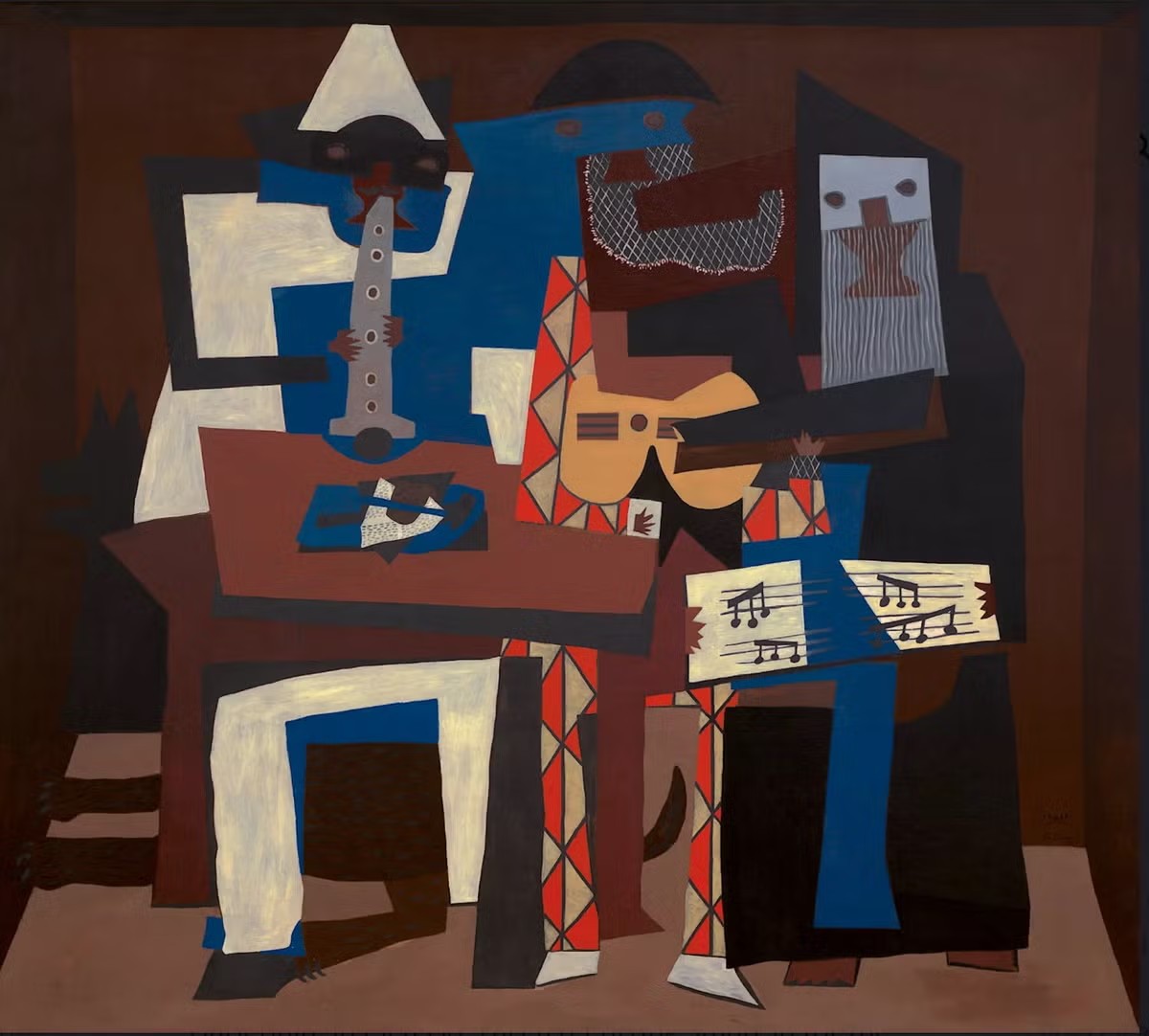
Los tres músicos 1921.
Pablo Picasso 1881-1971.
Época cubista del pintor.
Museo de Arte Moderno de Nueva York.
MoMa. Nueva York.
Estados Unidos de América.
The effective way the clarinet player does a musical call and response to the singer is just mesmerizing.
"Tu vuo' fa' l'americano" by Renato Carosone: cover by Hetty and the Jazzato Band, an Anglo-Italian jazz quintet.
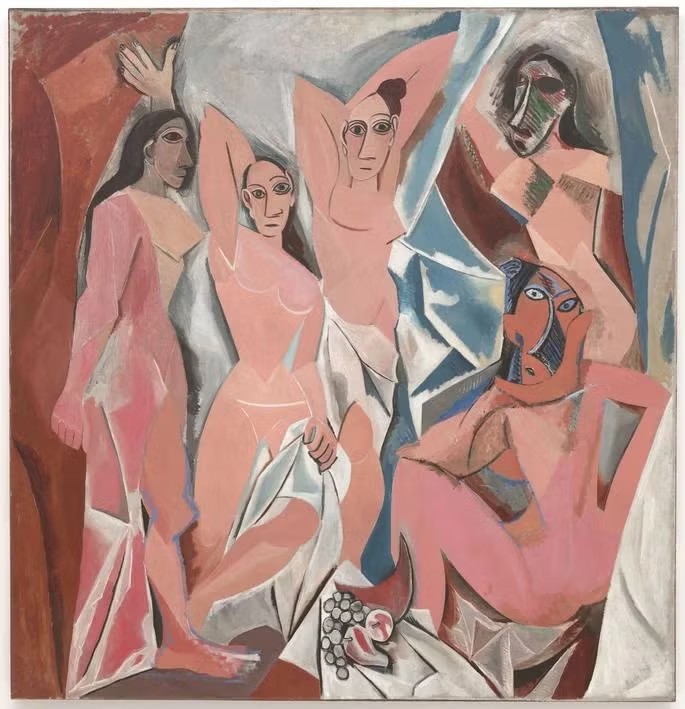
Las señoritas de Avignon 1907.
Pablo Picasso 1881-1971.
Inicio del cubismo del pintor.
Museo de Arte Moderno. MoMA.
Nueva York. Estados Unidos de América.
1855, Japan. In a woodblock print, two fish-men are playing music in the street. The one on the left holds a shamisen, a three-stringed Japanese instrument. The joke here is that the instrument's body is traditionally covered with cat skin**. So, a fish is playing an instrument made of cat skin. There isn't a single line of text in the print explaining this.Actually, everyone already gets it.
Let me explain.
These two fish-men are actually catfish. According to Japanese folklore, an earthquake happens when a giant underground catfish stirs. When a massive earthquake struck Tokyo (then called Edo) in 1855, people produced hundreds of prints about this belief. They were called namazu-e, meaning 'catfish pictures.'
The earthquake hit at 10:00 PM on the night of November 11, 1855. Between 8,000 and 10,000 people died. But the destruction wasn't evenly distributed. The worst-hit area was 'Daimyo Alley,' where the wealthy had their mansions. Why? Because that street had been part of the sea until 1600, when it was filled in to create land. The reclaimed land collapsed. The commoners' neighborhoods remained standing.
Two days after the earthquake, the first catfish print hit the market. It was a collaboration between the artist Kawanabe Kyosai and the writer Kanagaki Robun. Within two months, over 300 different designs were produced. They were all anonymous, all unauthorized - meaning they were all technically illegal. The government's censorship system had collapsed in the earthquake's chaos.
The two fish-men in this print are dressed as firefighters. The barrel next to them says 'Kashima': the name of the god who, according to folk belief, keeps the catfish pinned underground. The handwriting at the top is an earthquake parody of a well-known theater song. One line goes: 'Stayed too long, couldn't get out: inside the storehouse.' The wealthy got trapped while trying to save their belongings. Another goes: 'Dashed out naked: at the bathhouse.'
These prints weren't just earthquake news; they were an expression of class outrage. Two months later, the government banned the prints and had the printing blocks smashed. But it was too late - some were already hanging from ceilings, being used as earthquake amulets.
This print is currently at the Legion of Honor Museum in San Francisco. There's also a copy at the Edo-Tokyo Museum in Tokyo. Today, Japan's official earthquake warning logo is a catfish. This figure, printed illegally 170 years ago, is a symbol today.
**Today, the vast majority of shamisens use synthetic skin.
cherry blossoms
I fold my resume
into a crane
#haiku #俳句 #poem
This poem received recognition in the VCBF contest
and was published in haiga format on tinywords.