
Carlos I.R.
163 posts



Warning: The entire AI industry will likely be bottlenecked by two companies: 1. $AXTI ($700M) 2. $SMTOY ($31.7B) Which both control 60–70%+ of the world's InP substrates. Future $NVDA, $GOOGL TPU v7 pods, $META, $MSFT, $AMZN hyperscaler clusters require InP-based lasers and receivers. $AVGO, $LITE, $COHR use for EMLs for 800G/1.6T transceivers, DFB lasers, and other optical infra. Without InP substrates, the supply chain falters. After looking at TPU BOM to Maia BOM, it looks like future ASICs + GPUs + hyperscaler deployments are heavily reliant on photonics. And two vendors could freeze the global InP substrate market covering nearly all of: - Hyperscaler optics (TPU pods, etc) - Optical transceivers (5g, data) - LiDAR (robotaxis, drones, military) -Optical Modules (interconnect clusters) - Silicon photonics laser dies (Nvidia’s future co-packaged optics and Intel/Broadcom SiPh engines use InP CW laser arrays.) Since these companies make up majority of the market supply: -AXTI (est. ~30–35%) -Sumitomo (est.~30%) - JX Nippon (est. 10-15%) That’s it. (eg. 2021 industry note from Yole states that "Sumitomo Electric + AXT together had “more than 75%” of the InP substrate market") Hyperscalers/AI are moving toward photonics but the entire AI industry is fragile. If either $AXTI or $SMTOY stop supplying materials, the entire future AI buidlout gets crippled. It's even crazier that a $700m company could become the the center of it all. InP substrate will likely one of the biggest bottlenecks alongside HMB as the AI industry shifts to photonics.

Industry first: Multi-orbit tactical terminals certified for SES O3b mPOWER. ALL.SPACE has completed certification of the first multi-orbit, next-generation tactical terminal capability on the SES O3b mPOWER network. 👉🏼 all.pulse.ly/mjx0rgdahl @SESSpaceDefense


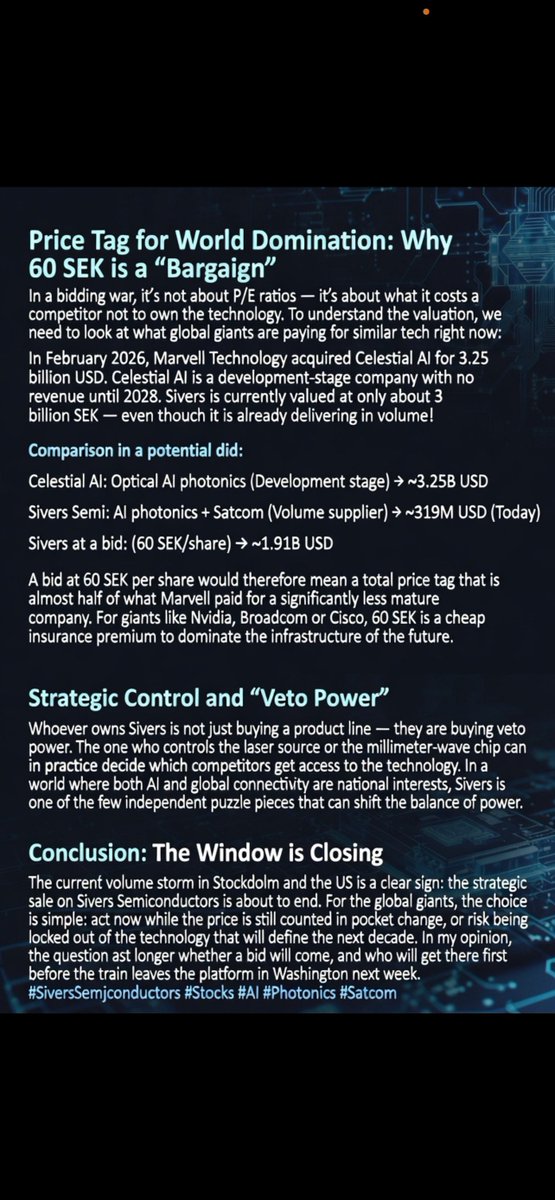

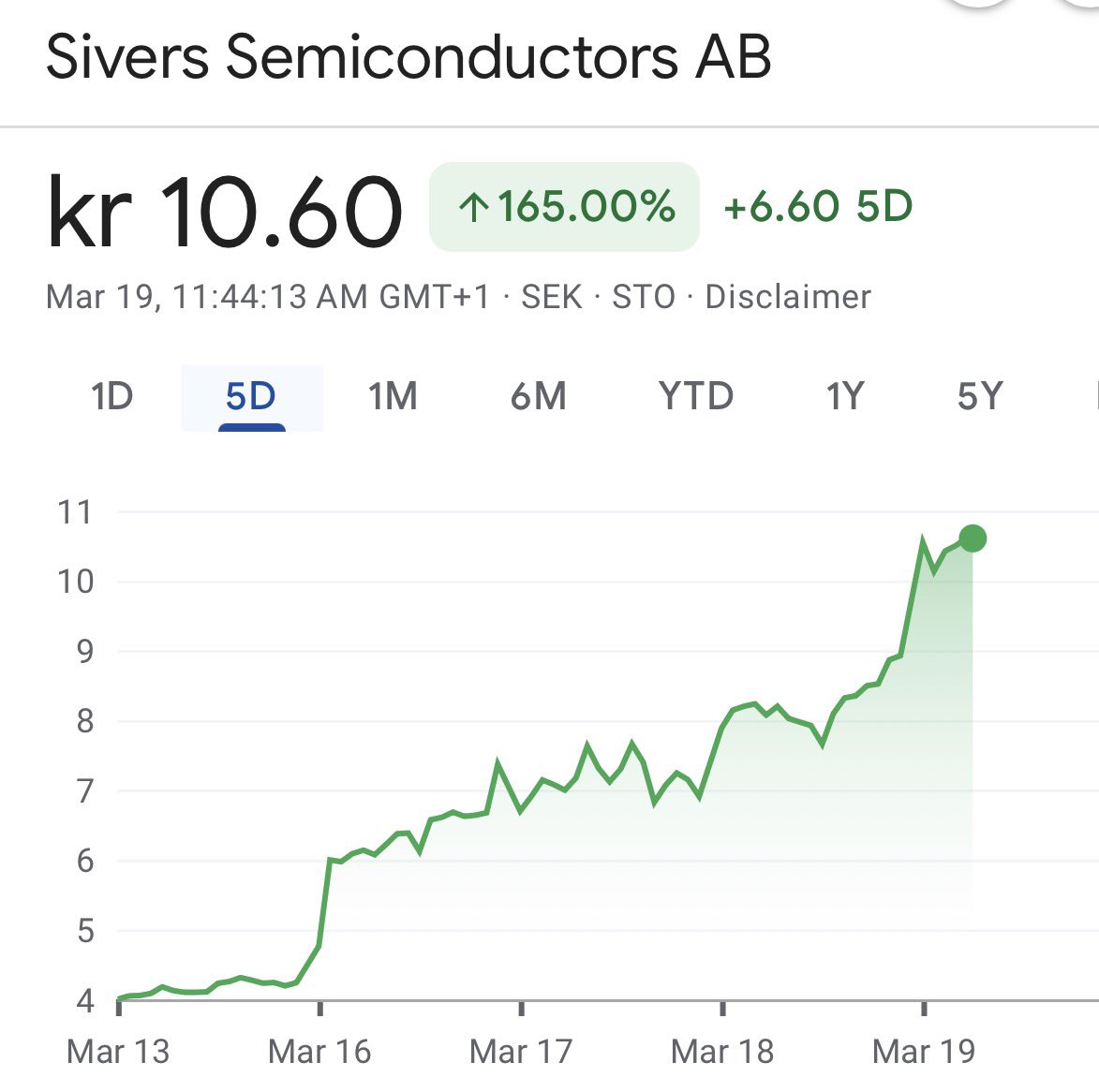
I’m long $SIVE at $140M. I believe this is the next $LITE that markets and institutions missed. $SIVE makes InP CW DFB lasers. Closest comparison is $LITE in the current EML laser bottleneck. But instead of supplying to Innolight/Eoptolink for current optical transceivers cycles. They supply the lasers to $POET Starlight, Ayar SuperNova. And others for the future CPO/silicon photonics architectures spearheaded by $NVDA. Current valuations make 0 sense to me personally. $POET is advanced packaging for $SIVE type lasers… But $POET commands worth 11x+ more than the company making the laser itself? It’s feels like valuing a more advanced $FN (~$20B) packaging at $400B when $LITE is valued at $40B. So now at $130m: - - You have a likely mini $LITE like laser supplier to Marvell Celestial + hyperscalers through $POET. - Laser supplier to Ayar ( $NVDA, $INTC ), though they do multi source with $LITE, Sumitomo, $MTSI. And other potential up and coming suppliers potentially like Lightmatter that they’ve name dropped (eg. Q2 2023 earnings). This is unconfirmed but supply chain BOM is confidential. On top, for revenue, they expected $453M "pipeline next few years”. And, they have capacity expansion through WIN: “Win Semi foundry qualification in progress for volume production from Laser designs from Sivers." Sivers feels the silicon photonics/CPO version of $LITE, with actual rapidly growing customers like Celestial through $POET, Ayar, with more to come. I wouldn’t have liked it last year, but just 3 weeks ago, they refinanced all their debt successfully to $12M convertible loan (10.85%) and a $5M term loan (12%), which cleans up debt. It’s $17m total, which feels like nothing to US markets when $AAOI is doing a $500m ATMs every other week. Best of all, this is their pure play inp laser segment for silicon/photonics + cpo. Their Lidar segment is ramping up and they have $53-138M projected revenue coming in. Downside risk: - execution (as always) - dilution to scale up capacity to compete with $LITE and others. - $LITE, $COHR competition on scale after $NVDA just gave them $4B - CPO ramp gets delayed. I have no clue how, $LWLG, a pre-revenue science project with $TSEM, is valued at $1B+ MC. Or how $POET, is worth ~9-10x more than its laser supplier. When $SIVE, the mini $LITE equivalent for CPO/Silicon photonics, is valued at $140M. I do believe this is largely undiscovered by institutions, since this is some random company in OMX Nordic Exchange (similar to micro $AXTI before I started posting about the inp substrate bottleneck). But I do think it will get a lot of institutional attention as Celestial and Ayar scale up. Especially if $POET and $SIVE gets qualified with other customers. If CPO completely replaces pluggable transceivers in the next generation of hyperscaler architectures. Sivers, with possible WIN Semi qualifcation and if they become the multi-source lasers for NVIDIA, Marvell, Intel, and Broadcom architectures, can be strongly rerated. Just as how $LITE did today going from $16 -> $622. This is just my personal thesis I'm sharing, DYOR/NFI. TLDR: InP Lasers are the current bottleneck in photonics as seen with $LITE valuations. $SIVE looks like the mini $LITE for the upcoming CPO/Silicon Photonics ramp. I personally took long position in $SIVE, as I believe they’re a large beneficiary of the upcoming silicon photonic/CPO architectural changes by $NVDA (with GTC cataylst). The upside here just way too compelling for me personally as the next possible $LITE.
Sivers < $SIVE / $SIVEF > powering Jabil ($27B MC) < $JBL > 1.6T LRO transcivers. As the laser light source. Is by far the biggest news from $NVDA GTC for Sivers ($280M MC) today... in history. Jabil brings in about $30B+ revenue from end users like $AMZN, $GOOGL, and $META. As well as OEMs like $NVDA, Arista, $AVGO, and Cisco. Especially after acquiring $INTC SiPH optical transceiver business, they're Tier 1 in the space. Sivers powering Jabil as the CW DFB laser source for Silicon Photonics and CPO and hyperscaler supply chains: At a $280M MC is incredible, and they're one of the most unknown yet highest potential company I've seen in the photonics sector so far. And the news from $NVDA GTC just cemented this thesis further. I think they genuinely have a shot at becoming the next $LITE.

$SIVE is the upstream laser supplier for CPO and Silicon Photonics. They're the likely $COHR / $LITE type future light source for: - $AMZN Trainium Clusters - $MSFT Maia Clusters and possibly other hyperscalers like $META MTAI and $GOOGL TPU clusters. At a ~$200M MC. Relational Mapping (speculative): $SIVE (light source) -> $POET (optical interposers) -> $MRVL (Likely Celestial Captive) -> $MSFT Maia + $AMZN Trainium. $SIVE (light source) -> Ayar -> AiChip -> $AMZN Inferentia/Trainium $SIVE (light source) -> Enablence -> O-Net -> ? Asia Hyperscalers _ Ongoing: $SIVE (light source) -> Ayar -> GUC -> ? (Google $TPU) $SIVE (light source) -> Ayar (TeraPHY/SuperNova)-> Wiwynn (captive CPO) -> ? ( $MSFT, $META historically Wiwynn's largest clients). Because of captive models like $MRVL Celestial, they get a free ride. However, they do compete multi-source ELS against Lumentum, Coherent, and $MTSI with Ayar and win anyway in merchant models. But they win either way. For high-volume production ramp up, a large part of it depends on the ongoing Win semi qualification, but this will likely be a large indicator. Again supply chain BOM is extremely confidential. $AMZN will never tell anyone "Hey, we use $SIVE ". But if you put 1+1+1+1+1 together, you can piece together the likely suppliers. Most people see "Poet Starlight" uses $SIVE. Or Ayar uses $SIVE. But don't map all the multi-hop relations to see where they end up. I do think $SIVE is an extremely undiscovered opportunity as the next possible mini $LITE for Silicon Photonics at $200m MC. As they're the likely upstream laser supplier for hyperscaler supply chains for future CPO/Silicon Photonics scale up with cw dfb lasers and scale out with laser arrays.




I just asked Jensen Huang a question. Why did he invest $4B $LITE and $COHR? "the amount of silicon photonics technology capacity that we need is substantially higher than the world has today" Photonics is next.