Robson Beans 🇿🇼

4K posts

Robson Beans 🇿🇼 banner
Robson Beans 🇿🇼

Robson Beans 🇿🇼

@BeansRobson

AI Enthusiast, Software Developer, Christian, Curious Sapiosexual, I write when I'm bored...and if you cut my veins, I bleed Liverpool RED. CIO @vanadiumtechzw

Zimbabwe Katılım Ocak 2013
6.4K Takip Edilen6.2K Takipçiler
Sabitlenmiş Tweet
Robson Beans 🇿🇼
Robson Beans 🇿🇼@BeansRobson·
Some deem it divine retribution - a penance for rebellion. Others, a cosmic duel between good and evil. Yet the enigma persists: Why does the battle endure? Two millennia post-Calvary, the faithful still grapple. The battlefield eludes sight, yet its echoes reverberate. Our strategy? Our leader? The truth crystallizes: We fight not against flesh and blood, but against unseen principalities. Our battleground? The human heart - the theater of choices. Our strategy? The armor of God - truth, righteousness, faith, salvation, the Word. Our leader? The One who conquered death - the risen Christ. robsonbeans.com/2020/05/28/the…
English
1
0
4
1.1K
Robson Beans 🇿🇼
Robson Beans 🇿🇼@BeansRobson·
@MitchellMGumbo There are many times I’m unsure of my position regarding issues or ideas. This is not one of them. He has an almost uncanny affinity for vulgarities. Moreover, the message of the cross is never about putting down people because of sin. This sounds sexist, actually.
English
0
0
0
224
Robson Beans 🇿🇼
Robson Beans 🇿🇼@BeansRobson·
Do yourself a favour and don’t watch ‘Nemesis’ on Netflix. Dstv channel 301 stuff. What a colossal waste of time…
English
8
3
19
8.9K
Juliette❤️
Juliette❤️@JulzZoey·
@BeansRobson I thought I was mad wen I was watching and I was like “wats d hype for”
English
1
0
1
234
Robson Beans 🇿🇼 retweetledi
Baba Ruhamah
Baba Ruhamah@MitchellMGumbo·
I turn a year older today . May I be empowered and enabled to leave this world better than I found it !
Baba Ruhamah tweet media
English
60
23
420
12.8K
Robson Beans 🇿🇼
Robson Beans 🇿🇼@BeansRobson·
This is a sober analysis of the situation Mr Chin’ono. However, allow me to push back a little on some issues. One thing worth naming. You frame this as Zimbabwe correcting its own legal mess. That’s partly true. But they are doing this now because Western creditors have made it a condition for debt relief. We are over 13 billion in debt, billions in arrears, locked out of global capital markets for two decades. This, by no means, is principled correction; it’s structural coercion. And the people paying the price for that coercion are the resettled farmers currently on those 67 farms. You somewhat dismissed them with ‘I can guarantee many weren’t utilised anyway.’ That guarantee deserves evidence. Because those are real families. The state that took land from white farmers is now taking it from Black ones - some of whom received it through official state allocation in good faith, with no knowledge of the legal encumbrances attached: because Europeans have BIPPAs and resettled Zimbabweans don’t. That asymmetry needs to be named, not glossed over. And let’s ask something fundamental. Did those resettled farmers know the land they were allocated carried BIPPA encumbrances? Almost certainly not. The state allocated it to them. They built on it, farmed it, raised families on it in good faith. Now the same state is reclaiming it to honour agreements it should never have violated. Will they be compensated for developments made? Given that the govt hasn’t paid the 2020 $3.5 billion white farmer compensation deal, the answer is obvious. And let’s apply your own standard here Mr Chin’ono. You argue land must go to people who can actually produce. Do we have any evidence these 67 farmers are productive? Has anyone assessed their agricultural output, their utilisation rates, their farming capacity? No. They are getting the land back purely because of treaty agreements: not merit, not competence, not productivity. The very standard you used to critique the resettlement programme is being quietly abandoned the moment European nationals are the beneficiaries. Do we assume they’re productive simply because they are European? Yes, BIPPA obligations are legally binding on Zimbabwe regardless of who currently occupies the land. But the legal obligation to foreign nationals doesn’t extinguish the moral and potentially legal obligation to resettled farmers for improvements made in good faith. Both obligations exist simultaneously. Zimbabwe is choosing which one to honour. The resettled Zimbabwean farmers have no BIPPA, no title deed - most have revocable offer letters, no treaty. They were political pawns in 2000, now they are collateral damage in a debt relief negotiation. How exactly is this correcting mistakes if new ones are being made in the process?
English
0
1
3
127
Hopewell Chin’ono
Hopewell Chin’ono@daddyhope·
People are misunderstanding this issue completely. Zimbabwe is not reversing the entire land reform programme. These are specific farms protected under Bilateral Investment Promotion and Protection Agreements, BIPPAs, signed between Zimbabwe and foreign countries. Many of these farms were bought after independence, not during colonial rule, and their expropriation violated legally binding agreements that Zimbabwe itself had signed. What happened in 2000 was chaotic, violent, and deeply political. Mugabe had just lost the constitutional referendum in 2000 and his grip on power had weakened significantly. ZANUPF was facing growing opposition from a restless population, particularly people who supported the party and were angry that they still did not have land 20 years after independence. To regain political control, Mugabe latched onto the land issue and unleashed a fast-track land reform programme that was often violent and lawless. The tragedy is that while the principle of land reform itself was necessary because of colonial land imbalances, the implementation became corrupted. Productive farms were handed to political cronies, chefs, military elites, judges, and connected individuals, many of whom could not farm. Some received multiple farms while genuinely capable black farmers were sidelined. Even today, some of that land is being rented back to white commercial farmers because the beneficiaries failed to utilise it productively. Zimbabwe’s agriculture has never fully recovered from that chaos. The country destroyed an advanced agricultural system without putting in place a competent replacement system based on productivity, financing, skills, irrigation, and accountability. You cannot build agricultural success by simply handing land to politically connected people who have no farming capacity. So what the government is doing now is not a reversal of land reform. It is trying to correct a legal and economic mess it created 26 years ago by violating its own laws and international agreements. It was criminal for the Zimbabwean government to sign BIPPAs and then ignore them when it became politically convenient. The important question now is not whether the farms are being returned. The important question is who currently holds those farms, whether they were being used productively, and what happens going forward. I can guarantee you that many of those farms were not being fully utilised anyway. Land must be in the hands of people who can actually produce. That is why I always say to countries considering land reform that land cannot simply be taken and distributed randomly. Even in precolonial African kingdoms, land belonged to the king and was allocated to people who could use it productively. You did not automatically get land simply because you belonged to the kingdom. I always use my own example. I was the third biggest Boer goat breeder in Zimbabwe, operating from just two acres at my ancestral village, yet producing far more than all Zimbabwean farmers sitting on massive commercial farms except for only two. Had I been given access to proper farming land, which I would have bought, I would probably have become the number one goat breeder in Zimbabwe. But that opportunity never came because productive land was often allocated to the wrong people for political patronage rather than agricultural competence. Robert Mugabe and ZANUPF’s chaotic and violent land reform programme was not really designed to build a productive Zimbabwean agricultural society. It became a political patronage system. Of course, some ordinary Zimbabweans benefited from the land redistribution, but the system was structured in such a way that land ownership often depended on political loyalty to ZANUPF. If you spoke against the government, you risked losing that land. Many black Zimbabweans have lost farms over the years simply because they fell out of political favour. That alone tells you that this was never truly about empowering citizens equally under the law. It became a tool of political control. And as we saw during the divorce case involving Mugabe’s daughter, she was given 21 farms. One person with 21 farms in a country where millions were supposedly land hungry tells you everything about how chaotic, corrupt, and mismanaged the entire programme became. Land reform was supposed to correct colonial imbalances and create productive black commercial farmers. Instead, in many cases, productive land was captured by politically connected elites, multiple farm owners, and people without farming expertise, while genuinely capable farmers struggled to access land. The current leadership in Zimbabwe, the President, the Vice Presidents, and many men and women of the old guard will not be in power in ten to twenty years’ time. They will all be gone. A new generation will eventually take over, and a lot more will be done to restructure Zimbabwe’s agriculture and bring back sanity, productivity, professionalism, and proper land utilisation. No country can build a strong agricultural sector on political patronage, chaos, and fear. Eventually, competence and productivity will have to matter more than political connections. It is embarrassing that with all that productive commercial farming land not being put to proper use, Zimbabwe now has to import maize from South Africa. That alone tells you how badly the agricultural sector was damaged. And unfortunately, the Zimbabwean example is now making many South Africans fearful of land reform because they look across the border and see collapse instead of increased productivity. But Zimbabwe should never be used as the standard example of proper land reform because what happened there was not a properly planned agricultural transformation programme. It became a violent, chaotic, and corrupt political project driven largely by patronage and power retention rather than long-term agricultural productivity and economic sustainability. Real land reform should increase production, strengthen food security, empower capable farmers, and grow the economy. It should not destroy a country’s ability to feed itself. Zimbabwe has capable black farmers, those are the ones that should have been given access to land not these grifters who are renting out famers and running protection rackets.
Hopewell Chin’ono tweet media
English
92
95
356
63.9K
Reuters Africa
Reuters Africa@ReutersAfrica·
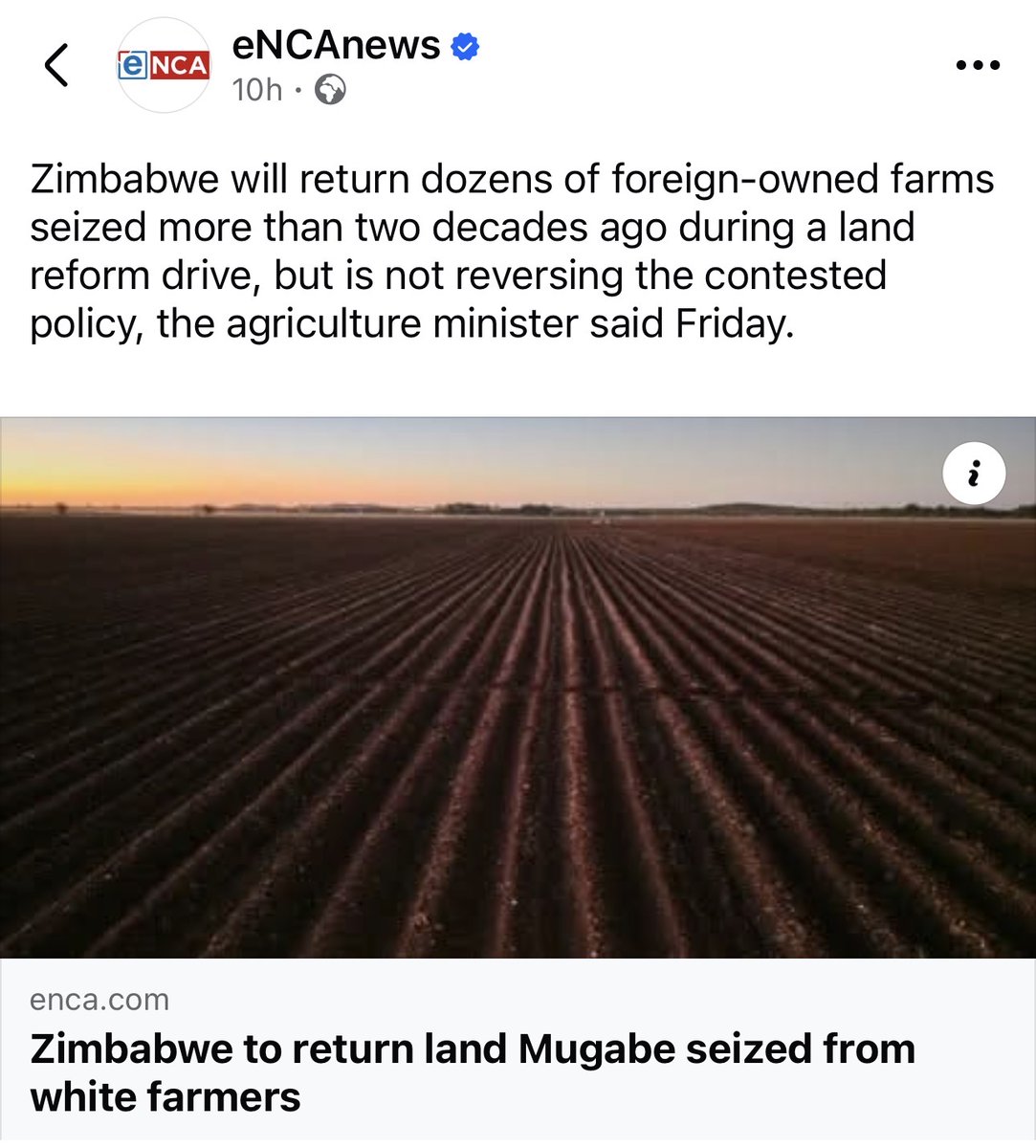
Zimbabwe will return 67 farms seized from foreigners from four European countries covered by bilateral investment pacts, the country's agriculture minister said, as it seeks to mend ties with Western countries while it battles for debt relief. reuters.com/sustainability…
English
469
600
965
308K
Robson Beans 🇿🇼
Robson Beans 🇿🇼@BeansRobson·
I see this as cynical and structurally coerced. We are being squeezed by creditors to undo, selectively, what the regime spent decades justifying. The losers will be resettled farmers with no legal recourse, no treaty, no lobby. The winners are European nationals and Western lenders. The ideology gets sacrificed; the debt gets managed. When creditors make debt relief conditional on land restitution and we fold: it confirms what critics always said: the land reform was never purely principled. It was wielded as political theatre when convenient and it’s now being abandoned when financially expedient. Agreeing to this is essentially admitting the debt problem is more urgent than the ideology.
Reuters Africa@ReutersAfrica

Zimbabwe will return 67 farms seized from foreigners from four European countries covered by bilateral investment pacts, the country's agriculture minister said, as it seeks to mend ties with Western countries while it battles for debt relief. reuters.com/sustainability…

English
0
0
1
118
Robson Beans 🇿🇼
Robson Beans 🇿🇼@BeansRobson·
I think the ‘tribes did it themselves’ narrative is a false equivalence. Intra-African slavery was largely captive integration, debt bondage, or war captivity: non-racialised, often non-hereditary, with paths to absorption into the host society. The Trans Atlantic Slave Trade was hereditary chattel slavery, racialised by law, industrial in scale: 12.5 million people extracted, children born enslaved by statute. Same word but completely different institutions. Also, the Middle Passage killed roughly 1.8 million people in transit (the gap between embarked and disembarked). No intra-African system had a comparable death-by-logistics signature, because no intra-African system moved people at that volume across that distance for commercial sale.
𝑻𝒉𝒆 𝑺𝒂𝒍𝒕 𝑶𝒇 𝑻𝒉𝒆 𝑬𝒂𝒓𝒕𝒉@Shadaya_Knight

Unpopular opinion: Black people are not owed anything for slavery or colonialism. Them being enslaved or colonised wasn't because they were good people BUT simply weak What white people did, enslave and colonize black people, the black tribes did that as well amongst themselves. It's not about morality but power. The weak get conquered simple as that If black people had developed the weapons that matched or better than what the whites had, they'd have never been enslaved or colonized. Maybe we would have been the conquerors Stop this victim mentality, your ancestors were conquered because they were weak. You're still oppressed not because you're good guys, but you're weak The only solution is POWER not this pity party. It's the way of the world - the strong do whatever they can and the weak suffer what they must.

English
0
0
0
124
Robson Beans 🇿🇼
Robson Beans 🇿🇼@BeansRobson·
Firstly, reparations claims aren't about morality of conquest, they're about unjust enrichment. The legal principle is straightforward and applies in any commercial law system: if value was extracted through a system later recognised as illegal (slavery was outlawed precisely because it was deemed wrong), and that extracted value compounded into present-day institutional wealth, restitution is owed. Germany pays Israel. The US paid Japanese internees. Britain compensated slave owners £20 million, only finished paying it off in 2015. The 'weakness' argument doesn't engage with any of this. Secondly, empires like Mutapa here at home, or the Ashanti in Ghana, were NOT 'weak' at point of contact. The balance shifted in the late 1800s with the invention of the maxim gun, steamships et cetera: not before. Conflating 1450 and 1885 to call a continent 'weak' is simply not history. Lastly, by your own rule: 'the strong do what they can, the weak suffer what they must': descendants organising politically to demand reparations IS power being exercised. It should be respected, not dismissed as a pity party. By that logic, is Germany weak for paying Israel? Is Britain weak for compensating its own slave owners?
English
1
1
2
197
𝑻𝒉𝒆 𝑺𝒂𝒍𝒕 𝑶𝒇 𝑻𝒉𝒆 𝑬𝒂𝒓𝒕𝒉
Unpopular opinion: Black people are not owed anything for slavery or colonialism. Them being enslaved or colonised wasn't because they were good people BUT simply weak What white people did, enslave and colonize black people, the black tribes did that as well amongst themselves. It's not about morality but power. The weak get conquered simple as that If black people had developed the weapons that matched or better than what the whites had, they'd have never been enslaved or colonized. Maybe we would have been the conquerors Stop this victim mentality, your ancestors were conquered because they were weak. You're still oppressed not because you're good guys, but you're weak The only solution is POWER not this pity party. It's the way of the world - the strong do whatever they can and the weak suffer what they must.
Kye@GxldSociety

I don’t care how unrealistic you think it is. Black people are owed reparations.

English
92
107
554
47.5K
Robson Beans 🇿🇼
Robson Beans 🇿🇼@BeansRobson·
They worry about the enormous arbitrary power they wield, power they cannot entrust to any one than them or even share in a way that can reduce political anxiety. The normative, institutional, and ideological mechanisms that would have made this power subject to constitutional constraints and accountability have never been prioritized from colonial times. After using it as their sole leverage to amass wealth and to ensure personal and economic security long enough, they grow increasingly fearful about what seems to them to be the grave consequences of losing to their rivals in the competition for the control of state power.
English
0
0
1
36
Baba Ruhamah
Baba Ruhamah@MitchellMGumbo·
The question to ponder on is, what is it about being powerless in such jurisdictions that make people want to cling onto power. Is it because the leaders are aware that through their actions and inactions they created a country that is extremely difficult for ordinary people ?
Bloomberg@business

Democratic Republic of Congo President Felix Tshisekedi said he’s willing to run for a third term — which is currently unconstitutional — if the Congolese people ask him to through a referendum bloomberg.com/news/articles/…

English
2
0
3
340
Robson Beans 🇿🇼 retweetledi
Baba Ruhamah
Baba Ruhamah@MitchellMGumbo·
Got to begrudgingly give it to the Caucasians . So far they have all other races trying to be accepted by them and seen as their deputies . You do not know pain till you have to share spaces with a fellow minority trying to be seen as a model minority
English
3
1
10
711
Robson Beans 🇿🇼
Robson Beans 🇿🇼@BeansRobson·
“Except for a few countries such as Botswana, politics remained a zero-sum game; power was sought by all means and maintained by all means. Colonial rule left most of Africa a legacy of intense and lawless political competition amidst an ideological void and a rising tide of disenchantment with the expectation of a better life.” Claude Ake.
English
0
0
0
48