HE MAPPED THE ROOM WITHOUT SEEING IT
In the quiet recovery ward of the animal hospital, a blind black-and-white cat sat in his corner bed, his head tilted as if listening to the very shape of the air. His eyes were cloudy, veiled by a world he could no longer see, but his spirit was far from lost. To the medical staff, he was a patient with a sensory disability; to the cat, the room was a complex puzzle of scents, textures, and distances. He sat on his low, padded bed, his charcoal fur contrasting sharply against the warm cream fabric, as he began the quiet work of building a map in his mind. He wasn't just resting; he was memorizing the exact placement of his water bowl, his food dish, and his litter tray—calculating the safety of his new world, one careful step at a time.
The true depth of his intelligence was revealed in the way he moved. He didn't wander aimlessly; he reached one white paw forward with deliberate precision, measuring the gap between his bed and the cool ceramic edge of his water bowl. He was counting the world in steps and smells, a silent architect of his own security. The turning point in his care came when a nurse, reaching in to clean, realized that moving a bowl even an inch caused him to flinch in sudden confusion. She paused, her hand hovering over the tray, as the realization struck her: he wasn't just a patient to be fed; he was a tenant who needed his world to stay exactly where he left it. With a soft apology, she returned the bowl to its original spot, and the tension instantly drained from his frame.
Understanding his needs transformed the way the clinic functioned around him. The nurse began to leave a cloth carrying her familiar scent beside his bed, a sensory anchor that told him he was among friends even when the room was silent. She ensured that every essential remained in its predictable, "kinder" arrangement, allowing him to navigate without the fear of a hidden corner or a shifted dish. The help was subtle, but for a cat living in darkness, it was the difference between a prison and a home. He didn't need the eyes he used to have; he needed a world that respected the eyes he had now.
By the end of his stay, the blind cat moved with a quiet, startling confidence. He could navigate from his bed to his water and back again without a single stumble, his charcoal-and-white fur moving fluidly through the pale mint shadows of the ward. The nurse watched from the doorway with a look of profound respect, realizing that the room hadn't changed, but it had finally learned how to be gentle with him. He was still blind, but the darkness was no longer a place of fear—it was a map he had mastered.
"Understanding a disability is sometimes the real treatment an animal has been missing."
Would you keep a blind cat’s world simple and predictable for comfort?
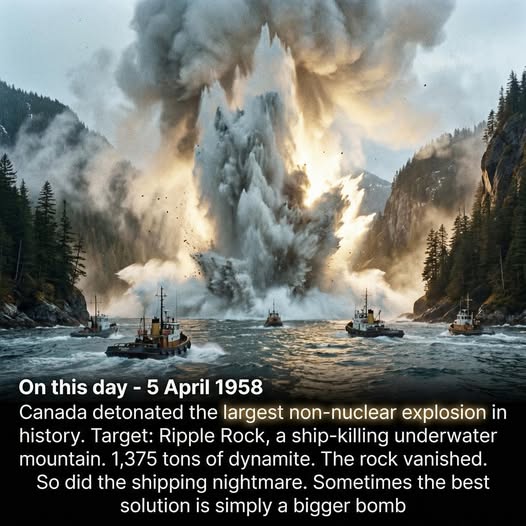
Imagine an underwater monster hiding just 9 feet below the surface. Ships sailing above it? Ripped open. Sunk. Over 100 sailors dead. For decades, Ripple Rock was the stuff of nightmares for mariners navigating British Columbia's Seymour Narrows. 📷📷
Engineers tried everything. Nothing worked. The rock refused to die.
So Canada did what Canada rarely does: It went absolutely huge.
They drilled three tunnels – from an island, under the seafloor – directly beneath the twin peaks. Then they packed 1,375 tons of dynamite into those tunnels. That's the weight of about 230 adult elephants. 📷📷📷
The explosion, when it came, was biblical:
· A wall of water shot 300 meters (1,000 feet) into the air.
· The blast registered on seismographs as a 4.0 earthquake.
· People 150 miles away heard it.
· And when the water settled? The rock was gone.
Not "damaged." Not "reduced." Gone.
The aftermath: Seymour Narrows became safe. Shipping routes opened. And Canada held a live TV broadcast to watch a mountain die by dynamite.
In 2026, we might wince at this kind of planetary brute force. But for the families who lost loved ones to Ripple Rock? That explosion was justice.
Sometimes the best solution really is a bigger bomb. 📷📷
Share this if you think history's biggest booms deserve a moment of silence
He did not cry when he found the bakery wall.
He did not scratch at doors.
He did not beg the world to notice him.
He only pressed his tiny sick body against the warm vent and stayed there… as if that little stream of heat was the last gentle thing this world still had to offer.
He was too weak to ask loudly anymore.
Too tired to run.
Too cold to keep searching.
So he chose warmth… and quietly hoped kindness might find him before the cold did.
Then she saw him.
A woman carrying life inside her own body looked down and found another little life barely holding on beside the wall. And in that moment, she did not need words. His trembling body had already said everything.
Some souls do not cry out when they are breaking.
They only lean into the smallest warmth they can find… and pray it leads them to love.
Before this date, parks were for royalty. For the rich. For private estates with "Keep Out" signs. If you were poor in industrial England? You breathed smoke, soot, and the stench of open sewers. 📷📷
Then Birkenhead happened.
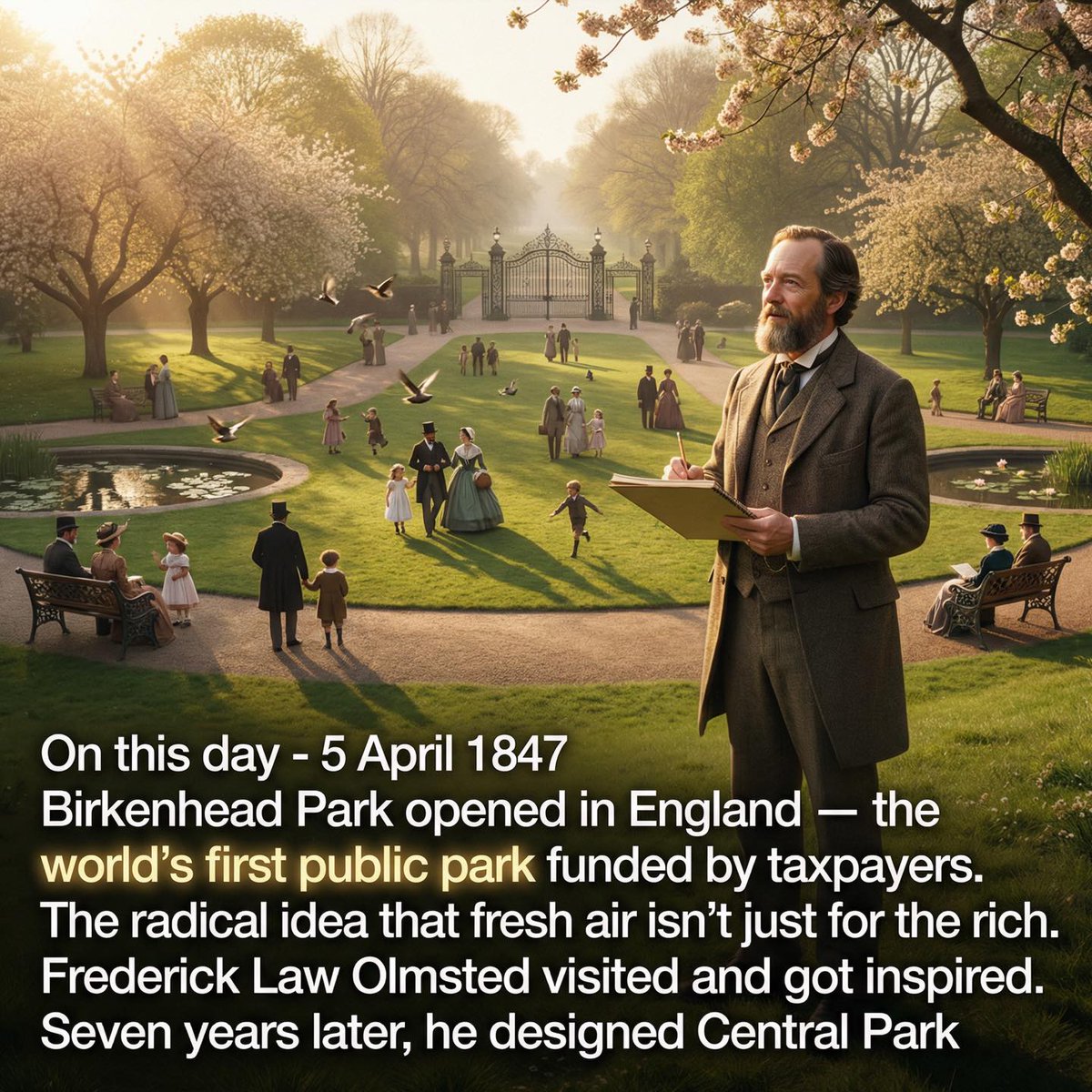
On this day 179 years ago, Birkenhead Park opened its gates to everyone – paid for by taxpayer money. No贵族 (aristocrats) allowed to lock it up. The idea was radical, almost scandalous:
"Fresh air is not a luxury. It is a public good."
The park had lakes, bridges, lodges, and something revolutionary: separate carriage drives so the rich couldn't complain about walking near "the wrong people." Even that compromise was genius.
Enter Frederick Law Olmsted.
The American architect visited in 1850. He walked those paths. He watched working-class families picnicking. He later wrote that moment changed him forever.
Seven (well, eight) years later? He designed Central Park – New York's breathing lung. And he borrowed the idea directly from Birkenhead.
So today, every time you enjoy a public park – from Hyde Park to Golden Gate Park to your local green space – you are walking through Birkenhead's shadow.
In 2026, as cities get hotter and greener spaces become battlegrounds for climate justice, this old story feels painfully new again. Who gets fresh air? Who decides?
Birkenhead's answer in 1847 was: Everyone. Taxpayers. The people.
Let's keep that radical idea alive. 📷
Share this if you believe parks belong to all of us
Imagine conquering most of Europe. Winning 68 battles. Redrawing maps with your signature.
Then losing it all in one brutal winter.
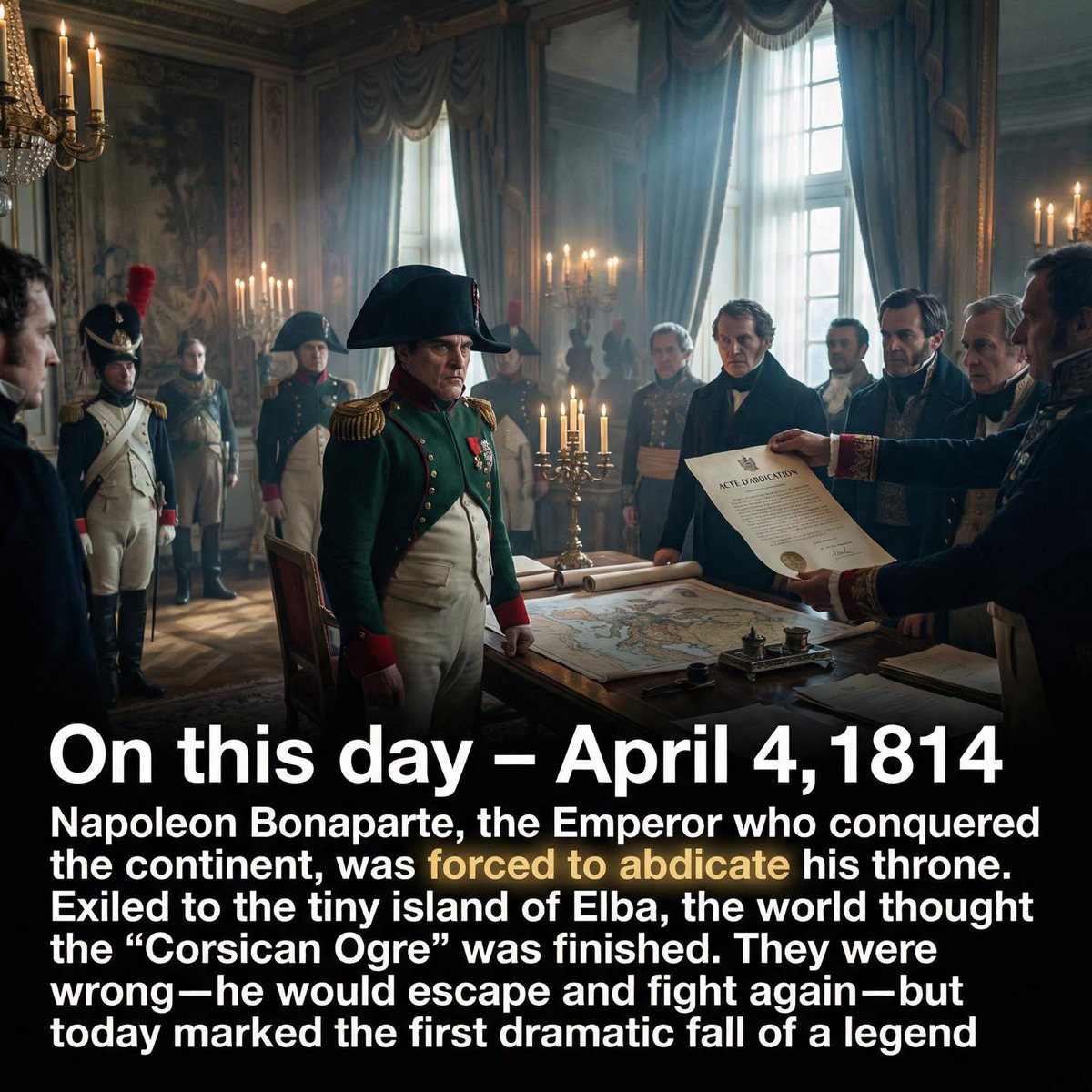
On this day 212 years ago, Napoleon Bonaparte – the self-crowned Emperor of the French – sat in his palace at Fontainebleau. His marshals, men who had bled for him from Egypt to Moscow, refused to fight anymore. One general reportedly shouted: "The army will obey its chiefs, not you."
Napoleon signed his abdication at 11:00 PM. He was 44 years old.
Europe breathed a collective sigh of relief. They exiled him to Elba – a speck in the Mediterranean with 12,000 residents and no army. The "Corsican Ogre" was finished. Everyone said so.
Everyone was wrong.
Ten months later, he escaped on a brig with 1,000 loyal soldiers. When King Louis XVIII sent troops to arrest him, Napoleon walked alone toward their rifles, opened his coat, and said: "If any of you will shoot your Emperor, shoot now."
They joined him instead.
He ruled France again for 100 days. Until Waterloo. Until Saint Helena. Until his final exile in 1821.
April 4, 1814, wasn't the end of Napoleon. It was the first act of his greatest comeback – and his final tragedy.
In 2026, here's the real question: Was Napoleon a liberator spreading revolutionary ideals, or a tyrant who caused millions of deaths? History still can't decide.
He promised to be a lawful king.
Three years later, he broke every vow.
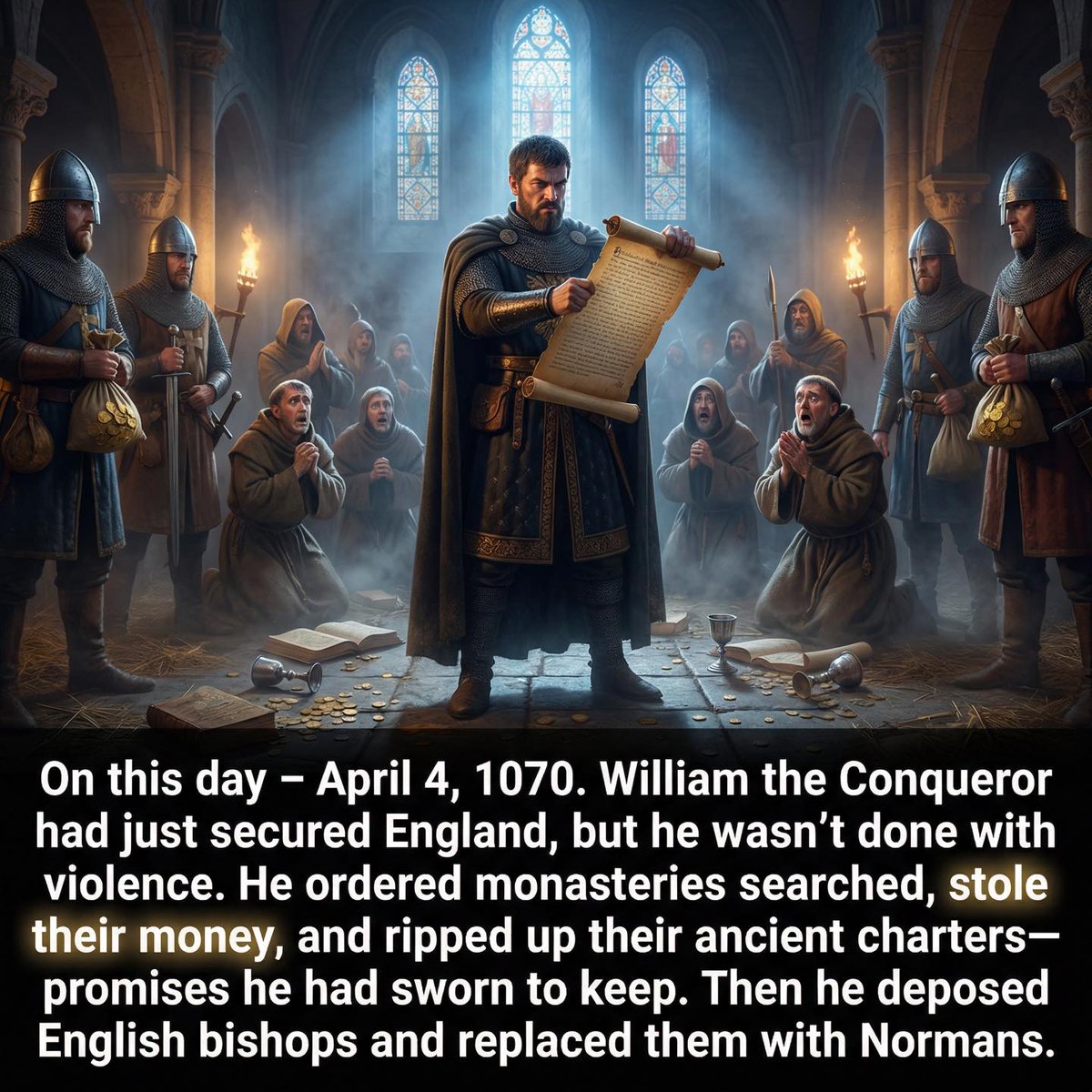
On this day 956 years ago, William the Conqueror – already feared across England – launched a quiet war. Not against armies. Against monasteries.
He sent Norman soldiers to search every abbey. They didn't find rebels. They found gold. Church treasures. Ancient land charters written in Old English. William confiscated the wealth. Then he literally ripped up the charters – centuries of legal rights, torn apart by Norman hands.
Then came the bishops. One by one, William deposed the English church leaders and replaced them with loyal Normans. Even the Archbishop of Canterbury was thrown out.
Why? Because William had sworn at his coronation (Christmas Day, 1066) to uphold English laws and customs. But monasteries had documents proving those old rights. Destroy the records. Replace the church leaders. Rewrite history.
That's what conquest looks like. Not just battles. Paperwork. Promises broken in silence.
By April 1070, William had already slaughtered thousands in the "Harrying of the North" – burning villages from York to Durham. But this monastery purge was different. It was administrative terror.
In 2026, we call it erasure. Back then, they called it justice – Norman-style.
The question for today: Is a promise sworn under threat of invasion ever truly binding?
We are taught to think of the Earth as a fragile glass ornament, always 1 ppm away from shattering.
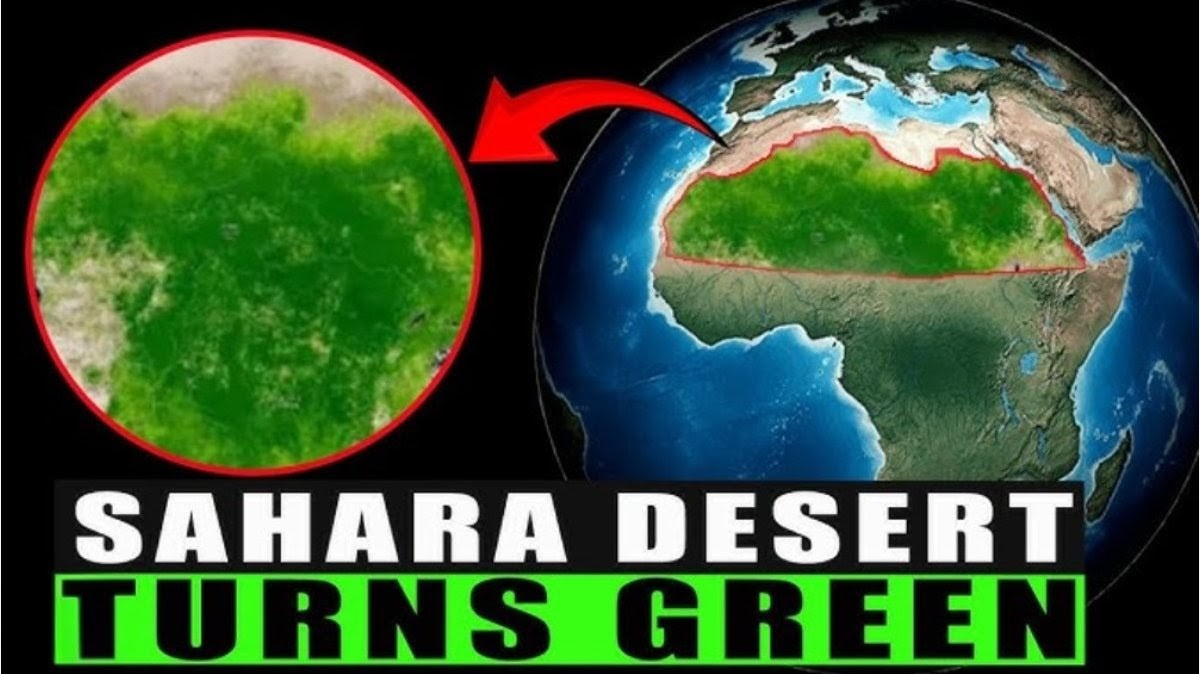
But 4.6 billion years of geology is the real story; the Earth is a massive, integrated system of equilibrium. Whether it’s the greening of the Sahara absorbing excess CO₂ or the oceans acting as a 3,700-meter thermal shock absorber, the Earth is a self-correcting system designed to seek balance, not collapse.
When CO₂ rises, the greening follows. NASA satellites aren't just seeing leaves, they're witnessing Earth as a primary self-correction mechanism in real-time. As the atmosphere changes, the biosphere expands to meet it. The world is pulling carbon back into the soil and the woodland biome of the great frozen northern forests.
The fleeting abnormalities of atmospheric temperatures are dampened by the colossal scale of the ocean abyss. The 1,000-year mixing cycle of the deep Pacific ensures that any spike in the gaseous envelope is met with the massive thermal inertia of the water planet.
The Earth has weathered code red' events that dwarf our modern experience - from the Eemian hothouse to the Little Ice Age. Each time, the system simply found its level. The crisis isn't planetary. It's a crisis of human perspective.
We live in the blink of an eye and wrongly mistake a seasonal shift in a 4 billion year cycle for the end of the world.
Today's Earth isn't breaking down at all, it's just doing what it has done for millennia: finding a balance.