Benjamin Felix

5.2K posts

Benjamin Felix banner
Benjamin Felix

Benjamin Felix

@benjaminfelix

Helping Canadians make better financial decisions. Chief Investment Officer, Portfolio Manager @PWLCapital; co-host @RationalRemind. Meet with PWL ⬇️

Canada Katılım Mart 2013
243 Takip Edilen27.3K Takipçiler
Spencer McGrath
Spencer McGrath@spencmcgrath·
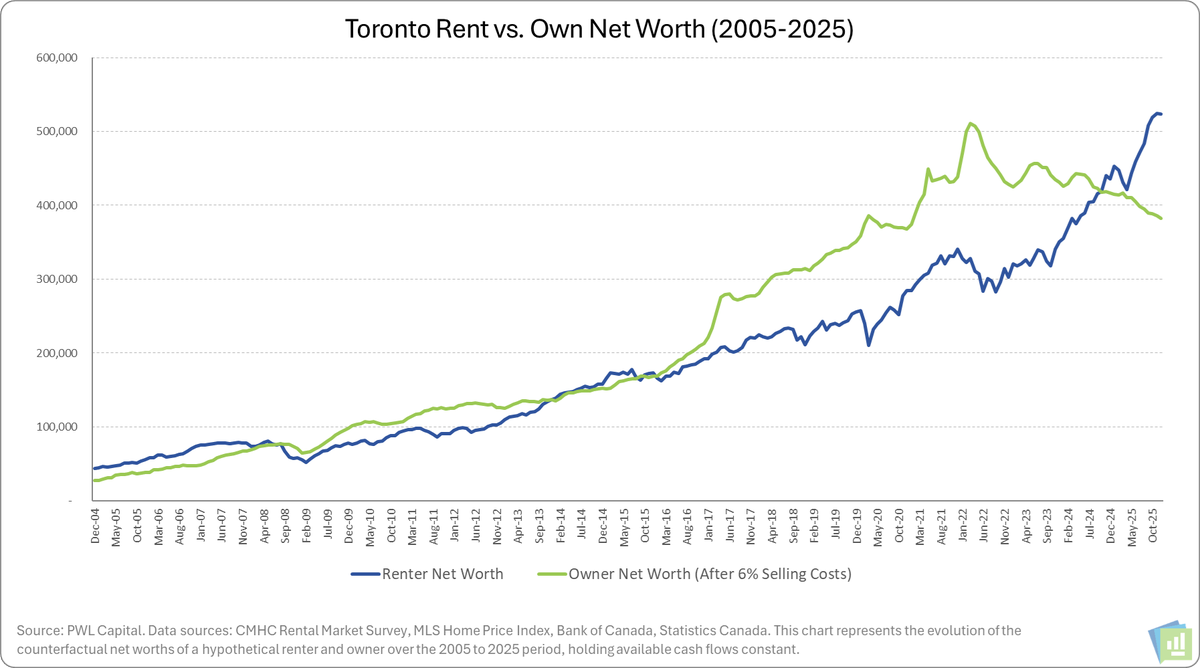
@wealthy_barber @benjaminfelix Not even close. If you bought a home in the GTA in 2005 you be a millionaire today. If you invested the same down payment of $40k you’d have $269k…. Sure thing. How many rentals do you have?…
English
1
0
0
230
David Chilton
David Chilton@wealthy_barber·
Ben Felix (@benjaminfelix) on what many people miss when comparing renting and owning a home.
English
18
16
232
13K
Wes Gray 🇺🇸
Wes Gray 🇺🇸@alphaarchitect·
Index providers are all contemplating the Space X IPO. The implications for passive investors are interesting -- and possibly destructive! cc @jasonzweigwsj Here is a great paper on the topic: papers.ssrn.com/sol3/papers.cf… "Value-weighted indexes must rebalance in response to stock market composition changes, e.g., issuance, buybacks, and IPOs. In doing so, existing index funds implicitly engage in market timing. Index funds’ long-short rebalancing portfolios have a -3.5% annual return and load negatively on value and profitability factors..."
English
5
4
31
5K
Cullen Roche
Cullen Roche@cullenroche·
@SEC_digger I was one of the first people writing research on this in 2009. I'm pretty sure Ben learned this from me. 😁 He's awesome BTW.
English
1
0
15
1.6K
Cullen Roche
Cullen Roche@cullenroche·
This is a compelling story, in part because it paints banking as a scam. It's also completely wrong and based on myths that have been debunked a million times. First, the 10% reserve ratio is a relic. Today, reserve requirements in the USA are 0%, yet banks didn't magically start making infinite loans. Why? Because solvent banks are capital constrained, not reserve constrained. This is where the original story is most misleading. When a bank receives a $10k deposit (a liability), the sending bank also sends $10k of reserves (an asset). The recipient bank’s Equity (assets minus liabilities) is unchanged. Their lending capacity hasn't improved because their Capital Adequacy Ratio hasn't moved an inch. They don't suddenly have the regulatory room to add $9k of risky new loans to their balance sheet just because they have more cash in the vault. A bank's capacity to lend is actually contingent on its profitability. If these new deposits are less expensive than their previous funding sources, the bank’s Net Interest Margin improves. Those profits eventually flow into Retained Earnings, which increases their capital. That is what actually creates the capacity to lend more. This isn't a scam; it's capitalism. Well-managed, profitable banks grow their capital base, which allows them to safely expand their lending to the economy. The multiplier story is popular because it's simple and cynical. But if you want to understand how the plumbing actually works, follow the capital, not the reserves. 👍
The Wolf Of All Streets@scottmelker

A man deposits $10,000 in a bank. The bank thanks him and records the deposit on its balance sheet. But not where you might expect. For the bank, that $10,000 is actually a liability – because technically it belongs to the customer and might have to be returned. So the bank does what banks do. It lends $9,000 of that money to someone buying a car. Now something interesting happens. The $9,000 loan appears on the bank’s books as an asset – because someone now owes the bank money. So the same $10,000 is doing two jobs at once. The depositor believes he has $10,000 safely in the bank. The borrower now has $9,000 to spend. That $9,000 gets deposited somewhere else. The next bank lends $8,100. That gets deposited again. Then $7,290 gets lent out. Soon the original $10,000 has quietly turned into tens of thousands of dollars of loans scattered across the economy. Everyone believes they have money. Depositors see balances in their accounts. Borrowers have the money they spent. Banks show healthy assets on their balance sheets because people owe them money. And here’s the best part. Banks charge interest on all those loans – maybe 7%. But the depositor who supplied the original money might earn only 0.5% on their savings account. So banks collect interest on money that mostly wasn’t theirs to begin with – and keep the difference. The system works beautifully. As long as nobody asks for the money back at the same time.

English
43
50
382
81K
Benjamin Felix
Benjamin Felix@benjaminfelix·
@VaksmanDan This one does. There's another chart on the source page that does not.
English
0
0
2
135
Benjamin Felix
Benjamin Felix@benjaminfelix·
U.S. stocks vs. gold and silver 1895-2026.
GIF
English
10
5
63
6.7K
Benjamin Felix
Benjamin Felix@benjaminfelix·
@bdkoepke Yes. See the flows into private markets. They’ll learn the truth one way or another, eventually.
English
0
0
5
124
Brandon Koepke
Brandon Koepke@bdkoepke·
I unsubscribed, but do people actually believe this garbage? I think they must because this seems to be a very common pitch.
English
4
0
4
376
Brandon Koepke
Brandon Koepke@bdkoepke·
I listened to a podcast yesterday from a firm that I formerly respected... Their CIO was the guest, and he went on and on about how they generate equity-like returns with a quarter of the risk "we're up in up markets, up in down markets, it's always roses and sunshine over here"
English
1
0
9
839
Benjamin Felix
Benjamin Felix@benjaminfelix·
@_dendolla I'd put gold in portfolios if I thought it made sense. There's no cost or lost revenue for a firm like PWL to do that. We don't use AVDV, but DFA600 (DFA Canadian Vector) has a ton of gold miner exposure. It has definitely benefitted from the recent gold price runup.
English
1
0
0
178
Den Dolla
Den Dolla@_dendolla·
@benjaminfelix 2/2 that being said I actually think your suggested investment portfolios are more than enough exposure to gold through the mining companies in AVDV. For what it’s worth I view gold as an insurance policy and rebalancing tool for long periods of time.
English
1
0
1
130
Benjamin Felix
Benjamin Felix@benjaminfelix·
@_dendolla It is a "true" comparison. The data sources are valid. Your point is not invalid though. The history of gold going back further, and in the UK where there was no EO 6102, doesn't make a particularly compelling case for gold as an investment.
English
1
0
1
155
Den Dolla
Den Dolla@_dendolla·
@benjaminfelix Fair, but the post itself is comparing the stock market returns to the price of gold. And when you consider the points I made I don’t think you can have a true one to one comparison through a chart like this.
English
1
0
0
139
Benjamin Felix
Benjamin Felix@benjaminfelix·
@_dendolla This is a chart comparing gold and stocks from 1895-2026 from a website that has some neat historical data. It's not my website or my chart.
English
1
0
6
312
Den Dolla
Den Dolla@_dendolla·
@benjaminfelix You’re ignoring the entire history of gold. This chart is ignoring that Gold’s price was pegged to the dollar. It was also illegal to hold gold personally from 1933 to 1974.
English
1
0
2
331
Benjamin Felix
Benjamin Felix@benjaminfelix·
I will be speaking at The Globe and Mail’s upcoming event - The New Investor Playbook: Setting up your financial future. Wednesday, March 11, 2026 | 12:30pm - 1:30pm EST. It's a webcast designed for new investors who want to learn how to invest confidently.
Benjamin Felix tweet media
English
4
1
39
3.5K
Henao Hodl ⚡️
Henao Hodl ⚡️@henaohodl·
@benjaminfelix In all honesty, I've only seen home prices going up, not down 😅 This data isnt accurate.
English
2
0
2
857
Benjamin Felix
Benjamin Felix@benjaminfelix·
It looks like we are in the worst real drawdown on record for Canadian residential real estate prices. Q4 1980-Q3 1984: -21% Q1 1989-Q4 1998: -20% Q1 2008-Q1 2009: -9% Q3 2017-Q3 2019: -3% Q1 2022-Q4 2025: -29%
Benjamin Felix tweet media
English
59
84
576
95.2K
Benjamin Felix
Benjamin Felix@benjaminfelix·
@somwchi300 I wonder the same. I’m on the edge of my seat every time new data are released.
English
3
0
11
2.2K
You may have a point
You may have a point@somwchi300·
@benjaminfelix I wonder if we will see a real price drawdown from 2019 prices that exceed the 80 to 84, and 89-98 periods. Covid made for some crazy speculating in 20-22 period.
English
2
0
10
2.3K
Benjamin Felix
Benjamin Felix@benjaminfelix·
Worth noting that using the data series from the Dallas Fed, which follows a different methodology, the 1980 decline was -31%. #data" target="_blank" rel="nofollow noopener">dallasfed.org/research/inter…
English
0
0
12
4.9K