@Apple please find a better bank provider @GreenDotBank is no where near the standard Steve job set for your company and to be honest they are not very helpful to the standard of APPLE SO PLEASE FIND ANOTHER BANK PROVIDER BECAUSE I CANT GO ANOTHER MONTH WITHOUT MY APPLE PAY SERIOUSLY IT LITERALLY COSTING ME MONEY RN
@mymixtapez Nigga sound stupid AF ANYTHING FROM SNOOP DAWG IS WORTH SOMETHING it ok bruh give it to me he only a hiphop legend who just HOST THE LAST OLYMPICS
• Context from Public Info — Finesse2Tymes publicly complained in early 2026 that he “ain’t made no money” in four years with Mob Ties, wanted out of the contract, and felt stuck (despite releases like 90 Days). He described it as unprofitable and begged for release — this aligns with the structure here feeling restrictive/unfair in practice.
In short: No, this doesn’t seem fair from an artist’s perspective. It gives the appearance of a good split while burying heavy control, deductions, and multi-party cuts that can leave the creator with little. Many similar hip-hop/indie deals have led to disputes, lawsuits, or public pleas for release (as seen with Finesse himself recently).
Strong advice (not legal advice — I’m not a lawyer): Anyone in or considering a similar deal should have an experienced entertainment attorney review it thoroughly before signing. Hip-hop contracts often look “okay” on the surface but contain clauses that heavily favor the label side.
If this is your situation or you’re analyzing it for someone else, getting independent counsel is crucial — the acknowledgment at the end notes the parties had the opportunity for legal advice, which is standard boilerplate but underscores the importance.
This contract excerpt appears to be from a September 9, 2022 amendment to Finesse2Tymes’ (Ricky Hampton / “Artist”) original recording agreement with Mob Ties Entertainment, LLC (“Company”), bringing in J. Prince Entertainment, Inc. (JPE) as a party. It restructures ownership, royalty flows, and control, particularly for ancillary rights (non-recording income like merch, endorsements, sponsorships, etc.) via a new Joint Venture entity (“Ancillary JV”).
Overall, this does not look like a particularly fair or artist-favorable contract, especially for a developing or mid-tier rapper in hip-hop. It heavily favors the label side (Mob Ties/Company + JPE) in terms of control, reduced effective take-home for the artist, and layered cuts that diminish the artist’s share. Here’s a breakdown:
Key Points from the Ancillary JV Section
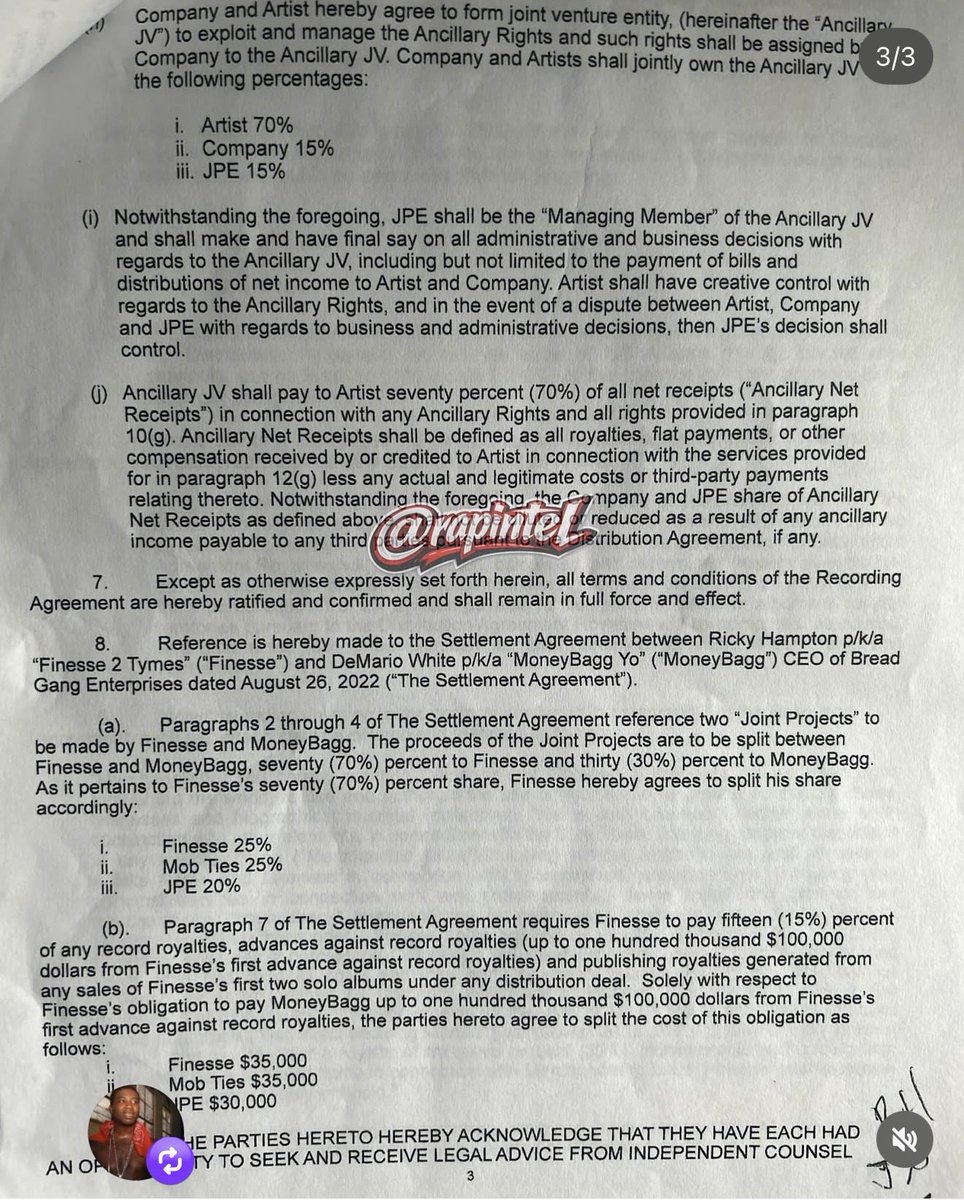
The amendment creates an Ancillary JV to handle and exploit “Ancillary Rights” (merch, endorsements, etc.), with rights assigned from the Company to the JV. Ownership is listed as:
• Artist: 70%
• Company: 15%
• JPE: 15%
But — and this is a massive “but” — JPE is named Managing Member with final say on all administrative and business decisions (bills, distributions of net income, etc.). The Artist only has “creative control,” and in any business/administrative dispute, JPE’s decision controls.
The JV pays the Artist 70% of “Ancillary Net Receipts” (royalties, flat payments, etc., minus legitimate costs/third-party payments). However, the Company and JPE’s shares can be reduced if third-party obligations (e.g., via a Distribution Agreement) eat into the pot.
This looks generous on paper (70% to the artist), but the effective take-home is lower due to:
• Net after costs (labels often deduct aggressively).
• JPE’s veto/control power, which could limit or delay distributions.
• Layered third-party obligations.
In standard hip-hop deals, ancillary/merch rights often go 30-50% to the label in 360-style deals, with the artist keeping the rest after costs — but rarely with such one-sided decision-making control handed to a third party like JPE.
Joint Projects / Settlement with Moneybagg Yo (Bread Gang)
This references a 2022 Settlement Agreement between Finesse2Tymes (“Finesse”) and Moneybagg Yo (“MoneyBagg”) involving “Joint Projects” (likely collabs):
• Proceeds split 70% Finesse / 30% MoneyBagg.
• Finesse then splits his 70% as: 25% to himself, 25% to Mob Ties, 20% to JPE (and presumably the remaining 30% elsewhere? — text is cut off, but it shows further dilution).
There’s also a $100k obligation from Finesse’s first solo advances/royalties to MoneyBagg, split as $35k Finesse, $35k Mob Ties, $30k JPE.
This shows additional layers where the artist’s incoming money gets carved up among multiple parties before he sees much.
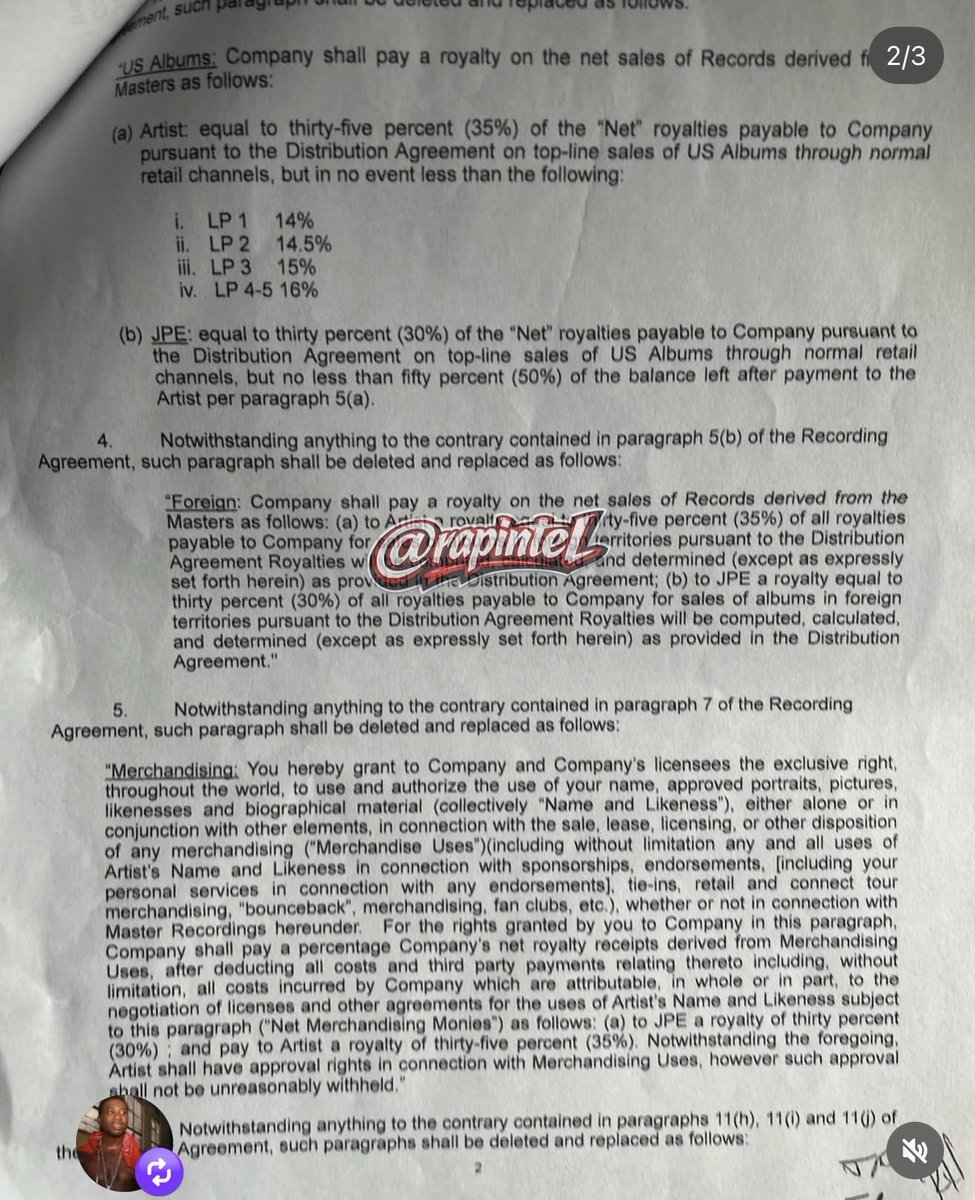
Recording Royalties (US Albums / Foreign)
The amendment adjusts the original agreement:
• Artist gets 35% of the Company’s “Net” royalties from distribution (with minimums like 14-16% on LPs 1-5).
• JPE gets 30% of the Company’s Net royalties (with floors).
This is a net deal structure common in indie/major hybrids, but the artist’s effective rate ends up lower after splits, recoupment, and deductions. Typical major-label artist royalties in 2022 were often 12-18% (escalating), but in joint ventures or 360 deals with indies, artists frequently complain of low effective payouts due to multiple cuts.
Overall Fairness Assessment
• Control — Heavily skewed toward JPE (final say on business decisions) and the Company. The artist has creative input but little real power over money flow — common in “bad” hip-hop deals where artists feel trapped.
• Money Flow — The 70% looks good, but after nets/costs/third-parties/layered splits (Mob Ties + JPE + possibly others), the artist’s actual pocket is significantly reduced. Hip-hop history is full of similar setups where artists end up with far less than expected.