
Tony Moroney

155.7K posts

Tony Moroney banner
Tony Moroney

Tony Moroney

@BetaMoroney

Top Voice LinkedIn & Thinkers 360 | Top 10 #DigitalDisruption & #GenAI | Top 25 #DigitalTransformation & #Fintech | Co-founder @DTLabUCC | Senator @wbaforum

Dublin, London & Miami Katılım Eylül 2019
4.3K Takip Edilen14.3K Takipçiler
Tony Moroney
Tony Moroney@BetaMoroney·
The CX Shift That Defines 2026: Al will no longer be judged by what it can do, but by what it reliably delivers at scale, with trust, and measurable business impact. @AccessCX
Tony Moroney tweet media
English
2
7
23
212.6K
Tony Moroney
Tony Moroney@BetaMoroney·
The CX Shift That Defines 2026: Al will no longer be judged by what it can do, but by what it reliably delivers at scale, with trust, and measurable business impact. Read our report: accesscx.com/wp-content/upl…
Tony Moroney tweet media
English
0
1
5
168
Tony Moroney
Tony Moroney@BetaMoroney·
The CX Shift That Defines 2026: Al will no longer be judged by what it can do, but by what it reliably delivers at scale, with trust, and measurable business impact. Read our report: accesscx.com/from-ai-adopti…
Tony Moroney tweet media
English
1
3
7
257
Tony Moroney
Tony Moroney@BetaMoroney·
Inside Huawei’s Top 10 Inventions: How Openness Powers Human Ingenuity “Every inventor is a guide in the dark.” That statement opened @Huawei 2025 Innovation and Intellectual Property Forum — and it captured the essence of what followed. At this year’s gathering in Beijing, the focus shifted from patents and platforms to the people whose imaginations light the way forward. Huawei’s inventors are not just technologists; they are architects of connection, collaboration, and shared progress. Their stories show that the next decade of digital transformation will be driven by openness — not as a slogan, but as a guiding principle, a mindset, and a movement. Human-Centred Ingenuity Among the winners of Huawei’s sixth Top Ten Inventions awards were breakthroughs in AI, computing, data storage, and next-generation user experience. Each reflects a deeper human motivation: to make technology more natural, seamless, and meaningful in everyday life. Take the Ultra Chroma Camera, a reimagining of colour perception itself. “In daily life, we expect to capture the world’s true colours,” one inventor explained. “The imaging industry has long struggled with colour inaccuracy. If we can integrate multispectral technology into practical products, that’s a true achievement.” The result is mobile imaging that replicates exactly what the eye actually sees — “what you see is what you get” — anchoring technology in authenticity rather than artificial saturation. The Next-generation SSD pushes another boundary. One engineer compared its function to that of the Three Gorges Dam: a large reservoir and a precise engine managing torrents of data. This system is designed for an era where data flows like water — supporting hospitals, financial systems, and AI models with reliability and speed. “The era of AI is truly the era of data infrastructure,” they observed. “Our inventions serve as vessels for this transformation.” Scaling the Impossible Some breakthroughs rewrite the scale of what’s possible. The Scale-up Ultra-Large-Scale SuperPoD Computing Platform. This architecture can connect hundreds to thousands of AI processors, allowing them to work together like a single computer — a feat one inventor described as replacing “bungalows” with “skyscrapers.”The analogy captures both ambition and precision: vertical integration that multiplies computing power while ensuring stability and efficiency. Meanwhile, the HarmonyOS Full-Stack Architectural Innovation redefines smoothness and privacy in connected systems. “It’s like making a weather forecast for your phone,” another engineer said. “We predict resource patterns to keep everything running seamlessly.” When users stop noticing the system, it’s proof of success. Technology Foresight with a Human Heart What unites these advances is a quiet humility. Every company spoke of continuity — improving experiences, preserving human heritage, and enabling discovery. Together, their work sketches a future of integrated intelligence: where hardware, software, and human intention converge; where computing becomes collaborative rather than competitive; and where progress relies on connection as much as code. Cooperation as the Core of Innovation When questioned about intellectual property, the inventors were unequivocal: protection and sharing are intrinsically linked. “Protection safeguards our core capabilities,” said one. Another reflected, “sharing is openness. And openness is the path we must steadfastly follow.” Their sentiment reflects the words of Alan Fan, Head of Huawei’s Intellectual Property Rights Department: “Innovation has the greatest impact when it moves. We publish patents, contribute to standards, share code, and collaborate across borders because the industry grows faster when technology is not siloed. We innovate to create value that can be scaled — not locked away.” Huawei’s engineers view IP not as a wall but as a bridge — a framework for collaboration. From open-source ecosystems like openEulerand OpenHarmony to the Chaspark Patent platform, which provides free access to over 200 million patent documents, Huawei is developing what could be called innovation infrastructure: systems where knowledge, tools, and talent circulate freely. What struck me most while reflecting on these conversations was not the scale of the technology but the humility of the inventors. They spoke less about disruption and more about contribution — how each breakthrough, from a camera to a computing platform, serves a larger purpose. In an era where technology often races ahead of reflection, Huawei’s engineers reminded me that progress rooted in openness, trust, and collaboration is the only kind that endures. Lighting the Way Forward The inventors’ reflections frequently revert to one concept: openness as illumination. They envision a world where progress in innovation radiates outward — where inventors, developers, and enterprises form an ecosystem that learns and evolves together. As the forum ended, a line on the screen encapsulated their mission: “Until they find the light, their endless exploration continues.” That spirit — curiosity, cooperation, and the courage to share — defines the path of openness. It is not just Huawei’s journey, but a blueprint for an industry rediscovering that the strongest advantage lies in connection.
Tony Moroney tweet media
English
2
4
4
115.4K
Tony Moroney
Tony Moroney@BetaMoroney·
Join us for the @TechEquityAi Summit, a premier two-day conference featuring representatives from leading companies, including Google, Microsoft, NVIDIA, AMD, Adobe, Plug and Play, Snowflake, and many more. Gain access to a network with industry leaders and startup founders who are shaping the future of AI technology. Explore cutting-edge research and innovation in artificial intelligence while participating in hands-on workshops focused on real-world applications that are transforming industries today. 🎟️ 𝗥𝗲𝗴𝗶𝘀𝘁𝗲𝗿 𝗻𝗼𝘄: eventbrite.com/e/techequity-a… Use code SOCIALINFLU20 for a 20% discount. See you there!
Tony Moroney tweet media
English
2
9
13
80K
Tony Moroney
Tony Moroney@BetaMoroney·
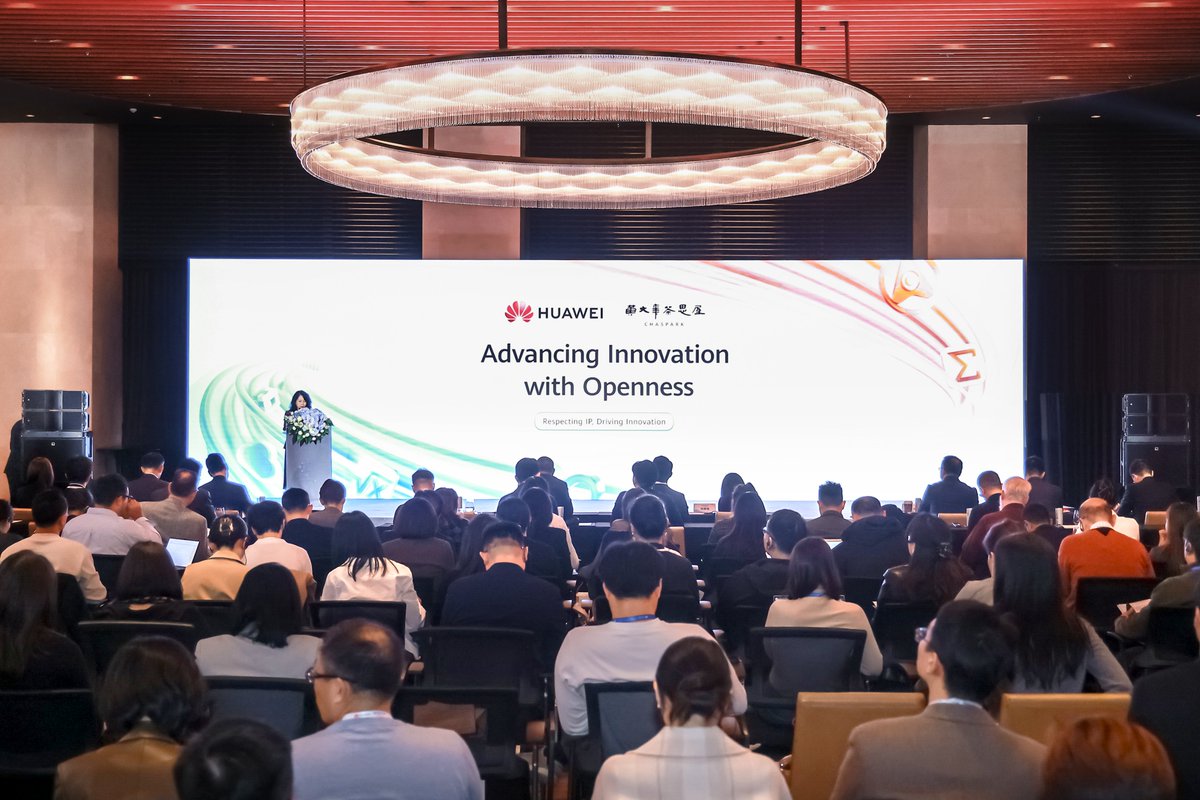
Huawei IPR 2025: Advancing Innovation Through Openness and Shared Value At Huawei’s 2025 Innovation and Intellectual Property Forum, held in Beijing, a clear message was conveyed to the global technology ecosystem: the next stage of digital progress will be defined not only by innovation but also by openness. Under the theme “Advancing Innovation with Openness,” this year’s event brought together senior industry leaders, global IP experts, and R&D pioneers to explore how collaborative and balanced approaches to intellectual property can drive innovation while enhancing trust and shared economic benefit. The Forum featured Huawei’s sixth Top Ten Inventions awards, recognising breakthroughs in computing, AI systems, architectural design, data storage, and next-generation operating systems. These are not incremental updates; they lay the groundwork for the coming decade — including ultra-large-scale AI clusters, advanced storage architectures, and adaptable, privacy-preserving operating systems. Yet the technology itself was not the core message. The emphasis was on the innovation model shaping it. The Economics of Shared Progress Huawei invested RMB 179.7 billion in R&D in 2024, accounting for over 20% of its annual revenue, with more than RMB 1.249 trillion invested over the past decade. This places the company among the world’s top six R&D investors. Such sustained commitment only matters if its benefits are broadly realised. That is where open innovation becomes strategic. * Participation in nearly 800 standards organisations * Over 10,000 technical contributions submitted in 2024 * More than 150,000 active patents worldwide * Patent licensing revenue of US$630 million in 2024, while historically paying nearly three times in royalties than it has received As Alan Fan, Head of Huawei’s Intellectual Property Rights Department, noted: “Innovation has the greatest impact when it moves. We publish patents, contribute to standards, share code, and collaborate across borders because the industry grows faster when technology is not siloed. We innovate to create value that can be scaled — not locked away.” This reflects a model of strategic IP circulation aimed at industrialising innovation. Openness as an Innovation Infrastructure The forum highlighted how Huawei is building an innovation infrastructure that is open by design — from open-source operating systems to globally accessible IP search platforms. openEuler now exceeds 10 million installations, and OpenHarmony has surpassed 1 billion powered devices, supported by thousands of global contributors. These are co-created ecosystems that expand capability and reduce duplication across industries. Similarly, the Chaspark Patent platform provides free access to over 200 million patent documents worldwide. Recent updates introduced AI semantic search and automated technical summaries, enabling researchers, startups, and students to analyse complex technical landscapes without specialised tools or licensing costs. Taken together, these initiatives embody a strategic philosophy: innovation accelerates when knowledge, code, and technical foundations are widely accessible. Openness is an economic multiplier. Why This Matters Breakthrough technologies such as large-scale AI compute, sovereign operating systems, and next-generation storage architectures only realise their full potential when supported by a strong surrounding ecosystem. The winners will be those who link breakthrough innovation with broad access and participation. Huawei is framing IP as shared infrastructure, allowing researchers, developers, and enterprises globally to collaborate. Why? Closed innovation scales slowly. Open, standards-based collaboration has the potential to scale exponentially. Openness is no longer philosophical — it is competitive. The Signal for 2025 and Beyond In an era of digital sovereignty strategies, fragmented standards, and geopolitical tension, Huawei presents a counter-narrative: openness and industrial competitiveness bolster each other. The leaders of the next decade will not be those who build the tallest walls, but those who build the strongest bridges — between technologies, markets, and ecosystems. The future will belong to those who innovate bravely and collaborate extensively.
Tony Moroney tweet media
English
0
5
6
116.7K
Tony Moroney retweetledi
Hans Stuttgart
Hans Stuttgart@HB_Logistics1·
@BetaMoroney @TechEquityAi Strong lineup. I'm most interested in practical AI applications and how they’ll drive long-term resilience in supply chains. Real-world impact will be the true measure of success.
English
0
3
1
282