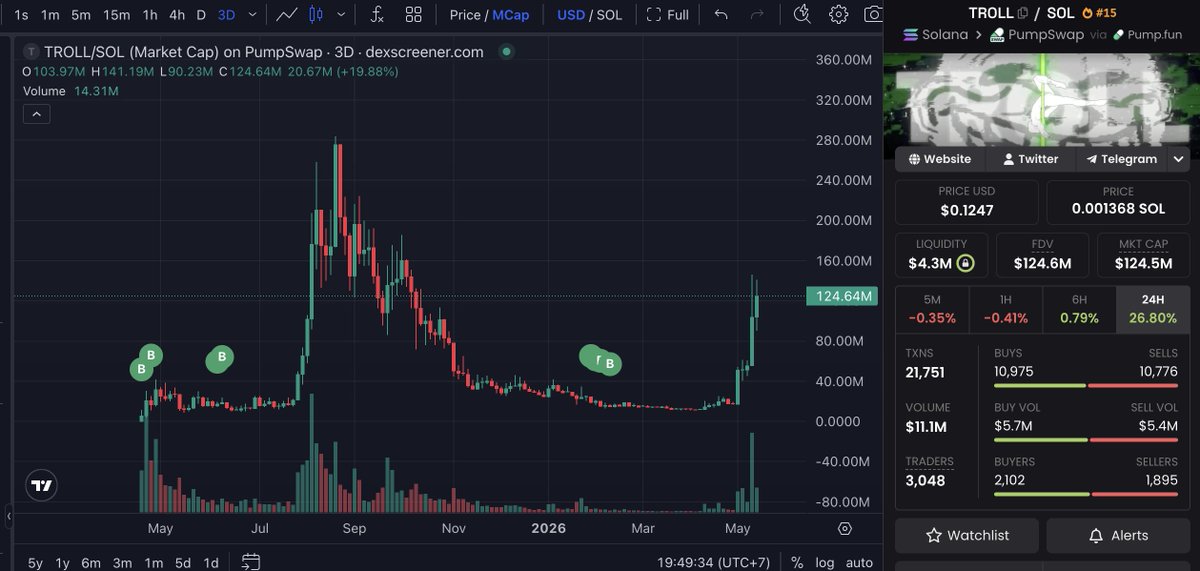
I think people forget how fast the memes can move solana:5UUH9RTDiSpq6HKS6bp4NdU9PNJpXRXuiw6ShBTBhgH2 very few are patient enough to wait for those moves.

English
𝐁 𝐈 𝐋 𝐋 𝐈 𝐎 𝐍 𝐒
38 posts





This wallet was literally 20x on his bag… why didn't he sell it? Because he believes in the $Troll community.


Cardano desperately needs more active traders in the ecosystem... WHY MEMECOINS ARE THE BEST SHOT AT MAKING IT HAPPEN 🧵👇
Finally order my dream car tank you cardano memecoins $TYC




Sorry, @RonSwanson1984, but if you are a CEO and entrepreneur, why are you so surprised that DReps ask about KPIs and future revenue predictions when you apply for a loan? The analysis was important in this case because revenues depend on on-chain activity. Listing SNEK on CEXs does not generate any direct profit; it is only an expense. Revenues come from fees and other associated businesses. If listing causes lower on-chain activity, the chances of repaying the loan will worsen. As an entrepreneur, you yourself must know that if a bear market comes, on-chain activity will decrease significantly. I assume everyone watched the Solana meme mania. We all know how and why it ended and what it left behind: a damaged reputation, many deceived people, and reduced on-chain activity. I certainly see the benefits of SNEK for Cardano, and I hope it becomes a successful meme coin. But I can't be blind to the negative aspects. The SNEK team should anticipate future developments and have a plan for risk mitigation. What's wrong with my thinking? It's definitely not overthinking, I'm asking the team direct, simple questions. Honestly, all DReps should have asked this instead of giving a "simple YES". Sorry, but instead of the SNEK team answering or providing feedback on the rationales that DReps provided, we only see comments about the credibility or expertise of DReps. Honestly, the proposal could have been better written and could have included key information.


As a DRep, I’ve decided to vote NO on the ₳5M loan proposal for Cardano’s Global Listing Expansion powered by SNEK. This decision was not made lightly. It followed a detailed analysis of the proposal and extensive engagement with the SNEK community. It was one of the most difficult governance choices I’ve faced so far. My rationale: The SNEK Foundation has already invested $4.5M into listings on several major centralized exchanges (CEXs). However, the current trading volumes are low. In the last 24 hours: ▪️ Kraken saw $88,000 in volume, ▪️KuCoin $30,000, and ▪️Crypto-com just $2,000. I examined the impact of these listings on Cardano’s on-chain activity and volume. While there was a short-term spike following the listings, the numbers quickly returned to previous levels. In fact, Cardano’s on-chain volume has been trending downward. The peak was in 2023, and by 2025, we’re seeing the lowest levels yet. Transaction counts are also gradually declining, aside from occasional spikes. This leads to a clear conclusion: listing on major CEXs has not significantly boosted Cardano’s on-chain activity or volume. At least so far. Meanwhile, HTX shows a much higher volume—$7M in the last 24 hours. This is substantially more than what we see on Cardano’s decentralized exchanges (DEXs), where: ▪️Minswap V2 recorded $480,000, ▪️Wingriders V2 $74,000, ▪️and Minswap $41,000. To better understand the broader implications, I analyzed the case of Shiba Inu, arguably the most successful meme token. Across the top five CEXs, Shiba Inu saw $125M in volume in a single day, while the top five DEXs combined for only $275,000. That’s a 450x difference. Despite having 1.5 million holders, Shiba Inu averages only about 6,000 on-chain transactions per day. This shows that even successful meme coins generate most of their activity on CEXs, not on-chain. If SNEK were to gain popularity following a major listing, it’s likely that the impact on Cardano’s DeFi ecosystem would be minimal—or even negative, as attention shifts away from on-chain protocols. After the FTX collapse, interest in self-custody grew, but this trend is mostly limited to BTC and ETH. For altcoins and meme coins, users still prefer CEXs due to ease of trading. While it’s possible that some users might discover SNEK on a CEX and then install a Cardano wallet, the number of such users will likely be small, though still welcome. The proposal should have included a clear forecast of how CEX listings would drive growth in on-chain activity, volume, and user adoption. That data is missing. Listing the first Cardano asset on a top-tier exchange could pave the way for future projects. However, it's important to note that IOG plans to list NIGHT on major CEXs without requesting Treasury support. Given this, the current proposal is not urgent. This proposal is also notable for being the first to request a loan from the Cardano Treasury. I appreciate the initiative. However, the community has not yet reached consensus on whether Treasury loans should be collateralized. In a recent poll I conducted: ▪️59% of voters supported collateralized loans, ▪️13% opposed, ▪️and 17% preferred a case-by-case approach. The SNEK proposal requests a loan without offering any collateral. Personally, I don’t believe the absence of collateral should automatically disqualify a proposal. The Treasury should act like a strategic investor—willing to take calculated risks to support ecosystem growth. Many teams seeking support likely don’t have collateral, and a strict requirement could stifle innovation and early-stage development. If the team had sufficient collateral or strong confidence in their project's success, they could secure funding by taking out a loan through DeFi platforms. That said, proposals must include: ▪️data-driven forecasts, ▪️measurable KPIs, ▪️and realistic revenue expectations. DReps need this information to assess risk and relevance. Funding should also be milestone-based, with future disbursements contingent on progress. Although off-chain discussions and private communications shouldn’t normally influence governance decisions, they are acceptable at this early stage. I publicly asked Goofycrisp, a core SNEK contributor, the following: "At present, the proposal doesn’t specify any form of on-chain or off-chain collateral. Can you clarify whether the loan will be collateralized, and if not, what safeguards will protect Treasury funds in the event of non-repayment?" He replied: "It's also the ONLY proposal that WILL pay back plus interest and is a direct net positive for the treasury. At this point, Cardano gotta trust us. And I believe we've earned it." This response is concerning. Treasury loans cannot be based solely on “trust me, bro.” That would set a dangerous precedent. This proposal will shape future governance standards, and we must demand transparency and accountability—not vague assurances. The SNEK team claims the loan will be repaid over five years using revenue from their products, including Snek-fun, SNEKbot, Snekx, and SecurityBot. They state: "Just as an example, over the last 30 days, Snek-fun has generated 100,000+ ADA. If we assume no growth at all, this alone would equal ~6.3M ADA over five years, already covering the loan principal." While this sounds promising, the team only provided concrete numbers for Snek-fun. The rest of the revenue streams are mentioned without supporting data. The assumption that Snek-fun will maintain its current revenue for five years is overly optimistic—if not naive. History shows that meme hype is short-lived. Solana’s recent meme boom collapsed, with volume and activity dropping by 90%. Every bear market has had similar effects. If Snek-fun’s revenue drops, the team may not be able to repay the loan. Without detailed financials from other products, it’s impossible to assess the risk. We also need to consider the broader ecosystem. Cardano currently has high fees and slippage, making it less competitive than Solana or CEXs for swaps. Under current conditions, it’s unlikely that Cardano will experience a meme coin mania similar to Solana’s. Beyond the short-term benefits of volume and attention, we must also weigh the long-term risks. Solana’s meme surge damaged its reputation. Some users left and may never return. The meme space has both bright and dark sides, and we must acknowledge that. The proposal does include a Board of Advisors intended to provide guidance and validation. However, I haven’t seen any public statements from these advisors clarifying their roles. Notably, representatives from EMURGO and the Cardano Foundation are listed as advisors, and they also serve as DReps voting on Treasury proposals. This dual role raises concerns. Even if their votes are based on merit, the optics of advising and voting on the same proposal could undermine community trust. In summary, while the proposal is ambitious and well-intentioned, it lacks the necessary data, transparency, and safeguards to justify a ₳5M loan from the Treasury. For these reasons, I am voting NO. I’m rejecting the proposal at this time to send a clear signal: Treasury loans must meet standards that will apply to all future projects. Ideally, these standards should have been defined earlier, perhaps even before the vote on the 39 withdrawals, but we can’t rewrite history. What we can do is keep improving our governance processes. In that sense, this proposal is valuable. It highlights gaps in our current framework and pushes the community to refine how we evaluate and manage Treasury loans going forward. If you'd like to support my work, consider delegating to the MANDA pool or backing me as a DRep. Your support helps drive meaningful contributions to the Cardano ecosystem. MANDA Pool ID: pool1c3fjkls7d2aujud8y5xy5e0azu0ueatwn34u7jy3ql85ze3xya8 My DRep ID: drep1km69g7ksf8t5g0h9d9tkrcd2tezxelx0wtr76rv2mrkl5nzd6v3