
Dr. Lynne Binnie

4.6K posts

Dr. Lynne Binnie banner
Dr. Lynne Binnie

Dr. Lynne Binnie

@BinnieL

Head of Education (Inclusion). The City of Edinburgh Council. Educational Psychologist. All views my own.

Scotland Katılım Aralık 2011
927 Takip Edilen1.9K Takipçiler
Dr. Lynne Binnie retweetledi

NHS Lothian
NHS Lothian@NHS_Lothian·
Neurodiversity recognises that there’s no single ‘right’ way for a brain to think, learn or experience the world 🌈🧠 Explore support, services and practical guidance available across Lothian and the wider community on our newly launched website: services.nhslothian.scot/neurodiversity/
NHS Lothian tweet media
English
0
4
4
402
Dr. Lynne Binnie retweetledi
Naomi Fisher
Naomi Fisher@naomicfisher·
Masking has no scientific validity, says Uta Frith, after sixty years of autism research. Yet masking resonates with so many autistic people. It feels true and it feels like an explanation. Both of those things can be true at the same time. Masking does resonate with many people. It describes something important about their experience. In fact, in my clinical experience masking resonates far beyond autism. It resonates for those who are socially anxious, those with OCD and those with depression. It resonates for people living in cultures they were not born into. It resonates for people going into unfamiliar or challenging environments. It resonates for many women in male-dominated workplaces. Whether or not they are autistic. And this is one of the problems. Masking is talked about as if it’s specific to autism, but the research hasn’t been done to demonstrate that. To draw that sort of conclusion, you need large scale quantitative research on representative samples. You need a carefully chosen comparison group. Online survey studies are unlikely to fulfil these criteria. Lived experience isn’t enough - no one can conclude from their lived experience whether something is autism-specific or not. There are other scientific problems with the idea of masking. It means different things to different people, and it is highly expansive. It is used to explain many different experiences - and researchers have found that there is no agreed upon definition. A third scientific problem with the concept of masking is that the evidence base is unrepresentative. Most of the research has been done on late-diagnosed females without intellectual disability - but it’s been assumed that this generalises to all autistic people. We simply don’t know if this is the case. There are other problems with the concept of masking, but these are three key issues identified in a recent review of the literature on masking/camouflaging. They looked at 389 studies. Number of papers published isn’t enough to make a concept scientifically valid. Other things matter too. journals.sagepub.com/doi/10.1177/13…
English
37
51
250
40K
Dr. Lynne Binnie retweetledi
Education Scotland
Education Scotland@EducationScot·
Explore the Inclusion, Wellbeing and Equalities Professional Learning Framework, offering flexible resources that support self-directed, collaborative or facilitated professional learning across ELC and school settings. 🔗 ow.ly/ayfs50YpJwI
Education Scotland tweet media
English
0
12
14
2.1K
Dr. Lynne Binnie retweetledi
Dr Danish
Dr Danish@operationdanish·
The Case for Childhood Boredom. A strange thing has quietly disappeared from childhood. Boredom. For most of human history, boredom was unavoidable. Childhood unfolded in long, uneven stretches of time that nobody bothered to organize. Summer afternoons drifted by without a schedule, car rides lasted hours with nothing but the passing landscape, and children spent entire days outside with only a loose instruction to be home before dinner. And something curious tended to happen in those empty spaces. Children invented things. A stick became a sword, and then a fishing rod, and then, without warning, a wand capable of defeating imaginary monsters. A patch of grass became a battlefield. A cardboard box became a spaceship. Entire worlds emerged out of nothing more than idle time and a restless mind. Neuroscientists now understand that the brain behaves differently in those moments. When external stimulation fades, a network deep in the brain called the default mode network begins to activate. It is the circuitry associated with imagination, memory integration, and abstract thinking. When the mind has nowhere specific to go, it begins to wander, and while it wanders it starts connecting dots that rarely meet during structured activity. Creativity often lives in that wandering. Modern childhood, however, has undergone a quiet redesign. Empty time has been steadily replaced with organized activity. Sports leagues, tutoring sessions, music lessons, enrichment programs. Even the small gaps between activities tend to be filled with screens engineered with extraordinary precision to eliminate boredom the moment it begins to appear. Parents worry when boredom surfaces. A child announcing “there’s nothing to do” can feel like a problem waiting to be solved, a signal that the environment lacks sufficient stimulation. But boredom is simply the brain beginning a different mode of operation. The mind starts generating its own stimulation instead of consuming someone else’s. Look closely at the childhoods of unusually creative people and a pattern emerges. Steve Jobs spent long stretches wandering the neighborhoods of Silicon Valley, exploring electronics shops and experimenting in garages. Albert Einstein famously described hours of quiet daydreaming as a child, staring out windows and imagining physical problems in his head. J.K. Rowling began inventing elaborate stories long before she had any audience for them. Each of them had something that has become surprisingly rare. Psychological whitespace. Modern childhood often resembles a corporate calendar. Every hour accounted for. Every activity supervised. Every quiet moment quickly filled by a glowing rectangle designed by teams of behavioral scientists whose job is to make sure attention never drifts into silence. And yet many of the qualities parents hope their children will develop—creativity, resilience, independence—tend to emerge from precisely the conditions we have learned to eliminate. Unstructured time confronts a child with a deceptively simple problem. What should I do next? That question trains the brain in powerful ways. It forces the mind to generate ideas, to tolerate the mild discomfort of inactivity, and eventually to invent something interesting enough to fill the gap. Children who rarely encounter boredom often struggle to resolve it on their own. They wait. They look outward for stimulation rather than inward for possibility. Childhood boredom, in that sense, becomes a kind of workshop. It is the place where imagination practices building things from nothing, where the mind experiments freely without instruction, and where curiosity slowly learns how to entertain itself. Left alone long enough, the mind begins to wander. And wandering minds have a peculiar habit of discovering entirely new worlds.
Dr Danish tweet media
English
58
598
2K
97.1K
Dr. Lynne Binnie retweetledi
Steve Magness
Steve Magness@stevemagness·
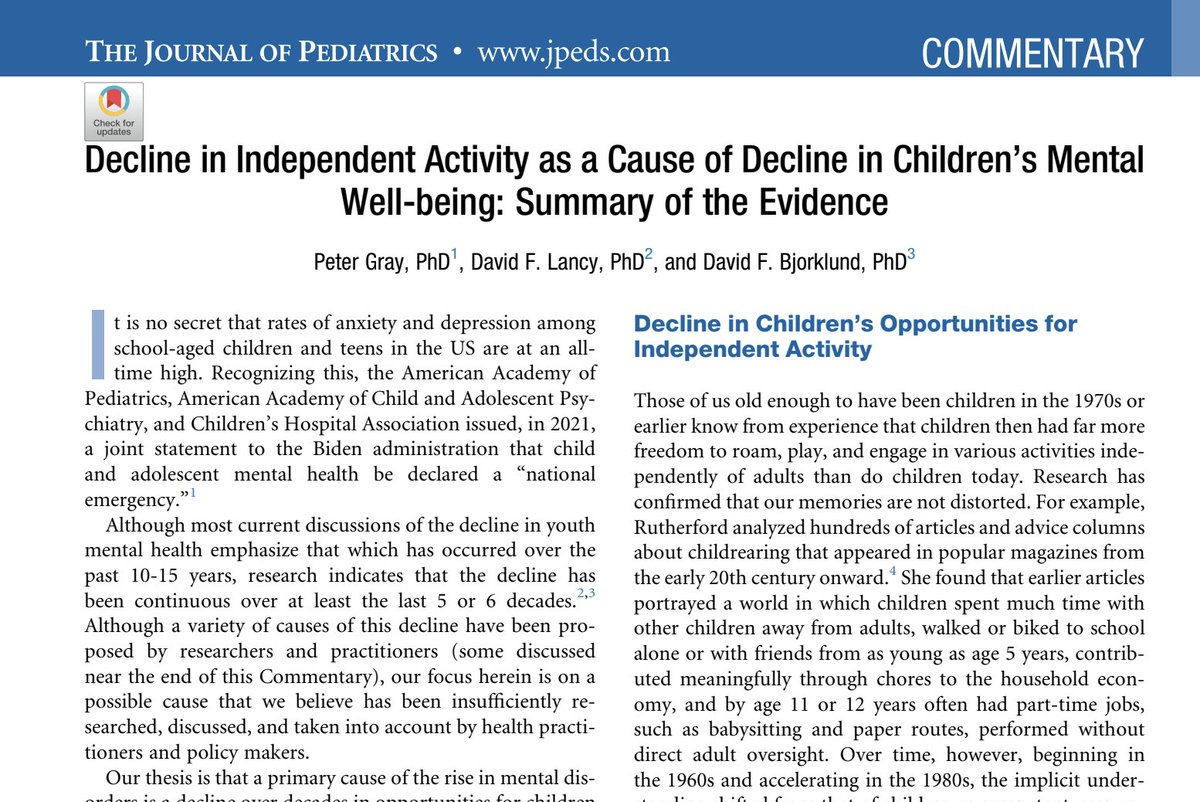
In a ​new paper​, researchers argue that: “a primary cause of the rise in mental disorders [in youth] is a decline over decades in opportunities for children and teens to play, roam, and engage in other activities independent of direct oversight and control by adults.”
Steve Magness tweet media
English
56
685
3.2K
138.4K
Dr. Lynne Binnie retweetledi
Tes magazine
Tes magazine@tes·
‘I’ve been swept up by the autism spectrum idea, and it’s only in the past 10 years that I have felt things have gone too far. Very slowly, I have come to say, “No, this is not right”’: Autism expert professor Uta Frith talks to @Helen_Amass tes.com/magazine/teach…
English
24
14
41
76.2K
Dr. Lynne Binnie retweetledi
Children's Health Scotland
Children's Health Scotland@ChildHealthScot·
Did you know? The My Rights, My Say service is designed to help young people aged 12-15 years old with additional support needs have their views and voices heard, and included, in decisions about their learning. Find out more👉 myrightsmysay.scot
English
0
2
1
112
Dr. Lynne Binnie retweetledi
Mel Ainscow
Mel Ainscow@MelAinscow·
‘Every Dundee Learner Matters’ provides many lessons on how to promote inclusion and equity across an entire education system. Now in its fifth year, it has made significant progress as a result of collective effort. More details in this paper: link.springer.com/article/10.100…
English
0
6
13
586
Dr. Lynne Binnie retweetledi
Tes magazine
Tes magazine@tes·
What’s behind the recent surge in parent complaints against schools? And what can be done to stop unnecessary complaints from taking up valuable staff time? @ellencph investigates tes.com/magazine/analy…
English
1
3
7
11.5K
Dr. Lynne Binnie retweetledi
Prof. James Davies (PhD) 💭
Prof. James Davies (PhD) 💭@JDaviesPhD·
"Two-thirds of young people in the UK felt they have had a mental disorder. We are broadening the criteria for what counts as illness [&] lowering the thresholds for diagnosis.....the evidence is gathering that this may be making us feel worse". theguardian.com/news/2026/feb/…
English
9
39
112
11.4K
Dr. Lynne Binnie retweetledi
Steven Pinker
Steven Pinker@sapinker·
The autism epidemic is a myth: The increase is only in expansive overdiagnosis of kids "on the spectrum," e.g. "Would rather be alone than with others,” “Has difficulty making friends,” and “Is regarded by other children as odd or weird.” Severe cases (no language, socially unresponsive, etc.) have decreased. By my former grad student @AdamOmaryPhD washingtonpost.com/opinions/2026/…
English
0
900
5K
763.7K
Dr. Lynne Binnie retweetledi
Tom Bennett OBE
Tom Bennett OBE@tombennett71·
Zones of Regulation is everywhere in primary schools, but the evidence base is thin. Teaching children to colour-code feelings *might* build emotional vocabulary, but there’s little proof it improves behaviour at scale. Too often it becomes labelling without change. Worse, it can externalise responsibility ( ‘I can’t help it, I’m in red zone’) as an explanation rather than something that prompts introspection. If schools want calmer classrooms, the research points far more strongly to consistent routines, explicit behaviour teaching/ curriculum, adult modelling, boundaries and consequences, with targeted pastoral support when necessary. ZoR can support strategy, and prompt useful conversations. The evidence base is suggestive, not conclusive, and there are pitfalls and opportunity costs. And sometimes, dwelling on emotional states can be unhelpful too..
Tes magazine@tes

Today’s primary pupils can struggle with behaviour because their early development was affected by the pandemic – but the Zones of Regulation have helped at our school, says this international leader tes.com/magazine/teach…

English
11
22
120
39.6K
Dr. Lynne Binnie retweetledi
respectme - Scotland's Anti-Bullying Service
‼️NEW for PARENTS AND CARERS‼️ We've launched a new FREE Anti-Bullying Learning Academy eLearning course. Gain practical skills and confidence to support children & young people. 📢Find out more: bit.ly/3ZeS028
English
0
1
2
182
Dr. Lynne Binnie retweetledi
respectme - Scotland's Anti-Bullying Service
‼️NEW for PARENTS AND CARERS‼️ We've launched a new FREE Anti-Bullying Learning Academy eLearning course. Gain practical skills and confidence to support children & young people. 📢Find out more: bit.ly/3ZeS028
English
1
4
5
132