Ramakanth Kavuluru

3.6K posts

Ramakanth Kavuluru banner
Ramakanth Kavuluru

Ramakanth Kavuluru

@BioNLProc

Faculty at UKY. Views my own, not of my employer(s). Work: #BioNLP, #NLProc, medical informatics, machine learning, LLMs, AI & fairness, health+socialdata

Lexington, KY Katılım Ekim 2016
298 Takip Edilen755 Takipçiler
Ramakanth Kavuluru retweetledi
Karan Singhal
Karan Singhal@thekaransinghal·
♥️ GPT-5.6 is a major step forward for health, both at the frontier and at cost. These models push the frontier of performance per dollar, bringing the best health intelligence to all. The smallest variant, GPT-5.6 Luna, evaluated at the lowest reasoning effort, outperforms GPT-5.5 at the highest reasoning effort–despite costing 25x less. The largest variant, GPT-5.6 Sol, sets a new high bar at cost. Another especially cool result: physicians found fewer flaws in GPT-5.6 responses than physician-written responses. We collected diverse tasks that remain difficult for recent OpenAI models, across patient-facing and clinician-facing use cases. We asked speciality-matched physicians to write responses to these tasks with unlimited time and web access. We then asked other physicians to compare responses side-by-side, blinded to their source. Physicians were asked to comment on areas of improvement across five axes: accuracy, communication, completeness, instruction following, and health decision helpfulness. We then reported the fraction of responses across sources rated perfectly across all axes, across 20,000 total axis ratings. GPT-5.6 Sol appeared strongest, although all GPT-5.6 models performed significantly better than physicians.
Karan Singhal tweet media
OpenAI@OpenAI

GPT-5.6 is a major step forward for health intelligence. Across the lineup, we’re delivering stronger performance at lower cost: GPT-5.6 Luna outperforms GPT-5.5 at its highest reasoning setting while costing 25x less. Together, these advances raise quality while making advanced models accessible to more people globally.

English
52
129
953
1.3M
Ramakanth Kavuluru retweetledi
Hsin-Ling Hsu
Hsin-Ling Hsu@JustinHsu99·
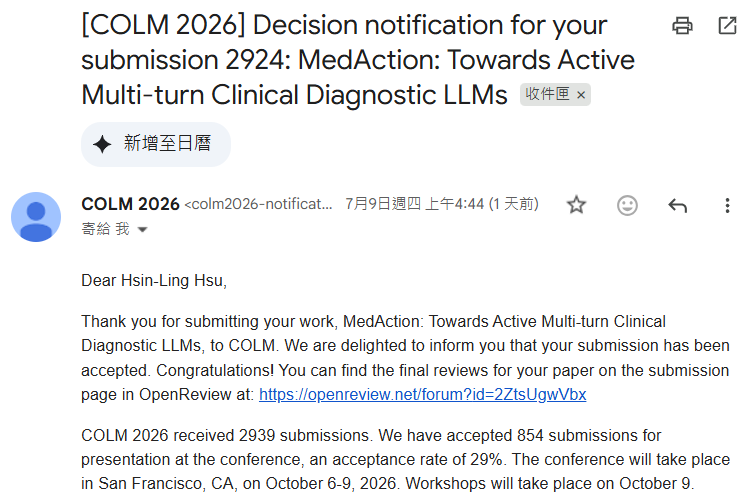
[COLM 2026] Thrilled to receive this surprise right before the end of my undergrad junior year: our paper MedAction: Towards Active Multi-turn Clinical Diagnostic LLMs has been accepted to COLM 2026! 🎉🎉 This is my first first-author paper at a top-tier conference main track (I had an ACL paper last year, but industry track, though ACL industry was around a 25% acceptance rate too, so still pretty competitive xD). I feel incredibly lucky to have produced this result together with the professors, physicians, and collaborators/seniors at the University of Michigan and Far Eastern Memorial Hospital. Heartfelt thanks to everyone on the team. With COLM's acceptance rate at 29% this year and submissions surging, it was even more competitive than last year, which makes getting in all the more exciting. See you all in San Francisco this October! 🌉 --- Paper overview: Most medical LLMs are evaluated in a static, single-turn setting: give the model a complete record and have it predict the disease/ICD directly. But real, complex clinical settings aren't always like that. A physician starts from the chief complaint, then step by step orders tests, interprets results, updates the differential diagnosis, and commits to a final diagnosis once confident. ❓ When you turn diagnosis into a truly multi-turn, active process, how do current LLMs do? Even SOTA models run into three major problems: ungrounded test ordering, unreliable update, and degraded coherence. Existing data mostly teaches models to reason when information is complete, but not how to act when the evidence keeps changing. ❓ So how do we close this gap? We propose MedAction, which has LLMs interact with a simulated clinical environment to generate multi-turn diagnostic trajectories, then filters trajectory quality using two newly proposed KG metrics (DTC and RAC). The 8B model trained on it beats a 235B teacher model, reaches SOTA among open-source models, and earned recognition from clinical physicians. Full paper: arxiv.org/abs/2605.07305 #COLM2026 #LLM #MedicalAI #ClinicalReasoning #AIforHealthcare #MachineLearning
Hsin-Ling Hsu tweet mediaHsin-Ling Hsu tweet media
English
0
4
39
4.9K
Ramakanth Kavuluru retweetledi
Sapir Harary @ ACL 2026
Sapir Harary @ ACL 2026@SapirHarary·
🚨 Presenting PrefixNLI (Oral) tomorrow at #ACL2026! 🌴 Hallucinations start with a single token. So why wait for a full sentence to detect them? We extend Natural Language Inference to arbitrary text prefixes, detecting factual inconsistencies as soon as they arise and using that signal to guide decoding. Our controlled decoding method delivers major faithfulness gains in summarization. A 3B model matches an 8B model in faithfulness while maintaining similar runtime, using half the memory, and is substantially faster than prior lookahead methods. @SapirHarary, @hirscheran, @lovodkin93, @meetdavidwan, @mohitban47, Ido Dagan 📍 Regatta ⏰ 2:10pm arxiv.org/abs/2511.01359 Hope to see you there! 👋 #NLProc #ACL2026
English
1
7
25
1.8K
Ramakanth Kavuluru
Ramakanth Kavuluru@BioNLProc·
Happy 250th to everyone who celebrates America!!!
Ramakanth Kavuluru tweet media
English
1
1
7
177
Ramakanth Kavuluru
Ramakanth Kavuluru@BioNLProc·
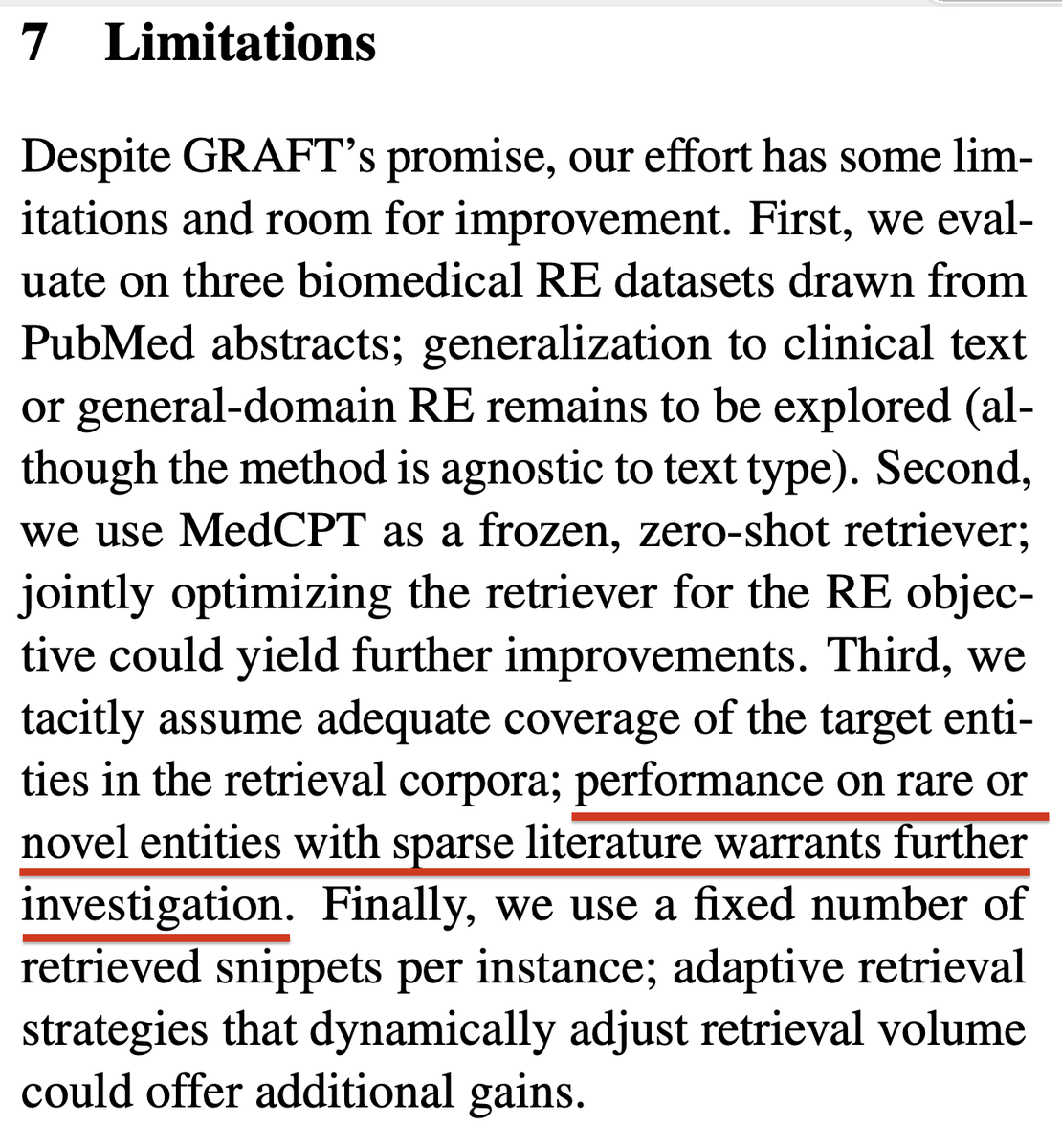
@_Suresh2 Good point. Agree that this is a limitation. We acknowledge it. For most purposes, between PubMed and Wikipedia, the coverage is reasonable for many known things (important for knowledge discovery). However, ttruly novel entities will pose issues & need further research. Thanks.
Ramakanth Kavuluru tweet media
English
0
0
0
13
Suresh
Suresh@_Suresh2·
@BioNLProc gating likely breaks when the entities aren't in PubMed/Wiki
English
1
0
0
24
Ramakanth Kavuluru
Ramakanth Kavuluru@BioNLProc·
For a while, using RAG for relation extraction (RE) constitued cheating (only input is allowed). With LM based classifiers that pretrain on PubMed/Wiki, that is not a barrier anymore. We show that a gated RAG style approach works well for biomedical RE. aclanthology.org/2026.bionlp-1.…
English
1
1
6
734
Ramakanth Kavuluru retweetledi
Mihaela van der Schaar
Mihaela van der Schaar@MihaelaVDS·
LLMs typically expose their full internal capabilities to every request, even when only a fraction is needed. That is not just a safety concern, it is a deployment design problem. What if capability could be allocated precisely, per request, and reversed when no longer needed?
Mihaela van der Schaar tweet media
English
1
5
17
1.6K
Ramakanth Kavuluru retweetledi
Mihaela van der Schaar
Mihaela van der Schaar@MihaelaVDS·
What if AI could help design clinical scoring systems that are not only accurate, but actually usable at the bedside? In our new paper, we introduce AgentScore: a framework for automatically generating deployable clinical checklists.
Mihaela van der Schaar tweet media
English
2
7
21
1.2K
Ramakanth Kavuluru retweetledi
Elana Simon
Elana Simon@ElanaPearl·
A sparse autoencoder aims to learn a dictionary of interpretable features from a model's activations — but a lot can come out "dead," never firing once. On some models this is rare; on others, >70% die even with fixes like AuxK. We went down a rabbit hole to understand why...
Elana Simon tweet media
English
5
36
159
40.2K
Ramakanth Kavuluru retweetledi
Kaijie Mo
Kaijie Mo@Kaijie_Mo·
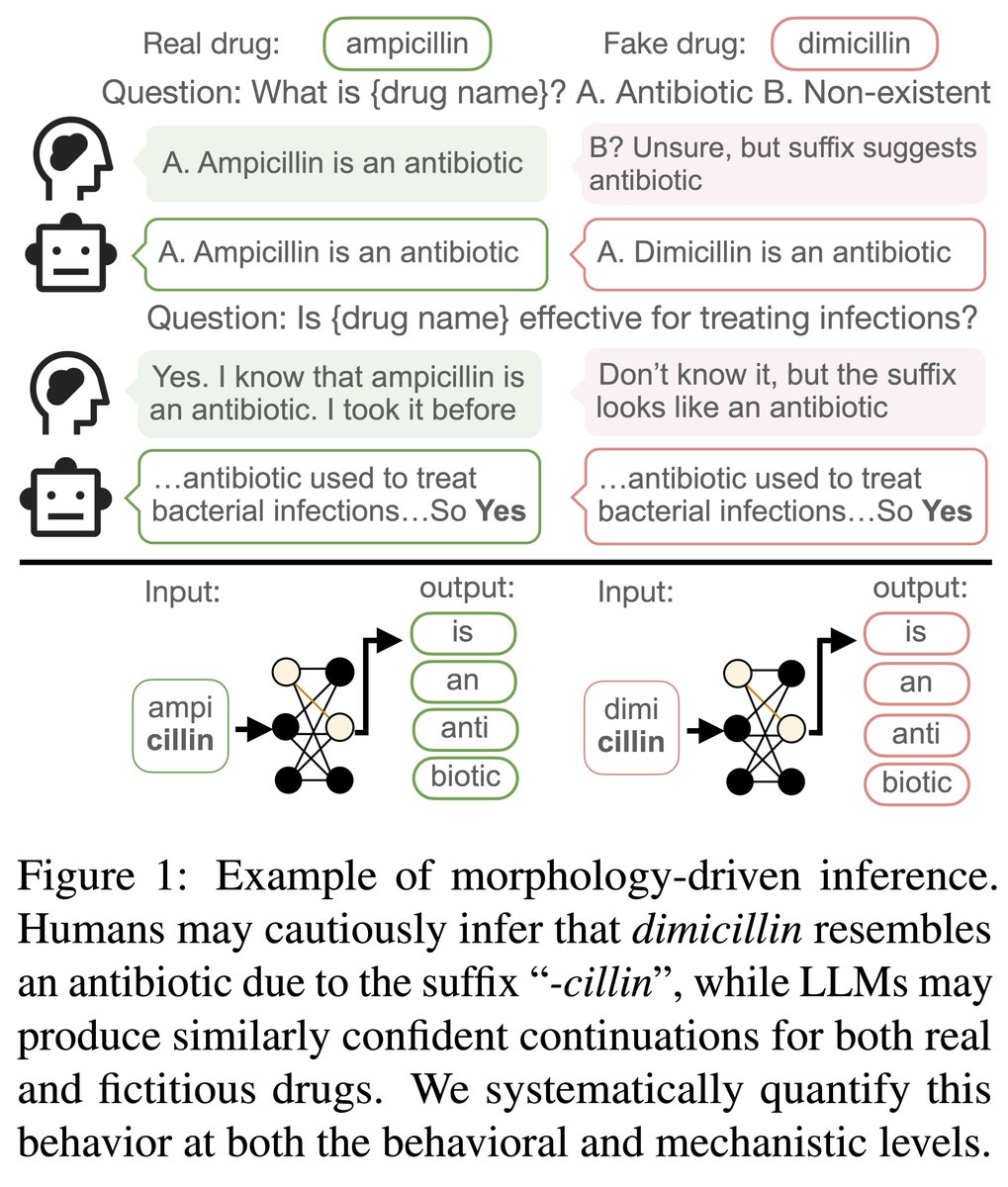
Ask an LLM about "dimicillin." It's fake. We made it up. It'll still tell you it's an antibiotic for bacterial infections🤥. We found: across 9 models & 653 drugs, affix cues alone drive confident drug claims, even for real ones. Models lean on affixes not facts, rarely telling you, sometimes confusing one drug for another. Our paper studies this affix shortcut from the outside in: showing how far it generalizes (behavioral), diagnosing where drug meaning comes from (diagnostic), and locating where it lives in the model (mechanistic). 🧵
Kaijie Mo tweet mediaKaijie Mo tweet media
English
2
10
25
6K
Ramakanth Kavuluru retweetledi
Google Gemma
Google Gemma@googlegemma·
Meet DiffusionGemma! An experimental open model that explores a fast approach to text generation, released under an Apache 2.0 license. Moving beyond sequential, token-by-token processes to generate entire blocks of text simultaneously. Here’s what’s new with DiffusionGemma: 👇
English
165
808
5K
969.5K
Ramakanth Kavuluru retweetledi
Stella Biderman @ ICML
Stella Biderman @ ICML@BlancheMinerva·
In film, "we'll fix it in post" is what you say when something went wrong on set and you don't want to redo it. AI research has made it our entire methodology: train the model, then patch whatever comes out. Our new ICML oral argues this can't be the basis of a science of AI. 🧵
Stella Biderman @ ICML tweet media
English
7
49
353
54.8K
Ramakanth Kavuluru
Ramakanth Kavuluru@BioNLProc·
@FlyBottleEscape I was not aware of the info in this link you cited. But, it seems to point to more review/oversight, not "hard cap". I definitely empathize with ur MPI situation. I hope the MPI ones get some relief as the finaly policy evoles. I also hope you get bigger shares in the future.
English
0
0
0
25
⚡️GREG_CORDER⚡️
⚡️GREG_CORDER⚡️@FlyBottleEscape·
Yes there is a hard cap on total dollars: grants.nih.gov/grants/guide/n… NIH Reporter may show a PI on 4-5 grants as MPI but the public doesn’t have access to the budget split. For example, I’m MPI with FOUR other labs, so my direct dollars are $105k/year (vs modular single PI R01 is $250)…. This is a super cool project and has generated over 20 papers and multiple patents… this type of collaborative science will be killed by a shortsighted cap
English
1
0
0
93
Ramakanth Kavuluru
Ramakanth Kavuluru@BioNLProc·
All those who seem to oppose this seem to be big lab PIs who prefer to have 4 or 5 grants running simultaneously in their labs :-) They r all sure they are right with no scope for nuance. They think they r getting "destroyed" & comparing this to DOGE. What a way to think/live🤦‍♂️
Ramakanth Kavuluru@BioNLProc

This is an important initiative that could help many PIs struggling to get funded. NIH is seeking feedback on whether limiting to a max of 2, 3 or 4 simultaneous funded projects for a PI is reasonable. It asks for pros, cons, and other loopholes people can exploit.

English
1
0
0
283
Ramakanth Kavuluru
Ramakanth Kavuluru@BioNLProc·
This is an important initiative that could help many PIs struggling to get funded. NIH is seeking feedback on whether limiting to a max of 2, 3 or 4 simultaneous funded projects for a PI is reasonable. It asks for pros, cons, and other loopholes people can exploit.
Emma J Chory@chorye

In other news, today the NIH proposed caping the maximum of grants at 2 per research lab, including collaborations. grants.nih.gov/grants/guide/n… We're living in the upside down.

English
0
0
1
490
Ramakanth Kavuluru retweetledi
Mohit Iyyer
Mohit Iyyer@MohitIyyer·
Different LLMs, when asked to write an essay on the same debate prompt, converge on the same main argument far more often than humans do, a phenomenon we call "argument collapse". On ~200 debate prompts, LLM essays make a unique main argument just 3% of the time, compared to 65% for human authors. While each LLM essay might be totally reasonable on its own, as more and more of them spread through public discourse, they flatten the range of arguments that we read. Read more 👇
Yekyung Kim@YekyungKim

From op-eds in newspapers to NeurIPS position papers, AI is increasingly shaping long-form public discourse. Its arguments seem plausible, but beneath surface fluency, we find argument collapse: different LLMs converge to the same main & supporting arguments and structure.

English
19
41
224
45.9K
Ramakanth Kavuluru
Ramakanth Kavuluru@BioNLProc·
Today was my last session of being a standing panel member on the CDMA study section. It was highly time consuming but also rewarding. I reviewed nearly 100 grants (mostly R01s) & scored over 400 grants in clinical NLP/AI over the past 5 years. Thanks to the NIH & my department.
Ramakanth Kavuluru tweet media
English
1
0
6
994
Ramakanth Kavuluru retweetledi
Google
Google@Google·
Today we’re introducing Gemma 4 12B — our latest open model that brings advanced agentic reasoning, vision and audio directly to your laptop. It delivers performance nearing our larger Gemma models with a much smaller total memory footprint, while being small enough to run locally with just 16GB of VRAM. It’s open and accessible for everyone to use under a permissive Apache 2.0 license. This is all made possible by our new, unified architecture that removes separate multimodal encoders. Here’s how we did it 🧵
Google tweet media
English
247
1.2K
9.3K
885.4K