
@niftynei @bitcoinpolicy Great question — the risk weighting is multiplied by a capital ratio which is typically 8%
So 1250 x .08 comes out to 100%
English
Conner Brown
219 posts

@BitcoinConner
Managing Director at Bitcoin Policy Institute | Fmr. Counsel for Senator Lummis, @Cravath @Stanford | Working towards an abundant American future.


Today we are launching a new BPI campaign at fixbasel.org to stop the shadow ban on Bitcoin — and we need your help 🇺🇸 Right now, Bitcoin financial services are severely limited due to guidance from central banks called “Basel” that treat bitcoin as a toxic, high risk asset. Basel serves as a backdoor way for global central banks to limit what Bitcoin products and services Americans have access to. US regulators are actively considering revising this guidance. They are accepting public comments on this issue until June 18th — We need your help to make this issue a priority for the administration. On our website below you can learn more about this issue and submit a comment. We’ve even provided a sample comment to help you get started. Check it out below.
US regulators have a rule on the books that effectively bans banks from holding Bitcoin — and the window to fight it closes June 18. We built FixBasel.org so you can submit a comment in *minutes*. This is your chance to stand for Bitcoin in the federal record. Make it count.
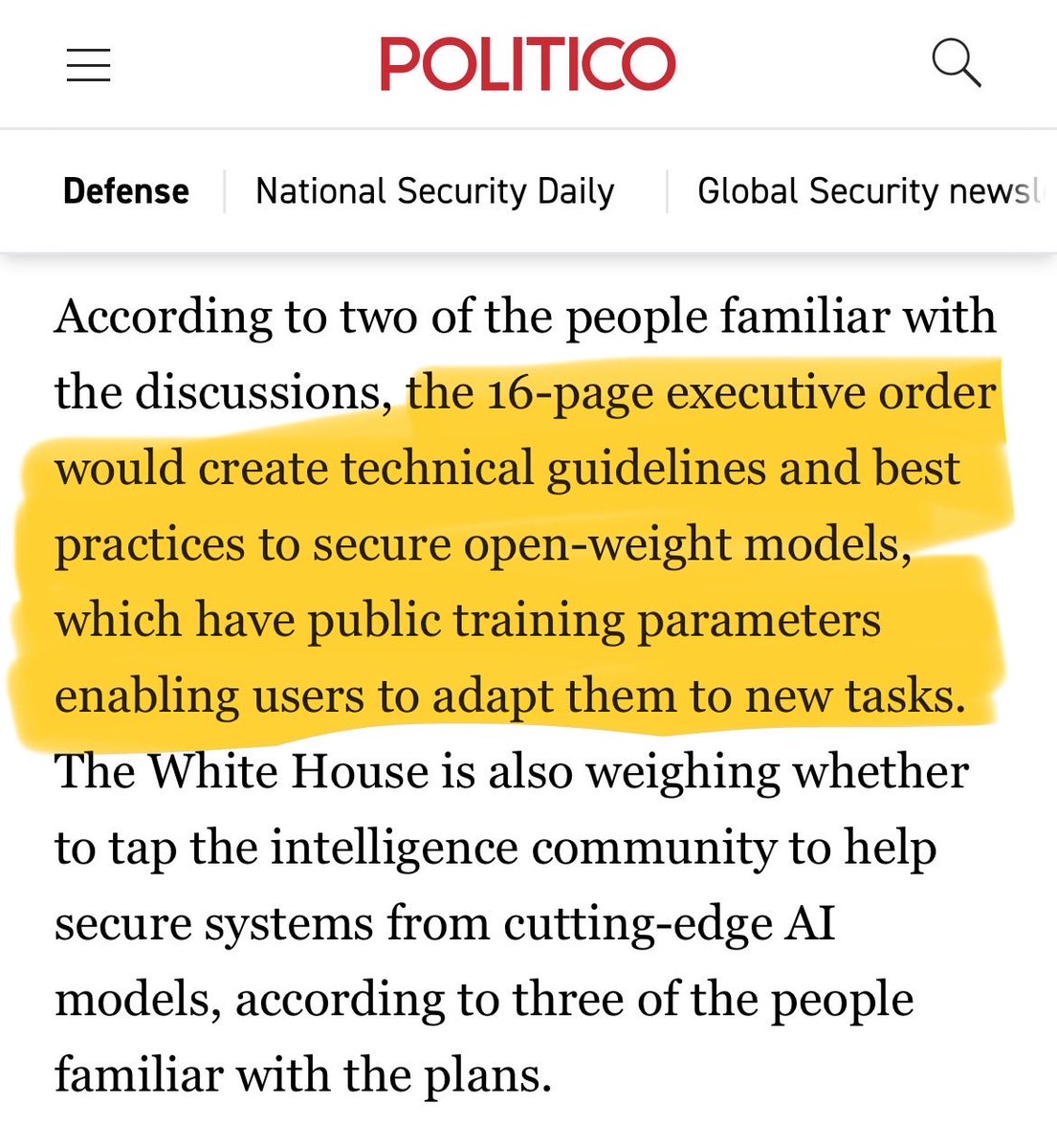
The White House is considering a slate of executive actions to address escalating security risks from advanced AI models, per 7 ppl familiar. 16-page draft EO would create new contracting/termination standards for vendors. A team effort @politico: politico.com/news/2026/05/0…



Google, Microsoft and xAI have reached agreements with the Trump administration to share early versions of their new models with CAISI, the Center for AI Standards and Innovation, run by the Department of Commerce. They will be evaluated before release to the public.

*WHITE HOUSE EYES VETTING A.I. MODELS BEFORE RELEASE: NYT
Bitcoin 2026: What a conference! Grateful for all the women in Bitcoin. 💕 @orangepeelpod @lisa_hough_ @21MMforthe21st @natbrunell @AGseedfree
This week, BPI was honored to have our research on the Geopolitical benefits of Bitcoin for Taiwan presented on the floor of Taiwan’s Legislative Yuan. Legislator Dr. Ko, a long-time Bitcoin advocate, presented our findings to representatives of Taiwan’s Central Bank and urged diversification of Taiwan’s substantial reserves into Bitcoin to bolster financial and monetary resilience.
BREAKING: Secretary Hegseth testifies that Bitcoin is a tool that supports American Power projection and counters digital authoritarianism when asked by @lancegooden about Bitcoin strategic competition.
Craig 's cryptanalysis work, among other things, may someday break Bitcoin and put at risk the $T of digital assets. @projecteleven is trying to mitigate that threat. Like Craig, I believe the need to migrate is urgent. Fine, QDay Prize sucked. So what's the right yardstick?
Project Eleven Awards 1 BTC Q-Day Prize for Largest Quantum Attack on Elliptic Curve Cryptography to Date Researcher breaks 15-bit ECC key on publicly accessible quantum hardware in a 512x jump from the previous public demonstration. Project Eleven today awarded the Q-Day Prize, a one Bitcoin bounty, to Giancarlo Lelli for breaking a 15-bit elliptic curve key on a publicly accessible quantum computer. The result is the largest public demonstration to date of the attack class that threatens Bitcoin, Ethereum, and over $2.5 trillion in ECC-secured digital assets. "The resource requirements for this type of attack keep dropping, and the barrier to running it in practice is dropping with them," said @apruden08, CEO of Project Eleven. "The winning submission came from an independent researcher working on cloud-accessible hardware. No national lab, no private chip. It shows that tangible progress is possible and highlights the urgency to migrate to post-quantum cryptography sooner rather than later. Google just committed to being quantum-secure by 2029. The window to get ahead of this is closing.” Lelli derived a private key from its public key across a search space of 32,767 using a variant of Shor’s algorithm. Shor's targets the Elliptic Curve Discrete Logarithm Problem (ECDLP), the math underlying the digital signature schemes securing Bitcoin, Ethereum, and most blockchains. Quantum attacks on ECC have moved from theory to practice over the last seven months. Steve Tippeconnic's 6-bit demonstration in September 2025 was the first public break on quantum hardware. Lelli's 15-bit result extends it by a factor of 512. Theoretical resource estimates for a full 256-bit attack, the scale Bitcoin operates at, have fallen sharply over the same period. Google's April 2026 whitepaper put the requirement at under 500,000 physical qubits. A subsequent paper from Caltech and Oratomic brought that figure as low as 10,000 qubits in a neutral-atom architecture. Lelli's result is the practical counterpart to those optimizations. The distance from 15 bits to 256 bits is large, but the gap is increasingly viewed as an engineering problem and not a fundamental physics problem. Roughly 6.9 million Bitcoin sit in wallets whose public keys are visible on-chain, exposing them to quantum attack. All blockchains using ECC share similar risks with vulnerable assets. Project Eleven is developing its next challenge, focused on the intersection of frontier AI models and quantum cryptanalysis.
INDOPACOM Commander Admiral Paparo revealed for the first time in history that the U.S. military is using a Bitcoin node to enhance national security. Proud to be an advocate for this technology.


This morning, @SenTuberville asked the @INDOPACOM Commander whether U.S. leadership in bitcoin affects deterrence and resilience against China. Adm. Paparo: "Bitcoin is a reality… a valuable computer science tool as a power projection… a peer-to-peer, zero-trust transfer of value. Anything that supports all instruments of national power for the United States of America is to the good." Years of BPI research anticipated this exchange: