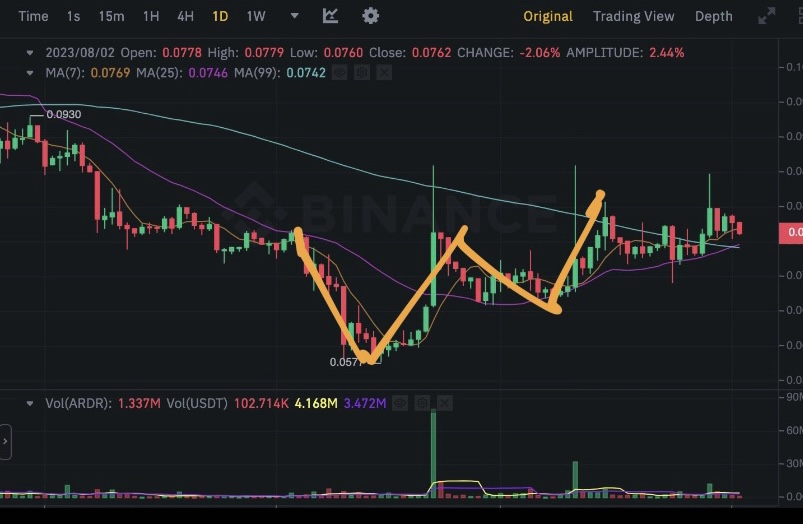
@PancakeBigBoss@PancakeSwap@arbitrum BnB has crumble currency on the cards. What would that do to pancake. Bnb pancake has stayed closely correlated since cz news dropped.
@PancakeSwap Why you guys are pushing for more liquidity of pegged $ETH & $BTC on #BNBChain ?? You have already active liquidity on Ethereum & @arbitrum . Nobody is interested in this. And all fake whale votes. You're putting up votes and then voting in favor of your agenda. Pathetic!!!
⚡️ Proposal for Adjusting BNB Chain v3 Farm Rewards
We propose an adjustment to the CAKE rewards for BNB v3 farms. Our aim is to reduce emissions, increase CAKE burn, and ensure sufficient liquidity for seamless trading.
🗳 Cast your vote for free here: pancakeswap.finance/voting/proposa…
The crypto lawyers out there aren't using all the defenses available to them. I came up with these ideas to help them. As blockchains are communications networks, they are protected by Section 230. There's lots of other theories and case law I've found to help you guys out there. It's important to use all of the defenses available to you. Shoutout to XRP and Coinbase for fighting the good fight for freedom.
Freedom of Speech & Expression:
• Cryptocurrency code is protected speech (Bernstein v. DOJ; Junger v. Daley)
• Banning code access violates free speech (Universal City Studios v. Corley)
• Disclosure mandates compel speech (Wooley v. Maynard; Riley v. Nat’l Federation of Blind)
• Vague standards chill protected speech (Reno v. ACLU)
• Anonymity enhances free speech (McIntyre v. Ohio Elections Commission)
Privacy Rights
• Warrantless surveillance violates reasonable expectation of privacy (Carpenter v. US; Kyllo v. US)
• Identity verification rules contravene informational privacy (Whalen v. Roe)
• Compelled disclosure invades privacy (McIntyre v. Ohio Elections Commission)
• Tracking blockchain transactions violates privacy (Carpenter v. US)
• Constitutional right to informational privacy (NASA v. Nelson)
Freedom of Association
• Cryptocurrency communities are expressive associations (Boy Scouts v. Dale; Roberts v. Jaycees)
• Identity verification rules violate association (NAACP v. Alabama)
• Surveillance deters association (Roberts v. Jaycees)
Limits on SEC Power
• SEC v. W.J. Howey Co - devised investment contract test
• SEC v. C.M. Joiner Leasing Corp - securities laws don’t apply to commodities
• Reves v. Ernst & Young - securities laws don’t apply to currency-like notes
• SEC v. SG Ltd - no securities where purchasers received website access
No Common Enterprise
• Gary Plastic Packaging Corp v. Merrill Lynch - no common enterprise with independent control
Compelled Speech Violations
• Wooley v. Maynard - prohibits compelled speech
• Riley v. National Federation of Blind - mandated speech scrutinized
Right to Informational Privacy
• NASA v. Nelson - constitutional right to information privacy
Administrative Law Violations
• Retroactive enforcement fails due process (Landgraf v. USI Film Products)
• Vague standards violate due process (Sessions v. Dimaya; US v. Davis)
• Lack of notice violates due process (Christopher v. SmithKline Beecham; FCC v. Fox Television Stations)
• Failed to provide notice and comment (Chamber of Commerce v. SEC)
• Arbitrary and capricious actions (Motor Vehicle Mfrs. Assn. of U.S., Inc. v. State Farm Mutual Automobile Ins. Co.)
Right to Financial Privacy
• Monitoring blockchain transactions violates privacy (Carpenter v. US)
• Identity verification rules violate financial privacy (Griswold v. Connecticut)
Self-Determination Rights
• Restricting cryptocurrency contravenes international law on self-determination (UN Charter, Art 1; ICCPR, Art 1)
Cryptocurrencies as Commodities/Currencies
• CFTC v. McDonnell - virtual currencies are commodities
• U.S. v. Faiella - Bitcoin is currency
Unconstitutional Vagueness
• Vague laws allow arbitrary enforcement (Johnson v. United States)
• Laws must provide fair notice (Connally v. General Construction Co.)
Regulatory Overreach
• Agencies cannot expand power without Congressional authorization (MCI v. AT&T)
• Crypto regulation should come from legislature (Cyan v. Beaver County Employees Retirement Fund)
Blockchains Similar to ISPs
• Running a blockchain is like being an ISP by providing data access (47 U.S. Code § 230)
• ISPs have immunity for third-party content (47 U.S. Code § 230)
• Blockchains have user-generated content like ISP sites (47 U.S. Code § 230)
• Blockchain users are publishers like ISP users (47 U.S. Code § 230)
• Blockchains deserve ISP protections as user-generated content networks (17 U.S. Code § 512)
You should also notice the defenses Coinbase is using. Failure to state a claim, No authority to regulate, Major questions doctrine, wallets aren't brokers, abuse of discretion, equitable estoppel, unclean hands, laches. You should also be notice the Torres ruling in XRPs favor and the that and judge Katherine Polk Failla's ruling in favor in Uniswap's favor. She is also the judge in the Coinbase case. docdroid.net/APrJolt/risley…
There's more defenses, not here, and this should be a great help to you fine legal folks out there. Blockchains are speech. You do math, you publish it. Someone else checks your math. Peer to peer. Securely removing middlemen for a decade and replacing trust with mathematical proof.
Many powerful quotes exist in these cases which would be quite useful for public commenting periods, and in defense of the citizens constitutional rights elsewhere.
Spooky Exploit Update! 🚨
Funds, LPs, and Farms are safe 💜
The Spooky team will fully secure our frontend before going live again 💪😼
Check out our article below to learn more 👇
spookyswap.medium.com/spooky-fronten…