Gabriel Chaves Bosch

763 posts

Gabriel Chaves Bosch banner
Gabriel Chaves Bosch

Gabriel Chaves Bosch

@BoschChaves

Economist and Data Scientist at @OECD | PhD from @qmuleconomics | From Girona 🌅 | First gen | Views my own

Katılım Mart 2021
836 Takip Edilen444 Takipçiler
Gabriel Chaves Bosch
Gabriel Chaves Bosch@BoschChaves·
@Jongonzlz “No hay ningún país en la OCDE cuya remuneración anual a los empleados sea mayor que la de España pero su productividad sea más baja.” ¿De donde sacas esto?
Español
0
0
2
414
Jon González
Jon González@Jongonzlz·
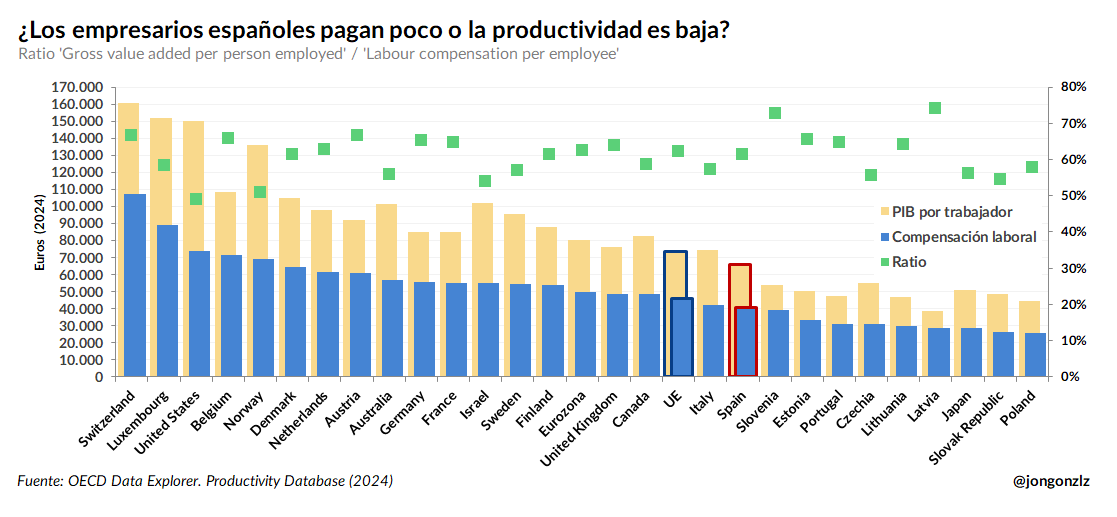
Mucho viralinchi en el lado izquierdo de X estos días con este informe (de Unicaja, por cierto). Al menos, la interpretación que se está haciendo por parte de algunos medios y personas no es el correcto. En este caso, los 269.000€ no es lo que "genera" el trabajador, es lo que las empresas asturianas facturan por trabajador (ingresos). Ahí dentro va todo: lo que aporta el trabajador y lo que la empresa ha comprado a otros (energía, materias primas, servicios…). Lo que realmente mide la productividad por trabajador es el valor añadido (VAB): VAB = ingresos − consumos intermedios Comparar los 269.000€ con 39.600€ no es correcto, porque estás comparando ventas brutas vs coste del trabajo. Cuando se habla de productividad, lo correcto es mirar VAB por empleado, no ingresos. Si no, se sobreestima mucho lo que "genera" cada trabajador, sobre todo en sectores con muchos costes intermedios. Y si lo comparamos bien, en España la relación entre productividad por trabajador y remuneración de los asalariados no se aleja de la de Europa. No hay ningún país en la OCDE cuya remuneración anual a los empleados sea mayor que la de España pero su productividad sea más baja.
Jon González tweet media
La Voz de Asturias@lavozdeasturias

Un trabajador asturiano genera al año 269.000 euros y la empresa paga por él 39.600💸 a.lavoz.es/aouc82

Español
25
165
607
49.3K
Gabriel Chaves Bosch retweetledi
Ben Golub
Ben Golub@ben_golub·
The great Paul Goldsmith-Pinkham did a series of videos with Markus Brunnermeier on Claude Code (more to come)
Ben Golub tweet media
English
1
106
648
37.9K
Gabriel Chaves Bosch retweetledi
Rutger Bregman
Rutger Bregman@rcbregman·
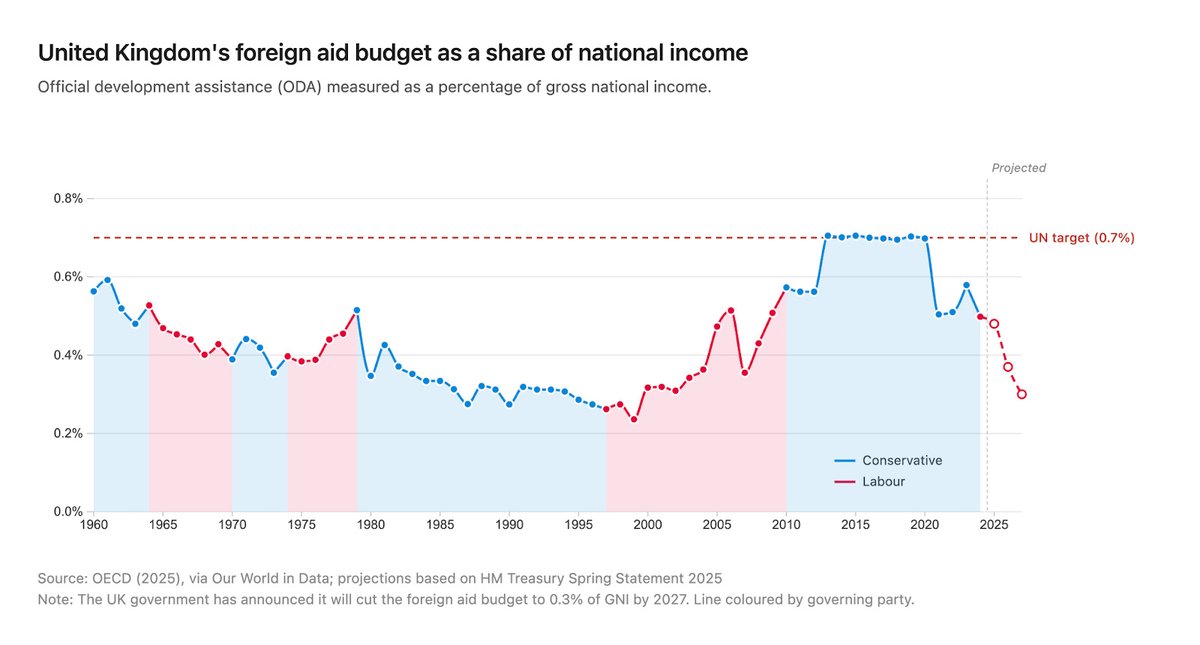
Narrative violation: massive cuts to development aid in the UK are done by... Labour. 'The only years where the UK met the 0.7% of GNI target were under a Conservative government.' from @_HannahRitchie's excellent newsletter
Rutger Bregman tweet media
English
4
11
55
8.7K
Gabriel Chaves Bosch retweetledi
Jon González
Jon González@Jongonzlz·
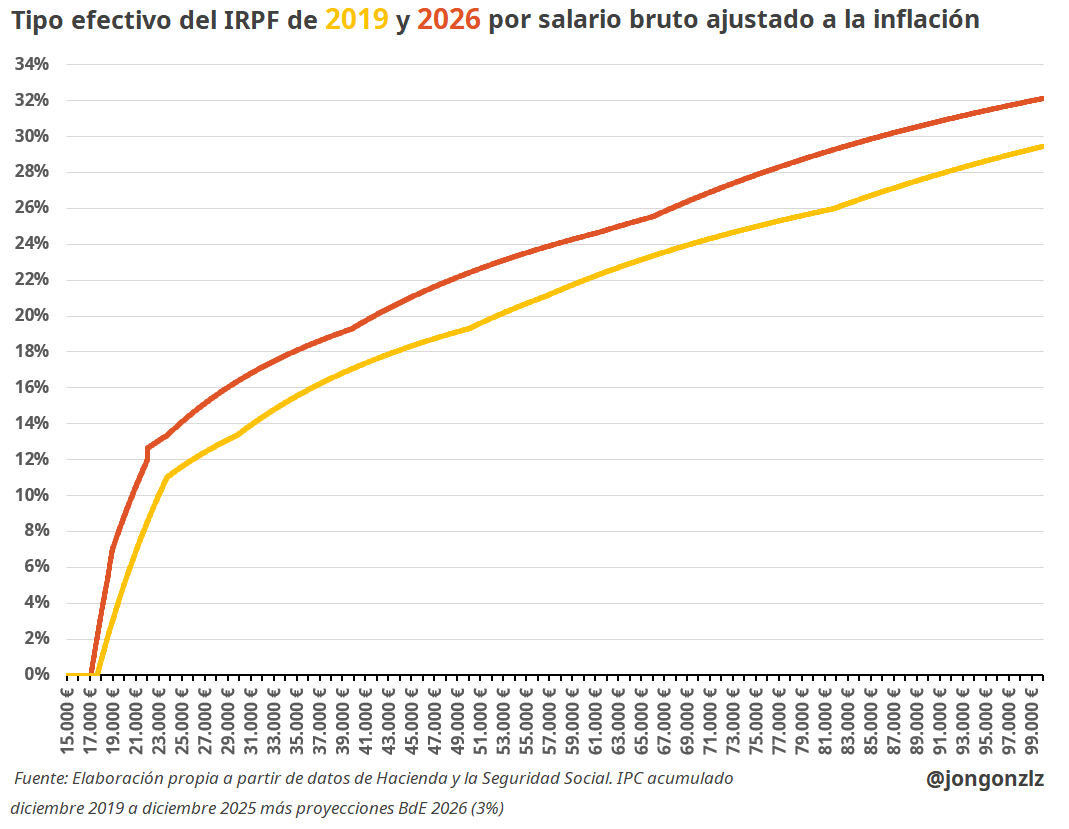
Yo ya no sé de cuántas más formas explicarlo. Tomando la normativa del IRPF que recibió este Gobierno, comparando con 2019 para que no haya matices, no hay ni un solo rango de salarios, ajustados a la inflación, en el que el tipo del IRPF sea inferior ahora. NINGUNO.
Jon González tweet media
Hoy por Hoy@HoyPorHoy

“El mayor alivio en materia fiscal se ha producido en las rentas medias-bajas; hemos contribuido a que el poder adquisitivo de los ciudadanos haya subido por encima de países del entorno” 🎙️ @carlos_cuerpo, Vicepresidente Primero del Gobierno de España

Español
57
1.8K
3.9K
221.7K
Gabriel Chaves Bosch
Gabriel Chaves Bosch@BoschChaves·
@annastansbury It does not end there. You can also suffer from class transfuge, whereby you feel alienated by the new set of social norms and rules.
English
0
1
1
468
Gabriel Chaves Bosch retweetledi
Anna Stansbury
Anna Stansbury@annastansbury·
We often think that the effects of class background are washed out by education. But we show that two people who did the same subject at the same university at the same time, and got the same grade …. end up earning quite different amounts when they enter the labour market
Resolution Foundation@resfoundation

Even after graduating from university, people who grew up in poverty face significant pay gaps when compared with their more affluent peers. @annastansbury explains 👇

English
55
346
1.8K
391.6K
Gabriel Chaves Bosch retweetledi
Luis Garicano 🇪🇺🇺🇦
At this point, banana republics and developing country dictators have higher standards of conduct and less corruption.
Luis Garicano 🇪🇺🇺🇦 tweet media
English
6
82
299
19.1K
Gabriel Chaves Bosch retweetledi
Philipp Heimberger
Philipp Heimberger@heimbergecon·
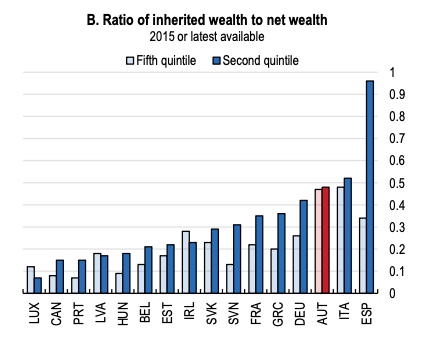
Wealth is highly concentrated and largely inherited in countries such as Spain, Italy, Austrian and Germany. Inheritances and gifts play a considerably smaller role in net wealth in countries such as Portugal, Hungary or Latvia.
Philipp Heimberger tweet media
English
13
127
418
31.3K
Gabriel Chaves Bosch retweetledi
Mihai Simion
Mihai Simion@faustocoppi60·
Such a beautiful finish with this background and always epic sprint battles in Sant Feliu de Guíxols. 😍 This stage is a keeper, dear @VoltaCatalunya . #VoltaCatalunya105
Mihai Simion tweet media
English
10
123
1.2K
27.6K
Gabriel Chaves Bosch retweetledi
Alex
Alex@notcomplex_·
The average adult height in China and the US is now roughly equal. Many have not fully realized just how much China has grown—in this case, literally.
Alex tweet media
English
373
1.2K
14.9K
1.8M
Gabriel Chaves Bosch retweetledi
Arpit Gupta
Arpit Gupta@arpitrage·
One lesson from Paris: the world's best cities will start to cut cars from their cores ft.com/content/882ebf…
English
41
266
1.4K
50.6K
Gabriel Chaves Bosch retweetledi
Branko Milanovic
Branko Milanovic@BrankoMilan·
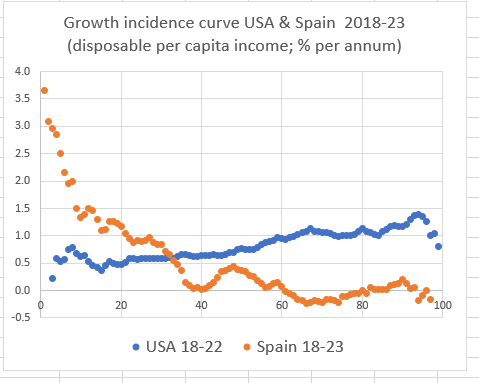
Re. individual counties, Spain's Growth Incidence Curve 2018-23 was strongly pro-poor. US was strongly pro-rich except at the very top of income distribution. @lisdata. But Spanish mean growth was 0.1% (i.e. practically zero), US mean growth was 0.9%.
Branko Milanovic tweet media
English
9
51
125
25.4K
Gabriel Chaves Bosch retweetledi
Nicholas Decker
Nicholas Decker@captgouda24·
Fertility has fallen in the United States. At the same time, housing has gotten substantially more expensive. Are these related? How so? Benjamin Couillard attributes fully half of the fertility decline of the 2000s and 2010s to housing prices, a loss of 13 million children! 1/
Nicholas Decker tweet media
English
11
95
521
93.2K
Gabriel Chaves Bosch retweetledi
Jesús Fernández-Villaverde
Jesús Fernández-Villaverde@JesusFerna7026·
By now, I have published a fair number of papers, and one more acceptance would have close to zero marginal impact on anything that matters professionally. But getting my survey on “Deep Learning for Solving Models” accepted into the Journal of Economic Literature made me genuinely happy, for reasons that have nothing to do with my CV. I had the misfortune of studying my undergraduate degree in economics at a quite awful institution. Two professors, David Taguas and Alfredo Arahuetes, were outstanding, and I owe them a great deal. The rest were well below any reasonable professional level, and some violated the basic standards of ethical conduct. They had no business teaching economics at any level, let alone at a university that charged tuition and claimed to prepare students for professional life. I had to work out most of my education on my own. The surveys published in the Journal of Economic Literature were how I did it. I spent hours in the library’s reading room going through one survey after another on topics I had never been properly taught. Some helped more than others, but collectively they gave me a solid enough foundation that, when I arrived at Minnesota for my PhD, I discovered, to my considerable surprise, that I was ahead of nearly all the other first-year students, including some who held master’s degrees, despite the fact that I had finished my undergraduate degree just six weeks before. I owe the Journal of Economic Literature a debt I will never be able to repay. Publishing a survey there is the closest I can come to trying. So, the thought that some student somewhere, working on her own in a library or on a laptop, might find my survey useful gives me tremendous satisfaction. But there is a broader point worth making. Even in the world of AI, the profession has an important mission in making educational material widely available. Textbooks, surveys, teaching slides, these are public goods in the economist’s sense: high social value, insufficient private incentive to produce. This is also why I post all my slides and teaching material online: sas.upenn.edu/~jesusfv/deepl… We do not reward these activities nearly enough, and their supply is well below what any reasonable social planner would choose. I do not have a good proposal for changing this, and I would welcome suggestions. What I do find heartbreaking is that many of the great economists of the past couple of generations never wrote textbooks on their areas of expertise. I do not mean this as criticism. All of them maximize, and perhaps they all suffer from the same bias I suffer from: the belief that one can always do it next year. But I often think about the hours of pure intellectual pleasure I would have had reading “Time Series Econometrics: An Advanced Textbook” by Chris Sims or “Methods in Structural Estimation” by Pat Bajari. Those books do not exist. They should.
Jesús Fernández-Villaverde tweet media
English
34
202
1.3K
138K
Gabriel Chaves Bosch retweetledi
Bouke Klein Teeselink
Bouke Klein Teeselink@BKleinTeeselink·
🚨 Come work with me on the Economics of AI! 🚨 I'm recruiting a fully funded 3.5-year PhD student to study how generative AI is transforming UK labour markets! This position is a unique collab between @KingsCollegeLon and the @AISecurityInst. Deadline: 22 April
English
3
51
185
19.5K
Gabriel Chaves Bosch retweetledi
Lídia Brun
Lídia Brun@LilyPurple311·
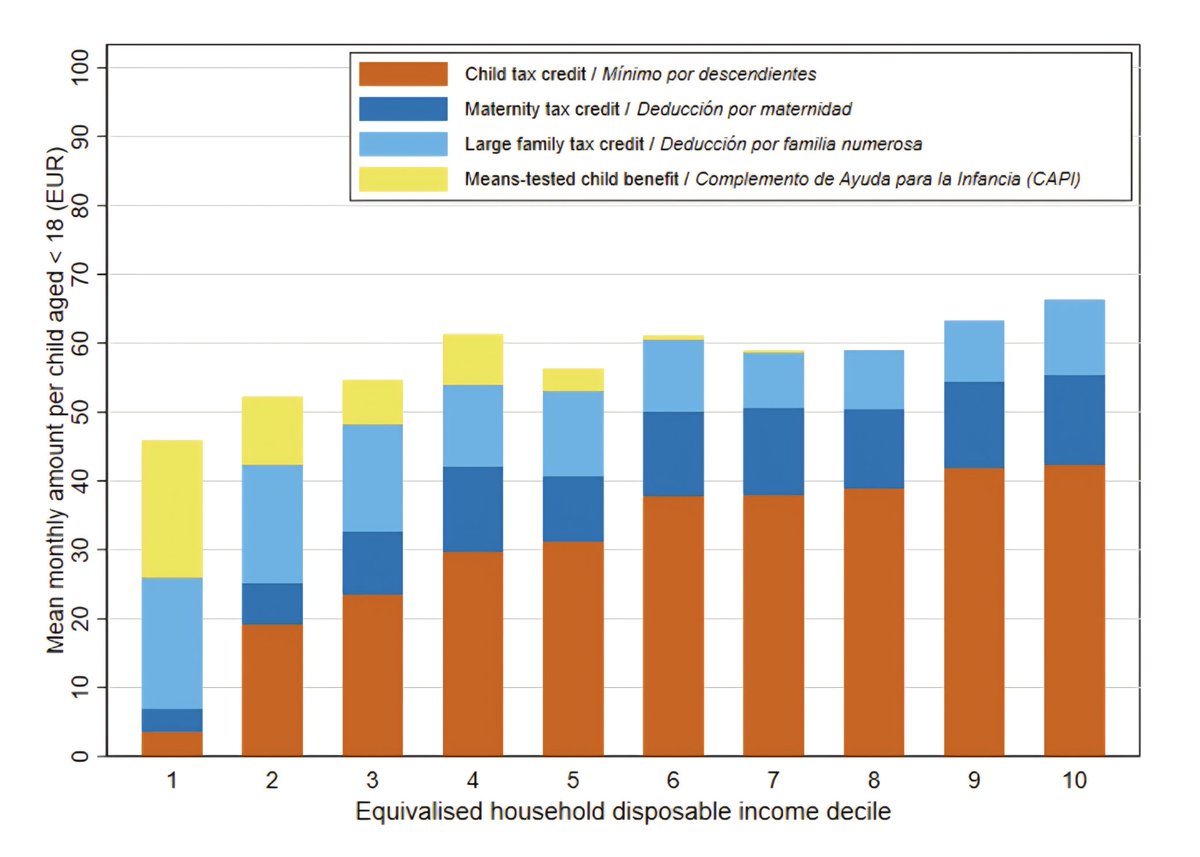
España es de los países europeos con mayor tasa de niños en riesgo de pobreza, un 29%. Las políticas basadas en deducciones fiscales son ineficaces: dejan al 60% de estos niños sin ayuda. Nueva evidencia de Cruces, Bornukova, Hernández y Picos, @EU_JRC publications.jrc.ec.europa.eu/repository/han…
Lídia Brun tweet media
Español
1
55
83
3.3K
Gabriel Chaves Bosch retweetledi
Jorge Galindo
Jorge Galindo@JorgeGalindo·
Hace unas semanas vi a José García Montalvo proyectar un gráfico muy parecido a este en un evento. Nos preguntaba: ¿qué está pasando aquí? ¿Por qué baja la tasa de esfuerzo en un contexto de precios disparados? La razón que intuía era... 👇🧵
Jorge Galindo tweet media
Español
3
40
73
17.9K