
Brain Inflammation Collaborative

3.5K posts

Brain Inflammation Collaborative banner
Brain Inflammation Collaborative

Brain Inflammation Collaborative

@BrainInflCollab

uniting patients, researchers & clinicians to advocate & research 30+ neuroinflammation-linked conditions with overlapping symptoms, causes & responses.

Katılım Haziran 2023
75 Takip Edilen8.9K Takipçiler
Brain Inflammation Collaborative
Read more about this case study and learn how researchers were able to identify this novel autoantibody here: buff.ly/nW0zTNr References: 1. Richard Stone. The Inflamed Brain. Science. May 16, 2024. 2. Bartley, C., Ross, D. Biol Psychiatry. 2020
Brain Inflammation Collaborative tweet media
English
0
3
13
336
Brain Inflammation Collaborative
After the Mayo Clinic learned about this patient, they examined their archives of suspected autoimmune cases and found 12 patients with the same symptoms. After testing the blood, they found the same newly identified autoantibody in all 12 patients.
English
1
2
12
351
Brain Inflammation Collaborative
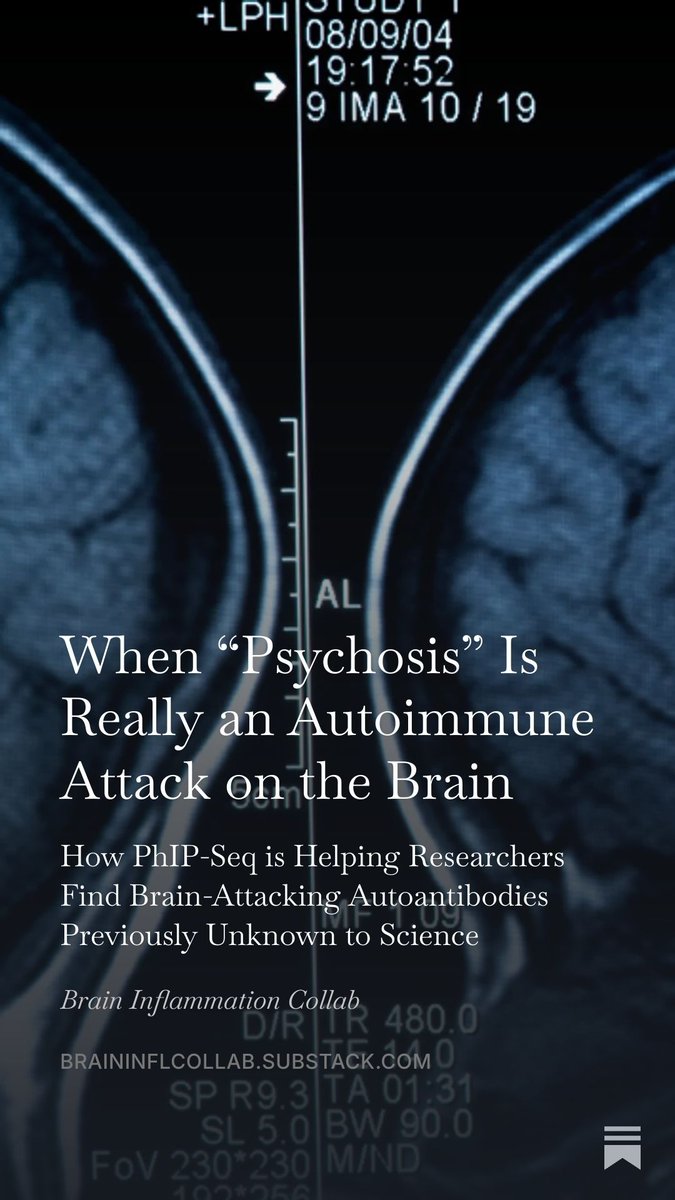
Autoantibodies can cause psychosis-like conditions characterized by a disconnection from reality, often involving: - delusions - hallucinations - impaired thinking or reasoning Only 18 harmful brain autoantibodies are known to science (1). What if there are more?🧵
Brain Inflammation Collaborative tweet media
English
2
29
124
3.9K
Brain Inflammation Collaborative
April Burrell lived in a psychiatric hospital for 20 years because her catatonic state left her immobile and unresponsive. But after 2 decades, she suddenly woke up. At the age of 21, April, a high school valedictorian and accounting major at the University of Maryland Eastern Shore, suddenly developed a severe form of schizophrenia. Her psychosis caused visual and auditory hallucinations. Unable to take care of herself, she was admitted to a psychiatric hospital. Sander Markx, director of precision psychiatry at Columbia University, met April as a patient while he was a medical student in 2000. “She is, to this day, the sickest patient I’ve ever seen,” he recalls. Little did he know he would cross paths with April 18 years later. In 2018, Markx encouraged one of his research fellows to spend time at the same hospital where he had met April 18 years earlier. Upon their return, a "trainee, Anthony Zoghbi, encountered a catatonic patient standing at the nurses’ desk. The fellow returned to Markx, shaken up, and told him what he had seen." Markx recalls a moment of déjà vu as he tells this story, when he asks Anthony, “Is her name April?” That's when he realized April was not only still there but still catatonic. Dr. Markx and colleagues investigated April's case further. They discovered that April, in addition to schizophrenia, also had Lupus, an autoimmune disease. Lupus, unlike schizophrenia, can be effectively treated with medication by suppressing the immune system. So a team of physicians started treating her. Every month for six months, April would "receive short, but powerful pulses" of intravenous steroids for five days, plus a single dose of cyclophosphamide, a heavy-duty immunosuppressive drug typically used in chemotherapy..." After her first treatment, April woke up. After her 3rd round of treatment, she could accurately draw a clock, something she hadn't been able to do in 20 years. Her miraculous response to treatment suggested that April's psychosis was caused by an autoimmune attack on her brain. Dr. Markx believes April's immune system was making autoantibodies that were attacking her temporal lobe (🧠 ), areas implicated in schizophrenia. This is a powerful story revealing that a rogue immune response can change how we think, feel, and act. How many other inpatients are sitting in psychiatric hospitals with neuronal autoantibodies attacking their brains? Read more here: buff.ly/Kds1Wd1
Brain Inflammation Collaborative tweet media
English
10
80
267
7.5K
on error resume next
on error resume next@FlorianHeigl1·
@BrainInflCollab I got all of that including the very same forgetting what way to exit my home subway station, easily triggered burning sensations in my brain and my neurologist knows every bit of that but hasn't come up with anything but increasing amounts of antidepressants so I don't feel as
English
3
0
5
587
Brain Inflammation Collaborative
In 2017, Alina Sternberg, a psychiatrist, was hit with crushing fatigue and brain fog. Neurologists told her the symptoms were caused by depression. "No, I can enjoy my life, and I know what depression is... I’m a psychiatrist!” It took 6 more years to discover the culprit. Alina's symptoms became progressively worse. By 2023, she spent most of her days in bed. Not only was she hit with soul-crushing fatigue, but her memory deteriorated. One day, she forgot her way home, a place she had lived for 20 years. Alina asked a colleague at the hospital where she worked if he would check to see if she had autoantibodies in her blood that might be attacking her brain. He told her, "That is impossible because you aren't psychotic.” Other neurologists agreed. Committed to exploring all immunological causes of her condition, Alina traveled to see Ludger Tebartz van Elst, a neuropsychiatrist at the Albert Ludwig University of Freiburg in Germany who specializes in identifying and treating autoantibodies that attack the brain. After a thorough examination, Dr. Tebartz van Elst found autoantibodies in her blood that target a brain protein called contactin-associated protein-like 2 (CASPR2). CASPR2 is found in the CNS and is crucial to the transmission of neural signals. Alina was treated with intravenous cortisone, and she "got [her] life back” almost immediately. Alina could jog a few days after treatment for the first time in nearly a decade. This is one of many stories revealing how a subset of patients suffering from psychosis, chronic fatigue, memory loss, etc., have autoantibodies in their blood that are attacking the brain. These autoantibodies are commonly produced in response to a brain infection or a tumor. Read more:
English
9
76
358
14.6K
Dara in Chains
Dara in Chains@DarainChains·
The scientific establishment tried to prove Long Covid is just a simple autoimmune disease by filtering out autoantibodies in a strict clinical trial in Germany. It completely failed. Stripping the antibodies out of the blood didn't cure the patients. Why? Because the autoantibodies are just the smoke—the persistent virus hidden in our marrow and tissues is the actual fire. You can't put out a house fire just by vacuuming up the smoke. We have to target the viral reservoir itself if we ever want our immune systems to stop panicking.
GIF
Jon Douglas@atranscendedman

Mainz University Medical Centre, 40 patients. Immunoadsorption stripped GPCR autoantibodies from blood, but Long COVID symptoms did not improve versus sham, and adverse events were more common. thelancet.com/journals/lanep…

English
8
33
102
5.6K
MECFS, MCAS and PTSD
MECFS, MCAS and PTSD@FatigueMe92484·
SIRT1/ NAD/ LDH/ Psychiatric Disorders / Anxiety / PTSD Summary Excerpt Investigation of serum lactate dehydrogenase levels in generalised anxiety disorder (Yazici & Ahi Üstün, 2026). This study found significantly lower serum LDH levels in patients with generalised anxiety disorder compared to healthy controls, with lower LDH correlating with higher anxiety severity (HAM-A scores). The authors propose that reduced LDH activity may impair lactate clearance, leading to lactate accumulation that exacerbates anxiety symptoms. In the model, this aligns with impaired astrocyte-neuron lactate shuttle (ANLS), astrogliosis, AQP4 dysfunction, and PDK4 upregulation (which inhibits PDH and diverts pyruvate toward lactate production). A plausible contributor to the low LDH is impaired SIRT1 activity and reduced NAD+ availability (common in the model due to inflammation, oxidative stress, and mitochondrial dysfunction). Low SIRT1/NAD+ can epigenetically suppress LDH expression and disrupt the NAD+/NADH ratio needed for efficient LDH function. When LDH activity is reduced in the presence of high PDK4 drive, the system faces a compounded bottleneck: increased lactate generation combined with impaired conversion/clearance, resulting in extracellular lactate buildup, lactylation, pH shifts, and metabolic stress. This lactate dysregulation contributes to heightened threat processing in fear circuits, excitotoxicity, brain fog, neurological episodes, and the lowered physiological stress threshold in the fused ME/CFS, MCAS-like, and PTSD-like presentation. The findings highlight altered lactate metabolism (via the PDK4–PDH–LDH–SIRT1 axis) as a plausible link between anxiety states and the broader metabolic vulnerabilities in the hypothesis. This correlates with several studies that show high lactate levels in mental health issues. Downregulation of SIRT1 is a cause of several issues in the model. @arta_semita @tessfalor FYI
English
1
0
3
256
Brain Inflammation Collaborative
Brain Inflammation Collaborative@BrainInflCollab·
It's well established that chronic inflammatory conditions increase your risk of psychiatric disorders. However, the mental health condition is widely assumed to stem from sadness over the medical condition's impact on their reduced quality of life. Here, we break down the inflammation-mental health connection facts using 70+ peer-reviewed citations. buff.ly/QNDfRSJ
Brain Inflammation Collaborative tweet media
English
3
11
29
1.2K
Brain Inflammation Collaborative
Brain Inflammation Collaborative@BrainInflCollab·
These microbial and metabolic shifts lead to a measurable reduction in: - systemic autoimmunity - autoantibody production - and life-threatening renal pathology This suggests Faecalibacterium prausnitzii is a promising probiotic candidate for the targeted management of autoimmune diseases through microbiome modulation.
English
1
0
2
173
Brain Inflammation Collaborative
Brain Inflammation Collaborative@BrainInflCollab·
Lupus is an autoimmune disease characterized by autoantibodies that attack healthy tissue. The drivers of this rogue immune response are unclear. Could the answer lie in the gut?
Brain Inflammation Collaborative tweet media
English
1
7
19
993
Brain Inflammation Collaborative retweetledi
Solve ME/CFS Initiative
Solve ME/CFS Initiative@PlzSolveCFS·
In this study, people diagnosed with ME/CFS and Long Covid borrow devices, shipped free, for 3 months. While borrowing, they contribute data through the @BrainInflCollab unhide® SolveTogether platform.
English
1
3
10
403