Bramha

23 posts

Bramha banner
Bramha

Bramha

@Bramha_01

Java Developer | Fintech

Katılım Şubat 2026
232 Takip Edilen191 Takipçiler
Bramha retweetledi
Alex Xu
Alex Xu@alexxubyte·
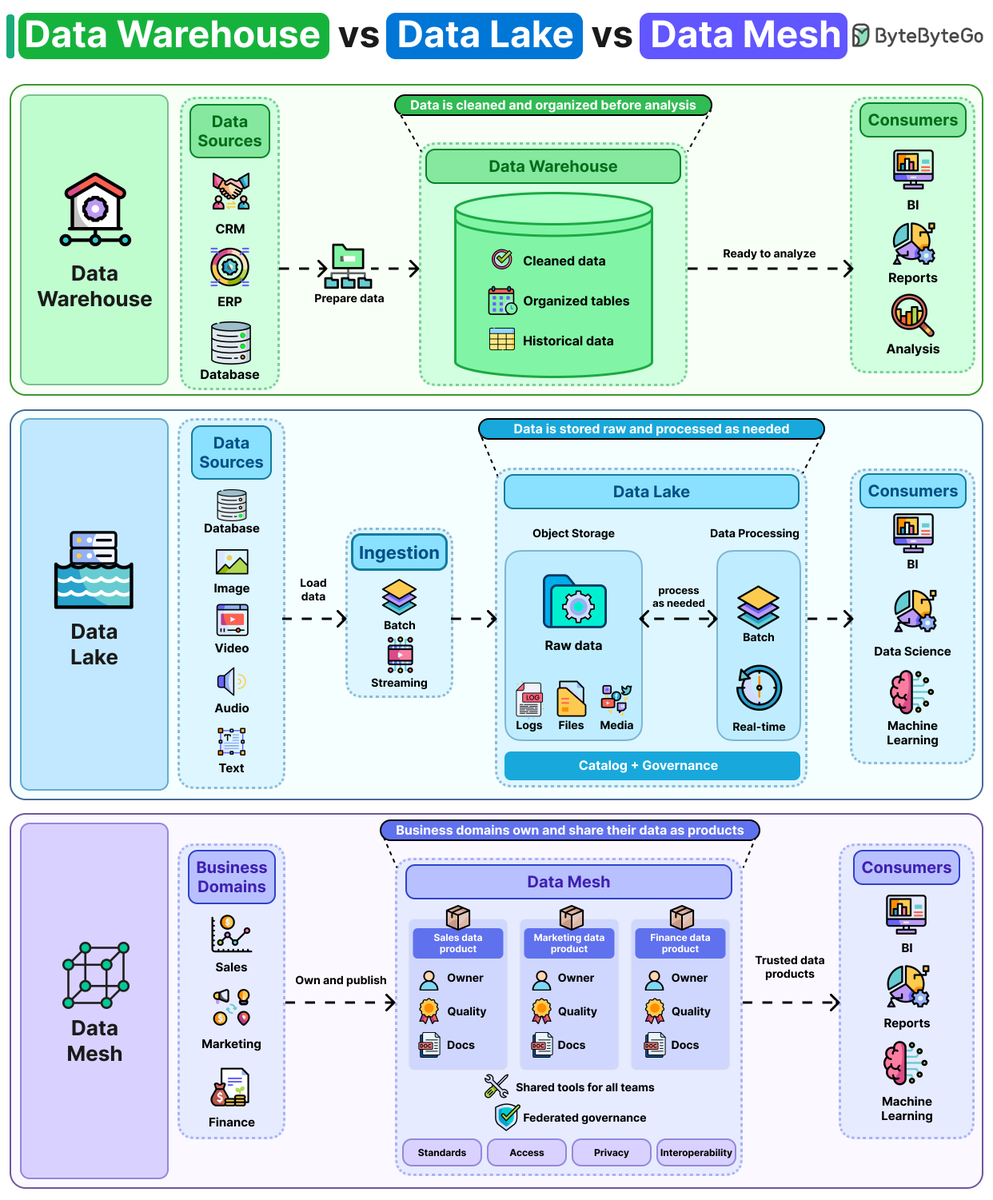
Data Warehouse vs Data Lake vs Data Mesh Storing data is the easy part. Deciding where and how to organize it is the real challenge. A data warehouse is the traditional approach. It cleans and structures data before storing it. Queries run fast, and reports stay consistent. But adding a new data source takes effort because everything has to fit the schema first. A data lake takes the opposite approach. It stores everything raw, like databases, logs, images, and video. Process it when you need it. The flexibility is great, but if rules around naming, formatting, and ownership are not properly set, you end up with duplicate, outdated, and undocumented data that is hard to manage. Data mesh shifts data ownership from a central team to individual departments. For example, sales publishes sales data, and finance publishes finance data. Shared standards keep things compatible across teams. It works well in larger organizations. But it requires every team to have the right people and processes to manage their data quality, documentation, and access, which is a challenge. In practice, many companies use more than one approach. They'll use a warehouse for dashboards and reporting, a lake for machine learning workloads and start applying mesh principles as teams scale.
Alex Xu tweet media
English
2
29
143
6.1K
aaröshi
aaröshi@itsaaroshi·
Be honest, is there any replacement for Vscode?
aaröshi tweet media
English
43
1
39
838
Bramha
Bramha@Bramha_01·
Most backend engineers don’t have a scaling problem. They have: too many DB calls no caching no indexing Fix this first. Your system will look 10x faster. #Backend #Java #Performance #SystemDesign
English
0
0
6
29
Vijay
Vijay@nshvijay7·
Which coding language do you love?
Vijay tweet media
English
13
0
12
307
Arslan Iqbal
Arslan Iqbal@thearslaniqbal·
Software developers aged 22 to 25 have seen a 20% drop in employment since 2024. Not because AI replaced them. Because senior developers using AI now produce what used to take a full junior team. The job did not disappear. The entry point did. The question every young person needs to ask: What skills make me irreplaceable to someone who uses AI? That answer is your career plan. #AI #Jobs #FutureOfWork #Developers #Career
English
5
2
19
376
Kishan
Kishan@ikishankewal·
I’m looking to connect with people working in: • App Development • AI / Machine Learning • Data Structures & Algorithms (DSA) • Full Stack / Frontend / Backend • DevOps • Electronics & Arduino If you’re building something or learning in any of these areas, let’s grow together #BuildInPublic #DevCommunity #Tech #Arduino #Electronics
English
78
3
114
4.1K
Vaishali Chavan
Vaishali Chavan@vaishali86c·
Today's backend progress 💻 Today I Learned: ✅ Created login & logout controller functionality ✅ How to set cookies ✅ Access token & refresh token concepts Got errors, fixed them, struggled a bit but learned a LOT 🔥 @Hiteshdotcom #backend #progress #DevelopmentFirst
English
1
0
2
60
Bramha
Bramha@Bramha_01·
In UPI systems, success isn’t just “200 OK”. It’s correct debit, correct credit, correct status. Anything else = reconciliation problem. #Fintech #UPI #Backend #Tech
English
0
0
5
77
Bramha
Bramha@Bramha_01·
@hiprathamhere True, loose coupling helps. But runtime dependencies still carry latency.
English
0
0
1
11
Pratham Jagga
Pratham Jagga@hiprathamhere·
@Bramha_01 it should not happen ideally, after all loose coupling is what we use microservices for
English
1
0
1
19
Bramha
Bramha@Bramha_01·
Microservices don’t fail individually. They fail as a chain. One slow service → everything slows down. Think end-to-end, not service-to-service. #Microservices #Backend #Developers
English
1
0
5
129
Bramha retweetledi
Pavan
Pavan@gpkpavan143·
REST vs gRPC — how do you pick? Most devs default to REST for everything. That's a mistake. Here's a simple decision guide : First — what even is gRPC? gRPC = Google Remote Procedure Call Instead of sending JSON over HTTP/1.1… gRPC serializes data into compact binary using a .proto schema file, then sends it over HTTP/2. Smaller payload. Faster transmission. Typed contracts. Choose REST when: → You're building a public API → Clients are browsers or mobile apps → Simplicity > performance → Your team knows HTTP/JSON well REST is boring. Boring is good for public-facing services. Choose gRPC when: → Service-to-service comms (microservices) → You need low latency + high throughput → Streaming data (bi-directional) → Strongly typed contracts across teams Protobuf beats JSON on the wire every time. Simple rule: 🌐 External API → REST ⚙️ Internal services → gRPC Follow @gpkpavan143 for more system design decision guides. ♻️ Repost if this helped someone on your feed.
Pavan tweet media
English
1
1
8
248
Bramha
Bramha@Bramha_01·
It’s okay to feel stuck. It’s not okay to stay stuck. Move forward, even slowly. #Growth #CodingJourney
English
1
1
12
142
Bramha
Bramha@Bramha_01·
Better code comes from better thinking. Better thinking comes from consistent effort. There’s no shortcut here. #CleanCode #DevLife
English
0
0
7
125
Bramha retweetledi
Alex Xu
Alex Xu@alexxubyte·
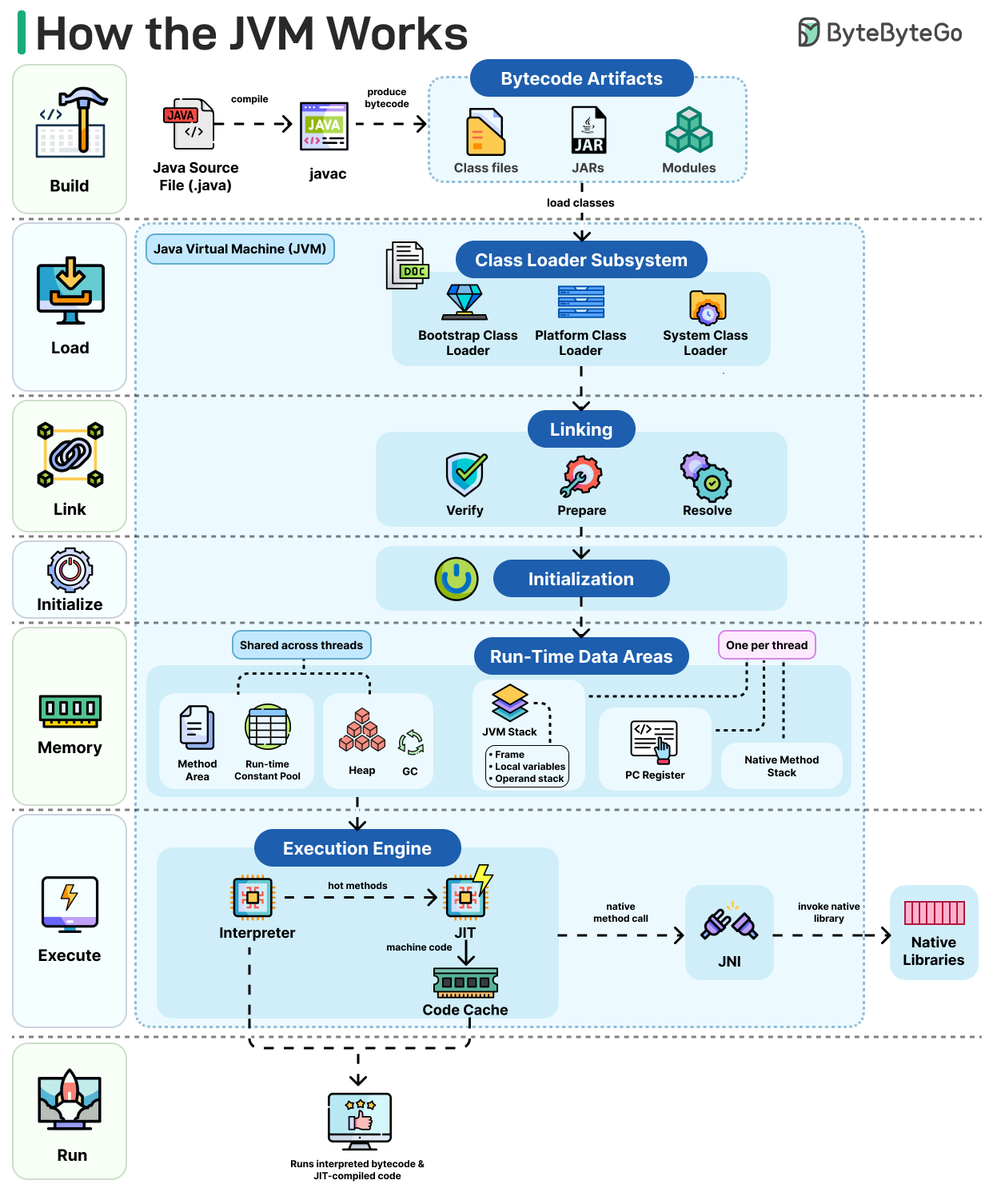
How the JVM Works We compile, run, and debug Java code all the time. But what exactly does the JVM do between compile and run? Here's the flow: Build: javac compiles your source code into platform-independent bytecode, stored as .class files, JARs, or modules. Load: The class loader subsystem brings in classes as needed using parent delegation. Bootstrap handles core JDK classes, Platform covers extensions, and System loads your application code. Link: The Verify step checks bytecode safety. Prepare allocates static fields with default values, and Resolve turns symbolic references into direct memory addresses. Initialize: Static variables are assigned their actual values, and static initializer blocks execute. This happens only the first time the class is used. Memory: Heap and Method Area are shared across threads. The JVM stack, PC register, and native method stack are created per thread. The garbage collector reclaims unused heap memory. Execute: The interpreter runs bytecode directly. When a method gets called multiple times, the JIT compiler converts it to native machine code and stores it in the code cache. Native calls go through JNI to reach C/C++ libraries. Run: Your program runs on a mix of interpreted and JIT-compiled code. Fast startup, peak performance over time.
Alex Xu tweet media
English
6
135
672
29.2K