

Brandon Brown

410 posts

Brandon Brown banner
Brandon Brown

Brandon Brown

@Brandon_Brown

Building Search Party: https://t.co/ufB2qxwjsM

California, USA Katılım Şubat 2008
174 Takip Edilen1.3K Takipçiler
Brandon Brown
Brandon Brown@Brandon_Brown·
Content marketing is broken. Traffic’s tanking, old playbooks are out, and algo Gods are becoming harder to please. And it all boils down to this: Nobody’s reading blog posts by looking up things on Google. They’re asking GPT. So your TOFU posts that you spent so much time writing to outrank your competition are completely useless. I ran an experiment. Asked GPT a bunch of “how to x” type questions and never had to click a single link. But when I asked for specific data like SaaS pricing benchmarks or startup funding trends, it cited sources…companies like ChartMogul and PitchBook. So, generic advice gets buried but original research is amplified. Some companies already get this. Stripe doesn't write "how to" posts. They publish economic data. Calendly tracks meeting behavior. Notion surveys productivity trends. My 2 cents: Don’t write more blog posts. Create original research that gets quoted everywhere. Become the data source for LLMs.
English
2
0
3
293
Brandon Brown
Brandon Brown@Brandon_Brown·
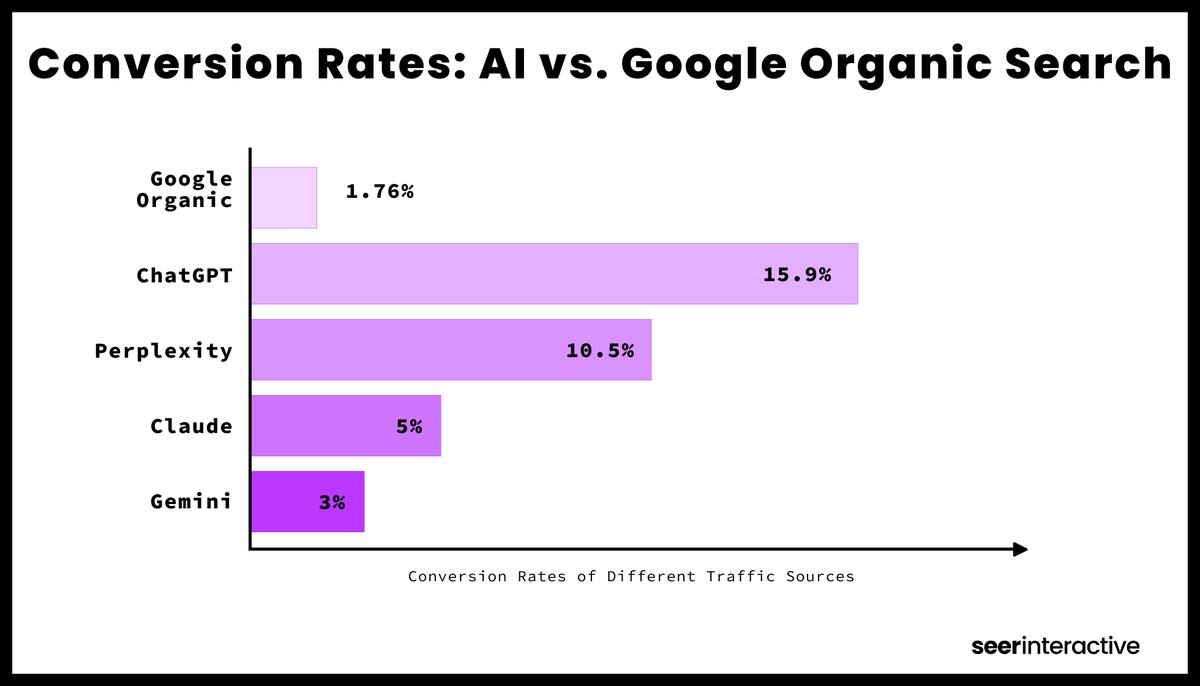
Someone finally measured ChatGPT vs Google conversion rates. The difference is huge: 16% vs. 1.8%. Seer Interactive tracked this across AI platforms: • ChatGPT: 16% • Perplexity: 10.5% • Claude: 5% • Gemini: 3% Makes sense when you think about it. If someone clicks through from GPT, they've already had a whole conversation about their problem. They've asked follow-up questions. Maybe compared a few solutions. When they finally click to your website, they're not browsing around. They know what they want. And they stick around longer. They view 2+ pages per session compared to 1.2 pages for Google visitors. But most companies have no idea how much traffic they're getting from AI tools. Probably smart to start measuring it before it becomes a bigger piece of the pie.
Brandon Brown tweet media
English
1
1
9
1K
Brandon Brown
Brandon Brown@Brandon_Brown·
I just realized QuickBooks doesn't want my software budget anymore. They want my payroll budget. QuickBooks launched AI agents last week that handle the work my bookkeepers do. Transaction categorization, reconciliation, invoice tracking. The routine stuff that takes my team hours every month. Right now I pay for QuickBooks and I pay for bookkeepers. Two totally different line items. But their new Accounting Agent automates bookkeeping and transaction categorization. Their Payments Agent predicts late payments and sends invoice reminders. They're claiming customers save 12 hours a month. So now QuickBooks can say "we'll handle all the backend work, your team can focus on strategy and analysis." Other vertical software companies are starting to see this opportunity. Instead of charging for seats and dashboards, they can charge for actual outcomes
English
2
1
3
265
Brandon Brown
Brandon Brown@Brandon_Brown·
Just tore through Figma's S-1. This is what a PLG machine looks like on paper. $821M trailing revenue, 46% growth, 91% gross margins. Rule of 40 score of 63 vs the typical SaaS benchmark of 40. But here's what really caught my attention: 13M+ monthly active users, and two-thirds aren't even designers. They're PMs, engineers, marketers, researchers. For every 1 designer they land, 2 others from the org get pulled in. Look at how they've built this out: • Started with Figma Design (UI/UX) • Added FigJam (whiteboarding) • Launched Dev Mode (code generation) • Now rolling out Slides and Sites The land-and-expand is working because they now have over 1,000 enterprise customers. Adobe tried to buy them for $20B in 2022, but regulators killed the deal. Adobe had to pay Figma a $1B breakup fee. Turns out that might have been the best outcome. Instead of getting absorbed, Figma used that cash to build this multi-product platform. Now they're about 3% the size of Adobe but growing 4x faster. Expected to raise $1.5B on NYSE under "FIG." Could debut at a valuation higher than Adobe's original offer. • This is how you turn a design tool into an OS for product teams.
English
0
0
0
116
Brandon Brown
Brandon Brown@Brandon_Brown·
Most marketing leaders compare channels wrong. They look at results per dollar spent. But they're only counting media cost, not execution cost. I've seen this at every budget table. Someone says "ABM has great ROI" but they're comparing apples to oranges. Here's what $200K actually gets you: Facebook ads: All $200K goes to impressions. You set it up once, the algorithm does the work. ABM: You need someone to run it full-time. That's $90K in salary plus three months to ramp. Then you need an ABM platform like 6sense - $30K. Intent data tools - another $15K. So you've spent $135K before a single prospect gets targeted. Basically, you’ve only got $65K left for actual campaigns and creative. That's not a knock on ABM. It's just reality. High-touch strategies have high execution costs. This is why I think AI changes the game completely. Agents can handle account research, personalization, and campaign orchestration. And suddenly that $135K in overhead disappears. Forget analyzing channel performance. Look at the total cost of execution.
English
0
0
1
89
Brandon Brown
Brandon Brown@Brandon_Brown·
My first company was an agency. I shut it down after a year. It was called Loring. Good work, great people but i started to feel the economics wouldn’t scale like I wanted them to. Service businesses are just hard to scale. You're trading time for money, and there are only so many hours in a day. Growth requires adding more hands, which means more overhead, more complexity, more coordination. That's why I walked away. But here's the irony: If I had started that same agency today, I might not have shut it down. Because agents change everything. AI agents can handle the routine work that used to require full-time attention. The research, the analysis, the first drafts. They free up talented people to focus on strategy, relationships, and high-value work. We're about to see a wave of service businesses scale much faster and more profitably. Better margins, faster delivery, more leverage from the same team. And this time, I'd bet on them.
English
0
0
0
91
Brandon Brown
Brandon Brown@Brandon_Brown·
Everyone wants to name the category. Great in theory, extremely hard in practice. You can’t just 𝘥𝘦𝘤𝘪𝘥𝘦 the market should adopt your label. You have to 𝘦𝘢𝘳𝘯 it through traction, repetition, and momentum that outweighs inertia. If you win, the rewards are massive. But if you don’t, you’ve spent millions educating people just to have them choose a name that’s not yours. So if you’re thinking about naming a new category: • Start with traction. • Build consensus. • Then earn the label. Not the other way around.
English
0
0
0
57
Brandon Brown
Brandon Brown@Brandon_Brown·
Every GEO demo I've seen follows the same script. "Here's your AI citation rate." "Here's your visibility score." "Here's how you compare to competitors." Cool charts. Zero solutions. I was talking to a CMO last week who said: "I have three GEO tools. They all tell me I'm losing visibility. None of them tell me what to do about it." This is the analytics trap. More measurement, less action. Marketing teams are drowning in dashboards that show problems they can't solve. They can tell you their organic traffic, keyword rankings, content engagement metrics. But ask them what to actually DO about AI search visibility and they're stuck. The winning move isn't better tracking. It's automated fixing. Don't show me the problem. Solve it for me. The GEO companies that figure this out will eat everyone else's lunch.
English
1
0
1
71
Brandon Brown
Brandon Brown@Brandon_Brown·
Your 12-email drip campaign lost to a single AI conversation. Users don't move through awareness, interest, consideration, intent anymore. They ask ChatGPT "what's the best XYZ tool for enterprise" and get all four stages in one response. The buyer journey went from weeks to seconds. But marketing teams are still building campaigns for each funnel stage. Welcome sequences. Educational content. Retargeting ads. Your prospect skipped all of that. They went from "I need AI visibility strategy" to "I'm comparing XYZ Agency to ABC Agency" without visiting a single website. The funnel didn't flatten. It disappeared. Stop trying to nurture prospects through stages they're not visiting. Start showing up where the decisions actually happen.
English
1
0
1
64
Brandon Brown
Brandon Brown@Brandon_Brown·
Your website's job just changed. It used to be awareness, education, nurture, then conversion. Now users arrive ready to buy. ChatGPT did the research. Claude compared your competitors. Perplexity explained why they need your solution. By the time they hit your site, they're not learning about your products. They're ready to buy. I see companies still optimizing for discovery traffic that isn't coming. Still writing blog posts that explain basic concepts. Still designing funnels for browsers instead of buyers. 30-page websites trying to educate users who already did their homework. Users hit your pricing page in 15 seconds now. Websites are becoming destinations, not discovery engines. The consideration phase moved off-site. Conversion stayed on-site.
English
0
0
0
96
Brandon Brown
Brandon Brown@Brandon_Brown·
Agencies are going to become as profitable as software companies in the next 24 months. Historically, agencies are difficult to scale. • Marginal costs were high. • People-heavy businesses. • Gross margins sit at 50% for most services businesses. • Growth has been expensive and slow. You need human labor to deliver. Human labor is expensive. It takes time and dollars to hire and train them. But now AI agents will change everything. Take bookkeeping firms. Right now: • 10 employees doing $2M revenue at 40% net margins. • Replace 8 employees with AI agents doing the same work. Same revenue. 80% lower labor costs. Software-like margins overnight. The irony is I avoided agencies because they couldn't scale like SaaS (my first business was an agency). Now agencies staffed with agents will perform like SaaS companies. We're 24 months away from this flip.
English
0
0
0
55
Brandon Brown
Brandon Brown@Brandon_Brown·
Reddit citations jumped 436% in ChatGPT over two weeks. That means Reddit is now ChatGPT's second-largest source of truth, behind only Wikipedia. Ramp just posted a job for a "Professional Redditor" to drive business impact through authentic community engagement. Two data points. One conclusion. Smart companies already know Reddit isn't a social platform anymore - it's where AI systems pull answers from. The OpenAI partnership made Reddit infrastructure for AI visibility. This validates what GEO research has been telling us: we're seeing the shift from link-based authority to text-based authority in real time. Reddit's overnight jump to 5.9% of all ChatGPT citations wasn't because of backlinks or domain authority. It was because of authentic, comprehensive discussions that AI systems recognize as valuable human knowledge. Most brands are still treating Reddit like a side channel. The ones that aren't will dominate every AI-generated answer in their space. The companies investing in authentic community engagement today will dominate AI-generated answers tomorrow. Image and data courtesy of @JBlyskal at Profound
Brandon Brown tweet media
English
0
0
1
116
Brandon Brown
Brandon Brown@Brandon_Brown·
"We don't want another dashboard. We want actionable insights." That's what a leader in the GEO space told me last week. Marketing teams are drowning in data. They can tell you their organic traffic, their keyword rankings, their content engagement metrics. But ask them what to actually DO about AI search visibility and they're stuck. Tracking where you stand isn't enough anymore. Brands want the product to do the work for them. They want to know: Which specific pieces of content should we create? Which sources should we target for citations? How do we get mentioned in the right context? The gap between measurement and action is where the real opportunity lives.
English
1
0
0
61
Brandon Brown
Brandon Brown@Brandon_Brown·
When your prospects ask ChatGPT or Claude for software in your space… does your company show up? Most marketing leaders have no idea their content has gone invisible. Not to Google. To AI. Most teams are still stuck in 2019 SEO playbooks. Meanwhile, buyers are asking AI (and trusting the answers). I started spotting this in conversations w/ VPs and directors of Marketing. They'd mention finding vendors via AI. But when I tested searches in their category… their company was nowhere. Radio silence. That’s the shift I can't stop thinking about. We’re in the middle of a discovery revolution. Buyers are changing faster than sellers are adapting. Prospects aren't clicking through ten search results anymore. They're asking AI for specific recommendations and trusting what they get back. And some of the best companies will become invisible just because they didn’t adjust.
English
2
0
0
78
Brandon Brown
Brandon Brown@Brandon_Brown·
𝗧𝗵𝗲 𝗺𝗮𝗿𝗸𝗲𝘁𝗶𝗻𝗴 𝗳𝘂𝗻𝗻𝗲𝗹 𝗶𝘀 𝗱𝗲𝗮𝗱. Here's what's happening: B2B buyers (and increasingly consumers) no longer move through awareness → interest → consideration → intent. They're having one conversation with AI that compresses the entire journey into minutes. Think about it. A prospect asks ChatGPT: "What's the best CRM for home service companies?" In that single thread, they get: • Market education • Vendor comparison • Feature analysis • Pricing context • Implementation advice • A recommendation The funnel didn't evolve. It collapsed. 𝗧𝗵𝗶𝘀 𝗰𝗵𝗮𝗻𝗴𝗲𝘀 𝗲𝘃𝗲𝗿𝘆𝘁𝗵𝗶𝗻𝗴. Traditional marketing assumed you could control the narrative at each stage. Create awareness through ads. Build interest with content. Drive consideration with demos. Convert intent with sales. But when the entire buyer journey happens inside an AI conversation you can't see, track, or influence directly, none of that matters. 𝗧𝗵𝗲 𝗼𝗻𝗹𝘆 𝘁𝗵𝗶𝗻𝗴 𝘁𝗵𝗮𝘁 𝗺𝗮𝘁𝘁𝗲𝗿𝘀 𝗻𝗼𝘄: 𝗪𝗵𝗮𝘁 𝗱𝗼𝗲𝘀 𝗔𝗜 𝘀𝗮𝘆 𝗮𝗯𝗼𝘂𝘁 𝘆𝗼𝘂 𝘄𝗵𝗲𝗻 𝘆𝗼𝘂'𝗿𝗲 𝗻𝗼𝘁 𝗶𝗻 𝘁𝗵𝗲 𝗿𝗼𝗼𝗺? You don't get to tell your story anymore. AI tells it for you. Every review, article, mention, and discussion about your brand gets synthesized into AI's response. Winners in this new world won't have better funnels. They'll have better AI presence. They'll be the default answer when someone asks AI for help. The companies still building traditional funnels are optimizing for a buyer journey that no longer exists.
English
1
0
0
74
Brandon Brown
Brandon Brown@Brandon_Brown·
I've been talking to marketing leads lately who think their SEO strategy is bulletproof. Most of them are still playing the 2019 game. Blue links, keyword density, long-form content that ranks on page one. The usual playbook that worked when people actually clicked through ten results to find what they needed. But that's not how search works anymore. ChatGPT, Gemini, Google AI Mode - they don't rank pages. They generate answers from sources they can parse and trust. If your content isn't structured for machines to understand, it doesn't get cited. Period. I realized this watching my companies struggle with visibility. We had solid traditional SEO, but we were invisible in the places that actually matter now. The AI systems that certain decision-makers use for research weren't finding us. The technical fixes aren't revolutionary. Structured data, entity markup, content that AI can confidently reference. Most of it builds on what good SEO already does. But here's what I keep thinking about: we're optimizing for a search experience that's becoming secondary. The companies that figure this out early will own visibility in AI-powered search. The ones that don't will wonder why their traffic disappeared. This shift is happening whether we acknowledge it or not. The only question is timing.
English
1
0
1
147
Brandon Brown
Brandon Brown@Brandon_Brown·
Marketing leaders ask the wrong question about AI. It's not: "How do we use AI in marketing?" It's: "How do we market when AI controls discovery?" AI is changing the way people find information: ChatGPT, Claude, and other LLMs are becoming the main research tool for many B2B buyers. Your SEO strategy assumes people click through search and get to your website. But what happens when they get their answers without ever going to Google or visiting your website? This shift requires fundamental changes to how enterprise marketing operates: Traditional approach: Optimize for search engines (and hope for clicks) New reality: Optimize for AI systems (that still may not send traffic) Enter GEO, which has recently taken my Linkedin feed by storm: "Generative Engine Optimization" ensures your brand and expertise appear in AI-generated responses. Early adopters are securing visibility in AI before their competitors understand that the game has changed. The companies that adapt their discovery strategy now will own market share when AI all but replaces traditional search. The question isn't whether this shift will happen. It's whether you'll be ready when it does. How is your team preparing for AI-led discovery?
English
0
0
0
77
Brandon Brown
Brandon Brown@Brandon_Brown·
Why I’m tracking 20+ GEO competitors (and what they’re all missing): GEO stands for Generative Engine Optimization, the next evolution of search focused on AI-powered systems like ChatGPT, Claude, and Perplexity, rather than traditional search engines like Google. I’m tracking every company, funding round, and product announcement in this space because patterns reveal what’s really happening. Here’s what I’ve found: 1/ Most GEO tools are just traditional SEO tools with “AI” slapped on the homepage. Same keyword tracking. Same link building. Just new marketing copy. 2/ While some companies target SMBs with affordable monthly tools, the ones truly leading in GEO are enterprise-focused. Profound, for example, has raised over $25 million to serve large organizations. 3/ The companies succeeding in the space are building for Fortune 1000s that need real GEO solutions. Why? Because the VP of Marketing at a large enterprise doesn’t need another dashboard. They need visibility where their customers actually search now, which is inside AI systems. This space is full of tools chasing yesterday’s problems using tomorrow’s buzzwords. Meanwhile, enterprise marketing teams need solutions that work today. Every week I aggregate this into actual insights. No hype. Just what’s working, what’s failing, and what this means for marketing leaders running SEO, growth, and demand generation inside large organizations.
English
1
0
1
153
Brandon Brown
Brandon Brown@Brandon_Brown·
Your SEO team isn't ready for AI search. If you're still optimizing for Google while your customers are using ChatGPT, you're already behind. You don't need another SEO audit or keyword research report. You need to show up where people actually search now. That's AI. Not search engines anymore. Your SEO team is fighting yesterday's battle. They're tracking rankings that matter less every day. They're building content for algorithms that fewer people use. They're measuring success with outdated metrics. Meanwhile, your competitors appear in every ChatGPT response. Every Claude answer. Every AI-powered search. This isn't about adding "AI keywords" to your pages. It's about rethinking visibility entirely. Stop optimizing for the past. Start building for where search is going. The shift already happened. Adapt now or scramble later.
English
0
0
1
75