

Precise Market Analysis.
71 posts

Managing the risks around price effects from the AI buildout sounds like a source of possible disagreement at the Fed
At a hearing on Capitol Hill, Kevin Warsh declined to associate himself with some of the concerns we're hearing from more policymakers wsj.com/finance/live/s…
Nick Timiraos@NickTimiraos
Cook's speech should make plain that the hawkish evolution on the FOMC is not really an oil/war story. She points to one specific cause: "the AI buildout does not show signs of slowing." And she points to a more generalized concern about an economy with cumulating shocks after years of elevated inflation.
English
Fed governor Lisa Cook's "a bit more time" suggests she's willing to hold rates steady in July but the later "prepared to act" comment sounds like what someone would say if they were open to a September hike if inflation is firmer this summer:
"Turning to monetary policy, I voted with the rest of the FOMC last month to keep rates steady. I supported this stance, because the two main factors that have pushed up inflation over the past year—tariffs and the conflict in the Middle East—should, in theory, result in only short-lived increases in inflation. At this juncture, I see it as prudent to give a bit more time to observe how inflation unfolds from here. Going forward, though, I believe the risks continue to be strongly weighted toward higher inflation for at least two reasons."
The punchline: "If we do not see signs of disinflation soon, I am prepared to act."
Federal Reserve@federalreserve
Speech by Governor Cook on the economic outlook: federalreserve.gov/newsevents/spe… Learn more about Governor Cook: federalreserve.gov/aboutthefed/bi…
English
Kevin Warsh returns to the Senate Banking Committee today for a second day of testimony. Some highlights from the Q&A:
After observing that the Fed has been missing its inflation target for 63 months, Warsh acknowledges the better CPI and PPI data for June as well as the imprecision of the gauges used to measure progress against that target.
"Any central bank would be happy to have the data going in the right direction" but the measures of inflation that the Fed uses to target inflation are "imperfect measures of the state of underlying inflation."
So one of the task forces is going to see whether we can do better, have better data from external sources" and to "think about how the [BLS and BEA] could do a better job."
English
Warsh today clarified that he thinks none of the existing, published measures of inflation that remove price outliers, such as the Dallas Fed trimmed mean, reliably capture underlying price pressures:
"None of those are very good measures of underlying inflation.... My view is that we need new measures to understand the underlying changes in inflation. Am I interested in what's the mean or median price of a good and a big box retailer? You bet I am. And none of these measures capture that. I am super interested in finding new measures to do a better job to help us inform our decisions so that the inflation of the last five years don't continue."
At his confirmation hearing, he had referred to "trimmed averages" and "median type measures" as possibly more useful gauges of underlying inflation. This led to greater focus on median or trimmed mean gauges from Wall Street analysts who closely monitor inflation and map price data into their analysis of the Fed's reaction function.
(In a WSJ story in May that was referenced at the hearing today, I wrote, "Warsh didn’t specify which trimmed mean he had in mind. The most widely cited is the Dallas Fed’s version...")
wsj.com/economy/centra…
English
A few takeaways from Warsh's first appearance before the House Financial Services Committee:
1. Warsh repeatedly defended his agenda by pointing to how the Fed had failed to restore price stability after 2022-23. He delivered a particularly pointed critique of the 2020 framework change:
"The Fed changed its academic framework and its operational framework and it led to higher prices, which did more harm to the least well off among us than any policy that I could have imagined. That's why we have to reform it." (He has made this critique before, but it lands differently when it's being made by the chairman before a congressional committee).
2. Warsh suggested that current inflation might be more deeply embedded:
"We cannot have a direct immediate effect on short-term particular prices at the grocery store and agricultural goods. But the job you gave us and the job we are resolute about accomplishing is to make sure that any short-term changes in particular prices don't broaden out. Don't change to a generalized change in the price level. Unfortunately, that's what's happened in the last 63 months.... The longer that prices have been above the inflation target, it's usually a bit harder to dislodge them and get them lower. Our job, my commitment to you is to take sticky prices and to unstick them."
3. Warsh suggested every Fed meeting should be live.
"Over the coming period, I'm going to ask our colleagues and have a good family fight about the extent and timing in which we would need to deploy those" tools.
He dismissed the June CPI as "one data point.... I don't want to overread or cherry-pick data. There might be some that look at this morning's data and say, 'Oh, mission accomplished. Everything is swell.' That is not my view."
English
Warsh refers to the Fed's tools: "Over the coming period I’m going to ask our colleagues and have a good family fight about the extent and timing in which we would need to deploy those to deliver on the promise."
English
About an hour and 40 minutes into this hearing, someone asked Kevin Warsh about the June CPI:
"It’s one data point.... I don’t want to overread or cherry pick data.
"There might be some who look at this morning's data and say, 'Well, mission accomplished, everything is swell.' That is not my view."
English
Warsh on the dollar swap lines: Those are monetary policy. "Those are independent."
English
How the cool June CPI reading helps Kevin Warsh:
Had core inflation come in hot, investors might have anticipated a July rate increase as more likely than not, and Warsh would have faced a choice he has spent his brief tenure trying to avoid over hours of testimony this week: signal to markets that they had it right or wrong, or let the pricing stand and risk being carried into a decision he hadn't made.
wsj.com/livecoverage/s…
English
Warsh on why he doesn't like to provide his views on the outlook. "We're human.... If we were to give you our projection... we'd then find ourselves sort of taking information that's consistent with our priors and rejecting information that's inconsistent. Being somewhat more circumspect is a better way of calling balls and strikes."
English
Warsh: "In six weeks we have caused, I think, a sea change in new thinking."
English
Warsh on the task forces: "They get to share their views first" with the FOMC. But "there's going to be nothing held in secret here"
English
Warsh on inflation: "There are a lot of things that are happening that are out of our control.... But inflation is a choice.... This isn’t a time for us to pass the buck and blame others."
English
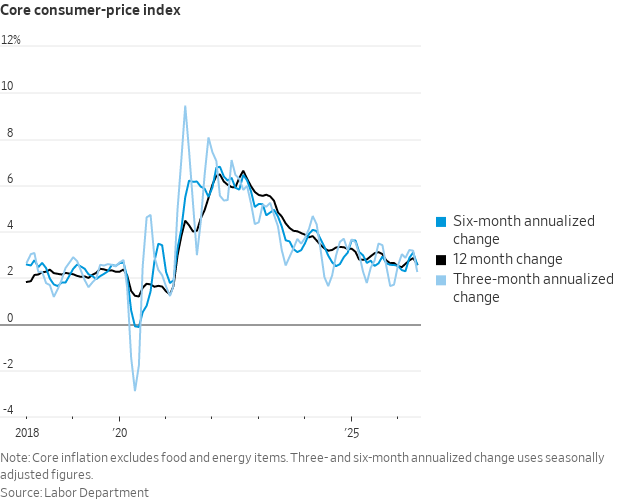
Core CPI *declined* in June, falling -0.02% and reducing the 12-month rate to 2.6%.
Headline CPI also fell, and by a larger-than-expected -0.42%, lowering the 12-month rate to 3.5%.
English
Warsh: Fed has “no tolerance for persistently elevated inflation”
“If we get policy right—and we will—the inflation surge of the last five years will be a thing of the past.” federalreserve.gov/newsevents/tes…
English
Very cool prices in the June CPI were across the board.
Core goods declined for the second straight month, down -0.09%
Housing was up just 0.12%
Core services ex-housing was -0.2%, the lowest since the lockdowns.

English