Blueprint For A Better Britain

53 posts

Blueprint For A Better Britain banner
Blueprint For A Better Britain

Blueprint For A Better Britain

@BritBlueprint

Why Britain stopped growing. What it's costing you. How to fix it. Evidence-based. Zero party affiliation. 🔗 https://t.co/EAaTOL07eo

Katılım Mart 2026
74 Takip Edilen20 Takipçiler
Sabitlenmiş Tweet
Blueprint For A Better Britain
Blueprint For A Better Britain@BritBlueprint·
Britain is still producing serious policy thinking. The reports are rigorous. The expertise is real. And yet outcomes keep disappointing. Housing doesn't get built. Energy costs four times what the US pays. Productivity stagnates. The same promises get made and broken by every government. The gap between diagnosis and delivery is the central fact of British decline. It has been widening for decades. It sits underneath most of what people experience as national decline. Starting this week: a ten-part series on how Britain lost the ability to turn good decisions into real outcomes. britblueprint.com/blog/broken-op…
English
0
0
0
48
Blueprint For A Better Britain
A new planning Direction will force councils to consult the Secretary of State before refusing housing schemes of 150 homes or more. assets.publishing.service.gov.uk/media/69c69124… It is meant to unblock big sites by using existing ‘call-in’ powers, fast. The related consultation runs to 4 May 2026. assets.publishing.service.gov.uk/media/69c69124… Matthew Pennycook should publish quarterly stats on how many refusals are reviewed, called in, and approved. Sunlight is the only way this becomes delivery. assets.publishing.service.gov.uk/media/69c69124… Blueprint is tracking this: britblueprint.com
English
0
0
0
11
Blueprint For A Better Britain
The grid connection queue for big electricity users grew 460% in six months. gov.uk/government/new… Government says waits can run up to 15 years because the queue is clogged with speculative applications. gov.uk/government/new… Ed Miliband should back Ofgem to impose real milestone deadlines and non-refundable deposits, then publish a monthly list of projects kicked out. gov.uk/government/new… Blueprint is tracking this: britblueprint.com #100DayReform
English
0
0
0
35
Blueprint For A Better Britain retweetledi
Ben Southwood
Ben Southwood@bswud·
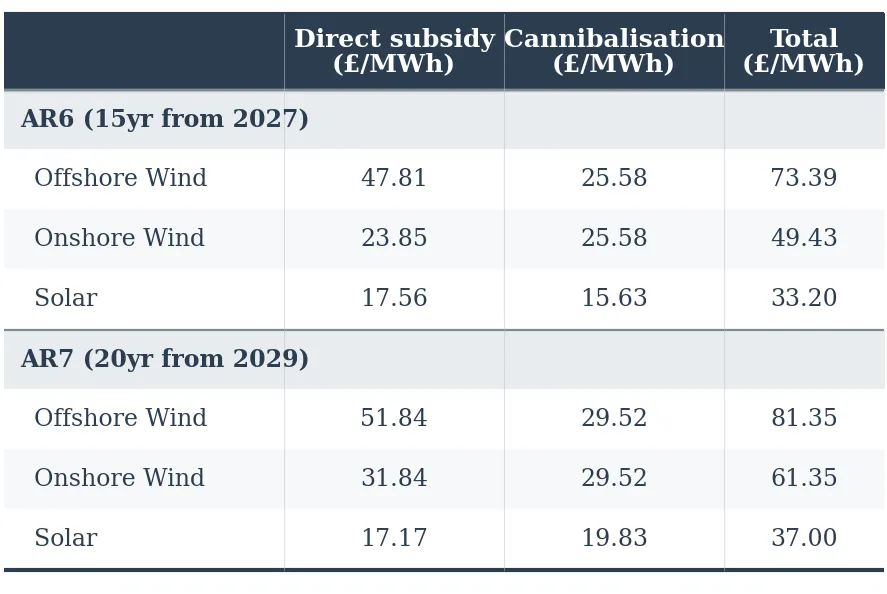
These distortions make most numbers you see about energy markets totally misleading. CfDs don't buy us power for the price they say, so they can't be compared to dispatchable power of the same price. It's like comparing an inflation-linked bond with a normal one and saying the inflation-linked one is cheaper. I don't think the British government has even attempted to produce numbers that account for these flaws, to give itself more situational awareness, allowing it to plan more effectively. (And make no mistake, the energy market is now mostly planned.) My friend Duncan McClements has attempted such an exercise for one of the elements, CfDs. He tries to account for the total cost of new CfDs by factoring in: - the direct subsidy (i.e., the expected difference between the market price we could buy electricity at when we pay producers contracted by CfD, and the strike price of their CfDs) - the cannibalisation subsidy: when we sign a new CfD, the new production will correlate strongly with old production signed under CfDs. But the old CfD producers are protected against market pricing changes, so the subsidy to them, relative to market prices, goes up. - the transmission subsidy. The government does calculate this one, and estimates that each megawatt hour of offshore wind has £14 of transmission costs on average, costs that are not included in the price of the CfD (but would need to be if we wanted an accurate price). - the capacity and balancing subsidy (paying to maintain and use a low-capacity-factor gas backup network for when the wind isn't blowing). Add all of these together and new offshore wind bought through a CfD faces a subsidy of £141 per megawatt hour on top of its actual cost, which was approx £90 per megawatt hour in the latest auction, for a total of £230 per megawatt hour. (For comparison, nuclear power at Hinkley Point C and Sizewell C will cost about £145 per megawatt hour wholesale, but face minimal of the other costs because output doesn't fluctuate, it is on the right side of transmission constraints, and it actively provides frequency response and capacity and requires no balancing. New gas run at 93% load factor costs about £55 per megawatt hour at pre-Iran prices, excluding carbon taxes.)
Ben Southwood tweet media
English
5
18
121
10.4K
Blueprint For A Better Britain retweetledi
GBTT — Great British Think Tank
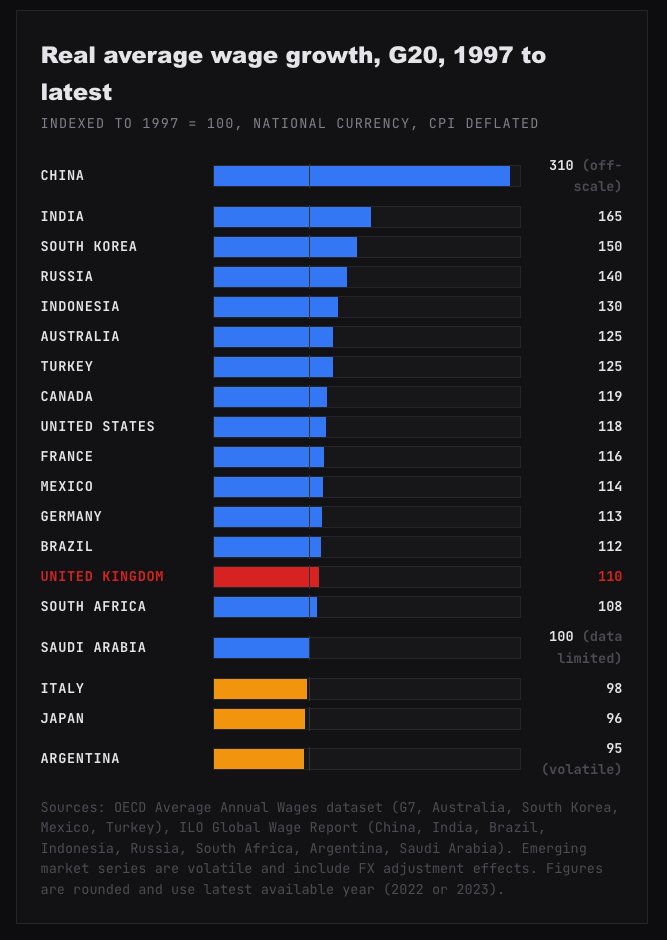
The Quiet Depression One defence you hear a lot is that wage stagnation is a problem everywhere. That the whole developed world saw real wages stagnate together, and the UK is just part of that story. It is not true! New report, dropping soon
GBTT — Great British Think Tank tweet media
English
2
8
41
1.8K
Blueprint For A Better Britain retweetledi
Josh Hunt
Josh Hunt@iAmJoshHunt·
Let me walk you through the arithmetic of Britain's demographic crisis. Because once you see the numbers, you can't unsee them. The UK has around 43 million people of working age. These are the people the entire system depends on. They pay the taxes. They fund the pensions. They staff the hospitals. 9 million of them are economically inactive. Not working and not looking for work. 1 in 5. That number deserves unpacking because it isn't one problem. It's several, layered on top of each other. The largest group, around 2.8 million, are out due to long-term sickness or disability. That number has been rising steadily since 2019 and recently hit a record high. Among younger people, the driver is mental health. Among older workers, it's musculoskeletal conditions, back problems, and other chronic illness. People in their early twenties are now more likely to be economically inactive due to ill health than people in their forties. That statistic alone should stop you in your tracks. The second largest group, roughly 2.4 million, are students in full-time education. They're investing in their future productivity. But while they study, they aren't contributing to the tax base. Around 1.6 million are looking after family or home, disproportionately women. Around 1.1 million took early retirement before state pension age. Many left during or after the pandemic and haven't returned. The rest are classed as discouraged or otherwise outside the labour market. On top of the 9 million inactive, another 1.87 million are unemployed. Youth unemployment has risen to around 16%. So of around 43 million people of working age, roughly 32 million are actually in work. About a quarter of the working-age population is not in paid employment. Now look at who they're supporting. There are roughly 12 million people above state pension age. The official dependency ratio is 278 pensioners per 1,000 people of working age. That sounds manageable. About 3.6 to one. But when you use the number of people actually working, it drops to roughly 2.7 workers per pensioner. Less than three. By 2047, the latest official projections show the ratio worsening to 302 per 1,000, even after planned pension age rises. ONS modelling submitted to the House of Lords suggests that to hold the current ratio constant, pension age would eventually need to reach 70 or beyond. Under current law, it rises to 67 by 2028, with further increases likely to stay on the table. And the support base is under growing pressure. The fertility rate just hit 1.41. The lowest on record. You need 2.1 to keep the population stable. We're at two thirds of that and falling. The average age of mothers is now 31. The government has expanded funded childcare significantly, and that's a genuine step forward. But the birth rate kept falling right through it. Because the problem isn't just childcare. It's housing. It's wages. It's the cost of being alive in this country while trying to raise a family. The overall population is still projected to grow, mainly through migration. But the pension-age population is growing faster than the working-age population. The number of people aged 85 and over is projected to nearly double, from 1.7 million in 2022 to 3.3 million by 2047. More pensions. More NHS demand. More social care. All landing on a workforce where the ratio of workers to dependants is weakening every year. And here's the part nobody talks about. According to the ONS, at least 1.4 million people in the UK are raising children while simultaneously caring for ageing parents. The sandwich generation. Wider estimates suggest the true figure may be considerably higher. Typically aged 35 to 64, spanning millennials and Gen X. These are people in mid-career. Many in management roles. Peak earning years. Maximum professional responsibility. And they're juggling all of that with school runs on one side and elderly care on the other. Two thirds say their finances are under strain. Carers UK estimates that over 600 people a day quit their jobs to care for a loved one. Research by the Centre for Economics and Business Research puts the average lifetime financial cost of being a sandwich carer at over £345,000 in lost earnings, reduced pension contributions, and direct care costs. Women are more than twice as likely to be the ones who leave work. Every one of those people who leaves is one fewer taxpayer. One fewer pension contributor. One fewer worker holding up the dependency ratio. And they don't just lose their salary. They lose years of compound growth on pension savings. They arrive at retirement with a depleted pot, needing the same support they were once helping to fund. This is about to intensify. As the over-85 population nearly doubles and social care continues to collapse, more people in that 35 to 64 age bracket will face the impossible choice between their career and their parents. The sandwich generation will get bigger. The workforce will come under even more strain. Now layer the health crisis on top. The Health Foundation projects that 3.7 million working-age people will be living with major illness by 2040, a 17% rise on 2019 levels. Already, 3.7 million people who are in work have a health condition that limits the type or amount of work they can do. That number has grown by 1.4 million in a decade. The House of Lords Economic Affairs Committee said it plainly. Those who are already economically inactive are becoming sicker, meaning they're less likely to return to work. The ageing effect that was previously being masked by other factors is now being reinforced by them. So here's the picture. The state pension costs around £146 billion a year. Funded entirely by current workers paying current retirees. There is no pot. The triple lock ratchets it higher every year. The working-age support base is under pressure and weakening. The number of dependants is growing. The people in the middle are getting sicker, burning out, and leaving work to care for parents the state can't look after. The generation behind them is smaller because the birth rate has collapsed. And the generation behind them will be smaller still. Nobody chose this. No generation is to blame. People didn't decide to be priced out of having children. Workers didn't choose to develop chronic conditions. The sandwich generation didn't volunteer to care for ageing parents with no safety net. This is a systems failure. We can argue over whether it's underinvestment in housing, health, social care, and prevention, or poor personal choices of the population at large that have produced a workforce that is too small, too sick, and too stretched to carry what's being placed on it. But this is where we're at. And the weight is growing every year. The arithmetic doesn't negotiate. And right now, it says we're running out of people to pay for the country we've built.
English
185
314
1.2K
149K
Blueprint For A Better Britain
Blueprint For A Better Britain@BritBlueprint·
CONTEXT Central government debt interest payable was £13.0bn in February 2026. That is £5.5bn higher than February last year. ons.gov.uk/economy/govern… RESULT ONS says £4.8bn of that bill was an RPI-linked ‘capital uplift’ on index-linked gilts. A 0.7% RPI rise (Nov to Dec 2025) drove a huge jump in the monthly bill. ons.gov.uk/economy/govern… CONSEQUENCES Borrowing in February was £14.3bn and came in £6.9bn above the OBR’s November forecast for the month. That volatility makes fiscal rules harder to run and easier to break. ons.gov.uk/economy/govern… QUESTION If debt interest can swing billions on one inflation print, why are we still pretending fiscal headroom is a stable number? britblueprint.com
English
0
0
0
22
Blueprint For A Better Britain
Blueprint For A Better Britain@BritBlueprint·
**CONSENSUS MAP: PLANNING REFORM AND NEW TOWNS DELIVERY** Where the left stands: Resolution Foundation: finalise NPPF and establish development corporations with financial firepower to build new towns (19 Jan 2026) resolutionfoundation.org/press-releases… Where the right stands: Policy Exchange: a new Planning Act is needed, NPPF rewritten, local plans rewritten (Rethinking the Planning System for the 21st Century) policyexchange.org.uk/wp-content/upl… Where the centre stands: Institute for Government: delivery capacity constraints inside Whitehall shape whether missions land (Whitehall Monitor 2025, 16 Jan 2025) instituteforgovernment.org.uk/publication/wh… The overlap: Clearer national rules + institutions that assemble land/finance + a delivery state that can execute at pace Why it hasn’t happened: Fragmented institutions and high upfront capital needs What it would take: legislate a strengthened development corporation model with multi-year infrastructure finance; owned by the Secretary of State for Housing, Communities and Local Government Blueprint is tracking this at britblueprint.com
English
0
0
0
24
Blueprint For A Better Britain
Blueprint For A Better Britain@BritBlueprint·
The grid connection queue for big electricity users grew 460% in six months. gov.uk/government/new… Government says waits can run up to 15 years because the queue is clogged with speculative applications. gov.uk/government/new… Ed Miliband should back Ofgem to impose real milestone deadlines and non-refundable deposits, then publish a monthly list of projects kicked out. gov.uk/government/new… Blueprint is tracking this: britblueprint.com #100DayReform
English
0
0
0
13
Blueprint For A Better Britain
Blueprint For A Better Britain@BritBlueprint·
Ofgem cut the household price cap to £1,641 for April to June. That is down 6.6% quarter on quarter. ofgem.gov.uk/information-co… But network costs in the cap rose by £66 while wholesale fell £38. Bills are still hostage to wires and pipes, not just gas prices. ofgem.gov.uk/information-co… Claire Coutinho should explain what it will take to stop network charges rising faster than savings from cheaper energy. ofgem.gov.uk/information-co… Blueprint is tracking this: britblueprint.com
English
0
0
0
6
Blueprint For A Better Britain
Blueprint For A Better Britain@BritBlueprint·
Britain spends £111 billion a year on debt interest. That’s nearly twice the defence budget. It approaches the combined schools and defence budgets (£127bn). Every pound to bondholders is a pound not spent on hospitals, schools, or growth.
English
0
0
0
7
Blueprint For A Better Britain
Blueprint For A Better Britain@BritBlueprint·
If UK GDP had grown at US rates since 2008, tax revenues would be approximately £150 billion higher. Per year. At existing tax rates. No new taxes needed. The deficit would be gone. The debt ratio falling. And there’d be fiscal space for investment. Growth isn’t one option. It’s the only option. (Source: @CBritProgress)
English
0
2
1
167
Blueprint For A Better Britain
Blueprint For A Better Britain@BritBlueprint·
99.8% of major UK infrastructure projects are delivered over budget, late, or without expected benefits. Average road project cost overrun: 66%. HS2: £37.5bn → £66bn+. Hinkley Point: £18bn → £46bn. This is not bad luck. It is a system designed to fail. (Source: Saïd Business School / BCG)
English
0
0
0
10
Blueprint For A Better Britain
Blueprint For A Better Britain@BritBlueprint·
Every government diagnoses the same problems. Every government proposes similar solutions. Nothing gets implemented. 300,000 homes — pledged 20 years, never built. NHS 18-week target — last met 2016. Social care cap — legislated 13 years ago, zero beneficiaries. The problem isn’t ideas. It’s delivery.
English
0
0
0
11
Blueprint For A Better Britain
Blueprint For A Better Britain@BritBlueprint·
We built this entire Blueprint using a multi-model AI research framework: Phase 1: GPT, Claude, Gemini write independently Phase 2: Each critiques the other two Phase 3: A fourth model reconciles It caught real errors. Produced better analysis than any single model alone. If AI can do this for policy, imagine what it can do for HMRC casework.
English
0
0
0
9
Blueprint For A Better Britain
Blueprint For A Better Britain@BritBlueprint·
NEW: Britain doesn’t need another think tank. It needs someone to make the ones we have actually matter. IPPR has diagnosed the problem. ASI has proposed a solution. CPS has costed an alternative. Resolution Foundation has tracked it for a decade. Institute for Government has written the autopsy. And yet nothing happened. The policy graveyard isn’t full of bad ideas. It’s full of good ones that nobody pushed hard enough, long enough, to see through. That’s the gap Blueprint exists to fill. britblueprint.com/blog/think-tan…
English
0
0
0
4
Blueprint For A Better Britain
Blueprint For A Better Britain@BritBlueprint·
NEW: Britain as a Lawyerly State in an Age That Rewards Builders. Dan Wang argues China is an engineering state while America has become a lawyerly society. Britain has drifted the same way — not because barristers run it, but because the state has lost the capacity to finish things. Britain can diagnose almost anything. Diagnosis has become one of the country’s favourite substitutes for action. On housing, energy, infrastructure, productivity — the pattern repeats: inquiry, strategy, target, consultation, revision, challenge, delay, reset. The challenge is not to become China. It is to become a competent liberal state: one that keeps the protections of a lawyerly society while recovering the execution capacity of a building one. britblueprint.com/blog/lawyerly-…
English
0
0
0
5
Blueprint For A Better Britain
Blueprint For A Better Britain@BritBlueprint·
£2.87 trillion in national debt. £102,000 per household. Up from £0.5 trillion in 2008. £111 billion a year in debt interest. Nearly twice the defence budget. Every pound to bondholders is a pound not spent on hospitals, schools, or growth. 14 years of near-zero real wage growth. The IFS calculates average pre-tax pay in 2023-24 was just 3.5% above 2009-10 levels. Fourteen years. That is not a rough patch. That is structural failure. Eight numbers. One diagnosis. britblueprint.com/blog/eight-num…
English
0
0
0
5
Blueprint For A Better Britain
Blueprint For A Better Britain@BritBlueprint·
Every delivery unit ever created has been co-opted. Blair’s PMDU — absorbed into Cabinet Office routine. Cameron’s Implementation Unit — downgraded to advisory. Cummings’ Project SPEED — slashed timelines from 25yr to <5yr. Reversed within months of his departure. Reform without institutional protection isn’t reform. It’s a temporary inconvenience for the permanent state.
English
0
0
0
8
Blueprint For A Better Britain
Blueprint For A Better Britain@BritBlueprint·
Istanbul built a new airport — with a terminal 4x the size of Heathrow T5 and two full runways — in just over 4 years. Britain has been debating a third Heathrow runway for over 20 years. The planning system is not a technical problem. It is an economic catastrophe. (Source: @CBritProgress)
English
0
0
0
15
Blueprint For A Better Britain
Blueprint For A Better Britain@BritBlueprint·
The Treasury is not just a department. It is the absorption mechanism for reform. It controls spending, tax, fiscal strategy, regulatory oversight, AND growth policy — all in one institution. When a PM creates a delivery unit, the Treasury starves it. When a reform generates savings, the Treasury captures them. The first structural change: break up HMT.
English
0
0
0
3